New here? Just sign up with Google — your account includes Matilda, our gift book, forever.
Stargirl · Garden Heights
Part 8
for Stargirl · Part 8 · Chapters 31–33
8 Parts40 min
What Happens in Part 8
At the Ocotillo Ball, Stargirl leads the whole school in one last joyful dance — then vanishes, leaving Mica changed forever.
The yellow gownThe Ocotillo Ball arrives, and Leo does not ask Stargirl; ashamed, he rides his bicycle to the edge of the parking lot and watches from the dark. Stargirl comes anyway — dateless, in a flower-covered bicycle sidecar pedaled by her one loyal friend Dori Dilson, wearing a billowing buttercup-yellow gown — and dances by herself, joyfully, in front of everyone.
The Bunny HopThen a boy named Raymond Studemacher asks her to dance, and the long silence around her finally cracks. The band strikes up the Bunny Hop, a line forms behind her, and within minutes nearly the whole school is hopping in one enormous snaking chain Stargirl leads out the doors, around the tennis courts, over the golf-course hills, and into the desert night. For one shining hour Mica High belongs to her.
Slap and kissAfterward Hillari Kimble confronts Stargirl, accuses her of ruining everything, and slaps her — and Stargirl answers by kissing her gently on the cheek. Then she is gone. Her house stands empty with a For Sale sign; Archie explains her family has moved to Minnesota and shows Leo her secret office in a tool shed — ribbons, calendars, files on the whole town, and a folder about Leo.
Fifteen years laterFifteen years later, Leo is a set designer in the East. On a last desert drive, Archie buries his fossil rat Barney in a rock with a crumpled paper bearing one word he will not reveal. Mica High has changed — a Sunflower Club does good deeds, a ukulele plays in the marching band, students cheer for the other team — and last month, on Leo's birthday, an anonymous package arrived: a porcupine necktie.
Resolution and denouement, the full-circle motif, and the novel’s theme pulled together
Cross-Curricular
Social contagion — how a feeling races through a crowd — and the ocotillo of the Sonoran Desert
Chapter Summary
Ch.
What happens
Chapter 31
The Ocotillo Ball — Stargirl arrives in a flowered bicycle sidecar; Raymond Studemacher asks her to dance, she leads the whole school in a Bunny Hop line out into the desert, and Hillari slaps her; Stargirl kisses her cheek.
Chapters 32–33
Gone, and Never Gone — Stargirl’s house is empty and her family has moved to Minnesota; Archie shows Leo her secret file-filled shed, and fifteen years later buries Barney with a single hidden word.
More Than Stars
The Necktie in the Mail — Mica High now has a Sunflower Club, a marching-band ukulele, and cheers for its opponents; an anonymous porcupine necktie reaches the grown Leo on his birthday.
Part 1
Vocabulary
Study 10 key words from Chapters 31–33, then answer each question.
🧠Knowledge Bank · Words of an Ending
Lexical Semantics · Words of an Ending
The last four words move from a crowded floor to an empty house. Exuberant means bursting with lively, joyful energy, and it is how she dances at the Ocotillo Ball, with the whole room finally moving too. A procession is a line of people moving along together, which is what the Bunny Hop turns into as it winds out of the hall and into the desert night. Defiance is bold refusal to obey or give in — and the word is here to be ruled out, because Stargirl answers Hillari’s slap with a kiss, and a kiss is not defiance. Vacant means empty, with nobody living there, and it is the last thing Leo sees. Nobody tells him she has gone; the house tells him. Four words, and the book spends three of them on joy before taking it all back in the fourth.
exuberantadj.Ch.31
Bursting with lively, joyful energy
“Stargirl’s exuberant dancing filled the whole floor.”
processionn.Ch.31
A line of people moving along together
“The Bunny Hop became a procession into the night.”
defiancen.Ch.31
Bold refusal to obey or give in
“Her gentle kiss answered Hillari’s slap without defiance.”
vacantadj.Ch.32
Empty; with no one living there
“Leo found her house dark and vacant.”
archiven.Ch.32
A stored collection of records or files
“Her tool shed held an archive of the whole town.”
bewilderv.Ch.32
To confuse someone completely
“Her sudden leaving seemed to bewilder Leo.”
dwindlev.Ch.33
To shrink slowly, little by little
“His visits to Archie began to dwindle.”
retrospectn.Ch.33
A look back at the past
“In retrospect, Leo saw what he had thrown away.”
enduringadj.More Than Stars
Lasting for a very long time
“Their bond turned out to be an enduring one.”
legacyn.More Than Stars
What a person leaves behind them
“The Sunflower Club was part of her legacy.”
ⓘ The vocabulary words in this list are selected to help you understand and complete this workbook. Some may not appear verbatim in the original novel.
🧠Knowledge Bank question
1The Knowledge Bank explains that defiance is the word to rule out because Stargirl answers Hillari's slap with ___.Ch.31
2A ‘procession’ is a line of people moving along together.Ch.31
3A ‘vacant’ house is ___.Ch.32
4An ‘archive’ is a stored collection of records.Ch.32
5Fill in each blank with the correct word.Ch.32
Word choices:bewildervacantprocessionocotillo- some words will not be used
Her sudden leaving seemed to Leo.
He stared at the dark, house.
6To ‘dwindle’ is to ___.Ch.33
7‘Retrospect’ means a plan for the future.Ch.33
8Something ‘enduring’ ___.More Than Stars
9Fill in each blank with the correct word.More Than Stars
Word choices:legacyenduringarchivedefiance- some words will not be used
The Sunflower Club is part of her .
Their bond turns out to be an one.
10A person’s ‘legacy’ is what they ___.More Than Stars
Part 2
Comprehension
Show you understood what happens in Chapters 31–33.
🧠Knowledge Bank · One Dance, Then Fifteen Years
Narrative Causality · One Dance, Then Fifteen Years
The ending can be followed as a climax, a meaningful return, and a final closure rather than as isolated incidents. The Ocotillo Ball arrives, and Leo does not ask Stargirl to go. Ashamed, he rides his bicycle to the edge of the parking lot and watches from the dark. Stargirl comes anyway — not with a date but in a flower-covered bicycle sidecar pedaled by her one loyal friend, Dori Dilson — wearing a buttercup-yellow gown that billows around her. She dances by herself, joyfully, in front of everyone. Then a boy named Raymond Studemacher walks over and asks her to dance, and the long silence around her finally cracks. The band strikes up the Bunny Hop, a line forms behind her, and within minutes nearly the whole school is hopping in one enormous snaking chain that Stargirl leads out the doors, around the tennis courts, over the golf-course hills, and away into the desert night. At the close, “One Dance, Then Fifteen Years” completes the book’s movement toward resolution.
🧠Knowledge Bank question
1According to the Knowledge Bank, the long silence around Stargirl finally cracks when ___.Ch.31
2How does Stargirl arrive at the ball?Ch.31
3A boy named Raymond Studemacher breaks the silence by asking Stargirl to dance.Ch.31
4What dance turns the ball into one enormous line?Ch.31
5Write the numbers 1–5 in the boxes to show the correct order of events. Number 1 = what happens first.Chapters 31–33
Stargirl leads nearly the whole school in a hopping line.
Fifteen years later, Archie buries Barney in the desert.
Leo finds her house empty; her family has moved away.
Hillari slaps her, and Stargirl kisses her cheek.
Leo watches the Ocotillo Ball from outside in the dark.
6Stargirl slaps Hillari back after Hillari strikes her.Ch.31
7Where has Stargirl’s family moved?Ch.32
8What does Archie show Leo inside Stargirl’s tool shed?Ch.32
9Fifteen years later, Archie buries Barney along with a paper holding a single word.Ch.33
10What arrives in the mail for the grown Leo on his birthday?More Than Stars
Part 3
Literary Elements
Understanding HOW and WHY Jerry Spinelli (author) tells the story across Chapters 31–33.
🧠Knowledge Bank · The Ocotillo
Narrative Technique · The Ocotillo
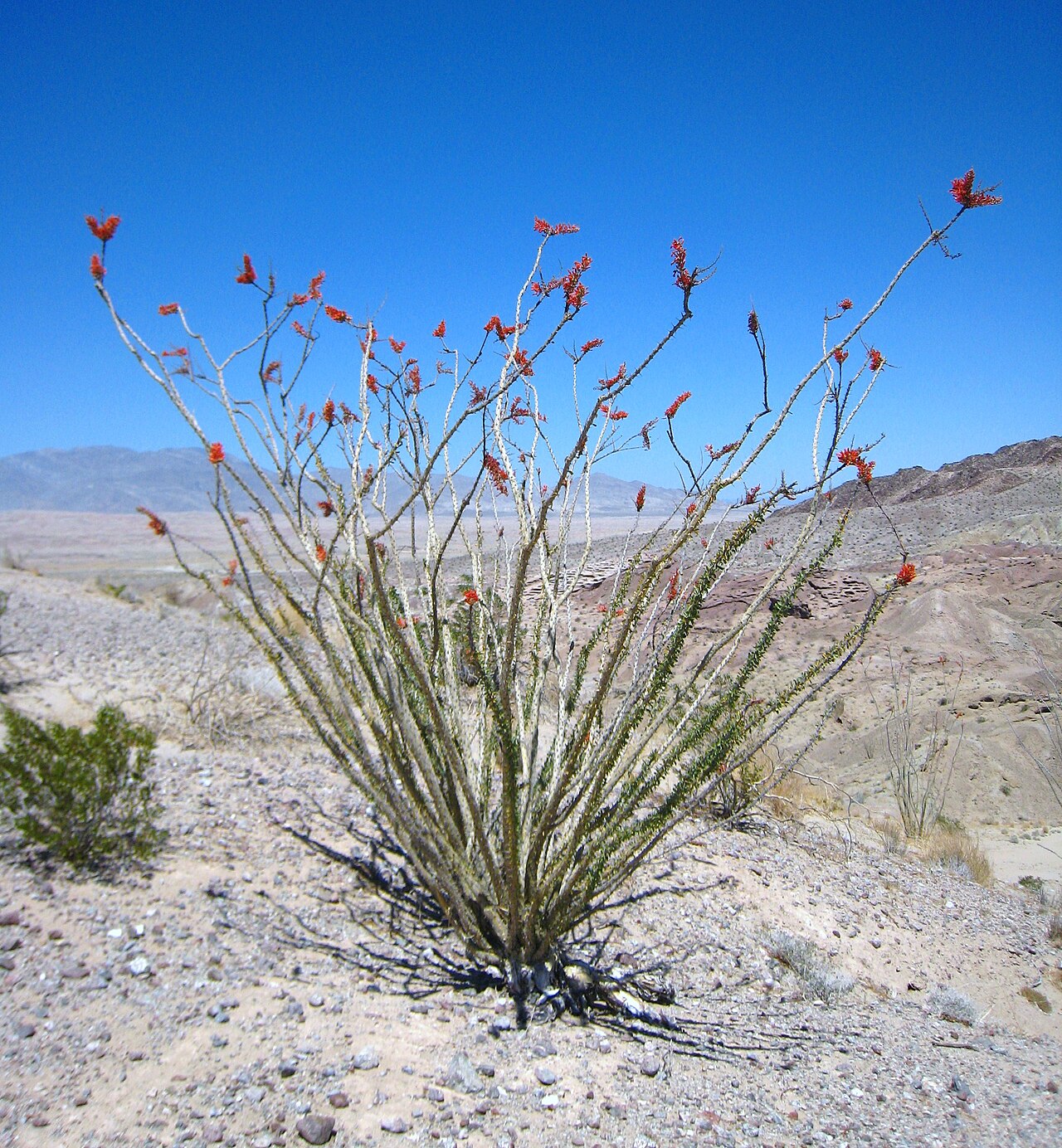
The closing movement joins denouement, motif, and theme, allowing the ending to answer the beginning. The dance is named for a real desert plant, and the choice is not accidental. The ocotillo is a tall, spiny, many-stemmed shrub of the Sonoran Desert that spends most of the year looking dead — a bundle of gray, thorny canes standing in the dust. Then rain comes, and within days the whole plant leafs out green and tips its stems with flaming scarlet flowers, feeding hummingbirds and bees. When the dry returns, it drops its leaves and waits again. It can do this several times in a single year. The ocotillo is the desert’s lesson in patience: what looks lifeless is only waiting for its moment, and its moment can be brief and blazing. That authorial design makes “The Ocotillo” a lesson in deliberate payoff.
Visual AidThe desert plant the ball is named for
Photograph of a whole ocotillo in flower in the Anza-Borrego desert, California. This is the plant the Knowledge Bank describes: for most of the year it is a bundle of gray thorny canes that looks dead, and then the tips blaze. Look at the whole shape rather than any one branch — a dozen canes rising from a single base, bare along most of their length, scarlet only at the ends. The picture cannot show the change happening; it catches one plant on one day, already in flower. That contrast between looking dead and blazing is why a school would name a dance after it.
Ocotillo (Fouquieria splendens) in flower, Anza-Borrego Desert, California. Source: Wikimedia Commons, file "Ocotillo at Anza-Borrego.jpg", public domain.
Resolution & denouement
The ball settles the conflict; the years afterward are the quiet winding-down that shows what it all meant.
Full-circle motif
The porcupine necktie returns at the end, answering the mystery Leo raised on the first pages.
Theme
The novel’s big idea: the courage to be yourself costs something, and it changes people long after you are gone.
🧠Knowledge Bank question
1The Knowledge Bank explains that the ocotillo can leaf out and flower ___.Ch.31
2The porcupine necktie arriving again at the very end is best called a ___.More Than Stars
3A theme is the big idea a story is built to explore.Ch.33
4The quiet chapters after the ball, showing the years that follow, are the story’s ___.Ch.33
5A resolution must make every single character happy.Ch.31
6Fill in each blank with the correct literary term.Ch.33
Word choices:themeresolutionrhymeindex- some words will not be used
The ball settles the conflict, so it is the .
The big idea about being yourself is the .
7Bringing back the necktie lets Spinelli end the book by ___.More Than Stars
8Mica High’s new Sunflower Club and cheers for opponents mainly develop the ___.More Than Stars
9The jump of fifteen years lets an older Leo weigh what Stargirl meant to him.Ch.33
10Fill in each blank with the correct literary term.More Than Stars
Word choices:full-circle motifdenouementsettingfootnote- some words will not be used
The returning necktie is a .
The years after the ball are the .
Part 4
Think Deeper
Four deeper challenges — no single-word recall. Read, weigh the evidence, and reason it out.
🧠Knowledge Bank · How a Crowd Catches a Feeling
Social Contagion · How a Crowd Catches a Feeling
For most of this novel the crowd has moved as one against Stargirl. At the Ocotillo Ball it moves as one with her — and the reason has a name. Social contagion is the way a mood, a gesture, or a behavior spreads through a group almost like a cold. Yawning is the simplest example; laughter is another; so is panic. Researchers have watched a single person start clapping and seen applause sweep a hall in seconds, not because anyone decided to clap but because human beings are built to sync up with the bodies around them. Sociologists have long described the special version of this that happens when people move together on purpose — dancing, marching, chanting — as collective effervescence: the buzzing, boundary-melting joy of a crowd that has briefly stopped being separate individuals. Spinelli gives Stargirl that one night and then takes it away, and the arrangement is deliberate. The same force that made the shunning possible is the force that makes the Bunny Hop possible. A crowd is not good or bad. It is only fast.
Visual AidHow one dance catches a whole school
Sequence diagram of the Ocotillo Ball as the Knowledge Bank on social contagion reads it: a girl dancing alone, one boy’s invitation, a band striking up, and nearly a whole school snaking out into the desert — the same syncing force that spread the silence, now running the other way. Hours are compressed into four panels, and the slap, the kiss and the fifteen years afterward are left out. The drawing takes no side; its point is the Knowledge Bank’s own: a crowd is not good or bad, only fast.
Sequence from Stargirl, Chapter 31; collective effervescence after Émile Durkheim, as described in the Knowledge Bank. Drawn for Garden Heights Academy.
Imagine a boy standing in the dark at the edge of a parking lot, too ashamed to go inside. Through the glass he sees a girl in a yellow gown dancing alone, and then not alone — one boy asks her, the band starts a silly hopping tune, and a line grows behind her until nearly the whole school is bouncing out the doors and over the dark hills, following the very person they spent months pretending not to see. It lasts an hour. Afterward a girl who hates her strikes her, and she answers with a kiss. Days later her house is empty and she is a thousand miles (1,609 km) away, and the boy who watched from the dark will spend fifteen years turning that night over in his mind — until a package with no name on it arrives in the mail.
Original passage written for Garden Heights — not a quotation from the novel.
1Claim: “The Ocotillo Ball shows that the crowd’s cruelty was never a firm decision — it was something catching, and it could be caught in reverse.” — choose the two details that best prove it.Claim & Evidence
2The night of the ball, or The fifteen years afterward? Tap each detail to sort it — tap again to switch sides. You can keep tapping to change your answer.Sort into two
◄ The night of the ballThe fifteen years afterward ►
3Match each cause to its result. For each cause, pick its result.Cause & Effect
Leo does not ask Stargirl to the ball→
Raymond asks her to dance→
Hillari slaps her→
Her family moves to Minnesota→
🧠Knowledge Bank question
4Fill both blanks to complete the reasoning.Build the Argument
The Knowledge Bank explains that the whole school joins the Bunny Hop because , which shows that the force behind the shunning .
Part 5
Standardized Test
Reading passage · The Ocotillo of the Sonoran Desert · SAT & TOEFL-style practice
Read the passage — the highlighted words are tested — then answer. Tap an answer, then tap it again to confirm.
SATCentral Ideas — the passage's main point
SATInference — a conclusion the passage implies
SATDetail — a fact stated in the passage
SATWords in Context — a word's meaning in this passage
SATText Connections — how two parts of the text relate
TOEFLFactual Information — a fact stated in the passage
TOEFLInsert Text — where a sentence best fits
TOEFLVocabulary — a tested word's meaning here
The Ocotillo's Wait for Rain
The dance that ends Stargirl’s story is named for a plant, and anyone who has walked the Sonoran Desert knows it on sight. The ocotillo is not a cactus, though often mistaken for one. It grows as a spray of long, slender, thorn-covered canes rising straight from the ground like the ribs of a half-opened umbrella. For most of the year those canes are gray and bare. A traveler passing in the dry season would swear the whole plant had died years ago and forgotten to fall over.
It has not died. It is waiting. Within days of a good rain, small green leaves push out along every cane, and the plant that looked like a bundle of dead sticks turns suddenly and completely green. Soon after comes an exuberant burst of bloom: each cane tips itself with a dense cluster of scarlet flowers, and hummingbirds and bees arrive; then the rain stops, the ground bakes, and the ocotillo drops its leaves and returns to gray. An ocotillo may repeat this cycle five or six times in a year, greening and flaming and going dormant as the weather allows; some of these enduring plants live well over a century.
This rhythm makes the ocotillo worth thinking about. It teaches that what looks lifeless may only be waiting for its conditions, and that a display can be brief and still be the whole point. Desert peoples have long put the ocotillo to work, planting rows of cut canes that take root and grow into living fences. Ranchers have used its blossoms; healers have used its bark. It asks almost nothing of the land and gives back, for a few fleeting weeks, one of the desert’s most startling sights — gray sticks turned into a field of red flame.
Original passage written for Garden Heights — not a quotation from the novel.
1What is the main idea of the passage?SAT · Central Ideas
2According to the passage, the ocotillo ___.TOEFL · Factual Information
3In the dry season, a passing traveler would most likely think the ocotillo is ___.SAT · Inference
4How quickly does the ocotillo leaf out after a good rain?SAT · Detail
5Insert Text (TOEFL). Look at the four squares [1]–[4] in the excerpt below. They show where this sentence could be added: “The change is so fast that it can startle someone who saw the same plant a week earlier.”
A traveler passing in the dry season would swear the whole plant had died years ago. [1] It has not died. [2] It is waiting. [3] Within days of a good rain, the plant that looked like a bundle of dead sticks turns suddenly and completely green. [4]
Where would the sentence fit best?TOEFL · Insert Text
6What color are the ocotillo’s flowers?TOEFL · Factual Information
7In the passage, exuberant most nearly means ___.SAT · Words in Context
8In the passage, enduring most nearly means ___.TOEFL · Vocabulary
9How have desert peoples used the ocotillo?SAT · Detail
10How does this passage best help explain Part 8?SAT · Text Connections
Part 6 · Optional
Creative Writing
A bonus challenge to practice your English. Take your time and have fun with it.
About This Section
This writing task is optional and is not part of your auto-graded score. The feedback below checks only the basics — length, spelling, and grammar — not whether your ideas are right or wrong. It is meant for classroom discussion and creative practice, so feel free to use your imagination!
Writing Task — Part 8 “The One Who Changed the Room”
Years after Stargirl leaves, Mica High still carries her mark — a club that does good deeds, a ukulele in the band, cheers for the other team. Write about someone who changed a group you belong to, or about a change you would like to leave behind you. What did they do, and what stayed after they were gone? 6–10 sentences. End with the one thing you hope people remember about you.
You can start with: “Long after she left, you could still see her in the way we...”
0 / 40 words minimum
🗣 Teach It · Just for Fun (optional)
No right or wrong — tell someone nearby what happened in this part. Can’t find anyone? Tell yourself out loud. The moment you teach it, you truly understand it.
Part 8 Complete — You Finished the Book! 🎉
You finished Chapters 31–33 — the final part of Stargirl.
Here are your auto-graded results:
-
points out of 100
Teach it to someone
The best last step is to teach it. In your own words, explain what happened — retell a favorite scene, teach a character’s big choice, or sum up the main idea for a parent, friend, or classmate. When you can teach it clearly, you truly own it.
Independent study guide by Garden Heights. Not affiliated with or endorsed by Jerry Spinelli. Contains original analysis only; no text from the novel is reproduced. Reference text: This workbook follows Jerry Spinelli’s classic text (the standard Puffin edition sold worldwide). Revised 2023 UK editions change some wording and may not match the vocabulary studied here.
SAT® is a registered trademark of College Board, which is not affiliated with, and does not endorse, these materials. TOEFL® is a registered trademark of ETS. These materials are not endorsed or approved by ETS. Garden Heights is an independent provider of test-style reading practice.