New here? Just sign up with Google — your account includes Matilda, our gift book, forever.
What Happens in Part 6
The Hatcher house gains a noisy new member: a myna bird! Fudge names him Uncle Feather, and this is no ordinary pet. A myna bird can mimic human speech, and Uncle Feather quickly learns to talk — greeting people, repeating favorite phrases, and even squawking a word or two of French. Fudge is delighted with his clever, chattering bird, and the whole family is soon trading lines with a pet that talks back. The bird’s cheeky dialogue fills the house with comedy: you never quite know what Uncle Feather will say next. Amid all the talking — the family’s, Fudge’s, and now the bird’s — life in Princeton grows livelier than ever. Uncle Feather becomes one of the most memorable characters in the whole book, proof that in a Judy Blume story, even a pet can have a voice all its own.
What We Will Learn
Focus
What It Means
Dialogue
A talking bird fills the house with comic back-and-forth
Characterization
Even a pet gets a lively voice of its own
Humor
You never know what Uncle Feather will say next
Chapter Summary
Pages
Key Events
pp. 104–124
The family gets a myna bird that Fudge names Uncle Feather; the clever bird learns to mimic human speech — greetings, favorite phrases, even a word of French — and its cheeky talk fills the house with comedy
💭 Before You Read · Warm-Up (not scored)
There are no wrong answers here — just think, guess, and talk:
Uncle Feather can copy human words. What would be the funniest thing to teach a talking bird to say — and why?
A myna bird mimics sounds without truly understanding them. How is that different from the way people use language?
Predict: with a talking bird in the house, what kinds of funny mix-ups or trouble might Uncle Feather cause?
Copyright Notice
This is an independent study guide created by Garden Heights Academy to support reading comprehension and literary analysis. It contains original analysis questions and does not reproduce any text from the novel. Superfudge is a work by Judy Blume. This guide is not affiliated with, authorized by, or endorsed by the author or any associated rights holder.
Part 1
Vocabulary
Study 10 key words from pages 104–124, then answer each question.
🧠Knowledge Bank · Words of a Talking Bird
Lexicology · Words of a Talking Bird
Pets play a surprising role in a child’s growing years. Caring for an animal teaches responsibility, patience, and gentleness, and studies show that children with pets often practice comfort and empathy on a creature before they fully manage it with people. A myna bird like Uncle Feather is special because it can copy human speech, though it does not understand the words the way a person does; it simply repeats sounds it hears often. To a young child, a talking pet can feel like a true friend who listens and answers, exactly the kind of steady companion a child craves during a season of family change. Seeing how the Hatchers fold an animal into their home shows you that a pet is never just a pet — it becomes family.
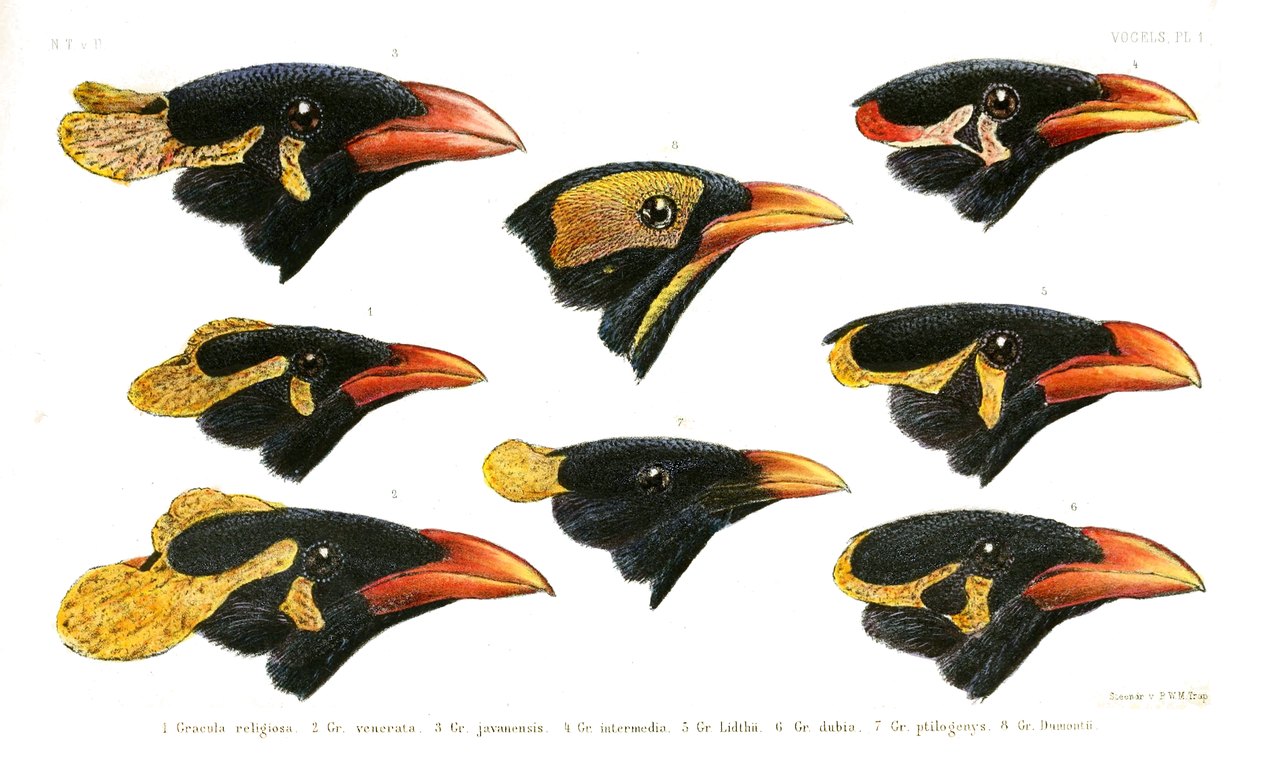
Visual AidThe heads of eight hill mynas
Hand-colored plate published in 1863 by the Dutch naturalist Herman Schlegel, showing the heads of eight kinds of hill myna, glossy black birds with orange bills and bright yellow flaps of bare skin around the eyes and neck. The Knowledge Bank explains that a myna bird like Uncle Feather is special because it can copy human speech, though it repeats sounds without understanding them the way a person does. These are the birds famous for that gift; the yellow patches are the quickest way to know one. It is a scientific drawing, not a photograph, and none of these birds ever said a word to Fudge. Notice the differences the naturalist was recording — the size and shape of the yellow flaps tell the kinds apart.
Heads of Gracula (hill mynas), plate by Herman Schlegel in Nederlandsch Tijdschrift voor de Dierkunde, 1863. Source: Wikimedia Commons, public domain.
mimicv.p.104
To copy the sounds or actions of another
“A myna can mimic human speech.”
mynan.p.104
A glossy black bird known for copying sounds
“Uncle Feather is a myna bird.”
dialoguen.p.108
The words characters say to one another
“The bird adds funny dialogue.”
imitatev.p.106
To copy what someone does or says
“Mynas imitate the sounds they hear.”
phrasen.p.110
A small group of words said together
“The bird repeats favorite phrases.”
greetv.p.107
To say hello to someone
“Uncle Feather greets visitors.”
cleveradj.p.112
Quick to learn; smart
“The clever bird learns fast.”
squawkv.p.114
To make a loud, harsh bird cry
“The bird squawks a word of French.”
vocabularyn.p.116
All the words a person or animal knows
“Uncle Feather builds a vocabulary.”
memorableadj.p.120
Worth remembering; unforgettable
“Uncle Feather is a memorable pet.”
🧠Knowledge Bank question
1According to the Knowledge Bank, a myna bird that copies human speech ___.p.104
2A ‘myna’ is —p.104
3Fill in each blank with the correct word.pp. 104–124
Word choices:dialoguephrasegreetsquawk- some words will not be used
The talking bird adds funny to the family’s home.
Uncle Feather repeats each favorite he hears.
4To ‘imitate’ is to —p.106
5A ‘phrase’ is a small group of words said together.p.110
6To ‘greet’ someone is to —p.107
7Fill in each blank with the correct word.pp. 104–124
Word choices:clevervocabularyimitatememorable- some words will not be used
Quick to learn, Uncle Feather is a very bird.
Word by word, the bird builds up a real .
8To ‘squawk’ is to —p.114
9Your ‘vocabulary’ is —p.116
10Something ‘memorable’ is dull and easy to forget.p.120
Part 2
Comprehension
How well do you understand pages 104–124?
🧠Knowledge Bank · Learning Character Through Speech
Narrative Logic · Learning Character Through Speech
Much of what we learn about a character comes from speech — not only what a person says, but how he says it. A careful reader listens for word choice, tone, and the little sayings a character repeats, because talk reveals age, mood, and personality. Fudge’s blunt, funny lines sound nothing like Peter’s wry ones, and that difference alone tells you who is who. Blume even lets a bird’s borrowed phrases add humor and heart, showing how much a single repeated line can carry. When you read dialogue, imagine the voice aloud and ask what each speaker’s words quietly reveal about him. Listening this closely turns flat text into living people, and it sharpens your ear for the real voices you hear.
🧠Knowledge Bank question
1The Knowledge Bank says talk reveals a character's ___.p.104
2What does Fudge name the bird?p.104
3What special thing can a myna bird do?p.104
4Fudge is delighted with his new talking bird.p.112
5Write the numbers 1–5 in the boxes to show the correct order across Part 6. Number 1 = what happens first.pp. 104–124
The bird even squawks a word of French.
The bird learns to greet people and copy phrases.
Fudge is allowed to get a myna bird.
Uncle Feather becomes a memorable family ‘character.’
He names the bird Uncle Feather.
6How does a myna bird actually learn its words?p.106
7What does the talking bird add to the house?p.108
8How does Uncle Feather rank among the book’s characters?p.120
9A myna bird understands the meaning of every word it says.p.106
10What surprising language does the bird squawk?p.114
Part 3
Literary Elements
Understanding HOW and WHY Judy Blume tells the story across pages 104–124.
🧠Knowledge Bank · Dialogue Literary Technique
Literary Technique · Dialogue Literary Technique
Dialogue is the words characters speak to one another, and it is one of a writer’s busiest tools. Good dialogue does three jobs at once: it moves the plot, reveals character, and breaks up description with the rhythm of real talk. Blume has a famous ear for how children actually speak — the interruptions, the odd logic, the blunt honesty — and her dialogue makes the Hatchers feel like people you could meet. Notice that she rarely wastes a line; each exchange either teaches you something about a character or nudges the story forward. When you read a scene built from talk, you are watching an author trust her characters to reveal themselves in their own words.
Visual AidThree jobs for one line of talk
Diagram for the Knowledge Bank on dialogue. The red card is a single line of speech and the three cards beneath are the three jobs the Knowledge Bank says good dialogue does at once, moving the plot, revealing character, and breaking up description with the rhythm of real talk. It does not quote any line from the book. Notice that all three arrows leave the same card — one good line can do every job at the same time.
The three jobs of dialogue as described in the Knowledge Bank. Drawn for Garden Heights Academy.
📚 Literary Devices in This Part · definitions & examples
Dialogue is the words characters say to one another. It does two jobs: it pushes the story forward and it reveals character, because people show who they are by how they talk. Blume even gives a myna bird a kind of dialogue, and Uncle Feather’s copied phrases become a source of pure humor.
🧠Knowledge Bank question
1According to the Knowledge Bank, good dialogue does three jobs: it moves the plot, reveals character, and ___.p.108
2Dialogue is the actual words characters speak to one another.p.108
3Fill in each blank with the correct word.pp. 104–124
Word choices:dialoguehumorsettingrhyme- some words will not be used
The back-and-forth words the characters speak are the
The laughs from the bird’s copied phrases are pure .
4Dialogue does two jobs: it moves the story and it —p.108
5How a character speaks can reveal their personality.p.108
6Fill in each blank with the correct word.pp. 104–124
Word choices:characterdialoguerhymeindex- some words will not be used
We learn what Fudge is like from his — the way he talks.
What his words reveal about him is his .
7Uncle Feather’s words are really —p.106
8What makes Uncle Feather’s dialogue so funny?p.112
9Fill in each blank with the correct word.pp. 104–124
Word choices:humordialoguesettingplot- some words will not be used
Reading the characters’ spoken lines — their — helps us know them.
A talking bird turns copied words into big .
10Reading dialogue closely mainly helps a reader —p.108
Part 4
Think Deeper
Four deeper challenges — no single-word recall. Read, weigh the evidence, and reason it through.
🧠Knowledge Bank · When Animals ‘Talk’
Ethical Reasoning · When Animals ‘Talk’
A myna bird can mimic human speech, and that makes people wonder how much an animal truly understands. Scientists explain that mimic birds copy sounds without grasping their meaning; the bird links a phrase to a moment, not to an idea. Yet to a child, a pet that seems to answer back feels like a real conversation partner, and that feeling matters. During a time of change, a talking pet can give a child comfort, company, and a sense of being heard, even if the animal understands nothing at all. This is worth weighing: the bird’s value to Fudge is emotional, not scientific. Responsibility grows clearer amid all the talking — the family’s, Fudge’s and finally Peter’s own. Working out who is answerable for a small brother is the quiet argument running underneath the comedy.
1Claim: “The talking myna bird becomes a lively new member of the family.” — choose the two details that best prove it.Claim & Evidence
2Shows Uncle Feather as a lively family member, or just a background fact? Tap each item to sort it — tap again to switch sides. You can keep tapping to change your answer.Sort into two
◄ A lively family memberJust a fact ►
3Match each cause to its result. For each cause, pick its result.Cause & Effect
The Hatchers get a myna bird→
A myna can mimic speech→
He greets people and repeats phrases→
Fudge adores his pet→
🧠Knowledge Bank question
4Fill both blanks to complete the reasoning.Build the Argument
The Knowledge Bank says a mimic bird links a phrase to , so the bird's value to Fudge is .
Part 5
Standardized Test
Key Details & Inference — SAT & TOEFL-style practice
Read the passage — the highlighted words are tested — then answer. Tap an answer, then tap it again to confirm.
SATWords in Context — a word's meaning in this passage
SATInference — a conclusion the passage implies
TOEFLFactual Information — a fact stated in the passage
TOEFLProse Summary — the three sentences that sum it up
TOEFLRhetorical Purpose — why the author included a detail
The Myna Bird's Talent for Mimicry
Some birds can copy human speech so well that, with your eyes closed, you might think a person was talking. The myna bird is one of the best of these mimics. A myna is a glossy black songbird from Asia, with bright yellow patches around its eyes, and it is famous for its ability to imitate almost any sound it hears often enough. A pet myna may learn to greet visitors, copy a family's favorite phrases, or even mimic a ringing telephone or a barking dog. It is important to understand, though, that a talking bird does not comprehend the words the way a person does. The bird is not choosing its words to share an idea; it is simply repeating sounds it has heard. Scientists call this mimicry: copying without understanding. In the wild, this talent helps mynas communicate with their flock and blend into the chorus of the forest. As pets, their gift for copying makes them lively and comical companions, though they need plenty of attention and can grow very noisy. A talking myna is a wonderful reminder that human speech is not the only kind of voice in nature.
Original passage written for Garden Heights — not a quotation from the novel.
1According to the passage, a myna bird is famous for its ability to —TOEFL · Factual Information
2A pet myna may copy a family’s favorite “phrases,” meaning —SAT · Words in Context
3A myna can imitate almost any sound, meaning it can ___.SAT · Words in Context
4How, according to the passage, does a myna produce its words?TOEFL · Factual Information
5A myna that learns to greet visitors ___.SAT · Words in Context
6In the wild, how does the myna’s talent help it?TOEFL · Factual Information
7According to the passage, as pets mynas need plenty of —TOEFL · Factual Information
8What can the reader infer is the passage’s main point about talking birds?SAT · Inference
9This TOEFL task lists six sentences; choose the THREE that best capture the passage’s main ideas. The other three do not belong — they state minor details or ideas the passage does not present.TOEFL · Prose Summary
A bonus challenge to practice your English. Take your time and have fun with it.
About This Section
This writing task is optional and is not part of your auto-graded score. The feedback below checks only the basics — length, spelling, and grammar — not whether your ideas are right or wrong. It is meant for classroom discussion and creative practice, so feel free to use your imagination!
Writing Task — Part 6 “A Pet with a Voice”
Uncle Feather the myna bird can copy human words. Write about an interesting or unusual pet — one you have, one you have met, or one you would love to own. What makes it special, and what would you teach it? Write at least 40 words.
You can start with: “An interesting pet I know (or would love) is…”
0 / 40 words minimum
🗣 Teach It · Just for Fun (optional)
No right or wrong — close the screen and tell someone nearby about Uncle Feather, the talking myna bird. Can’t find anyone? Tell yourself out loud. The moment you teach it, you truly understand it.
Part 6 Complete!
You finished pages 104–124 of Superfudge.
Here are your auto-graded results:
-
points out of 100
Teach it to someone
The best last step is to teach it. In your own words, explain what happened — retell a favorite scene, teach a character’s big choice, or sum up the main idea for a parent, friend, or classmate. When you can teach it clearly, you truly own it.
Independent study guide by Garden Heights Academy. Not affiliated with or endorsed by the author or any rights holders. Contains original analysis only; no text from the novel is reproduced.
SAT® is a registered trademark of College Board, which is not affiliated with, and does not endorse, these materials. TOEFL® is a registered trademark of ETS. These materials are not endorsed or approved by ETS. Garden Heights is an independent provider of test-style reading practice.