New here? Just sign up with Google — your account includes Matilda, our gift book, forever.
What Happens in Part 8
The Hatchers’ year in Princeton comes to its close, and the book gathers up its threads. There is one last scare when Uncle Feather goes missing — the beloved myna bird vanishes, and the family hunts high and low before he is happily found. Then comes a moment everyone has been waiting for: baby Tootsie says her very first word. After all the fuss and love poured over her, the word she chooses is a perfect, comic surprise: “yuck!” With Dad’s book-writing year finished, the family faces a big decision: stay in Princeton or move back to New York City. They put it to a vote, and the answer is New York — home. Peter, who once dreaded leaving the city, has grown so much that he can look back on the whole Princeton year with fondness, even as he looks forward to going home. Fudge is no longer the baby; Peter is a surer, kinder big brother; and the Hatchers, a little bigger and a little wiser, are ready for whatever comes next.
What We Will Learn
Focus
What It Means
Resolution
The story’s worries settled and its threads tied up
Theme Resolved
A dreaded change became a year worth treasuring
Character Growth
Peter transformed into a surer, kinder big brother
Chapter Summary
Pages
Key Events
pp. 146–166
Uncle Feather goes missing and is found; baby Tootsie says her first word — ‘yuck’; and, with Dad’s writing year over, the family votes to move back to New York. Peter, who once dreaded it all, looks back on Princeton with fondness and heads home a wiser, kinder big brother
💭 Before You Read · Warm-Up (not scored)
There are no wrong answers here — just think, guess, and talk:
The family decides where to live by taking a vote. Why is it meaningful that even the children get a say in such a big choice?
Peter began the book dreading everything and ends it looking back fondly. What does his change show about facing things we don’t want to do?
Looking back over the whole book — the new baby, the move, kindergarten, Uncle Feather, the scare — which part changed Peter the most, and why?
Copyright Notice
This is an independent study guide created by Garden Heights Academy to support reading comprehension and literary analysis. It contains original analysis questions and does not reproduce any text from the novel. Superfudge is a work by Judy Blume. This guide is not affiliated with, authorized by, or endorsed by the author or any associated rights holder.
Part 1
Vocabulary
Study 10 key words from pages 146–166, then answer each question.
🧠Knowledge Bank · Words of an Ending
Lexicology · Words of an Ending
A single year can change a child a great deal, because childhood is a time of fast growth in both body and mind. Over the months of this story, Peter meets a new sibling, moves to a new town, starts a new school, and lives through a frightening scare — and each experience quietly stretches him. Psychologists describe development as the slow gathering of such moments; no one grows up in a day, but many small challenges, met one by one, add up. This is why Peter at the end is not quite the boy he was at the start; the year has taught him patience, courage, and a wider sense of family. Looking back across a whole story lets a reader measure that growth and see how much a person can change.
Visual AidA year of small challenges adds up
Chart for the Knowledge Bank on how a single year changes a child. The four rising bars are the four experiences the Knowledge Bank lists for Peter’s year, a new sibling, a move, a new school, and a real scare, drawn as stairs from Peter at the start to Peter at the end, and the red card is what the Knowledge Bank says the year taught him. The heights show order, not measured amounts. Notice that no single step is tall — the Knowledge Bank’s point is that growth is the sum of small ones.
Four challenges and their lessons as described in the Knowledge Bank; heights show order only. Drawn for Garden Heights Academy.
voten.p.160
A way of deciding by counting each person’s choice
“The family takes a vote.”
decisionn.p.158
A choice you make after thinking
“A big decision faces the family.”
resolutionn.p.164
The point where a story’s problems are settled
“The resolution ties up the story.”
fondnessn.p.162
A gentle, warm liking for something
“Peter looks back with fondness.”
homecomingn.p.163
A happy return to your home
“The move is a joyful homecoming.”
matureadj.p.161
Grown-up in the way you act
“Peter is more mature now.”
treasurev.p.162
To value something greatly
“Peter treasures the Princeton year.”
reliefn.p.150
A happy feeling when worry ends
“There is relief when the bird is found.”
democraticadj.p.160
Deciding fairly, with everyone’s say
“A vote is a democratic choice.”
growv.p.165
To change and develop over time
“Peter has grown all year.”
🧠Knowledge Bank question
1According to the Knowledge Bank, psychologists describe development as ___.p.160
2A ‘decision’ is —p.158
3Fill in each blank with the correct word.pp. 146–166
Word choices:resolutionhomecomingvoterelief- some words will not be used
The place where the story’s problems are settled is its
The joyful move back to New York is a .
4‘Fondness’ is —p.162
5A ‘homecoming’ is a happy return to your home.p.163
6Someone ‘mature’ —p.161
7Fill in each blank with the correct word.pp. 146–166
Word choices:treasuredemocraticgrowmature- some words will not be used
Deciding by a vote where everyone has a say is
Peter has come to his year in Princeton.
8‘Relief’ is —p.150
9Something ‘democratic’ is decided —p.160
10To ‘grow’ can mean to change and develop over time.p.165
Part 2
Comprehension
How well do you understand pages 146–166?
🧠Knowledge Bank · Seeing the Whole Journey
Narrative Logic · Seeing the Whole Journey
When a book ends, a strong reader zooms out to see the whole journey rather than just the final scene. This means comparing the beginning to the end and asking what shifted — in the characters, the family, and your own understanding. Peter began the story dreading a new baby and a big move; by the close, both have become part of a life he can handle. Naming that arc, from where a character started to where he arrived, reveals the story’s deeper point. Blume trusts you to hold the early chapters in mind so the ending means something. Reading for the whole journey is how you turn a series of events into a story with shape, and it is the skill that makes a last page feel truly earned.
1Near the end, the bird Uncle Feather goes missing before he is found.p.148
🧠Knowledge Bank question
2The Knowledge Bank says a strong reader at the end of a book ___.p.150
3What big milestone does baby Tootsie reach?p.154
4What is Tootsie’s surprising first word?p.154
5Write the numbers 1–5 in the boxes to show the correct order across Part 8. Number 1 = what happens first.pp. 146–166
Baby Tootsie says her first word: ‘yuck!’
Peter looks back on the year with fondness.
The family faces a big decision about where to live.
They take a vote and choose to move back home.
Uncle Feather goes missing, then is found.
6How does the family make its big decision?p.160
7What do they decide to do?p.160
8How does Peter feel about the Princeton year by the end?p.162
9Peter ends the book exactly the same as he began it, unchanged.p.165
10How has Peter changed since the start of the book?p.161
Part 3
Literary Elements
Understanding HOW and WHY Judy Blume tells the story across pages 146–166.
🧠Knowledge Bank · Resolution & Theme
Literary Technique · Resolution & Theme
The resolution is the part of a story where the main problems settle and loose threads are tied, letting the reader feel the tale is complete. A good resolution does more than stop the action; it shows how the characters have changed and quietly restates the story’s theme. As Superfudge closes, the family’s year of change comes to rest, and the book’s big idea — that a real home is made of people, not places — shines through without ever being announced. Blume lets the ending prove what the whole book has been arguing. When you reach a story’s resolution, ask what the final scene says about the theme, because a skillful ending always sends you back through the book to deepen your understanding.
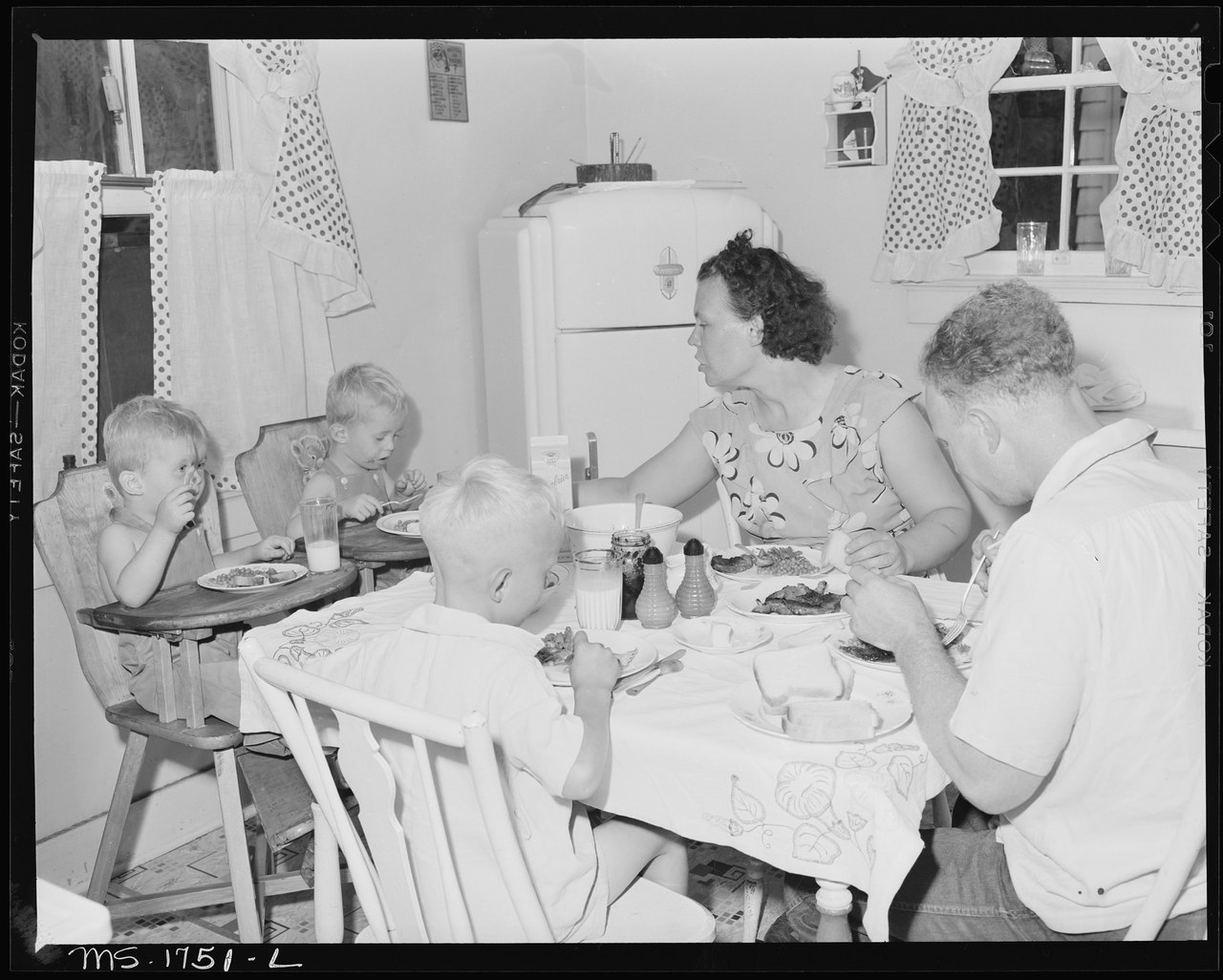
Visual AidA family at the kitchen table
Photograph by Russell Lee, taken in August 1946 for a government survey of coal-mining towns, of a mine worker named James Jasper and his family eating dinner around their kitchen table, the smallest child in a high chair. The Knowledge Bank says the book’s big idea, proved by its ending, is that a real home is made of people, not places, and this plain kitchen in a company housing project shows exactly that. The house is small and borrowed from the mining company; the home is the five people around the table. They are not the Hatchers, and this is not Princeton or New York. Notice where everyone is looking — at the meal and at each other, not at the room.
James Jasper, a motor brakeman, and his family at dinner in company housing, August 22, 1946; photograph by Russell Lee, U.S. National Archives. Source: Wikimedia Commons, public domain.
📚 Literary Devices in This Part · definitions & examples
A resolution is the part of a story where the problems are settled and the loose threads are tied up. A great resolution also answers the theme — the story’s big idea. Here, Peter’s journey from dreading change to treasuring it resolves the plot and proves the theme through his own character growth.
🧠Knowledge Bank question
1According to the Knowledge Bank, a good resolution quietly restates the story's ___.p.164
2A resolution is where a story’s problems are settled.p.164
3Fill in each blank with the correct word.pp. 146–166
Word choices:resolutionthemesettingrhyme- some words will not be used
The tying-up of the story’s problems is the
The big idea it proves — a dreaded change can be treasured — is the .
4A great resolution does more than end the plot; it —p.164
5A character can grow and change over the course of a story.p.161
6Fill in each blank with the correct word.pp. 146–166
Word choices:character growththemerhymeindex- some words will not be used
Peter changing from dread to fondness is his
That growth is how Blume proves the book’s .
7The theme this ending proves is that —p.162
8The ending echoing the beginning mainly shows —p.162
9Fill in each blank with the correct word.pp. 146–166
Word choices:resolutionthemesettingplot- some words will not be used
The place where the worries are all settled is the
The lesson it leaves us with is the story’s .
10Noticing the resolution mainly helps a reader see —p.164
Part 4
Think Deeper
Four deeper challenges — no single-word recall. Read, weigh the evidence, and reason it through.
🧠Knowledge Bank · How Far Peter Has Come
Ethical Reasoning · How Far Peter Has Come
At the start of the book, Peter met the news of a new baby with dread, sure it would ruin everything he loved. By the end, he has weathered a sibling, a move, a new school, and a real scare — and come out steadier and kinder. This is the heart of growing up: not that troubles vanish, but that we grow big enough to carry them. Psychologists call this maturing, the slow trade of a smaller, more fearful self for a larger, more capable one. Peter still has his sharp tongue and his eye-rolls, yet underneath he has stretched. As you close the book, weigh how much of his growth came from the events themselves, and how much came from his own quiet choice to adapt.
1Claim: “A last scare over the missing bird reminds the family how much they care.” — choose the two details that best prove it.Claim & Evidence
2Shows why the bird’s disappearance matters, or just a detail of the ending? Tap each item to sort it — tap again to switch sides. You can keep tapping to change your answer.Sort into two
◄ Why it mattersJust a detail ►
3Match each cause to its result. For each cause, pick its result.Cause & Effect
Uncle Feather goes missing→
Everyone is worried→
The bird means so much→
Uncle Feather is found→
🧠Knowledge Bank question
4Fill both blanks to complete the reasoning.Build the Argument
The Knowledge Bank says the heart of growing up is not that troubles vanish but that , which psychologists call .
Part 5
Standardized Test
Key Details & Inference — SAT & TOEFL-style practice
Read the passage — the highlighted words are tested — then answer. Tap an answer, then tap it again to confirm.
SATWords in Context — a word's meaning in this passage
SATInference — a conclusion the passage implies
TOEFLFactual Information — a fact stated in the passage
TOEFLInsert Text — where a sentence best fits
What Makes a House a Home
What makes a house into a home? A home is not really about the building, the number of rooms, or whether it stands in a busy city or a quiet town. A home is about the people inside it and the way they belong to one another. That is why the same family can feel at home in very different places, and why moving, though hard, does not break a family apart. Some families make big choices together by talking them through and even taking a vote, so that everyone, including the children, has a say. Making a decision together this way helps each person feel valued and part of the whole. Home is also built from ordinary moments: meals together, inside jokes, a baby's first word, the relief of finding a lost pet. These small shared experiences weave people together over time. Families are rarely tidy or perfect; they are noisy, messy, and full of squabbles, and people treasure them for exactly that reason. And when a family has grown a little wiser together, as the Hatchers have, they can carry that feeling of home wherever they go next.
Original passage written for Garden Heights — not a quotation from the novel.
1According to the passage, what really makes a house into a home?TOEFL · Factual Information
2In the passage, a decision is ___.SAT · Words in Context
3Some families make big choices by taking a “vote,” meaning they —SAT · Words in Context
4Why, according to the passage, is sharing decisions helpful?TOEFL · Factual Information
5The passage says a home is also built from —TOEFL · Factual Information
6The passage gives “a baby’s first word” as an example of —TOEFL · Factual Information
7People treasure their messy families, meaning they ___.SAT · Words in Context
8What can the reader infer is the passage’s main idea?SAT · Inference
9According to the passage, a family that has grown wiser together can —SAT · Inference
10Insert Text (TOEFL). Look at the four squares [1]–[4] in the excerpt below. They show where this sentence could be added: “It is those small, shared moments, far more than any building, that quietly turn a group of people into a family.”
A home is not really made of walls. [1] It is made of the people inside it and how they belong together. [2] Families share meals, jokes, and small daily routines. [3] Over time, those little moments bind them tightly together. [4]
Where would the sentence fit best?TOEFL · Insert Text
Part 6 · Optional
Creative Writing
A bonus challenge to practice your English. Take your time and have fun with it.
About This Section
This writing task is optional and is not part of your auto-graded score. The feedback below checks only the basics — length, spelling, and grammar — not whether your ideas are right or wrong. It is meant for classroom discussion and creative practice, so feel free to use your imagination!
Writing Task — Part 8 “What Makes a Home”
The Hatchers decide that home is wherever the family is. Write about what makes a place feel like home to you — the people, the moments, the little things. Or write about the whole Peter-and-Fudge story: what will you remember most? Write at least 40 words.
You can start with: “What makes a place feel like home to me is…”
0 / 40 words minimum
🗣 Teach It · Just for Fun (optional)
No right or wrong — close the screen and tell someone nearby the whole story of Peter, Fudge, Tootsie, and the year in Princeton. Can’t find anyone? Tell yourself out loud. The moment you teach it, you truly understand it.
🐦 You Finished Superfudge! 🐦
Mini Report Card · the whole journey, part by part
Part
What Happened
Big Idea
1
Peter learns a new baby is coming; he threatens to run away
Facing a big change
2
Baby Tootsie is born; Fudge grows wildly jealous
Sibling rivalry
3
The family moves from New York to Princeton
A new setting
4
Peter befriends Alex and starts to settle in
A friend makes a home
5
Fudge’s kindergarten disaster with his teacher
Home rules vs. school rules
6
Uncle Feather, the talking myna bird, joins the family
Every character has a voice
7
Fudge and Daniel disappear and are found at a bakery
Fear, relief & consequence
8
Tootsie says ‘yuck’; the family votes to move home
A dreaded change, treasured
A new baby, a big move, a talking bird, and a boy who grew up a little — a warm, funny story about family, change, and finding home wherever the people you love are. Well done, reader.
Part 8 Complete!
You finished pages 146–166 of Superfudge.
Here are your auto-graded results:
-
points out of 100
Teach it to someone
The best last step is to teach it. In your own words, explain what happened — retell a favorite scene, teach a character’s big choice, or sum up the main idea for a parent, friend, or classmate. When you can teach it clearly, you truly own it.
Independent study guide by Garden Heights Academy. Not affiliated with or endorsed by the author or any rights holders. Contains original analysis only; no text from the novel is reproduced.
SAT® is a registered trademark of College Board, which is not affiliated with, and does not endorse, these materials. TOEFL® is a registered trademark of ETS. These materials are not endorsed or approved by ETS. Garden Heights is an independent provider of test-style reading practice.