New here? Just sign up with Google — your account includes Matilda, our gift book, forever.
Bridge to Terabithia · Garden Heights Academy
Part 6
for Bridge to Terabithia · Part 6 · Chapters 11
a novel by Katherine Paterson
35 min5 Parts
This workbook is built on a solid pedagogical foundation, effectively integrating content and language learning based on the CLIL framework (Content and Language Integrated Learning), elevated by our unique 5th C — Connection — and an integrated Standardized Test section that weaves every SAT & TOEFL question type right into the novel, so learners build real test skills easily, naturally, and with fun.
What Happens in Part 6
Jess comes home from his wonderful day to the most terrible news of his life. While he was away, Leslie went alone to Terabithia. As she swung over the flooded creek, the old rope broke — she fell, struck her head, and drowned in the rushing water. At first Jess simply cannot take it in and shouts ‘No!’, certain it must be a mistake or a lie. The friend who made his whole world come alive is suddenly, impossibly gone.
What We Will Learn
Focus
What It Means
Plot (Climax)
The tragic accident and the loss of Leslie
Theme
Sudden loss and the first shock of grief
Feelings
Understanding shock, denial, and sorrow
Chapter Summary
Chapter
Key Events
Ch.11
While Jess is away, Leslie drowns when the rope breaks over the flooded creek; Jess refuses to believe it
💭 Before You Read · Warm-Up (not scored)
There are no wrong answers here — just think, guess, and talk:
This part holds the saddest chapter of the book. Why do you think authors include very sad events in stories for young readers?
Who is YOUR trusted person for hard days — the one you could tell anything?
The story has warned us about the creek again and again. How are you feeling as you begin this part?
Copyright Notice
This is an independent study guide created by Garden Heights Academy to support reading comprehension and literary analysis. It contains original analysis questions and does not reproduce any text from the novel. Bridge to Terabithia is a work by Katherine Paterson. This guide is not affiliated with, authorized by, or endorsed by the author or any associated rights holders. Students should read the original book, available from libraries and booksellers.
Part 1
Vocabulary
Study 10 key words from Chapters 11, then answer each question.
🧠Knowledge Bank · Talking About Loss
Lexicology · Talking About Loss
Many beloved books, like this one, include the loss of a character to help readers understand grief in a safe way. If a sad story (or real life) brings up big feelings, that is completely normal — and talking with a trustedadult, such as a parent or teacher, can help. Sharing sadness with people who care makes a heavy feeling easier to carry. Leslie drowns when the rope breaks over the flooded creek, and the shock is realistic: sudden death gives no time to prepare, so the mind’s first response is often numb disbelief. The book refuses to soften how fast and final such a loss can be. Plot (Climax): The tragic accident and the loss of Leslie. Feelings: Understanding shock, denial, and sorrow. Naming a feeling is the first step to carrying it, which is why the vocabulary arrives before the grief.
tragedyn.Ch.11
A very sad and terrible event
“Leslie’s death was a tragedy.”
disbeliefn.Ch.11
The inability to believe something
“Jess stared in disbelief.”
shockn.Ch.11
A sudden, upsetting surprise
“The news came as a shock.”
denyv.Ch.11
To refuse to accept as true
“At first Jess tried to deny it.”
numbadj.Ch.11
Unable to feel anything
“Jess felt cold and numb.”
griefn.Ch.11
A feeling of deep sorrow
“Grief washed over the family.”
accidentn.Ch.11
An unexpected, harmful event
“It was a terrible accident.”
mournv.Ch.11
To feel and show deep sorrow for a death
“The family would mourn Leslie.”
tremblev.Ch.11
To shake, often from emotion
“Jess began to tremble.”
overwhelmv.Ch.11
To affect someone very strongly
“Sorrow began to overwhelm him.”
ⓘ The vocabulary words in this list are selected to help you understand and complete this workbook. Some may not appear verbatim in the original novel.
🧠Knowledge Bank question
1According to the Knowledge Bank, the vocabulary arrives before the grief because ___.Ch.11
2True or False: “Disbelief” is the inability to believe something.Ch.11
3A sudden, upsetting surprise is a ___.Ch.11
4True or False: To “deny” something is to accept it fully.Ch.11
5Fill in each blank with the correct word.Ch.11
Word choices:tragedyshockdisbeliefdeny- some words will not be used
The left Jess in and .
6True or False: “Grief” is a feeling of deep sorrow.Ch.11
7Unable to feel anything means feeling ___.Ch.11
8True or False: To “mourn” is to feel and show deep sorrow for a death.Ch.11
9Fill in the blanks with the correct words.Ch.11
Word choices:griefnumbmourntremble- some words will not be used
Jess began to as washed over him.
10An unexpected event that causes harm is an ___.Ch.11
Part 2
Comprehension
How well do you understand Chapters 11?
🧠Knowledge Bank · The Unthinkable
Narrative Logic · The Unthinkable
This short, powerful chapter changes everything. Follow gently what happened: Jess was away, Leslie went to Terabithia alone, the rope broke over the flooded creek, and she drowned. Notice that Jess’s first response is not tears but disbelief — the news is simply too big and too painful to accept at once. Chapter 11 covers While Jess is away, Leslie dies after the rope snaps above the rain-swollen creek; Jess refuses to believe it. Jess comes home from his wonderful day to the most terrible news of his life. While he was away, Leslie went alone to Terabithia. As she swung over the flooded creek, the old rope broke — she fell, struck her head, and drowned in the rushing water. At first Jess simply cannot take it in and shouts ‘No!’, certain it must be a mistake or a lie. Refusing to believe it is not stupidity; it is a mind buying time it cannot yet afford to spend, and psychologists would call that first flat refusal an act of denial.
🧠Knowledge Bank question
1The Knowledge Bank explains that Jess's first refusal to believe the news is ___.Ch.11
2What happened to Leslie?Ch.11
3What is Jess’s first reaction to the news?Ch.11
4True or False: Leslie went to Terabithia alone while Jess was away.Ch.11
5Write the numbers 1–5 in the boxes to show the order of what Jess learns in Part 6.Ch.11
His family gently tells him terrible news.
He learns Leslie had gone to Terabithia alone.
Jess refuses to believe it and cries ‘No!’
Jess returns home from his day in Washington.
The rope had broken and she drowned in the flooded creek.
6True or False: Jess immediately accepts the news calmly.Ch.11
7Why did the accident happen?Ch.11
8Which feeling best describes Jess in this chapter?Ch.11
9True or False: The swollen creek the story warned about became deadly.Ch.11
10Fill in the blanks.Ch.11
Word choices:ropecreekgoldrace- some words will not be used
The old broke as Leslie crossed the flooded .
Part 3
Literary Elements
Understanding HOW and WHY Katherine Paterson creates certain feelings across Chapters 11.
🧠Knowledge Bank · The Climax
Literary Technique · The Climax
Leslie’s death is the story’s climax — the most intense, devastating turning point, the moment everything has been building toward and from which nothing will be the same. Paterson writes it quietly, without frightening detail, trusting the reader’s feelings. The earlier foreshadowing of the creek now becomes tragically real. Science — drowning is fast and silent: real drowning often happens quietly and in seconds, especially in cold, fast water; the tragedy is grimly realistic. Culture — the rope swing: crossing a creek on a single rope was common rural play — thrilling, and genuinely dangerous once the water rose. The friend who made his whole world come alive is suddenly, impossibly gone. Psychology — shock and denial are protection, not weakness: the mind lets unbearable truth in a little at a time. Paterson trusts that slowness completely and refuses to hurry Jess toward acceptance.
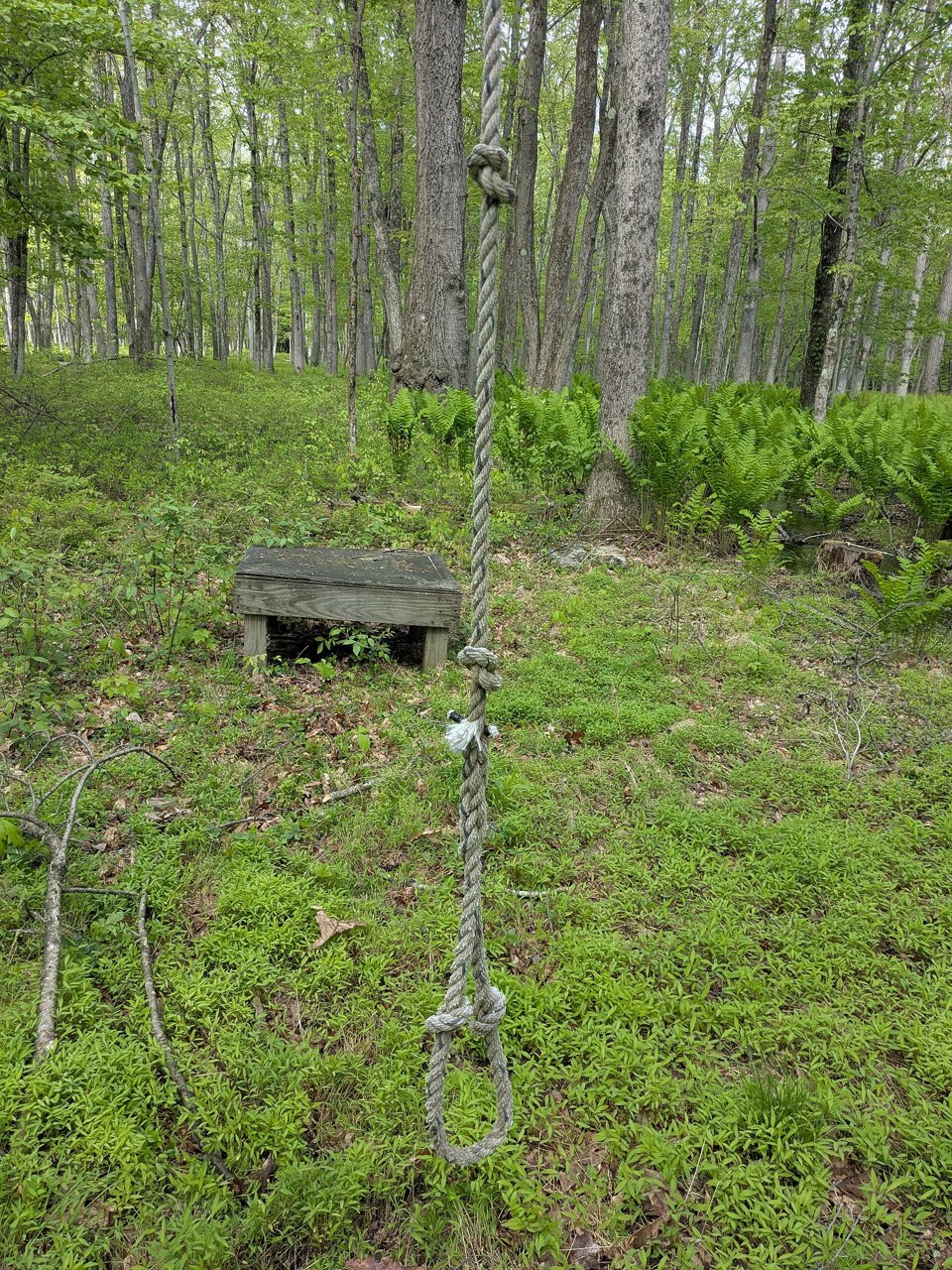
Visual AidA rope in the woods
Photograph of a rope swing hung from a tree in a wood, with the wooden platform it is launched from. The Knowledge Bank explains that crossing a creek on a single rope was common rural play, thrilling and genuinely dangerous once the water rose. This rope hangs over dry ground, in a place the novel never mentions, and no one is on it. Notice the knots and the frayed loop: everything about a swing like this is improvised, which is exactly what the Knowledge Bank means by the danger.
Rope swing with launch platform. Source: Wikimedia Commons, CC0.
📚 Literary Devices in This Part · definitions & examples
Leslie’s death is the story’s climax and great turning point.The book becomes a tragedy — a story with a deeply sad event.The tone turns sorrowful and shocked.
The questions below are mixed — not grouped by device. Decide which device each one is about.
🧠Knowledge Bank question
1According to the Knowledge Bank, Paterson writes the climax quietly, without frightening detail, because she ___.Ch.11
2A tragedy is a story with a deeply sad event.Ch.11
3Fill in each blank with the correct word.Ch.11
Word choices:climaxtragedytonesetting- some words will not be used
Leslie’s death is the story’s peak, its
A story with such a sad event becomes a .
4With Leslie’s death, the book becomes a —Ch.11
5Tone is the feeling the author’s words carry.Ch.11
6Fill in each blank with the correct word.Ch.11
Word choices:toneclimaxtragedymood- some words will not be used
After the death, the story’s feeling turns sorrowful — its
Leslie’s death is the story’s great .
7After the tragedy, the story’s tone turns —Ch.11
8The peak, most intense moment of the story is the —Ch.11
9Fill in each blank with the correct word.Ch.11
Word choices:tragedytoneclimaxplot- some words will not be used
A story with a deeply sad turn is a
Leslie’s death is the book’s .
10The shift to a sorrowful tone mainly makes readers feel Jess’s —Ch.11
Part 4
Think Deeper
Four deeper challenges — no single-word recall. Read, weigh the evidence, and reason it through.
🧠Knowledge Bank · When Bad News Feels Unreal
Ethical Reasoning · When Bad News Feels Unreal
Jess cannot believe Leslie is gone — the news feels impossible. The central issue is why our minds sometimes refuse to accept very painful news at first, and why that is a normal way to cope. This context establishes that big feelings are easier to bear when shared with people who care about us. When we suddenly lose someone we love, the very first feeling is often disbelief — the mind protects us by refusing to accept such painful news. That is why Jess shouts ‘No!’ This shock and denial is a normal, natural first stage of grief. Over time, with the help of caring family and friends, the sharp pain slowly softens, even though the person is always remembered. Six gentle threads for the hardest chapter. None of them is a cure; together they are what a grieving child actually needs, which is steady company.
Visual AidThe guards at the door
Diagram for the Knowledge Bank on when bad news feels unreal. It draws the Knowledge Bank’s own picture: the mind as a door with two guards, shock and denial, letting the truth in a crack at a time, and then the slow softening that comes with people who care. It does not put a timetable on any of it. Notice that the guards are not drawn as enemies — the Knowledge Bank calls them protection, and so does the drawing.
The stages described in the Knowledge Bank. Drawn for Garden Heights Academy.
1Claim: “Leslie’s death comes as a sudden, shocking blow.” — choose the two details that best prove it.Claim & Evidence
2Jess’s happy day, or the tragedy at home? Tap each item to sort it — tap again to switch sides. You can keep tapping to change your answer.Sort into two
◄ Jess’s happy dayThe tragedy at home ►
3Match each cause to its result. For each cause, pick its result.Cause & Effect
Miss Edmunds invites Jess to the museum→
Leslie goes to Terabithia by herself→
The old rope suddenly breaks→
Jess comes home unaware→
🧠Knowledge Bank question
4Fill both blanks to complete the reasoning.Build the Argument
The Knowledge Bank says shock and denial are a normal first stage of grief because , which shows that .
Part 5
Standardized Test
Reference & Sentence Simplification — SAT & TOEFL-style practice
Read the passage — the highlighted words are tested — then answer. Tap an answer, then tap it again to confirm.
SATWords in Context — a word's meaning in this passage
SATInference — a conclusion the passage implies
TOEFLFactual Information — a fact stated in the passage
TOEFLReference — what a pronoun refers to
TOEFLSentence Simplification — the shorter sentence that keeps the meaning
TOEFLProse Summary — the three sentences that sum it up
The Mind's First Response to Loss
When terrible news arrives, the mind has guards at the door. The first is shock: a numb, unreal feeling, as if the news belonged to somebody else. The second is denial — disbelief, the urge to shout “No!” and call the news a mistake. Psychologists say these guards are not weakness but protection: a loss taken in all at once could overwhelm a person completely, so the mind lets the truth in slowly. It opens the door only a crack at first; shock and denial are temporary — the heart’s way of buying the time it needs.
The grief that follows is not a straight road but a process: waves that come and go, gentle days and suddenly hard ones, in no fixed order. What helps most as people mourn, research agrees, is support — a trusted adult, a good friend, anyone who listens without rushing. Talking does not push sadness away; it gives sadness somewhere safe to stand. And people do not “get over” a great loss so much as learn to cope with it: to carry it, and to keep living — and loving — while they do.
Original passage written for Garden Heights — not a quotation from the novel.
1According to the passage, the mind’s first “guard” is —TOEFL · Factual Information
2To “overwhelm” someone is to —SAT · Words in Context
3According to the passage, denial is —TOEFL · Factual Information
4In the passage, disbelief is ___.SAT · Words in Context
5In paragraph 1, the word “It” in “It opens the door only a crack at first” refers to —TOEFL · Reference
6In the passage, as people mourn they ___.SAT · Words in Context
7The passage suggests that grieving people are mostly helped by —SAT · Inference
8According to the passage, what does talking give to sadness?TOEFL · Factual Information
9Which sentence best keeps the meaning of: “people do not ‘get over’ a great loss so much as learn to carry it”?TOEFL · Sentence Simplification
10This TOEFL task lists six sentences; choose the THREE that best capture the passage’s main ideas. The other three do not belong — they state minor details or ideas the passage does not present.TOEFL · Prose Summary
Part 6 · Optional
Creative Writing
A bonus challenge to practice your English. Take your time and have fun with it.
About This Section
This writing task is optional and is not part of your auto-graded score. The feedback below checks only the basics — length, spelling, and grammar — not whether your ideas are right or wrong. It is meant for classroom discussion and creative practice, so feel free to use your imagination!
Writing Task — Part 6 “When Someone Is Gone”
This is a very sad chapter. Write gently about a loss you have known (a person, a pet, or a friend who moved away), or about how you would comfort a friend who is grieving. What helps people feel a little better when they are sad? Write at least 40 words.
You can start with: “When someone is sad about losing a friend, one kind thing we can do is…”
0 / 40 words minimum
🗣 Teach It · Just for Fun (optional)
No right or wrong — close the screen and tell someone nearby what happened in this part. Can’t find anyone? Tell yourself out loud. The moment you teach it, you truly understand it.
Part 6 Complete!
You finished Chapters 11 of Bridge to Terabithia.
Here are your auto-graded results:
-
points out of 100
Teach it to someone
The best last step is to teach it. In your own words, explain what happened — retell a favorite scene, teach a character’s big choice, or sum up the main idea for a parent, friend, or classmate. When you can teach it clearly, you truly own it.
Independent study guide by Garden Heights Academy. Not affiliated with or endorsed by the author or any rights holders. Contains original analysis only; no text from the novel is reproduced.
SAT® is a registered trademark of College Board, which is not affiliated with, and does not endorse, these materials. TOEFL® is a registered trademark of ETS. These materials are not endorsed or approved by ETS. Garden Heights is an independent provider of test-style reading practice.