New here? Just sign up with Google — your account includes Matilda, our gift book, forever.
📚
Garden Heights Academy
Members sign in to continue.
The Twits · Garden Heights Academy
Part 2
for The Twits · Part 2 · Chapters 5–7
a story by Roald Dahl
30 min5 Parts
This workbook is built on a solid pedagogical foundation, effectively integrating content and language learning based on the CLIL framework (Content and Language Integrated Learning), elevated by our unique 5th C — Connection — and an integrated Standardized Test section that weaves every SAT & TOEFL question type right into the novel, so learners build real test skills easily, naturally, and with fun.
What Happens in Part 2
The trick-war begins. Mrs. Twit drops her glass eye into Mr. Twit’s mug of beer so that it stares up at him and gives him a dreadful fright. Burning for revenge, Mr. Twit pays her back by hiding a slimy frog in her bed — and she strikes again, stirring wriggling worms into his spaghetti. Each trick is a little nastier than the one before.
What We Will Learn
Literary Element
What It Means
Conflict
A struggle between two characters or forces — here, the trick-war between the Twits
Cause and Effect
How one event (the cause) makes another event (the effect) happen
Humor
The way a writer makes us laugh, even at nasty things
Chapter Summary
Chapter
Title & Key Events
Ch.5
The Glass Eye — Mrs. Twit drops her glass eye into Mr. Twit’s mug of beer so it stares up at him and gives him a horrible shock
Ch.6
The Frog and the Worms — furious, Mr. Twit hides a frog in Mrs. Twit’s bed; she answers with wriggling worms in his spaghetti
💭 Before You Read · Warm-Up (not scored)
There are no wrong answers here — just think, guess, and talk:
Have you ever seen a harmless prank? What separates a funny prank from a mean trick?
Predict: Mrs. Twit has a glass eye, and Mr. Twit loves his beer. How might those two facts collide?
Once a trick-war starts, why is it so hard for either side to stop first?
Copyright Notice
Independent study guide by Garden Heights Academy. Not affiliated with or endorsed by Roald Dahl or the Roald Dahl Story Company. No text from the novel is reproduced. Students should read the original book. Reference text: This workbook follows Roald Dahl’s classic text (the standard Puffin edition sold worldwide). Revised 2023 UK editions change some wording and may not match the vocabulary studied here.
Part 1
Vocabulary
Study 10 key words from Chapters 3–4, then answer each question.
🧠Knowledge Bank · The Glass Eye
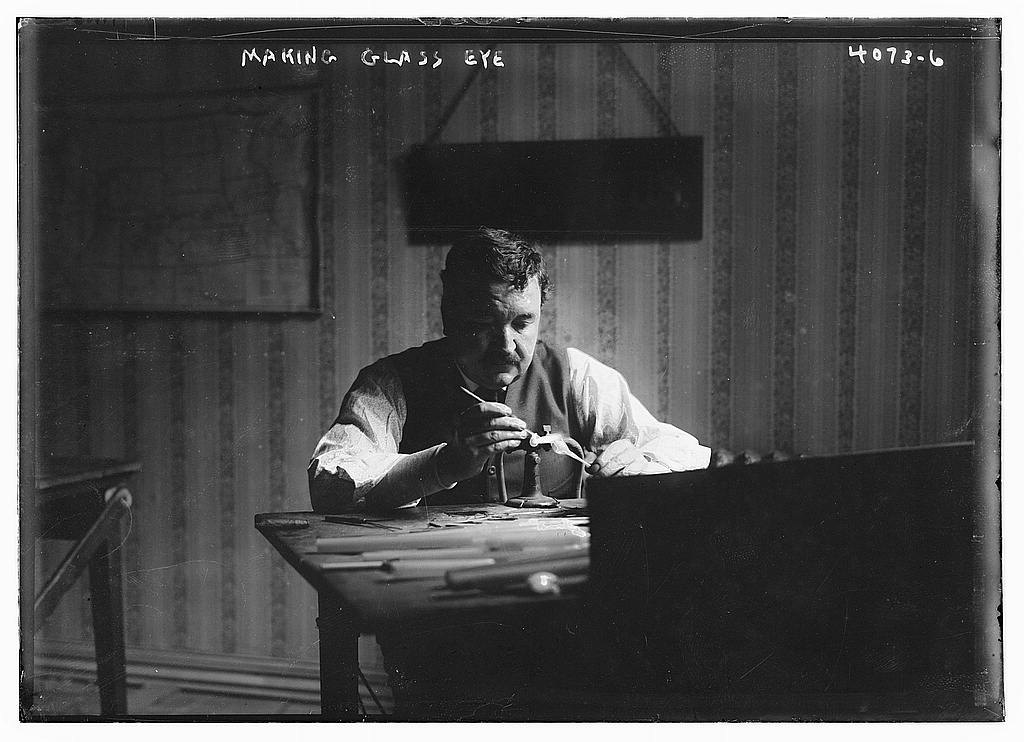
Science · The Sense of SightMrs. Twit wears a glass eye, and glass eyes are real. Someone who loses an eye can wear a painted one so their face still looks whole; specialists still fit and color-match them by hand today. The eye cannot see. It only fills the empty space and matches its partner. Your real eyes are sense tools that send pictures to the brain, and the brain is oddly alert to being watched. Even a fake eye staring up from the bottom of a glass can make a person feel uneasy, which is exactly the feeling the Twits love to fool.
Visual AidMaking a glass eye by hand
Photograph from the Bain News Service, taken between about 1915 and 1920, of a craftsman seated at a bench, bending over a small flame as he shapes a glass eye by hand. The Knowledge Bank explains that glass eyes are real: someone who loses an eye can wear a painted one so the face still looks whole, and specialists still fit and color-match them by hand today. This is that craft a century ago, one eye at a time. The man is a working artisan, not Mrs. Twit, and the eye he is making will fill a space rather than see. Notice how close he leans to the work — matching the color of a living eye takes a steady hand and a careful look.
Making a glass eye, Bain News Service, about 1915 to 1920; George Grantham Bain Collection, Library of Congress. Source: Wikimedia Commons, public domain.
ⓘ Vocabulary words are selected to help you understand and complete this workbook. Some may not appear verbatim in the novel.
trickn.Ch.5
A sneaky plan made to fool or frighten someone
“Mrs. Twit thought up a nasty trick to play on her husband.”
shudderv.Ch.5
To shake suddenly from fear, cold, or disgust
“Mr. Twit gave a great shudder when he saw the eye in his beer.”
starev.Ch.5
To look at something for a long time with wide eyes
“The glass eye seemed to stare straight up at him.”
mugn.Ch.5
A large cup with a handle
“She slipped the eye into the bottom of his mug.”
revengen.Ch.6
Paying someone back because they hurt you first
“Burning for revenge, Mr. Twit planned his own trick.”
wrigglev.Ch.6
To twist and turn the body about, the way a worm does
“Live worms began to wriggle in the spaghetti.”
slimyadj.Ch.6
Covered in a wet, slippery, unpleasant coating
“The frog felt cold and slimy in the bed.”
squirmv.Ch.6
To wriggle and twist about, especially in disgust
“Mrs. Twit began to squirm when she felt the worms.”
furiousadj.Ch.6
Extremely angry
“Mr. Twit was furious about the glass-eye trick.”
disguisev.Ch.6
To hide what something really is
“She tried to disguise the worms as ordinary spaghetti.”
1Fill in each blank with the correct word.Ch.5–7
Word choices:revengeprankgloatghastly- some words will not be used
The glass-eye trick starts a war of ,
each nasty worse than the one before.
🧠Knowledge Bank question
2According to the Knowledge Bank, a glass eye ___.Ch.5–7
3Something “ghastly” is —Ch.5–7
4To “gloat” means to feel smug, mean delight at another person’s trouble.Ch.5–7
5A “spiteful” act is one done —Ch.5–7
6Fill in each blank with the correct word.Ch.5–7
Word choices:wriggledisgustboastterror- some words will not be used
The worms on her plate,
filling Mrs. Twit with once she learns the truth.
7If you are filled with “terror,” you feel —Ch.5–7
8A “spiteful” act is meant to be kind and helpful.Ch.5–7
9To “boast” is to —Ch.5–7
10“Revenge” means paying someone back for a wrong they did to you.Ch.5–7
Part 2
Comprehension
How well do you understand Chapters 3–4?
🧠Knowledge Bank · Cause and Effect
Reading Skill · Cause & EffectEvery trick in this story works like a chain. First something happens; then, because of it, something else happens. The first part is the cause, and the second part is the effect. When Mrs. Twit slips her glass eye into the beer, that is the cause. Mr. Twit gasping in fright is the effect. Good readers keep asking, ‘What made this happen?’ and ‘What happened next?’ Linking cause to effect helps you follow every mean joke and guess what may come. In Dahl’s world, one nasty cause almost always leads to an even nastier effect.
Visual AidOne nasty cause, one nastier effect
Diagram for the Knowledge Bank on cause and effect. The first two cards are the very example the Knowledge Bank gives, the glass eye in the beer as the cause and Mr. Twit’s fright as the effect, and the third card shows the effect turning into the cause of the next trick; the dashed arrow is the chain running on. It does not describe the later tricks. Notice that the loop never closes on its own — in this book one nasty cause almost always leads to a nastier effect.
Cause, effect and the chain of tricks as described in the Knowledge Bank. Drawn for Garden Heights Academy.
🧠Knowledge Bank question
1The Knowledge Bank says that when Mrs. Twit slips her glass eye into the beer, that is ___.Ch.5–7
2Mr. Twit is calm and pleased to find the eye glaring from the bottom of his mug.Ch.5–7
3What does Mr. Twit hide in Mrs. Twit’s bed?Ch.5–7
4The creature in the bed is truly a monster called the Skillywiggler.Ch.5–7
5Put these events in the correct order. Write 1–5 (1 = first).Ch.5–7
Furious at being watched, Mr. Twit plots his revenge.
Mrs. Twit secretly drops her glass eye into Mr. Twit’s mug of beer.
Then he feeds her Wormy Spaghetti and tells her only after she has eaten.
When Mr. Twit drains the mug, the glass eye is glaring up at him from the bottom.
He hides a big frog in her bed and calls it the Giant Skillywiggler.
6What is the “Wormy Spaghetti” really made of?Ch.5–7
7When does Mr. Twit tell Mrs. Twit about the worms?Ch.5–7
8The Twits are playing these cruel tricks to get revenge on each other.Ch.5–7
9Why does Mr. Twit wait to reveal the truth about the worms?Ch.5–7
10What do these two chapters show about the Twits’ marriage?Ch.5–7
Part 3
Literary Elements
Understanding HOW and WHY Dahl writes Chapters 3–4 the way he does.
🧠Knowledge Bank · A War of Tricks
Literary Craft · ConflictA good story needs a problem, and writers call this problem the conflict. In The Twits the conflict is a silly, spiteful war between a husband and a wife. Mr. Twit plays a mean trick; Mrs. Twit strikes back with a worse one. This back-and-forth is a battle of tricks, and it drives the whole book forward. Each new trick raises the stakes and makes us laugh a little harder. Dahl turns their nasty conflict into comedy by keeping it wildly over the top. Two tricksters trying to out-prank each other is an old comic tradition, far older than Dahl himself. Watch how each attack sparks the next revenge.
📚 Literary Devices in This Part · definitions & examples
Conflict is a struggle between two characters or forces. The Twits are in constant conflict, each trying to out-trick the other.Cause and effect means one event (the cause) makes another event (the effect) happen. The glass-eye trick causes Mr. Twit’s revenge.Humor is the way a writer makes us laugh. Dahl makes even cruel tricks, like worms in spaghetti, feel silly and funny.
The questions below are mixed — not grouped by device. Decide which device each one is about.
🧠Knowledge Bank question
1According to the Knowledge Bank, the conflict in The Twits is ___.Ch.5–7
2Conflict is a struggle between opposing forces or characters.Ch.5–7
3Fill in each blank with the correct word.Ch.5–7
Word choices:conflicthumorsettingrhyme- some words will not be used
The Twits’ tit-for-tat tricks create ,
and Dahl’s silly cruelty turns it into .
4Mr. Twit’s furious revenge is the direct effect of —Ch.5–7
5In a cause-and-effect chain, the effect always happens before the cause.Ch.5–7
6Fill in each blank with the correct word.Ch.5–7
Word choices:causeeffectthemesimile- some words will not be used
The glass-eye prank is the ,
and Mr. Twit’s revenge is its .
7What makes the Wormy Spaghetti funny rather than simply sickening?Ch.5–7
8Naming an ordinary frog the “Giant Skillywiggler” is an example of Dahl’s —Ch.5–7
9Fill in each blank with the correct word.Ch.5–7
Word choices:motivetoneclimaxsetting- some words will not be used
Revenge is each Twit’s ,
and Dahl’s teasing keeps their spite funny.
10Much of Dahl’s humor in these chapters comes from —Ch.5–7
Part 4
Think Deeper
Four deeper challenges — no single-word recall. Read, weigh the evidence, and reason it through.
🧠Knowledge Bank · Why the Tricks Get Worse
Ethics · RevengeHave you noticed the tricks keep getting nastier? That is no accident. When two people answer meanness with more meanness, the cruelty grows and grows. Each one wants to win, so each trick must beat the one before. This is called a cycle of revenge, and it never really ends. Real life can be like this too: a small unkindness can swell into a big fight if nobody chooses to stop. The Twits never say sorry and never forgive, so their nastiness only climbs. Kindness, not payback, is the one thing that could break the cycle.
1Claim: “The Twits’ pranks are a cruel contest of revenge.” — choose the two details that best prove it.Claim & Evidence
2A trick meant to frighten, or a trick meant to disgust? Tap each item to sort it — tap again to switch sides. You can keep tapping to change your answer.Sort into two
◄ Meant to frightenMeant to disgust ►
3Match each cause to its result. For each cause, pick its result.Cause & Effect
Mrs. Twit drops her glass eye in his beer→
Mr. Twit burns for revenge→
Mrs. Twit strikes back→
Each trick is answered→
🧠Knowledge Bank question
4Fill both blanks to complete the reasoning.Build the Argument
The Knowledge Bank says each trick must beat the one before because , and the one thing that could break the cycle of revenge is .
Part 5
Standardized Test
Key Details & Main Idea — SAT & TOEFL-style practice
Read the passage — the highlighted words are tested — then answer. Tap an answer, then tap it again to confirm.
SATWords in Context — a word's meaning in this passage
SATInference — a conclusion the passage implies
SATCentral Ideas — the passage's main point
TOEFLFactual Information — a fact stated in the passage
TOEFLRhetorical Purpose — why the author included a detail
TOEFLProse Summary — the three sentences that sum it up
Earthworms as Garden Engineers
Under every garden lies a hidden workforce. Earthworms spend their lives tunneling through the soil, swallowing dead leaves and tiny bits of earth as they go. A worm can digest the soft parts of what it swallows, and what it leaves behind forms crumbly little piles that enrich the ground like a natural fertilizer. A single burrow can reach more than a meter (about three feet) down, letting air and rainwater travel to the roots of plants. The scientist Charles Darwin was so amazed by this quiet work that he studied earthworms for almost forty years and wrote an entire book about them. He calculated that the worms in a single field can carry many tons of fresh earth up to the surface every year. Gardeners today agree that a garden full of worms is a healthy garden. The creatures that wriggle and make people shudder are, in truth, some of nature's most useful engineers.
Original passage written for Garden Heights — not a quotation from the novel.
1Worms tunnel through the “soil,” which is —SAT · Words in Context
2As earthworms move, they swallow —TOEFL · Factual Information
3Worms that wriggle ___.SAT · Words in Context
4What do the worms leave behind that helps plants?TOEFL · Factual Information
5People who shudder at worms ___.SAT · Words in Context
6How do the worms’ tunnels help plants?TOEFL · Factual Information
7We can infer that a garden with many worms would be —SAT · Inference
8The main idea of the passage is that earthworms —SAT · Central Ideas
9Calling the worms “a hidden workforce” presents them as —TOEFL · Rhetorical Purpose
10Prose Summary (TOEFL).Earthworms are humble but powerful helpers that keep garden soil healthy. This TOEFL task lists six sentences; choose the THREE that best capture the passage’s main ideas. The other three do not belong — they state minor details or ideas the passage does not present.TOEFL · Prose Summary
Part 6 · Optional
Creative Writing
A bonus challenge to practice your English.
About This Section
This writing task is optional and not part of your auto-graded score. Feedback checks length, spelling, and grammar only.
Writing Task — Part 2 “The Best Trick”
Imagine you are Mr. Twit thinking up a trick to play on Mrs. Twit. Describe your trick and how she will react. Write at least 40 words.
You can start with: “I rubbed my hairy hands together and grinned, because I had thought of the perfect trick…”
0 / 40 words minimum
🗣 Teach It · Just for Fun (optional)
No right or wrong — close the screen and tell someone nearby what happened in this part. Can’t find anyone? Tell yourself out loud. The moment you teach it, you truly understand it.
Part 2 Complete!
You finished Chapters 5–7 of The Twits.
Here are your auto-graded results:
-
points out of 100
Teach it to someone
The best last step is to teach it. In your own words, explain what happened — retell a favorite scene, teach a character’s big choice, or sum up the main idea for a parent, friend, or classmate. When you can teach it clearly, you truly own it.
SAT® is a registered trademark of College Board, which is not affiliated with, and does not endorse, these materials. TOEFL® is a registered trademark of ETS. These materials are not endorsed or approved by ETS. Garden Heights is an independent provider of test-style reading practice.