New here? Just sign up with Google — your account includes Matilda, our gift book, forever.
📚
Garden Heights Academy
Enter your access code to open this workbook.
The Twits · Garden Heights Academy
Part 8
for The Twits · Part 8 · Chapters 27–29
a story by Roald Dahl
30 min5 Parts
This workbook is built on a solid pedagogical foundation, effectively integrating content and language learning based on the CLIL framework (Content and Language Integrated Learning), elevated by our unique 5th C β Connection β and an integrated Standardized Test section that weaves every SAT & TOEFL question type right into the novel, so learners build real test skills easily, naturally, and with fun.
What Happens in Part 8
The grand finale. Sure they are upside down, the Twits stand on their heads to get “the right way up.” Because Mr. Twit had once tricked Mrs. Twit about the dreaded Shrinks, they now believe they are shrinking — and they really do shrink away to nothing, leaving two crumpled heaps of clothes. The Muggle-Wump monkeys and the birds are free at last, and the cruel Twits finally get the justice they deserve.
What We Will Learn
Literary Element
What It Means
Theme
The big idea or lesson behind a story
Resolution
The ending, where the story’s problems are finally sorted out
Poetic Justice
When characters get exactly what they deserve
Chapter Summary
Chapter
Title & Key Events
Ch.27
The Twits Get the Shrinks — believing they are upside down, the Twits stand on their heads, think they have caught the Shrinks, and shrink away to nothing, leaving only their clothes; the animals are free at last
💭 Before You Read · Warm-Up (not scored)
There are no wrong answers here — just think, guess, and talk:
Back in Part 3, Mr. Twit invented a pretend illness called the ‘Shrinks.’ How do you think that fib comes back to haunt the Twits now?
A satisfying ending often feels fair. What would a fair ending for two lifelong tricksters look like to you?
Looking back over the whole book: which of the Twits’ own tricks did you most want to see turned against them?
Copyright Notice
Independent study guide by Garden Heights Academy. Not affiliated with or endorsed by Roald Dahl or the Roald Dahl Story Company. No text from the novel is reproduced. Students should read the original book. Reference text: This workbook follows Roald Dahl’s classic text (the standard Puffin edition sold worldwide). Revised 2023 UK editions change some wording and may not match the vocabulary studied here.
Part 1
Vocabulary
Study 10 key words from Chapters 18, then answer each question.
🧠Knowledge Bank · Stories That Punish the Wicked
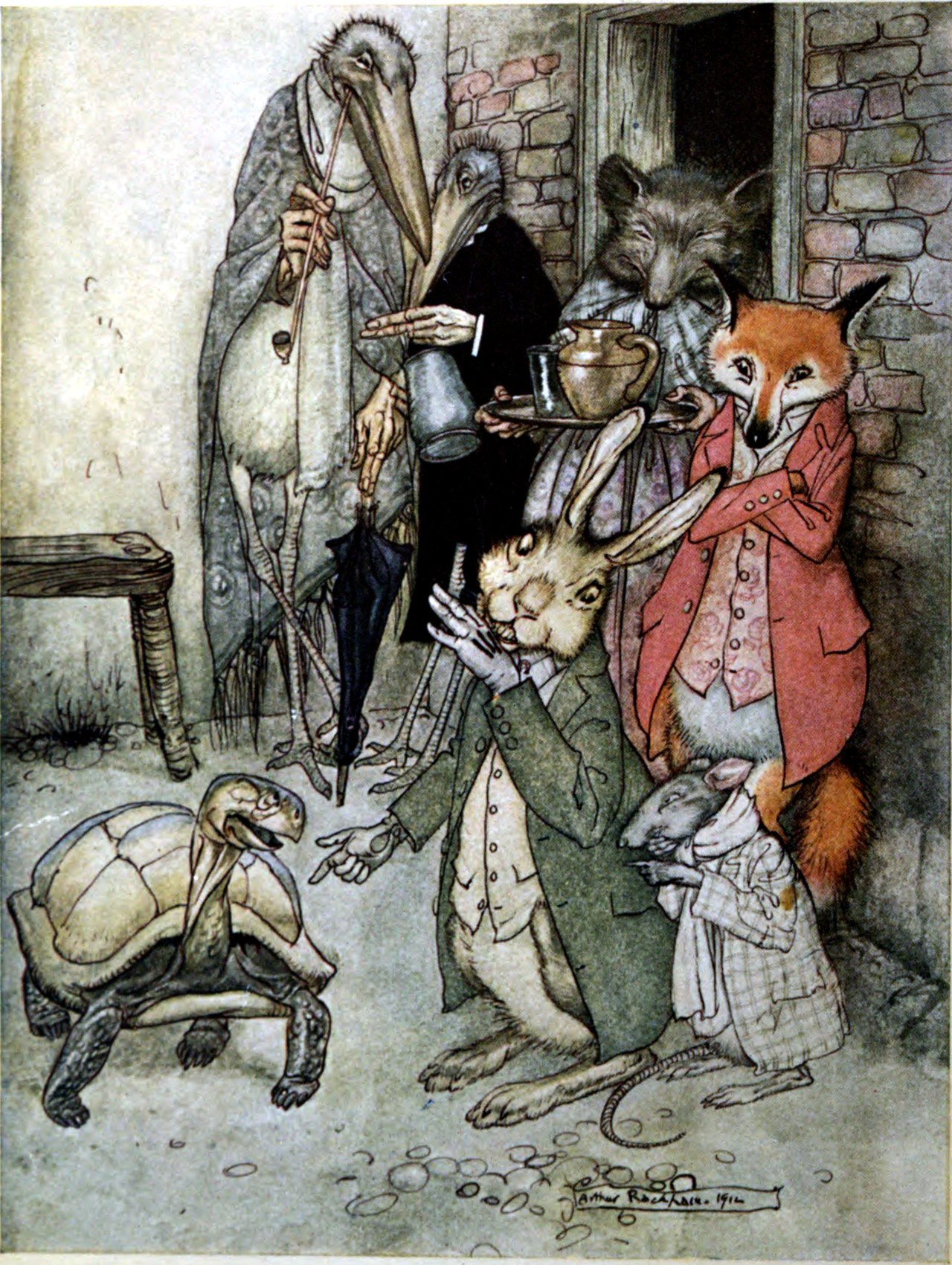
Folklore · The Fable TraditionThe Twits meet a wild, well-earned ending, and this fits a very old kind of story. For thousands of years, people have told fables and folktales in which the wicked are punished and the kind are rewarded. Aesop, a storyteller from long ago, filled his tales with animals who teach a clear lesson. Stories in which mistreated animals turn the tables on their masters appear all over the world. When the cruel get exactly what they deserve, we call it poetic justice. Dahl stands in this ancient line of storytellers. His book is funny and modern, yet it carries the same old promise: bad hearts lead to a bad end.
ⓘ Vocabulary words are selected to help you understand and complete this workbook. Some may not appear verbatim in the novel.
topplev.Ch.27
To wobble and fall over
“The Twits began to topple as they stood on their heads.”
vanishv.Ch.27
To disappear completely
“Little by little, the Twits vanished altogether.”
freedomn.Ch.27
Being free, not trapped or caged
“The monkeys won their freedom at last.”
justicen.Ch.27
Fairness; people getting what they deserve
“The cruel Twits finally met justice.”
deservev.Ch.27
To have earned something by what you have done
“They got exactly what they deserved.”
rejoicev.Ch.27
To feel and show great joy
“The freed animals began to rejoice.”
crumplev.Ch.27
To crush and collapse into folds
“Their empty clothes crumpled into two heaps.”
shrinkv.Ch.27
To become smaller and smaller
“The Twits began to shrink away to nothing.”
dreadedadj.Ch.27
Greatly feared
“They thought they had caught the dreaded Shrinks.”
downfalln.Ch.27
A fall from power; a ruin or defeat
“Their own foolishness caused their downfall.”
1To wobble and fall over is to —Ch.27
2To “vanish” means to disappear completely.Ch.27
3Being free, not trapped or caged, is called —Ch.27
4Fill in each blank with the correct word.Ch.27
Word choices:justicedeserverejoiceshrink- some words will not be used
Most readers feel the ending is fair, because the cruel Twits get the they
5To “rejoice” means to feel and show great sadness.Ch.27
6As they get the Shrinks, the Twits slowly — away to nothing.Ch.27
7A word for a fall from power, a ruin or a defeat, is —Ch.27
8If something is “dreaded,” it is greatly feared.Ch.27
9Fill in each blank with the correct word.Ch.27
Word choices:rejoicefreedomcrumplevanish- some words will not be used
When the Twits , the monkeys win their
10To crush and collapse into folds, the way empty clothes do, is to —Ch.27
Part 2
Comprehension
How well do you understand Chapters 18?
🧠Knowledge Bank · Reading for the Ending
Reading Skill · SummarizingThe last chapter ties the whole story together. This closing part is called the resolution, where problems are solved and we learn how things turn out. Good readers pause at the end to summarize — to say in a few words what happened from start to finish. Think back: the Twits were cruel, the animals fought back, and cleverness won. A good summary keeps only the biggest events and drops the small ones. Reading for the ending helps you see the point of the whole book and remember its main lesson.
1Why do the Twits decide to stand on their heads?Ch.27
2The Twits stand on their heads because they think they have caught the dreaded Shrinks.Ch.27
3What finally happens to Mr. and Mrs. Twit?Ch.27
4It is Mr. Twit’s own invention, the “Shrinks,” that helps destroy them.Ch.27
5Put the events of the ending in the correct order. Write 1–4 (1 = first).Ch.27
The Twits shrink away until only their clothes are left.
They become sure they are catching the dreaded Shrinks.
The freed monkeys and birds rejoice.
Believing they are upside down, the Twits stand on their heads.
6What happens to the Muggle-Wump monkeys and the birds at the end?Ch.27
7In the end, the Twits shrink away until there is nothing left but two heaps of clothes.Ch.27
8Why does the ending feel fair to most readers?Ch.27
9The Twits’ downfall is caused by their own foolishness and cruelty, not by bad luck.Ch.27
10Who really defeats the Twits in the end?Ch.27
Part 3
Literary Elements
Understanding HOW and WHY Dahl writes Chapter 18 the way he does.
🧠Knowledge Bank · The Lesson of the Story
Literary Craft · ThemeEvery fable leaves you with a big idea to carry home. That main idea is called the theme, or the moral of the story. The theme of The Twits is clear: cruelty destroys itself, while kindness and cleverness win. Dahl does not lecture; he lets the funny, gross events teach the lesson for him. To find a theme, ask what the whole story seems to be saying about life. Two readers can word the same theme differently and both be right. A strong theme stays with you long after the last page, like a wise little seed planted in your mind.
📚 Literary Devices in This Part · definitions & examples
Theme is the big idea or lesson behind a story. The Twits teaches that cruelty leads to your own ruin while kindness wins.Resolution is the ending of a story, where the problems are finally sorted out. Here, the Twits vanish and the animals go free.Poetic justice is when characters get exactly what they deserve — the cruel are punished and the kind are rewarded.
The questions below are mixed — not grouped by device. Decide which device each one is about.
1The Twits teaches that cruelty leads to ruin and kindness wins. This big lesson is the — of the story.Ch.27
2The resolution is the part of a story where the main problems are finally sorted out.Ch.27
3Fill in the blanks with the correct words.Ch.27
Word choices:justicedeserverhymesenses- some words will not be used
When characters get exactly what they deserve, it is poetic . The cruel are punished and the kind get what they .
4The part of the story where everything is sorted out and the Twits are gone is the —Ch.27
5Poetic justice is when the bad characters get what they deserve and the good are rewarded.Ch.27
6Fill in the blanks with the correct words.Ch.27
Word choices:themeruinrhymeceiling- some words will not be used
The big idea or lesson behind a story is its . In The Twits, cruelty leads to .
7The cruel Twits are destroyed by their own trick while the kind animals go free. When characters get just what they deserve, it is called —Ch.27
8A theme is the big idea or lesson a story teaches.Ch.27
9Fill in the blanks with the correct words.Ch.27
Word choices:resolutionvanishrhymeglue- some words will not be used
The ending, where the problems are sorted out, is the . It is where the Twits finally .
10Ending the cruel Twits’ story with their own trick destroying them gives the reader a strong sense of —Ch.27
Part 4
Think Deeper
Four deeper challenges — no single-word recall. Read, weigh the evidence, and reason it through.
🧠Knowledge Bank · Beaten by Their Own Trick
Ethics · Reaping What You SowIn the end the Twits are undone by their own nasty ways, and the gentle animals go free. This is the heart of poetic justice: the cruel fall, and the kind rise. It leaves us feeling that the world has been set right. Dahl’s message to young readers is warm and simple. Meanness may seem strong for a while, but it rots from the inside and finally fails. Kindness, courage, and clever teamwork are the powers that truly last. Choose to fill your heart with good, and let no ugly thought take root.
1Claim: “The Twits are undone by their own trick and cruelty.” — choose the two details that best prove it.Claim & Evidence
2The Twits’ downfall, or the freedom the animals win? Tap each item to send it left or right.Sort into two
◄ The Twits’ downfallThe animals’ freedom ►
3Match each cause to its result. For each cause, pick its result.Cause & Effect
The Twits see the upside-down room→
They try to get ‘the right way up’→
Their heads meet the glue→
The cruel Twits get their comeuppance→
4Fill both blanks to complete the reasoning.Build the Argument
The Twits are destroyed by their own trickery because , which shows the book’s belief that .
Part 5
Standardized Test
Prose Summary & Whole-Passage Reading — SAT & TOEFL-style practice
🎯 You already have the skills from the sections above — this is just a fun way to meet real SAT & TOEFL-style questions. Read the passage (the highlighted words are tested below), then answer the questions below. Tap an answer to select it, then tap it again to confirm — you can change your choice until you confirm.
Long before novels existed, people taught lessons with tiny stories called fables. The most famous fable-teller of all was Aesop, said to have lived in ancient Greece more than two thousand years ago. His stories are short and their characters are usually animals — a boastful hare, a patient tortoise, a lying shepherd boy. Each fable ends with a clear lesson, or moral, that the reader is meant to carry away. In “The Boy Who Cried Wolf,” a shepherd fools his neighbors so often that, when a real wolf comes, nobody believes his cries — the moral is that liars are not trusted even when they finally tell the truth. What makes fables last is justice: the proud are humbled and the cruel are punished, almost always by their own behavior. Modern authors still borrow the shape. When a wicked character in a story is undone by his own trick, he is walking straight out of Aesop — proof that the oldest pattern in storytelling still delights readers today.
Original passage written for Garden Heights — not a quotation from the novel.
1In the passage, the “characters” of Aesop’s fables are usually —SAT · Words in Context
2A “moral” is —SAT · Words in Context
3In “The Boy Who Cried Wolf,” why does nobody help at the end?TOEFL · Factual Information
4To say the neighbors no longer “believe” the boy means they do not —SAT · Words in Context
5What does the passage say makes fables last?TOEFL · Factual Information
6According to the passage, in fables the proud and the cruel are usually punished —TOEFL · Factual Information
7Insert Text (TOEFL). Look at the four squares [1]–[4] in the passage excerpt below. They show where the following sentence could be added: “Yet the same simple shape can still be found in books written only last year.”
For centuries, fables were passed on by word of mouth before anyone wrote them down. [1] Aesop’s little tales of proud hares and patient tortoises were told at firesides across the ancient world. [2] Later, printers gathered them into books that children read for hundreds of years. [3] Some readers assume such old stories must feel dusty and out of date. [4]
Where would the sentence fit best?TOEFL · Insert Text
8What can the reader infer about modern stories from the passage?SAT · Inference
9Which TWO ideas together best summarize the passage?TOEFL · Prose Summary
10The author mentions “a wicked character… undone by his own trick” mainly to —TOEFL · Rhetorical Purpose
Part 6 · Optional
Creative Writing
A bonus challenge to practice your English.
About This Section
This writing task is optional and not part of your auto-graded score. Feedback checks length, spelling, and grammar only.
Writing Task — Part 8 “Justice at Last”
Imagine you are a Muggle-Wump monkey on the day the Twits disappear. Describe how it feels to finally be free. Write at least 40 words.
You can start with: “At last the cage door swung open, and as I stepped out into the sunshine I felt…”
0 / 40 words minimum
π£ Teach It Β· Just for Fun (optional)
No right or wrong β close the screen and tell someone nearby what happened in this part. Canβt find anyone? Tell yourself out loud. The moment you teach it, you truly understand it.