New here? Just sign up with Google — your account includes Matilda, our gift book, forever.
What Happens in Part 7
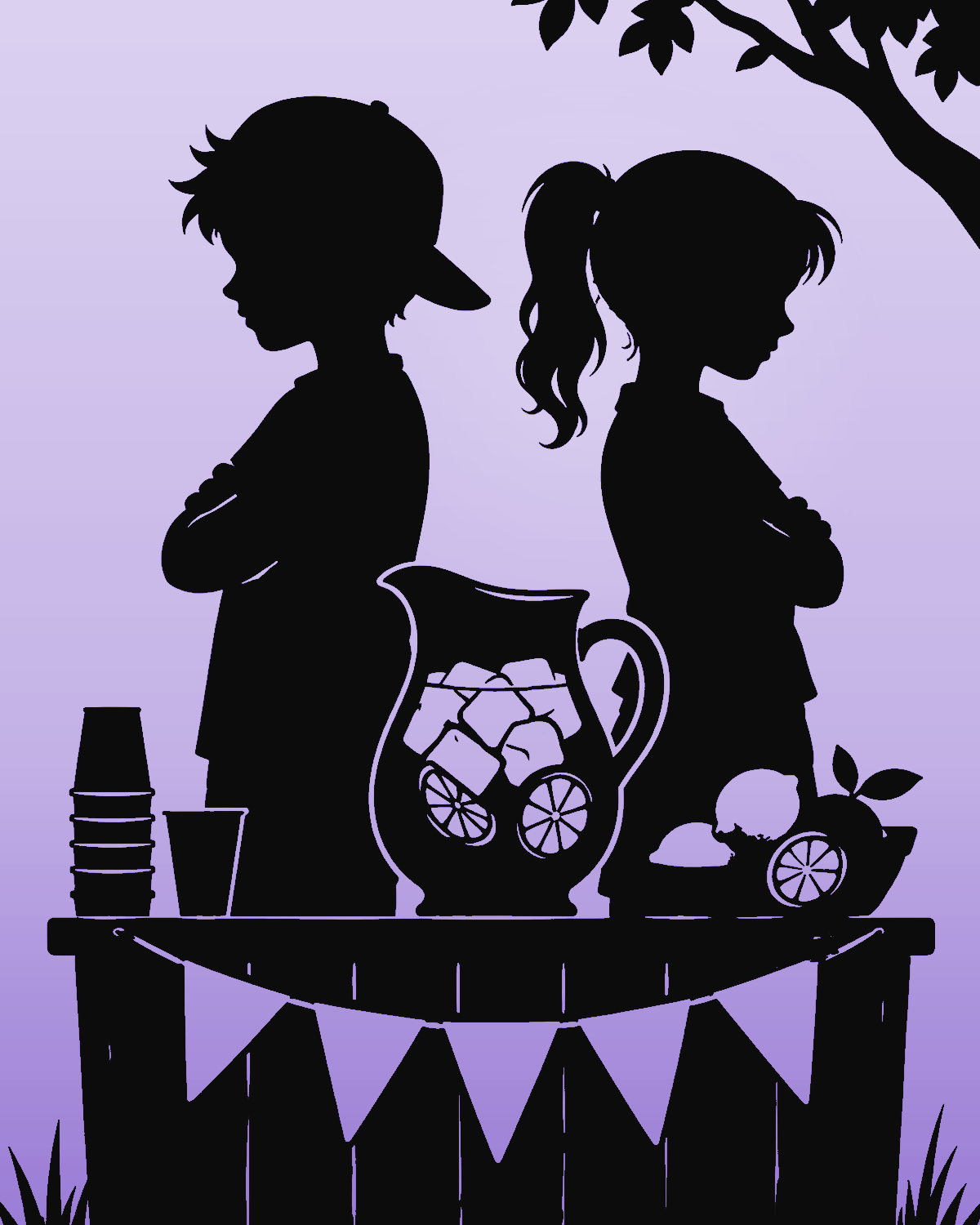
The crisis finally breaks open. All the anger, spying, and stolen money boil over into one furious fight between Evan and Jessie — and then, at last, into something better: the truth. Evan admits that he took her money and lost it; Jessie admits that she sabotaged his lemonade. In the middle of the storm, the two do what they should have done from the very start — they say how they really feel. Evan confesses that he was scared and jealous that his clever little sister would show him up at school; Jessie confesses how lonely and shut out she felt when he pushed her away. This is crisis management: not pretending the trouble away, but facing it honestly, together. The anger drains out of both of them, and in its place comes a great, tearful relief. The war is nearly over — not because someone won, but because they finally stopped fighting and started listening.
What We Will Learn
Focus
What It Means
Dynamic Character
A character who changes inside the story — both siblings grow here
Tone
The feeling in the writing — it softens from tense to tender
Catharsis
The great relief when bottled-up feelings finally pour out
Chapter Summary
Chapter
Key Events
Ch. 13 — Crisis Management
The anger explodes into a fight, then into honesty. Evan admits taking and losing the money; Jessie admits the sabotage. They finally share their real feelings — fear, jealousy, loneliness — and the crisis begins to heal.
💭 Before You Read · Warm-Up (not scored)
There are no wrong answers here — just think, guess, and talk:
When something goes badly wrong, why is telling the truth quickly usually better than hiding it?
Have you ever felt better after finally saying how you really felt? What changed?
Predict: now that the truth is out, how do you think Evan and Jessie will end their war?
Copyright Notice
This is an independent study guide created by Garden Heights Academy to support reading comprehension and literary analysis. It contains original analysis questions and does not reproduce any text from the novel. The Lemonade War is a work by Jacqueline Davies. This guide is not affiliated with, authorized by, or endorsed by the author or any associated rights holder.
Part 1
Vocabulary
Study 10 key words from Chapter 13, then answer each question.
🧠Knowledge Bank · Words of Facing the Truth
Business · Crisis ManagementIn the world of business, a crisis is an emergency — a ruined product, a lost shipment, a furious customer — and how a company handles it can matter more than the trouble itself. The steps of good crisis management are surprisingly : stay calm, face the problem honestly, tell the truth , and work together on a fix. The instinct to panic or to hide the mess always makes things worse, because a covered-up problem festers while an admitted one can be solved. What is striking is that these business rules are the rules of mending a friendship. Evan and Jessie stumble straight into them: only when they stop hiding and begin speaking plainly does the deeper emergency — the wreck of their bond — begin to heal. The same honesty that saves a company saves a family, which is why the bravest first move in any disaster is a single unglamorous act: to admit.
crisisn.Ch.13
A time of great danger or trouble
“The lost money became a crisis.”
confrontv.Ch.13
To face someone about a problem
“Jessie confronted her brother.”
apologizev.Ch.13
To say that you are sorry
“Both needed to apologize.”
forgivev.Ch.13
To stop being angry at someone
“They began to forgive each other.”
admitv.Ch.13
To agree that something is true
“Evan had to admit the truth.”
reliefn.Ch.13
The good feeling when trouble ends
“A great relief washed over them.”
misunderstandv.Ch.13
To get the wrong idea about something
“They had misunderstood each other.”
trucen.Ch.13
An agreement to stop fighting
“At last they called a truce.”
sincereadj.Ch.13
Truly meant; honest
“His sorry was sincere.”
calmv.Ch.13
To make quiet and peaceful
“The truth helped them calm down.”
1A ‘crisis’ is —Ch.13
2To ‘confront’ someone is to —Ch.13
3Fill in each blank with the correct word.Ch. 13
Word choices:admitforgivetrucerelief- some words will not be used
To agree that something is true is to it.
To stop being angry at someone is to them.
4A ‘truce’ is —Ch.13
5‘Relief’ is the good feeling that comes when trouble ends.Ch.13
6To ‘misunderstand’ is to —Ch.13
7Fill in each blank with the correct word.Ch. 13
Word choices:apologizesincerecrisiscalm- some words will not be used
To say that you are sorry is to .
A sorry that is truly meant is .
8To ‘admit’ something is to —Ch.13
9A ‘sincere’ apology is one that is —Ch.13
10To ‘confront’ a problem means to hide from it and hope it goes away.Ch.13
Part 2
Comprehension
How well do you understand Chapter 13?
🧠Knowledge Bank · From Fight to Feeling
Reading Skill · Tracking ChangeThis single powerful chapter turns a fight into a healing, and reading it well means watching a character change in real time. Follow the shift carefully, because it happens in stages: first the hot anger pours out, then come the hard admissions of what each child actually did, and only underneath all of that do the real feelings finally surface — the fear, the jealousy, the loneliness that started everything. To understand how the war ends, you have to infer what is happening beneath the shouting, reading the hurt that the angry words are about. Notice what each sibling at last dares to say, and what those words reveal that all summer’s coins and prices never could. A reader who tracks that inner turn — from attacking each other to finally understanding each other — grasps the true story Davies has been telling all along, a story that was never about lemonade.
1How does the crisis first break open?Ch.13
2What does Evan finally admit?Ch.13
3What does Jessie finally admit?Ch.13
4What real feeling does Evan confess?Ch.13
5Write the numbers 1–5 in the boxes to show the order of events in Part 7. Number 1 = what happens first.Ch. 13
Both admit the wrongs they did.
The buried anger bursts into a fight.
They share how they really feel inside.
A tearful relief replaces the anger.
The shouting suddenly turns into honesty.
6What real feeling does Jessie confess?Ch.13
7What is ‘crisis management’, as the siblings finally do it?Ch.13
8What replaces the anger by the end of the chapter?Ch.13
9The war ends because one sibling finally beats the other.Ch.13
10Telling the truth, though painful, helps the crisis begin to heal.Ch.13
Part 3
Literary Elements
Understanding HOW and WHY Jacqueline Davies tells the story in Chapter 13.
🧠Knowledge Bank · Dynamic Character, Tone & Catharsis
Literary Craft · CatharsisThree literary tools shape this chapter of healing. A dynamic character is one who changes across a story — and both Evan and Jessie end this scene different from how they began it, softened and opened by the truth they finally speak. Tone is the feeling carried in the writing itself; notice how Davies’ sentences shift from sharp and tense to gentle and warm as the anger burns off, so the style mirrors the mending hearts. Most interesting is catharsis — the great release that comes when bottled-up feelings at last pour out. All summer the children buried their real emotions under a game of coins; here the dam breaks, and the flood, painful as it is, leaves them lighter. When a writer can make a reader feel that same lifting of weight, an argument becomes a gift, and honest anger reveals itself as a door swinging open toward relief.
📚 Literary Devices in This Part · definitions & examples
A dynamic character is one who changes during the story (both Evan and Jessie grow). Tone is the feeling the writing gives (here it softens from tense to tender). Catharsis is the powerful relief that comes when built-up feelings are finally released (the tearful honesty).
1Both Evan and Jessie, who change and grow here, are —Ch.13
2Tone is the feeling that the writing gives the reader.Ch.13
3Fill in each blank with the correct word.Ch. 13
Word choices:dynamictonerhymeindex- some words will not be used
A character who changes across the story is called .
The soft, warm feeling of the writing here is its .
4The great release of feeling when the truth pours out is called —Ch.13
5A dynamic character stays exactly the same from start to finish.Ch.13
6Fill in the blank with the correct word.Ch. 13
Word choices:catharsisrhymesetting- some words will not be used
The tearful relief after the truth is spoken is a moment of .
7How does the tone of the writing change in this chapter?Ch.13
8The huge relief the siblings feel when their feelings burst out is —Ch.13
9Fill in the blank with the correct word.Ch. 13
Word choices:dynamicrhymeplot- some words will not be used
Evan and Jessie, who learn and change, are each a character.
10Why does Davies let the fight happen instead of skipping to peace?Ch.13
Part 4
Think Deeper
Four deeper challenges — no single-word recall. Read, weigh the evidence, and reason it through.
🧠Knowledge Bank · How Honesty Heals
Social-Emotional · Honesty & ForgivenessThe book’s turning point comes from truth-telling, not winning. All summer, Evan and Jessie hid their real feelings behind a war of prices and stands; the moment they finally speak those feelings aloud, the healing begins. Ask yourself why hiding a hurt tends to make it grow, while naming it out loud can shrink it — a secret kept in the dark swells, but a feeling spoken into the open loses its terrible power. Notice how much courage honesty actually takes: it is far easier to keep fighting than to admit you were scared, or jealous, or wrong. Notice, too, that the healing needs both sides — one brave enough to confess, the other generous enough to forgive. Winning a lemonade war turns out to be worth nothing beside winning back a person you love, and that reunion only begins with a single hard thing: the truth.
1Claim: “The furious fight finally clears the air with the truth.” — choose the two details that best prove it.Claim & Evidence
2Shows the turn from fighting to truth, or just a detail? Tap each item to send it left or right.Sort into two
◄ The turn to truthJust a detail ►
3Match each cause to its result. For each cause, pick its result.Cause & Effect
The anger has built up→
The fight breaks something open→
Evan is honest at last→
The truth is shared→
4Fill both blanks to complete the reasoning.Build the Argument
The fight leading to the truth shows that , which means that .
Part 5
Standardized Test
Handling a Crisis — SAT & TOEFL-style practice
🎯 You already have the skills from the sections above — this is just a fun way to meet real SAT & TOEFL-style questions. Read the passage (the highlighted words are tested below), then answer the questions below. Tap an answer to select it, then tap it again to confirm — you can change your choice until you confirm.
Sooner or later, every business hits a crisis — a sudden emergency like a ruined product, a lost order, or an angry customer. What separates those who survive from those who sink is how they respond. The first rule is to stay calm; a panicked mind makes poor choices. The second is to be honest fast: hiding a problem almost always makes it worse, while telling the truth early builds trust. The third is to work together on a fix rather than waste time blaming one another. Big companies even practice for emergencies ahead of time, so that no one freezes when real trouble strikes.
The very same rules help with troubles far beyond business. When friends or family face a hard moment, staying calm, speaking honestly, and solving it as a team can turn a disaster into a fresh start. A crisis, handled well, can even leave people stronger than before. A sports team that loses a key player, or a class facing a tough project, can lean on the same three steps. History is full of people who met a disaster head-on and came out braver for it.
Original passage written for Garden Heights — not a quotation from the novel.
1What is a business “crisis”?TOEFL · Factual Information
2To stay “calm” means to keep —SAT · Words in Context
3What is the first rule of handling a crisis?TOEFL · Factual Information
4Why is it wise to be honest fast?TOEFL · Factual Information
5To speak “honestly” is to speak —SAT · Words in Context
6What is the third rule of crisis management?TOEFL · Factual Information
7Where else do these same rules help, besides business?TOEFL · Factual Information
8What can a crisis, handled well, even do?TOEFL · Factual Information
9What is the passage mainly about?TOEFL · Rhetorical Purpose
10This passage connects to Part 7 because Evan and Jessie —TOEFL · Rhetorical Purpose
Part 6 · Optional
Creative Writing
A bonus challenge to practice your English. Take your time and have fun with it.
About This Section
This writing task is optional and is not part of your auto-graded score. The feedback below checks only the basics — length, spelling, and grammar — not whether your ideas are right or wrong. It is meant for classroom discussion and creative practice, so feel free to use your imagination!
Writing Task — Part 7 “Clearing the Air”
Evan and Jessie finally tell each other the truth about how they feel. Write the honest talk you imagine they have. What does Evan say about his fear and jealousy? What does Jessie say about feeling shut out? Write their conversation, or write about a time honesty helped you and someone make up. Write at least 40 words.
You can start with: “Evan took a deep breath and finally said…”
0 / 40 words minimum
🗣 Teach It · Just for Fun (optional)
No right or wrong — close the screen and tell someone nearby what ‘crisis management’ means, and how honesty finally ended the Treskis’ war. Can’t find anyone? Tell yourself out loud. The moment you teach it, you truly understand it.

Part 7 Complete!
You finished Chapter 13 of The Lemonade War.
Here are your auto-graded results:
-
points out of 100
Your Writing
Your writing was checked automatically for length, spelling, and grammar. Scroll back to Part 6 anytime to read your feedback and improve your work.
Independent study guide by Garden Heights Academy. Not affiliated with or endorsed by the author or any rights holders. Contains original analysis only; no text from the novel is reproduced.
