New here? Just sign up with Google — your account includes Matilda, our gift book, forever.
The Outsiders · Garden Heights
Part 8
for The Outsiders · Part 8 · Chapter 12
8 Parts40 min
What Happens in Part 8
Acquitted and adrift, Ponyboy finds Johnny's letter and turns his grief into the theme that becomes the novel itself.
The hearingThe hearing is nothing like the trial Ponyboy dreaded. Randy, Cherry, and the other Socs testify that Johnny acted to save Ponyboy's life the night Bob died, and his doctor has already spoken with the judge. After a few gentle questions — grades, Sodapop, living with Darry — the judge acquits Ponyboy, closes the case, and leaves the brothers together.
Drifting, then steelStill shaky from the concussion and hollowed by losing Johnny and Dally, Ponyboy loses his appetite, runs into things, forgets assignments, and watches his grades slide until English teacher Mr. Syme offers a passing C for one honest theme. Outside the store where greasers eat lunch, three Socs corner him over Bob's death; he breaks a pop bottle, backs them down, then picks up the glass so no one gets a flat — showing Two-Bit the real Ponyboy is in there.
The tug-of-warAt home, Darry and Ponyboy finally boil over about the unwritten theme, and Sodapop bolts — his letter to Sandy has come back unopened, and Ponyboy learns she left for Florida expecting a baby that was not Soda's, though Soda had offered to marry her anyway. The brothers catch him in the park, where he begs them to stop making him the rope in their tug-of-war, and the three race home under a truce that feels like a new start.
Johnny's letterThat night Ponyboy opens Johnny's Gone with the Wind and finds a hospital letter: saving the children was worth his life, staying gold means keeping a kid's wonder, and the world still holds good worth seeing. Ponyboy pours the last weeks' hurt into his theme — the story of boys like Johnny and Dally, told so strangers stop judging them at a glance — opening with the sentence that began Chapter 1: the book in your hands is the theme itself.
What We Will Learn
Section
What you will practice
Vocabulary
The courtroom and the road back: acquitted, testimony, guardian, listless, truce…
Literary Elements
A frame narrative that closes its circle, a resolution earned through a letter, and a motif — one worn paperback — carried all the way to the last page
Cross-Curricular
Publishing history — how a Tulsa teenager’s manuscript became the novel that started young-adult fiction, and why her name shrank to two initials
Chapter Summary
Ch.
What happens
Chapter 12 · The Hearing
Acquitted — Randy, Cherry, and the doctor have already told the court the truth, so the judge asks Ponyboy only a few quiet questions about home and school before clearing him and leaving him in Darry’s care. The family stays together — but Ponyboy walks out numb instead of relieved.
Chapter 12 · Running on Empty
The Slide — Concussion and grief catch up with Ponyboy: no appetite, no balance, no memory for schoolwork. His grades sink until Mr. Syme offers a C for one honest semester theme. Outside a store, Ponyboy backs down three Socs with a broken bottle — then picks up the glass, and Two-Bit breathes again.
Chapter 12 · The Fight and the Park
Soda Breaks — Darry and Ponyboy explode over the unwritten theme, and Sodapop — carrying his own returned, unopened letter to Sandy — sprints out of the house. In the park he begs his brothers to stop tearing at each other with him in the middle, and the three race home under a truce.
Chapter 12 · Johnny’s Letter
The Frame Closes — Inside Gone with the Wind, Ponyboy finds Johnny’s hospital letter: the children were worth it, staying gold means keeping a kid’s wonder, and there is still good in the world. Ponyboy starts his theme with the novel’s own first sentence — the book is the essay.
Part 1
Vocabulary
Study 10 key words from Chapter 12, then answer each question.
📚Knowledge Bank · The Name on the Cover
Publishing · Pen Names & InitialsWhen Viking Press prepared The Outsiders for publication in 1967, the publisher gave its teenage author some blunt advice: sign the book “S. E. Hinton,” not Susan Eloise. The worry was simple. This was a novel about gang fights, knives, and boys dying young, and the publisher feared that reviewers — and boy readers — would not trust such a story if the cover announced that a teenage girl had written it. Hiding a writer’s identity this way has a long history. In the 1840s the Brontë sisters published as three brothers named Bell; Mary Ann Evans wrote as George Eliot; and decades after Hinton, J. K. Rowling’s publisher made the same initials request for the same reason. A disguised name is called a pseudonym, and initials are its mildest form — nothing is false, but something is withheld. The trick worked: early readers argued about who S. E. Hinton was, and the book was judged on its pages instead of its author.
acquittedv.Ch.12
Declared not guilty of a charge by a court
“The judge acquitted Ponyboy and closed the case for good.”
testimonyn.Ch.12
A witness’s formal statement given in court
“Randy and Cherry’s testimony told the court what really happened.”
guardiann.Ch.12
An adult who is legally responsible for a child
“The hearing decides whether Darry can stay on as guardian.”
mechanicallyadv.Ch.12
Automatically, without thought or feeling
“Ponyboy ate mechanically, hardly tasting what was on his plate.”
listlessadj.Ch.12
Without energy, interest, or spirit
“For weeks after the hearing he stayed listless and far away.”
tauntv.Ch.12
To mock someone in order to provoke a reaction
“The three Socs taunted Ponyboy about the night Bob died.”
strickenadj.Ch.12
Overcome by sudden shock, grief, or distress
“Soda’s stricken face stopped both of his brothers cold.”
trucen.Ch.12
An agreement between opponents to stop fighting
“The race home sealed a truce between Darry and Ponyboy.”
themen.Ch.12
A long graded essay written for an English class
“Mr. Syme promised a C in exchange for one honest theme.”
reconcilev.Ch.12
To bring people back into friendship after conflict
“It took Soda’s tears to reconcile the Curtis brothers.”
ⓘ The vocabulary words in this list are selected to help you understand and complete this workbook. Some may not appear verbatim in the original novel.
🧠Knowledge Bank question
1The Knowledge Bank suggests initials give incomplete testimony about an author because ___.Ch.12
2‘Testimony’ is a witness’s formal statement in court.Ch.12
3A child’s ‘guardian’ is the adult who ___.Ch.12
4Doing something ‘mechanically’ means doing it ___.Ch.12
5Fill in each blank with the correct word.Ch.12
Word choices:listlesstruceguardiantaunt- some words will not be used
After the hearing Ponyboy stayed for weeks.
The race home sealed a between the brothers.
6To ‘taunt’ someone is to praise him in front of others.Ch.12
7A ‘stricken’ face shows that a person is ___.Ch.12
8In Ponyboy’s school, a ‘theme’ is a long graded essay.Ch.12
9Fill in each blank with the correct word.Ch.12
Word choices:reconciletestimonymechanicallystricken- some words will not be used
Soda’s plea helps Darry and Ponyboy.
The court heard from Randy and Cherry.
10A ‘truce’ is an agreement to ___.Ch.12
Part 2
Comprehension
Show you understood what happens in Chapter 12.
⚖Knowledge Bank · A Kid in Juvenile Court
Legal History · The First Juvenile CourtsPonyboy’s hearing happens in juvenile court, a separate court system the United States built for people under eighteen. Its first version opened in Chicago in 1899 on a new idea: a child who breaks the law should be guided, not simply punished, so juvenile judges were given unusual freedom to ask about a young person’s whole life — home, school, grades, family — and not just the crime. That is why Ponyboy’s judge asks about Sodapop and report cards instead of about the night in the park. A hearing is also quieter than a trial: often no jury, a smaller room, records kept private so one bad year does not follow a child forever. The stakes are still enormous. The judge who acquitted Ponyboy could instead have ruled the home unfit, removed Darry as guardian, and scattered the brothers into foster care or a boys’ home. One adult’s decision holds the whole family in custody.
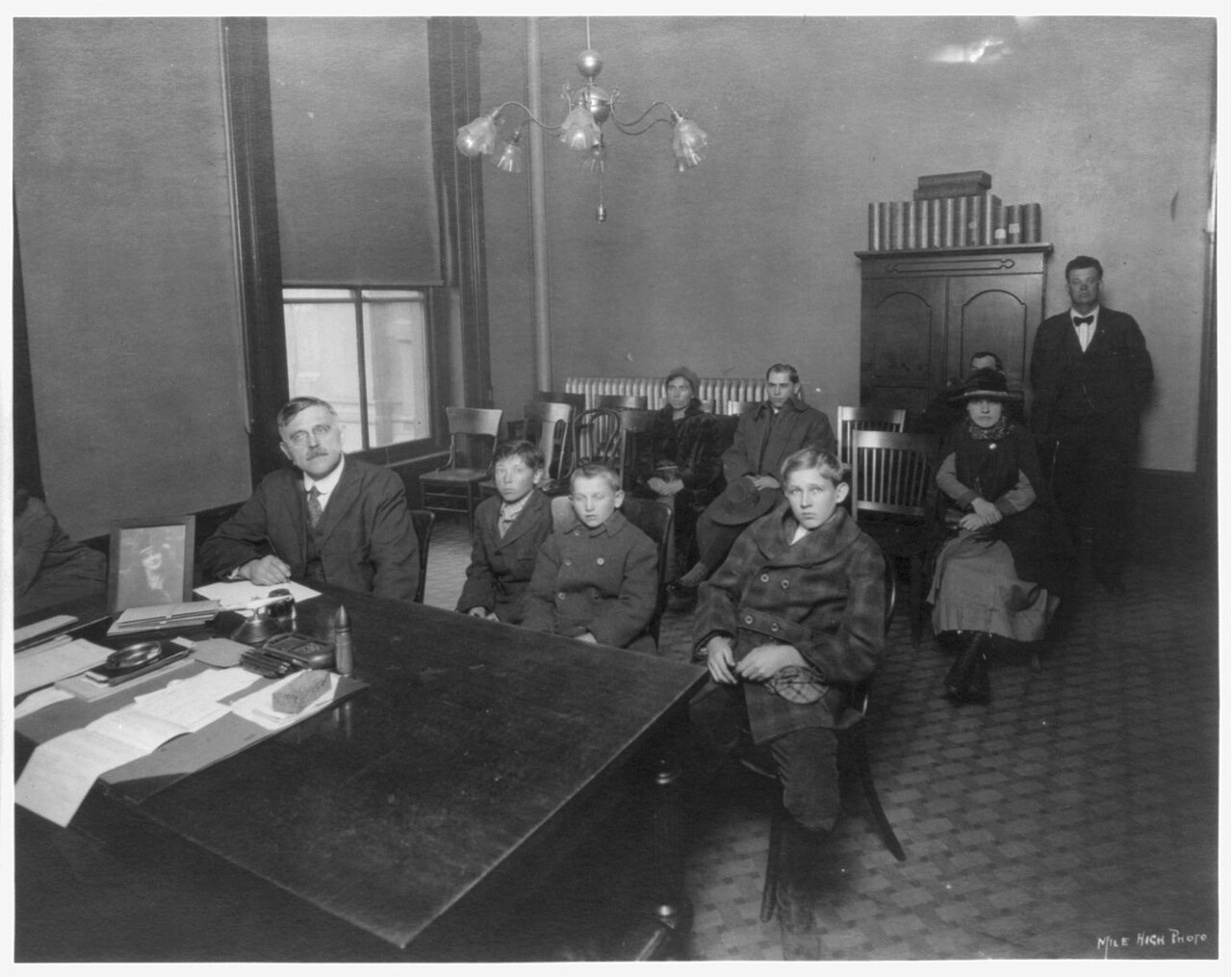
Visual AidA hearing room, not a courtroom
Photograph of Judge Ben Lindsey’s juvenile-court chambers in Denver, Colorado, in the early 1900s, with three boys waiting beside the desk. Lindsey ran one of the first courts built on the idea A Kid in Juvenile Court explains: a child’s case is heard in a smaller, quieter room, by a judge free to ask about home, school, and grades rather than only the offense. The scene was posed for the camera — real hearings kept photographers out — and it shows the system’s early model, decades before Ponyboy’s morning in court; no one in it is connected to the novel. Notice what the room is: an office with a radiator and a bookcase, and no jury box anywhere — the architecture of the Knowledge Bank’s hearing.
Judge Ben Lindsey in his Juvenile Court chambers, Denver, Colorado, early 1900s; Mile High Photo Co.; Library of Congress. Source: Wikimedia Commons, file “Judge Ben Lindsey’s Juvenile Court chambers” (LCCN 2007678631), public domain.
🧠Knowledge Bank question
1According to the Knowledge Bank, the judge asks Ponyboy about home and grades because ___.Ch.12
2What does the judge mostly ask Ponyboy about?Ch.12
3Ponyboy has to give long, detailed testimony about Bob’s death.Ch.12
4What deal does Mr. Syme offer Ponyboy?Ch.12
5Write the numbers 1–5 in the boxes to show the correct order of events. Number 1 = what happens first.Chapter 12
Darry and Ponyboy explode over the unwritten theme, and Soda runs.
Ponyboy backs down three Socs with a broken bottle.
Johnny’s letter falls out of Gone with the Wind.
In the park, Soda begs his brothers to stop pulling him apart.
The judge acquits Ponyboy and leaves him in Darry’s care.
6Soda’s letter to Sandy comes back from Florida unopened.Ch.12
7After the Socs drive off, what does Ponyboy do with the bottle?Ch.12
8In the park, what does Sodapop beg his brothers to do?Ch.12
9Johnny’s letter says that saving the children was worth his life.Ch.12
10What does Ponyboy decide his English theme will be about?Ch.12
Part 3
Literary Elements
Understanding HOW and WHY S. E. Hinton tells the story across Chapter 12.
🔁Knowledge Bank · The Essay Is the Book
Literature · Frame NarrativeA frame narrative is a story wrapped inside another act of storytelling: someone inside the book is telling, writing, or remembering the very tale you are reading. Mary Shelley (author) built Frankenstein as letters; Wuthering Heights arrives through a visitor listening to a housekeeper. S. E. Hinton (author) saves her frame for the final page. Only when Ponyboy sits down and begins his English theme with the same sentence that opened Chapter 1 do you learn that everything you have read was that theme — the book loops back to its own beginning like a snake biting its tail. The device changes the story’s meaning. Ponyboy is no longer just a boy things happened to; he is the narrator who chose to tell it, turning private grief into public testimony for boys nobody listens to. Watch what the frame does to rereading, too: the novel’s first page was always its ending.
Visual AidThe essay is the book
Structure diagram of the frame The Essay Is the Book uncovers: the whole story sits inside Ponyboy’s English theme, and the last page loops back to the first sentence, so the novel ends by beginning itself. Box sizes mean nothing — the inner rectangle holds nearly every page — and the drawing deliberately does not print the looping sentence, which belongs to the novel. The loop is the shape of the device, not a route any character walks. Notice what the outer box changes: once the frame closes, Ponyboy is no longer only a boy things happened to but, as the Knowledge Bank says, the narrator who chose to tell it.
Frame narrative as a standard device of the novel, from Frankenstein (1818) and Wuthering Heights (1847) onward. Drawn for Garden Heights Academy.
Frame Narrative
A story presented inside another act of telling — the last page reveals that the whole novel is the school theme Ponyboy sits down to write.
Resolution
The part of a story after the final crisis where the pieces settle — the hearing, the truce, and the letter each close one open wound.
Motif
A repeated object or image that gathers meaning — Gone with the Wind travels from the hospital to Ponyboy’s hands, carrying Johnny’s last words inside it.
🧠Knowledge Bank question
1The Knowledge Bank explains that the last-page frame changes the story's meaning because Ponyboy becomes ___.Ch.12
2The hearing, the truce, and the letter all belong to the story’s ___.Ch.12
3A motif is a repeated object or image that gathers meaning across a story.Ch.12
4Gone with the Wind carrying Johnny’s letter to the last chapter is an example of ___.Ch.12
5A frame narrative means a story is interrupted every chapter by a different narrator.Ch.12
6Fill in each blank with the correct literary term.Ch.12
Word choices:resolutionframeclimaxrhyme- some words will not be used
The quiet settling after the last crisis is the .
A story wrapped inside an act of telling is a narrative.
7Ponyboy opening his theme with the novel’s own first sentence creates a ___.Ch.12
8Because of the frame, the reader can see Ponyboy as the author of his own story.Ch.12
9Which detail best shows the resolution of Darry and Ponyboy’s conflict?Ch.12
10Fill in each blank with the correct literary term.Ch.12
Word choices:motifnarratorglossaryfootnote- some words will not be used
A repeated, meaning-gathering object is a .
The person telling the story is its .
Part 4
Think Deeper
Four deeper challenges — no single-word recall. Read, weigh the evidence, and reason it out.
💡Knowledge Bank · The Year Teen Books Grew Up
Literary History · The Birth of Young Adult FictionBefore 1967, American fiction for teenagers was deliberately safe. The shelves held wholesome romances, sports stories, and career tales in which adults were wise, problems were small, and endings arrived scrubbed clean. The Outsiders broke the pattern on purpose: parents are dead or absent, class hatred draws real blood, and three boys are gone before the last chapter — yet the book was written not by a daring adult but by an actual teenager, which is why its anger felt reported rather than imagined. Critics called the wave it started the New Realism, and publishers responded by carving out a shelf that had never existed: young-adult fiction, books that took adolescent trouble seriously. Nearly every hard-edged school novel since — from The Chocolate War to modern YA — stands in a doorway this book opened. When Ponyboy decides strangers deserve the truth about boys like Johnny, the novel is describing its own revolution.
Picture a boy standing in front of a judge, waiting to hear whether his family will be taken apart — and the judge barely asks him anything at all. Five minutes of quiet questions about home and school, one word — acquitted — and the courtroom part of the story is over. The rest of the story is harder. Ponyboy comes home free and finds that freedom does not fix him: his grades sink, food loses its taste, he drops things, he forgets where he is going. One afternoon he holds a broken pop bottle up to three older boys and hardly feels a thing, and that scares his friends more than the bottle does. It takes a shouting match in the kitchen, a brother sprinting out the door, and a plea in a dark park to pull the three Curtis brothers back together. And it takes one letter, hidden in the pages of a borrowed paperback, to hand Ponyboy the one thing that can carry him out of this year alive: a reason to tell the story. The last page of the novel is the first page of his essay — and it is the first page you already read.
Original passage written for Garden Heights — not a quotation from the novel.
1Claim: “Chapter 12 shows that Ponyboy heals by turning his experience into words rather than by forgetting it.” — choose the two details that best prove it.Claim & Evidence
2Signs Ponyboy is still hurt, or Signs the healing has begun? Tap each detail to send it left or right.Sort into two
◄ Signs Ponyboy is still hurtSigns the healing has begun ►
3Match each cause to its result. For each cause, pick its result.Cause & Effect
Randy, Cherry, and the doctor speak to the court→
Darry and Ponyboy explode over the unwritten theme→
Soda’s plea in the park→
Johnny’s letter falls out of Gone with the Wind→
🧠Knowledge Bank question
4Fill both blanks to complete the reasoning.Build the Argument
The Knowledge Bank argues that The Outsiders felt different from earlier teen fiction because , which is why critics say it .
Part 5
Standardized Test
Written at Sixteen · Reading & Vocabulary · SAT & TOEFL-style practice
Read the passage — the highlighted words are tested — then answer. Tap an answer, then tap it again to confirm.
SATCentral Ideas — the passage's main point
SATWords in Context — a word's meaning in this passage
SATInference — a conclusion the passage implies
SATAuthor’s Purpose — what the author wants to achieve
TOEFLFactual Information — a fact stated in the passage
TOEFLInsert Text — where a sentence best fits
TOEFLVocabulary — a tested word's meaning here
Written at Sixteen
In 1965, a sixteen-year-old junior at Will Rogers High School in Tulsa, Oklahoma, decided the books aimed at readers her age were useless. Novels about teenagers were mostly gentle stories of proms, dates, and championship games, mechanically repeating a formula in which nothing serious was ever at stake. None of it matched what Susan Eloise Hinton saw at school, where rival camps clashed and a friend was beaten up for the way he dressed. So she wrote the missing book, pushing a manuscript about greasers and rich kids through four drafts. That same year, her school handed her a D in creative writing.
A classmate's mother, herself a professional writer, read the pages and pointed them toward a New York literary agent. Viking Press bought the novel around her high-school graduation. The Outsiders appeared in April 1967, when its author was an eighteen-year-old college freshman. Her publisher worried that reviewers and boy readers would never take a gang story seriously if they knew a teenage girl had written it, so “Susan Eloise” shrank to genderless initials on the cover. For years, readers argued about who the mysterious author was.
The novel sold modestly at first, then spread slowly from teacher to student and hand to hand. Readers said the book felt authentic in a way adult-written teen novels never had — angry, sad, and true to how teenagers actually spoke. Their letters read like testimony from witnesses: someone had finally told the truth. Publishers noted the phenomenon and built a new category of honest fiction for teen readers, which is why 1967 is often called the birth year of young-adult literature. The Outsiders has sold millions of copies, and in 1988 Hinton (author) received the American Library Association’s first lifetime award for young-adult writing.
Original passage written for Garden Heights — not a quotation from the novel.
1What is the main idea of the passage?SAT · Central Ideas
2According to the passage, what bothered Hinton about teen novels of her time?TOEFL · Factual Information
3How did Hinton’s manuscript reach a literary agent?TOEFL · Factual Information
4In the passage, mechanically most nearly means ___.SAT · Words in Context
5Insert Text (TOEFL). Look at the four squares [1]–[4] in the excerpt below. They show where this sentence could be added: “The name printed on that first cover, though, was not one she had chosen herself.”
Novels about teenagers were mostly gentle stories of proms and championship games. [1] The Outsiders appeared in April 1967, when its author was a college freshman. [2] That same year, her school handed her a D in creative writing. [3] The novel sold modestly at first, then spread slowly to schools. [4]
Where would the sentence fit best?TOEFL · Insert Text
6In the passage, authentic most nearly means ___.TOEFL · Vocabulary
7What can be inferred about publishers’ view of readers in 1967?SAT · Inference
8Why does the passage mention Hinton’s D in creative writing?SAT · Author’s Purpose
9In the passage, testimony most nearly means ___.TOEFL · Vocabulary
10How does this passage best help explain Part 8?SAT · Inference
Part 6 · Optional
Creative Writing
A bonus challenge to practice your English. Take your time and have fun with it.
About This Section
This writing task is optional and is not part of your auto-graded score. The feedback below checks only the basics — length, spelling, and grammar — not whether your ideas are right or wrong. It is meant for classroom discussion and creative practice, so feel free to use your imagination!
Writing Task — Part 8 “The Story Only You Can Tell”
Ponyboy ends the novel by writing about boys the world judged at a glance, so that strangers might finally understand them. Think of a person, a place, or a group that people around you misjudge — or a time you were misjudged yourself. Write the opening of an essay that tells the truth about them. Describe what outsiders see, what they miss, and one moment that proves the judgment wrong. 6–10 sentences. End with the sentence you would want a stranger to remember.
You can start with: “Everybody thinks they know what my neighborhood is like, but...”
0 / 40 words minimum
🗣 Teach It · Just for Fun (optional)
No right or wrong — tell someone nearby what happened in this part. Can’t find anyone? Tell yourself out loud. The moment you teach it, you truly understand it.
Part 8 Complete — You Finished the Book! 🎉
You finished Chapter 12 — the final part of The Outsiders.
Independent study guide by Garden Heights. Not affiliated with or endorsed by S. E. Hinton. Contains original analysis only; no text from the novel is reproduced. Reference text: This workbook follows S. E. Hinton’s classic text (the standard Puffin edition sold worldwide). Revised 2023 UK editions change some wording and may not match the vocabulary studied here.