New here? Just sign up with Google — your account includes Matilda, our gift book, forever.
The Phantom Tollbooth · Garden Heights
Part 2
for The Phantom Tollbooth · Part 2 · Chapters 4–5
8 Parts40 min
What Happens in Part 2
In Dictionopolis, Milo tours the Word Market, meets the Humbug and Spelling Bee, and is jailed after their quarrel wrecks it.
The Word MarketMilo and Tock arrive in Dictionopolis, the kingdom of words, ruled by King Azaz the Unabridged. At its heart lies the Word Market, where words and single letters are sold from stalls like fruit and vegetables, and shoppers taste and buy the words they want to say. Norton Juster (author) fills the scene with language jokes: one stall sells 'half-baked ideas' — a saying turned into actual half-cooked food.
Bee versus HumbugHere Milo meets two characters. The Humbug is a large, boastful beetle whose grand speeches are mostly nonsense — his very name means empty, showy talk. The Spelling Bee is an oversized bee who proudly spells aloud every word he uses. The two fall to quarreling, and their squabble knocks over a stall, setting off a chain reaction that topples the whole marketplace into chaos.
Six million yearsInto the wreckage marches Officer Shrift, a tiny but overbearing policeman who is judge and jailer all at once. Delighted to find someone to blame, he charges Milo with causing the commotion and, with ridiculous speed, sentences him to six million years in the palace dungeon.
What We Will Learn
Section
What you will practice
Vocabulary
Words of the Word Market: bustling, wares, auction, commotion, unabridged…
Literary Elements
Puns you can eat, the personified Humbug and Spelling Bee, and idioms taken literally
Cross-Curricular
How words really work — where words come from (etymology) and synonyms
Chapter Summary
Ch.
What happens
Chapter 4
The Word Market — in Dictionopolis, King Azaz’s city, Milo wanders a busy market where words and letters are bought and sold, and meets the boastful Humbug and the Spelling Bee.
Chapter 5
A Quarrel and a Dungeon — the Humbug and Spelling Bee squabble, the market topples into chaos, and Officer Shrift jails Milo for the commotion.
Part 1
Vocabulary
Study 10 key words from Chapters 4–5, then answer each question.
🧠Knowledge Bank · Where English Words Come From
Historical Linguistics · Roots and Word Families
The Word Market makes vocabulary look like merchandise, but its jokes rest on real linguistic history. Etymology studies where words come from and how their forms and meanings change. English is especially layered: it grew from Germanic roots, absorbed French after the Norman Conquest, and borrowed scholarly terms from Latin and Greek. That history helps explain why English often has several near-synonyms with different tones, such as “ask,” “question,” and “interrogate.” A morpheme is the smallest meaningful unit in a word; prefixes, roots, and suffixes let readers unpack unfamiliar terms rather than memorize them whole. The Spelling Bee emphasizes form, while the Humbug’s speeches remind us that correct-looking language can still lack substance. Neither spelling nor length guarantees a useful idea. In Part 2, notice how words can be tasted, purchased, misspelled, inflated, or wasted. Each physical joke points back to a genuine feature of language. Studying a word’s parts, origin, context, and tone therefore builds more than a larger list—it develops precise usage.
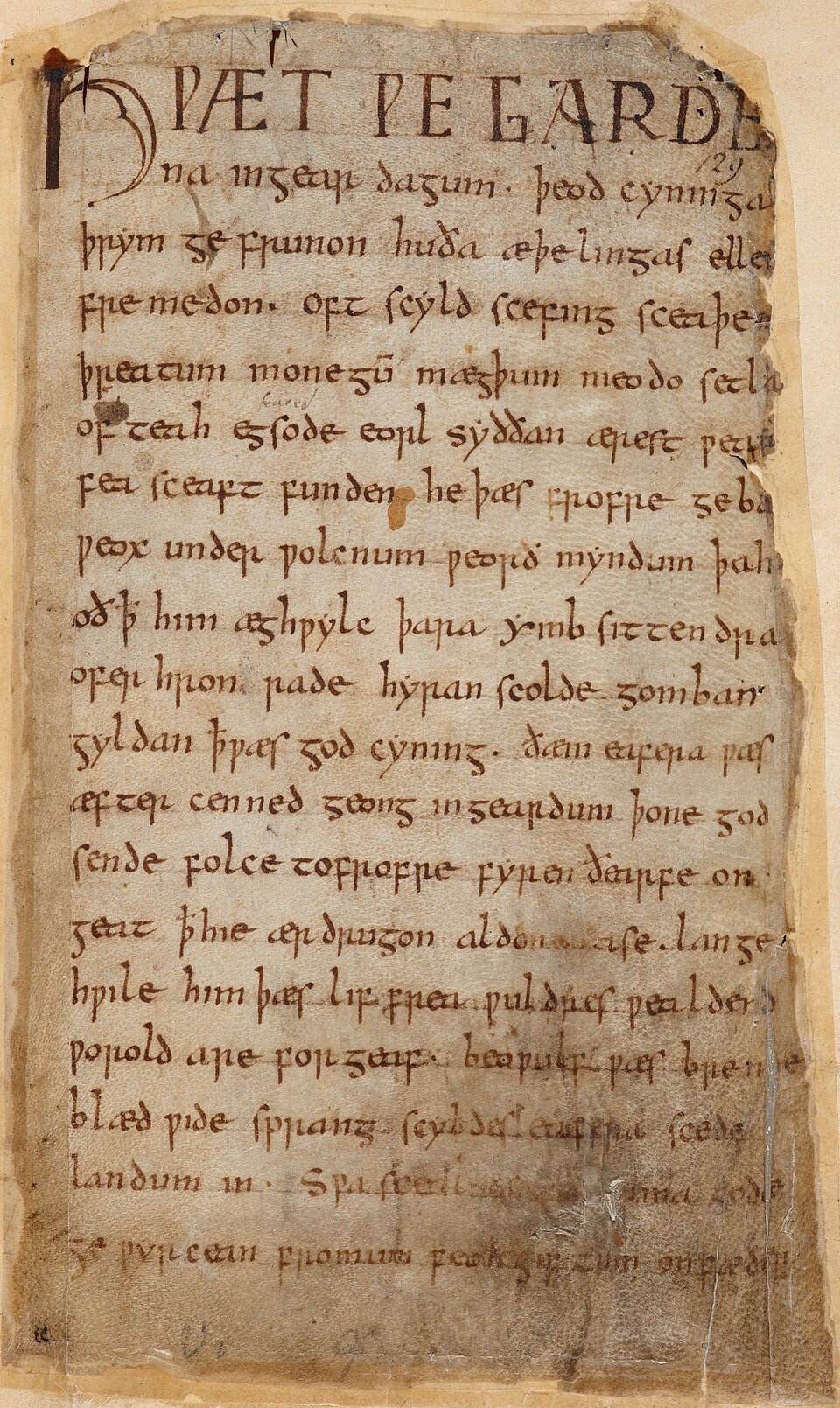
Visual AidEnglish before the layers arrived
Photograph of the first page of the Beowulf manuscript, copied by hand around the year 1000 and now in the British Library — English as it looked before the layers the Knowledge Bank describes were added. This is the Germanic base of the language; the French of the Norman Conquest and the Latin and Greek of the scholars came later, which is why the page is nearly unreadable to us now. The parchment’s scorched edges record a real fire in 1731, not age alone. The page has no connection to the Word Market — it simply shows that English really is a thing with a history, layer on layer, exactly as etymology studies it.
First page of Beowulf, Cotton MS Vitellius A XV, f. 132r, copied c. AD 1000; British Library, London. Source: Wikimedia Commons, File:Beowulf Cotton MS Vitellius A XV f. 132r.jpg, public domain.
bustlingadj.Ch.4
Full of busy, energetic activity
“The bustling market was crowded from end to end.”
marketplacen.Ch.4
A place where goods are bought and sold
“In the marketplace, whole words sat on the stalls.”
waresn.Ch.4
Goods that are offered for sale
“Each merchant shouted about his wares.”
auctionn.Ch.5
A sale where buyers offer higher and higher bids
“Rare letters were sold at a lively auction.”
quarreln.Ch.5
An angry argument between people
“A silly quarrel started the whole disaster.”
commotionn.Ch.5
Noisy, confused disturbance
“The falling stalls made a terrible commotion.”
officialn.Ch.5
A person who holds authority or office
“The self-important official blamed Milo at once.”
dungeonn.Ch.5
A dark underground prison
“Officer Shrift sent Milo to the palace dungeon.”
unabridgedadj.Ch.4
Complete, with nothing left out
“King Azaz the Unabridged loved every single word.”
synonymn.Ch.4
A word that means nearly the same as another
“Big and huge are close in meaning, so they are a synonym pair.”
ⓘ The vocabulary words in this list are selected to help you understand and complete this workbook. Some may not appear verbatim in the original novel.
🧠Knowledge Bank question
1According to the Knowledge Bank, English holds many near-synonyms with different tones, such as ‘ask’ and ‘interrogate,’ because the language ___.Ch.4
2‘Wares’ are goods that are offered for sale.Ch.4
3A ‘commotion’ is a ___.Ch.5
4Something ‘unabridged’ has had most of it cut out.Ch.4
5Fill in each blank with the correct word.Ch.5
Word choices:quarrelauctionwarescheerful- some words will not be used
A silly between the two knocked over a stall.
Rare letters were sold off at a lively .
6An ‘official’ is a person who holds ___.Ch.5
7A ‘dungeon’ is a dark underground prison.Ch.5
8A ‘synonym’ for a word is another word with nearly the same ___.Ch.4
9Fill in each blank with the correct word.Ch.4
Word choices:marketplaceunabridgedcommotionofficial- some words will not be used
In the , words sat on the stalls like fruit.
King Azaz the ruled the whole city of words.
10In the Word Market, the shoppers actually ___ the words.Ch.4
Part 2
Comprehension
Show you understood what happens in Chapters 4–5.
🧠Knowledge Bank · What the Word Market Reveals
Economics · Markets and Incentives
A market coordinates many choices by assigning goods a place, an audience, and often a price. Economists use scarcity to describe the condition that time, money, and resources are limited, so people must choose among alternatives. Dictionopolis applies this familiar system to language. Letters and words appear valuable because people seek, compare, and exchange them, but the scene also exposes a danger: owning impressive words is not the same as communicating well. The Humbug consumes attention with grand claims, while the Spelling Bee focuses intensely on accuracy. Their quarrel changes a crowded but orderly market into a chain reaction of damage. Officer Shrift then turns that disruption into a second chain: accusation, judgment, and punishment occur before Milo can explain. For comprehension, separate each character’s goal from the result. Merchants want trade, shoppers want language, the rivals want recognition, and Shrift wants a quick culprit. Those goals collide, producing effects no single character planned. Mapping motive, event, and consequence reveals how a comic scene is organized by incentives.
🧠Knowledge Bank question
1The Knowledge Bank explains that economists use ‘scarcity’ to describe the condition that ___.Ch.4
2In the Word Market, the stalls sell ___.Ch.4
3The Humbug is honest and always tells the plain truth.Ch.4
4The Spelling Bee is a bee who proudly ___ every word he uses.Ch.4
5Write the numbers 1–5 in the boxes to show the correct order of events. Number 1 = what happens first.Chapters 4–5
The Humbug and the Spelling Bee begin to quarrel.
Officer Shrift arrives and sentences Milo to the dungeon.
Milo meets the boastful Humbug and the Spelling Bee.
Their squabble knocks over a stall and the market topples.
Milo and Tock reach Dictionopolis and its Word Market.
6The market falls into chaos after the two characters quarrel.Ch.5
7Officer Shrift is a policeman who is also the ___.Ch.5
8Officer Shrift blames Milo for ___.Ch.5
9Milo is given a fair and careful trial before being jailed.Ch.5
10By the end of Part 2, Milo has been sentenced to the ___.Ch.5
Part 3
Literary Elements
Understanding HOW and WHY Norton Juster (author) tells the story across Chapters 4–5.
🧠Knowledge Bank · When Figurative Language Turns Solid
Semantics · Idioms and Verbal Ambiguity
Juster’s wordplay often begins when a figurative expression is treated as a physical fact. An idiom is a phrase whose customary meaning cannot be calculated simply from its individual words. A “half-baked idea,” for instance, normally means an incomplete plan; imagining it as unfinished food exposes both meanings at once without requiring a quotation from the novel. A pun similarly creates humor through multiple meanings or similar sounds. Dictionopolis expands this method from isolated jokes into setting: language can be displayed, sampled, bought, damaged, or consumed. The method works because readers first recognize the ordinary expression and then experience a brief collision between expectation and literal image. Character names participate too. “Humbug” labels empty or deceptive talk, while “Shrift” evokes a rushed process, so names quietly guide interpretation before actions confirm it. This technique is not random silliness. By materializing language, Juster invites readers to inspect phrases they usually use automatically. The joke becomes a small lesson in semantic flexibility and verbal ambiguity.
Pun
A joke on double meaning — in the Word Market, words and letters are literally bought, sold, and eaten.
Personification
Giving human form to an idea — the Humbug is ‘humbug’ (empty, showy talk) walking around as a boastful beetle.
Idiom
A phrase that means more than its words — the market’s ‘half-baked ideas’ are served as real half-cooked food.
🧠Knowledge Bank question
1According to the Knowledge Bank, Juster’s literal wordplay amuses readers because they experience ___.Ch.4
2Fill in each blank with the correct literary term.Ch.4
Word choices:personificationidiomsettingrhyme- some words will not be used
The Humbug, who is empty talk given a body, shows .
‘Half-baked ideas’ served as food is an taken literally.
3An idiom is a phrase whose meaning is different from its plain words.Ch.4
4The Humbug’s name, meaning empty and showy talk, makes him a ___ of nonsense.Ch.4
5When a ‘half-baked idea’ becomes real food, Juster is taking an idiom ___.Ch.4
6Through the Humbug, Juster gently mocks big words used to hide empty thinking.Ch.4
7Most of the Word Market’s comedy comes from taking language ___.Ch.4
8Fill in each blank with the correct literary term.Ch.4
Word choices:punpersonificationnarratorclimax- some words will not be used
Buying and eating words in the market is a .
The Humbug, empty talk with legs, is a .
9Puns depend on a word or phrase having more than one meaning.Ch.4
10The Spelling Bee and the Humbug mainly help Juster show off the fun of ___.Ch.4
Part 4
Think Deeper
Four deeper challenges — no single-word recall. Read, weigh the evidence, and reason it out.
🧠Knowledge Bank · Why a Fast Verdict Can Be Unfair
Civics · Justice and Due Process
Officer Shrift’s rapid judgment is funny because it exaggerates the opposite of fair procedure. In civic systems, due process means that rules must be applied through established, impartial steps before the state takes away liberty. Core protections include hearing the accusation, examining evidence, answering witnesses, and receiving judgment from a neutral decision-maker. Shrift collapses policeman, prosecutor, judge, and jailer into one figure. That concentration of roles creates a conflict of interest: the person eager to discover a crime also decides who committed it and what punishment follows. Milo’s confusion matters because fairness is not only about reaching a correct result; it is also about using a reliable method. A hasty procedure can punish the innocent even when officials believe they are maintaining order. Critical readers should distinguish legal authority from legitimacy. Shrift may possess power inside Dictionopolis, yet his speed and delight in blame undermine trust in his decision. The episode uses absurdity to pose a serious civic question: what safeguards keep authority from becoming arbitrary? The answer begins with transparent evidence and independent judgment.
Visual AidDue process in four boxes, collapsed into one
Structure diagram of the contrast the Knowledge Bank draws: the top row holds the four protections of a fair procedure, and the gray bar beneath shows Officer Shrift holding every role at once. Real legal systems involve many more steps and people than four boxes can show; the drawing ranks no country’s courts and describes no real case. Notice what disappears when the roles collapse — the person eager to find a crime is also the one who judges it, which is the conflict of interest the Knowledge Bank names.
Elements of due process as described in standard introductions to civics and the law of criminal procedure. Drawn for Garden Heights Academy.
Imagine a marketplace where the fruit stalls are piled not with apples but with words — short cheap ones by the bushel, long expensive ones under glass — and shoppers wander through tasting a syllable here, buying a sentence there. Among them struts a large beetle who talks grandly and constantly and means almost nothing by any of it, and a giant bee who cannot say a word without spelling it out first. The two of them get to bickering, an elbow knocks a stall, and in a heartbeat the whole glittering market of language crashes down in a heap. Out of the dust marches a policeman no taller than a thumb, thrilled to have a crime at last, who names the visiting boy the guilty party and, before Milo can explain, sends him down millions of years into the dark.
Original passage written for Garden Heights — not a quotation from the novel.
1Claim: “Part 2 uses the Word Market to argue that words are valuable and that using them carelessly causes trouble.” — choose the two details that best prove it.Claim & Evidence
2Careless, empty use of words, or Careful, valuable use of words? Tap each detail to sort it — tap again to switch sides. You can keep tapping to change your answer.Sort into two
◄ Careless, empty use of wordsCareful, valuable use of words ►
3Match each cause to its result. For each cause, pick its result.Cause & Effect
Words are sold in a market→
The Humbug boasts and blusters→
The two characters quarrel→
Officer Shrift finds a suspect→
🧠Knowledge Bank question
4Fill both blanks to complete the reasoning.Build the Argument
The Knowledge Bank warns that Officer Shrift’s justice is unfair because , which shows that .
Part 5
Standardized Test
Reading passage · Where Words Come From: Etymology and Synonyms · SAT & TOEFL-style practice
Read the passage — the highlighted words are tested — then answer. Tap an answer, then tap it again to confirm.
SATCentral Ideas — the passage's main point
SATDetail — a fact stated in the passage
SATWords in Context — a word's meaning in this passage
SATText Connections — how two parts of the text relate
TOEFLFactual Information — a fact stated in the passage
TOEFLVocabulary — a tested word's meaning here
TOEFLProse Summary — the three sentences that sum it up
Word Roots and Etymology
In the Word Market, words are sold like fruit, and merchants shout about their wares as if syllables were goods. The joke rests on a real truth: every word has a history. The study of where words come from and how their meanings change over time is called etymology. English is a great borrower, taking in words from Latin, Greek, French, Old English, and dozens of other languages. An unabridged dictionary — the kind that leaves nothing out — records them all: ‘dictionary’ grows from a Latin root meaning ‘to say,’ and ‘alphabet’ is simply the first two Greek letters, alpha and beta, joined together.
Knowing a word’s roots is more than a curiosity; it is a key that unlocks whole families of words at once. Many English words are built from small, repeated roots that carry a core meaning. Take the Latin root ‘port,’ which means to carry: once you know it, you can hear it working inside portable, import, export, and transport. A reader who learns to spot these roots can often guess a word never seen before.
English is also unusually rich in synonyms — different words that mean nearly, but not exactly, the same thing. Consider big, large, huge, enormous, and gigantic; all point in the same direction, yet each carries its own faint shade, so ‘huge’ feels heavier than ‘big.’ Choosing the right word is a real skill, and it is the very skill the Humbug lacks, for he pours out impressive words meaning almost nothing. The Word Market teaches the opposite lesson: a person who truly knows words — where they come from and how they differ — is rich in a way that matters, able to say exactly what they mean.
Original passage written for Garden Heights — not a quotation from the novel.
1What is the passage mainly about?SAT · Central Ideas
2The study of where words come from is called ___.TOEFL · Factual Information
3English has borrowed words from ___.SAT · Detail
4The Latin root ‘port’ means to ___.TOEFL · Factual Information
5Knowing a root can help a reader guess the meaning of a word that is ___.SAT · Detail
6Synonyms are words that mean ___ the same thing.TOEFL · Factual Information
7In the passage, wares most nearly means ___.SAT · Words in Context
8In the passage, unabridged most nearly means ___.TOEFL · Vocabulary
9Prose Summary (TOEFL).This passage explains where words come from and why word choice matters. This TOEFL task lists six sentences; choose the THREE that best capture the passage’s main ideas. The other three do not belong — they state minor details or ideas the passage does not present.TOEFL · Prose Summary
10Which idea from Part 2 does this passage BEST explain?SAT · Text Connections
Part 6 · Optional
Creative Writing
A bonus challenge to practice your English. Take your time and have fun with it.
About This Section
This writing task is optional and is not part of your auto-graded score. The feedback below checks only the basics — length, spelling, and grammar — not whether your ideas are right or wrong. It is meant for classroom discussion and creative practice, so feel free to use your imagination!
Writing Task — Part 2 “A Word Worth Knowing”
In Dictionopolis, words are treasures worth buying. Write about a word you love or find interesting — maybe one that sounds wonderful, or one whose meaning surprised you. What is the word, what does it mean, and why does it matter to you? 6–10 sentences. End with a sentence that uses the word just right.
You can start with: “There is one word I keep coming back to...”
0 / 40 words minimum
🗣 Teach It · Just for Fun (optional)
No right or wrong — close the screen and tell someone nearby what happened in this part. Can’t find anyone? Tell yourself out loud. The moment you teach it, you truly understand it.
Part 2 Complete!
You finished Chapters 4–5 of The Phantom Tollbooth.
Here are your auto-graded results:
-
points out of 100
Teach it to someone
The best last step is to teach it. In your own words, explain what happened — retell a favorite scene, teach a character’s big choice, or sum up the main idea for a parent, friend, or classmate. When you can teach it clearly, you truly own it.
Independent study guide by Garden Heights. Not affiliated with or endorsed by Norton Juster. Contains original analysis only; no text from the novel is reproduced. Reference text: This workbook follows Norton Juster’s classic text (the standard Puffin edition sold worldwide). Revised 2023 UK editions change some wording and may not match the vocabulary studied here.
SAT® is a registered trademark of College Board, which is not affiliated with, and does not endorse, these materials. TOEFL® is a registered trademark of ETS. These materials are not endorsed or approved by ETS. Garden Heights is an independent provider of test-style reading practice.