New here? Just sign up with Google — your account includes Matilda, our gift book, forever.
The Phantom Tollbooth · Garden Heights
Part 4
for The Phantom Tollbooth · Part 4 · Chapters 9–11
8 Parts40 min
What Happens in Part 4
On the road Milo learns about point of view from Alec Bings, wrecks Chroma's color orchestra, and meets noisy Dr. Dischord.
Alec BingsOn the road, Milo meets characters who each teach him how we see the world. First is Alec Bings, a boy who floats in the air because everyone in his family is born at their adult height and grows down toward the ground. He can see straight through things yet often misses what is right in front of him, and he shows Milo that the same scene looks different depending on your point of view.
Chroma's silent orchestraNext they meet a fellow who turns out to be the Giant, the Midget, the Fat Man, and the Thin Man all at once — the same average person seen from four points of view. Then they arrive at the sunset kingdom of Chroma the Great, who conducts a silent orchestra whose music is not sound but color: each morning his players paint the sunrise, each evening the sunset, filling the world with all its hues.
Chaos and dinMilo waits until Chroma sleeps and tries to conduct the orchestra — but he bungles the baton, throwing the colors into chaos and making days and nights flash past in seconds until he stops the tangle. Escaping onward, the travelers run into Dr. Dischord and his companion the awful DYNNE, who manufacture and bottle horrible noises, filling the once-quiet air with crashes, screeches, and din.
What We Will Learn
Section
What you will practice
Vocabulary
Words of seeing and sound: perspective, vantage, conduct, illusion, deafening…
Literary Elements
Point of view, personified color and noise, and vivid imagery
Cross-Curricular
Point of view and perception — and how we actually see color and light
Chapter Summary
Ch.
What happens
Chapters 9–10
Points of View — Milo meets Alec Bings, who grows downward and sees through things, and the man who is Giant, Midget, Fat, and Thin at once — all lessons in perspective.
Chapter 11
Color and Noise — at Chroma’s kingdom Milo conducts the color orchestra and throws it into chaos; then Dr. Dischord and the DYNNE fill the air with terrible sounds.
Part 1
Vocabulary
Study 10 key words from Chapters 9–11, then answer each question.
🧠Knowledge Bank · How Viewpoint Changes What We Notice
Optics and Perception
Alec Bings helps Milo discover that seeing is not the same as understanding. A vantage is the position from which a person observes something, while perspective is the way that position shapes what the observer thinks. Alec can look through solid objects, yet this unusual vision does not guarantee that he notices what is directly before him. The many-sized figure makes the same lesson concrete: Giant, Midget, Fat Man, and Thin Man are not four separate beings but four descriptions of one ordinary person. Each label depends on comparison. Even the word average changes meaning when the observer chooses a different group or scale. These encounters prepare Milo to question first impressions rather than treating one view as complete. A reader can apply the idea by asking who is observing, what that observer can see, and what may remain hidden. Juster turns an abstract reading skill into a comic journey: evidence stays the same, but its meaning shifts with the observer’s perspective.
Visual AidGiant, midget — the same man
Measure diagram of the many-sized man the Knowledge Bank explains: three bars on one baseline, and the teal bar — the man himself — is the same height in every comparison. Next to the tiny folk he is called a giant; next to the huge folk, a midget. The crowds are drawn as plain bars because their looks do not matter, only their heights. The drawing measures nothing real — the man is Norton Juster (author)’s joke — but the mechanism is exact: the evidence never changes, and the label comes entirely from the comparison group the observer picks.
Relative judgment of size as described in the Knowledge Bank; the four-in-one man appears in The Phantom Tollbooth, Chapter 9. Drawn for Garden Heights Academy.
perspectiven.Ch.9
The particular way a person sees or thinks about things
“From Alec’s perspective, the world looked upside down to everyone else.”
vantagen.Ch.9
A position that gives a clear or wide view
“From that high vantage, Milo could see for miles.”
conductv.Ch.10
To direct a group of musicians
“Chroma would conduct his orchestra at dawn.”
orchestran.Ch.10
A large group of musicians who play together
“The color orchestra filled the sky with hues.”
batonn.Ch.10
The slim stick a conductor uses to lead
“Milo lifted the baton and the colors obeyed.”
symphonyn.Ch.10
A long musical work for a full orchestra
“Each sunset was a silent symphony of color.”
blundern.Ch.10
A careless, foolish mistake
“Milo’s blunder sent the colors flashing wildly.”
illusionn.Ch.9
Something that fools the senses
“What looked solid was only an illusion of the eye.”
deafeningadj.Ch.11
So loud it seems to overwhelm the ears
“The DYNNE’s deafening racket filled the road.”
duskn.Ch.10
The darker part of twilight
“At dusk the orchestra painted the sky in reds.”
ⓘ The vocabulary words in this list are selected to help you understand and complete this workbook. Some may not appear verbatim in the original novel.
🧠Knowledge Bank question
1The Knowledge Bank explains that a "vantage" is the position an observer looks from, while "perspective" is ___.Ch.9
2A ‘vantage’ is a position that gives a clear view.Ch.9
3To ‘conduct’ an orchestra is to ___ it.Ch.10
4A ‘blunder’ is a careful, wise choice.Ch.10
5Fill in each blank with the correct word.Ch.10
Word choices:batonorchestravantagecheerful- some words will not be used
Milo raised the to lead the players.
Chroma’s color painted the whole sky.
6An ‘illusion’ is something that ___ the senses.Ch.9
7‘Deafening’ means extremely loud.Ch.11
8A ‘symphony’ is a long musical work for a full ___.Ch.10
9Fill in each blank with the correct word.Ch.9
Word choices:perspectiveillusionduskbaton- some words will not be used
From Alec’s , everyone else stood on their heads.
What looked solid was really an .
10At ‘dusk,’ the darker part of ___, the orchestra painted the sunset.Ch.10
Part 2
Comprehension
Show you understood what happens in Chapters 9–11.
🧠Knowledge Bank · Chroma’s Orchestra and the Work Behind Color
Color Science
Chroma’s orchestra imagines color as a coordinated performance. In real life, visible light includes different wavelengths, which human eyes interpret as colors. A hue names a color family, such as red or blue, while intensity describes how strong or bright it appears. The episode does not offer a scientific model of sunrise; instead, it makes an invisible process feel organized and deliberate. Chroma’s careful conducting suggests that a beautiful pattern depends on timing, sequence, and cooperation. Milo notices the finished display but initially underestimates the knowledge required to produce it. When he takes the baton, colors arrive at the wrong moments and whole days seem to tumble past. The resulting confusion reveals an important cause-and-effect chain: curiosity leads to action, action without preparation disrupts the system, and disruption teaches respect for expertise. The scene therefore joins wonder with responsibility. Nature may appear effortless to an observer, but Juster’s fantasy asks readers to imagine the hidden order behind every changing pattern.
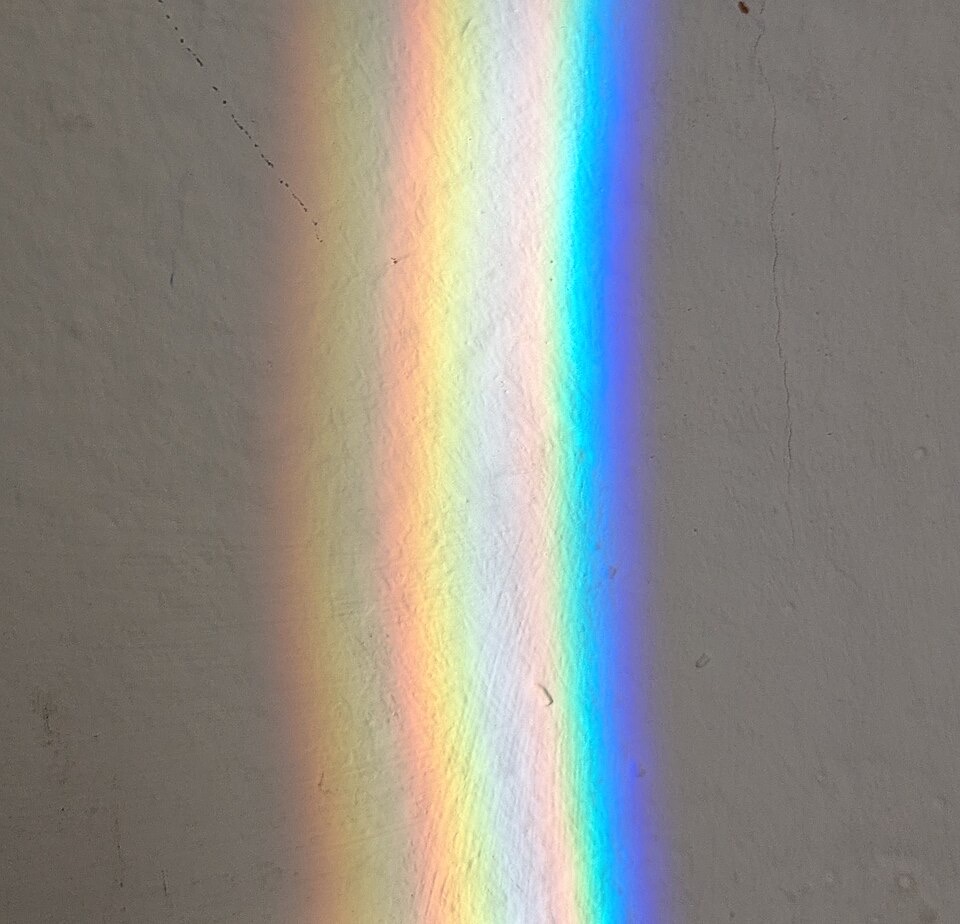
Visual AidThe colors hiding inside white light
Photograph of sunlight after it has passed through a prism: the wavelengths the Knowledge Bank describes, spread across a plaster wall from red to violet. Every one of these colors was inside the white beam all along — the glass only bends each wavelength by a different amount, so they land apart. This is the real, silent physics behind Chroma’s orchestra; no conductor arranges it, and the picture makes no claim that sunrises are performed. Notice that the band has no sharp edges: one hue — a color family — slides into the next without a border.
Visible spectrum cast on a wall by sunlight dispersed through a prism; photograph by Aligatorigiganti, 2025. Source: Wikimedia Commons, File:Dispersion of White Light Through a Prism.jpg, CC0.
🧠Knowledge Bank question
1According to the Knowledge Bank, "intensity" describes ___.Ch.9
2Alec mainly teaches Milo a lesson about ___.Ch.9
3The Giant, Midget, Fat Man, and Thin Man turn out to be four different people.Ch.9
4Chroma the Great conducts an orchestra whose music is really ___.Ch.10
5Write the numbers 1–5 in the boxes to show the correct order of events. Number 1 = what happens first.Chapters 9–11
Milo conducts the orchestra and throws the colors into chaos.
The travelers reach Chroma’s kingdom of color.
Dr. Dischord and the DYNNE fill the air with terrible noise.
Milo meets Alec Bings, who grows down from the air.
He meets the man who is Giant, Midget, Fat, and Thin at once.
6Milo conducts Chroma’s orchestra perfectly on his first try.Ch.11
7When Milo bungles the baton, the days and nights ___.Ch.11
8Dr. Dischord and the DYNNE are happiest when they ___.Ch.11
9Alec Bings can see through solid things but sometimes misses what is right in front of him.Ch.9
10The characters in Part 4 mostly teach Milo about how we ___ the world.Ch.9
Part 3
Literary Elements
Understanding HOW and WHY Norton Juster (author) tells the story across Chapters 9–11.
🧠Knowledge Bank · Painting Music with Light
Sensory Imagery
Juster builds Chroma’s performance through imagery, language that helps readers imagine sensory experience. The orchestra is silent, yet its music appears as bands and bursts of color across the sky. This crossing of senses resembles synesthesia, a technique in which one kind of sensation is described through another. Color behaves like melody, the baton controls time like rhythm, and the sky becomes a stage. The comparison also creates an extended metaphor: many details develop the idea that natural color is a musical composition. Soon afterward, Dr. Dischord and the DYNNE reverse the effect. Instead of silent beauty, they produce harsh noise, creating a strong contrast between harmony and disorder. These neighboring scenes encourage readers to compare kinds of sensory experience rather than merely list events. Chroma organizes differences into a meaningful whole; Dischord prizes disturbance for its own sake. Through personified ideas and mixed senses, the journey makes an artistic claim: perception becomes richer when the mind recognizes relationships among sound, sight, movement, and harmony.
Point of view
The position from which we see and judge — Alec Bings shows that the same scene changes with where you stand.
Personification
Giving human form to an idea — the DYNNE is harsh noise (a pun on ‘din’) turned into a creature.
Imagery
Language that appeals to the senses — Chroma’s painted sunrises and Milo’s flashing color chaos.
🧠Knowledge Bank question
1The Knowledge Bank explains that "synesthesia" is a technique in which ___.Ch.9
2Fill in each blank with the correct literary term.Ch.11
Word choices:personificationimagerysettingrhyme- some words will not be used
The DYNNE, who is noise given a body, shows .
Chroma’s painted sunsets are vivid .
3Point of view is the position from which a person sees and judges things.Ch.9
4Turning harsh noise into the creature called the DYNNE is ___.Ch.11
5Chroma’s vividly painted sunrises appeal to the reader’s senses, which is ___.Ch.10
6The DYNNE’s name is a play on the word ‘din,’ meaning harsh noise.Ch.11
7The four-in-one man makes Juster’s point that no single ___ shows the whole truth.Ch.9
8Fill in each blank with the correct literary term.Ch.9
Word choices:point of viewimagerynarratorclimax- some words will not be used
Alec Bings teaches Milo about .
Chroma’s glowing sunsets are rich .
9Imagery uses language that appeals to the senses.Ch.10
10Alec and the four-in-one man both teach that to understand something you should ___.Ch.9
Part 4
Think Deeper
Four deeper challenges — no single-word recall. Read, weigh the evidence, and reason it out.
🧠Knowledge Bank · Curiosity Needs Preparation
Ethics of Expertise
Milo’s attempt to conduct the color orchestra begins with genuine admiration, not harmful intent. Nevertheless, good intentions do not erase the effects of an unprepared choice. Chroma’s work requires expertise, the trained knowledge that allows someone to manage a difficult system. Milo has watched the conductor, but observation alone has not given him the necessary judgment. His mistake exposes a common thinking error: a polished result can make skilled work look easy. Once he controls the baton, the scale of his responsibility becomes clear because every motion affects the entire sky. Readers can evaluate his decision by separating motive, readiness, and consequence. His motive is curiosity; his readiness is low; his consequence is widespread confusion. The lesson is not that children should avoid experimenting. It is that responsible experiments need limits, guidance, and awareness of who or what may be affected. Milo gains something more valuable than embarrassment: he learns to respect the labor hidden inside beauty. Mature curiosity asks not only “Can I try?” but also whether I am prepared to act with care.
Picture a boy standing beside another boy who floats in midair, insisting that his own upside-down way of seeing is perfectly ordinary and everyone else is strange. A little further on, a small polite fellow explains that he is, at the very same moment, a giant and a midget and a fat man and a thin man, depending only on who is doing the looking. Then the road opens into a kingdom where color is not simply there but has to be played each dawn and dusk, like music, by a huge silent orchestra with a conductor waving his baton at the sky. The boy cannot resist; he waits for the conductor to nod off, snatches up the baton, and instantly the sunsets and sunrises go tumbling over one another, days and nights blinking past like a broken clock, until he drops his arms in a panic and the world holds still again.
Original passage written for Garden Heights — not a quotation from the novel.
1Claim: “Part 4 argues that what we notice about the world depends on our point of view.” — choose the two details that best prove it.Claim & Evidence
2A lesson about how we see (point of view), or A lesson about sound and its opposite? Tap each detail to sort it — tap again to switch sides. You can keep tapping to change your answer.Sort into two
◄ A lesson about how we see (point of view)A lesson about sound and its opposite ►
3Match each cause to its result. For each cause, pick its result.Cause & Effect
Alec grows down from the air→
The four-in-one man appears→
Milo grabs Chroma’s baton→
Dr. Dischord meets the travelers→
🧠Knowledge Bank question
4Fill both blanks to complete the reasoning.Build the Argument
According to the Knowledge Bank, watching Chroma could not prepare Milo because , which shows that .
Part 5
Standardized Test
Reading passage · Point of View, and How We See Color · SAT & TOEFL-style practice
Read the passage — the highlighted words are tested — then answer. Tap an answer, then tap it again to confirm.
SATCentral Ideas — the passage's main point
SATDetail — a fact stated in the passage
SATWords in Context — a word's meaning in this passage
TOEFLFactual Information — a fact stated in the passage
TOEFLVocabulary — a tested word's meaning here
TOEFLRhetorical Purpose — why the author included a detail
TOEFLInsert Text — where a sentence best fits
Point of View and Color
Part 4 is full of characters who see the world differently — a lesson in point of view, the position from which a person looks at things. Alec Bings grows downward from the air and is certain his way of seeing is the only correct one, while a man who seems a giant to some and a midget to others is really average, changed by who looks. The same scene changes with your vantage, the spot you look from, so understanding anything means seeing it from more than one side.
Juster plays with a second kind of seeing in Chroma's kingdom, where color is conducted each day like music. This fantasy points at a truth: color is not fixed inside objects but is made by light, for white sunlight is really a blend of every color. When light strikes an object, the object absorbs some colors and reflects others back, and the bounced-back ones are what we see. A ripe tomato looks red because it reflects red light and soaks up the rest; grass looks green because it reflects green. Change the light, and the color changes with it.
Our eyes complete the process. Special cells at the back of the eye catch the reflected light, and the brain turns those signals into what we call color. That is why, with the light out, the world does not just darken but loses color entirely, fading to gray with nothing to reflect. Juster captures this by replaying color each morning and at dusk, as daylight fades. When Milo seizes the baton and the hues tumble into chaos, he discovers that the order of light and sight is a daily masterpiece, one that looks effortless until you run it yourself.
Original passage written for Garden Heights — not a quotation from the novel.
1What is the passage mainly about?SAT · Central Ideas
2‘Point of view’ is the ___ from which a person looks at things.TOEFL · Factual Information
3Alec Bings is certain that his way of seeing is the ___ one.SAT · Detail
4Color, the passage says, is really made by ___.TOEFL · Factual Information
5White sunlight is really a blend of ___ color.SAT · Detail
6A ripe tomato looks red because it reflects red light and ___ the rest.TOEFL · Factual Information
7In the passage, vantage most nearly means ___.SAT · Words in Context
8In the passage, dusk most nearly means ___.TOEFL · Vocabulary
9By making color a daily performance, Juster shows that the world of light is ___.TOEFL · Rhetorical Purpose
10Insert Text (TOEFL). Look at the four squares [1]–[4] in the passage excerpt below. They show where the following sentence could be added: “In other words, the color we see is really the light an object refuses to keep.”
[1] A ripe tomato looks red because it reflects red light and soaks up the rest; grass looks green because it reflects green. [2] Change the light, and the color changes with it. [3] Our eyes complete the process. [4]
Where would the sentence fit best?TOEFL · Insert Text
Part 6 · Optional
Creative Writing
A bonus challenge to practice your English. Take your time and have fun with it.
About This Section
This writing task is optional and is not part of your auto-graded score. The feedback below checks only the basics — length, spelling, and grammar — not whether your ideas are right or wrong. It is meant for classroom discussion and creative practice, so feel free to use your imagination!
Writing Task — Part 4 “From Where I Stand”
Alec Bings shows that the same thing looks different depending on your point of view. Write about a time you saw something one way and someone else saw it completely differently — an argument, an event, or even a picture. What did each of you see, and did looking from the other side change anything? 6–10 sentences. End with what you learned about point of view.
You can start with: “We were looking at the very same thing, and yet...”
0 / 40 words minimum
🗣 Teach It · Just for Fun (optional)
No right or wrong — close the screen and tell someone nearby what happened in this part. Can’t find anyone? Tell yourself out loud. The moment you teach it, you truly understand it.
Part 4 Complete!
You finished Chapters 9–11 of The Phantom Tollbooth.
Here are your auto-graded results:
-
points out of 100
Teach it to someone
The best last step is to teach it. In your own words, explain what happened — retell a favorite scene, teach a character’s big choice, or sum up the main idea for a parent, friend, or classmate. When you can teach it clearly, you truly own it.
Independent study guide by Garden Heights. Not affiliated with or endorsed by Norton Juster. Contains original analysis only; no text from the novel is reproduced. Reference text: This workbook follows Norton Juster’s classic text (the standard Puffin edition sold worldwide). Revised 2023 UK editions change some wording and may not match the vocabulary studied here.
SAT® is a registered trademark of College Board, which is not affiliated with, and does not endorse, these materials. TOEFL® is a registered trademark of ETS. These materials are not endorsed or approved by ETS. Garden Heights is an independent provider of test-style reading practice.