New here? Just sign up with Google — your account includes Matilda, our gift book, forever.
The Phantom Tollbooth · Garden Heights
Part 6
for The Phantom Tollbooth · Part 6 · Chapters 14–16
8 Parts40 min
What Happens in Part 6
The Dodecahedron leads Milo to Digitopolis, where the Mathemagician shows number wonders and is tricked into blessing the rescue.
The number mineThe travelers journey toward Digitopolis, the kingdom of numbers, guided by the Dodecahedron, a genial fellow with twelve faces — one for each mood — whose shape is a solid with twelve sides. He leads them down into the number mine, a glittering cavern where numbers are dug from the rock like jewels and broken bits of number are swept up as fractions.
Wonders of numbersThere they meet the Mathemagician, King Azaz's equally stubborn brother, who rules Digitopolis with a staff shaped like a giant pencil and insists numbers matter more than words. He shows Milo wonders: he leads him toward infinity, the number that never ends no matter how long you count, and reveals that the biggest number is always one more than whatever you name, the smallest always half of whatever tiny amount you have.
Trapped by logicOver a meal of subtraction stew — the more you eat, the hungrier you become — Milo works out a trick. Knowing the two brothers disagree about everything, he gets the Mathemagician to admit that rescuing the princesses is impossible; then, since Azaz already approved the quest and the brothers never agree, the Mathemagician is trapped by his own logic into allowing it too. Outwitted and amused, he gives Milo his blessing, and the quest goes on.
What We Will Learn
Section
What you will practice
Vocabulary
Words of number: digit, infinity, average, precise, fraction…
Literary Elements
The many-faced Dodecahedron (personification), number puns, and hyperbole
Cross-Curricular
Infinity and the very large and very small — the reach of numbers
Chapter Summary
Ch.
What happens
Chapters 14–15
Into the Number Mine — the twelve-faced Dodecahedron leads Milo into Digitopolis, where numbers are mined like jewels and the Mathemagician shows him infinity and the biggest and smallest numbers.
Chapter 16
Subtraction Stew and a Trick — over a meal that leaves him hungrier, Milo cleverly traps the Mathemagician, who always disagrees with Azaz, into allowing the ‘impossible’ rescue.
Part 1
Vocabulary
Study 10 key words from Chapters 14–16, then answer each question.
🧠Knowledge Bank · Twelve Faces, Fractions, and Infinity
Geometry and Number
Digitopolis gives mathematical ideas physical form. The Dodecahedron is named for a solid with twelve flat faces; “dodeca” refers to twelve, and “hedron” refers to a surface or face. In the number mine, whole numbers appear like valuable stones, while broken pieces become fractions, numbers that describe equal parts of a whole. The Mathemagician then challenges Milo with infinity. Infinity is not an ordinary largest number waiting at the end of counting. No matter what finite whole number someone names, adding one produces a larger number. Likewise, between zero and any positive amount, another smaller positive fraction can be found by dividing again. These patterns explain why the Mathemagician’s demonstrations never arrive at a final greatest or smallest positive value. Juster turns difficult concepts into places, objects, and jokes so readers can picture relationships before formalizing them. The fantasy is playful, but the underlying reasoning is precise: numbers form patterns that continue beyond any single example. Milo’s visit encourages mathematical curiosity by presenting abstraction as an open-ended landscape of possibility.
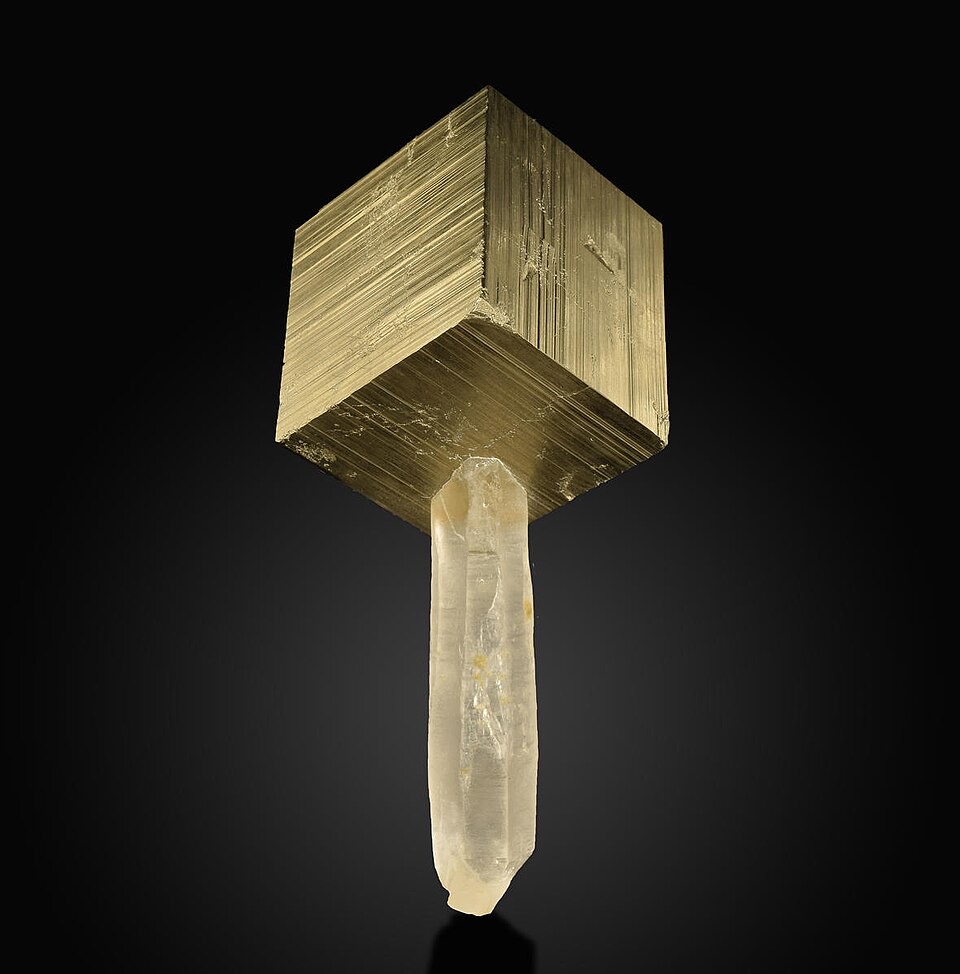
Visual AidGeometry that grows out of rock
Photograph of a pyrite crystal on quartz, from the U.S. Geological Survey — a real mineral that grew as an almost perfect cube, no cutting involved. Digitopolis mines numbers like gems, and this specimen shows the true fact under the joke this Knowledge Bank builds on: mathematical shapes really do come out of rock, because pyrite’s atoms stack in strict cubic order; the same internal rule can also yield a twelve-faced form related to the Dodecahedron’s namesake solid. Miners call pyrite fool’s gold — it glitters but is iron, not treasure. The fine parallel lines on each face are natural growth striations, not tool marks.
Pyrite cube on a quartz crystal, Spruce Claim, Washington; photograph by Carlin Green, U.S. Geological Survey. Source: Wikimedia Commons, File:Pyrite and quartz (USGS).JPG, public domain.
digitn.Ch.14
Any single number from zero to nine
“In the mine, each digit was dug out like a jewel.”
dodecahedronn.Ch.14
A solid shape with twelve flat faces
“Their guide was a dodecahedron with a face for every mood.”
infinityn.Ch.15
A quantity or amount that never ends
“The Mathemagician led Milo toward infinity itself.”
averagen.Ch.14
A number found by evening out several others
“The average child, he joked, had an odd number of parts.”
quantityn.Ch.15
An amount or number of something
“No quantity was too large for the number mine.”
preciseadj.Ch.15
Exact and free from error
“The Mathemagician demanded precise answers.”
fractionn.Ch.15
A part of a whole number
“Broken bits of number were swept up as each fraction.”
dwindlev.Ch.15
To grow steadily smaller
“The smallest number seemed to dwindle without end.”
stewn.Ch.16
A dish of food slowly cooked together
“The subtraction stew left Milo hungrier with every bite.”
contradictv.Ch.16
To say or claim the opposite
“The Mathemagician would always contradict his brother.”
ⓘ The vocabulary words in this list are selected to help you understand and complete this workbook. Some may not appear verbatim in the original novel.
🧠Knowledge Bank question
1The Knowledge Bank explains that infinity is not an ordinary largest number waiting at the end of counting. Why not?Ch.14
2‘Infinity’ is a quantity that never ends.Ch.15
3A ‘fraction’ is a ___ of a whole number.Ch.15
4‘Precise’ means rough and full of errors.Ch.15
5Fill in each blank with the correct word.Ch.14
Word choices:dodecahedronaveragestewcheerful- some words will not be used
Their guide was a with twelve faces.
The is found by evening out several numbers.
6To ‘dwindle’ is to grow steadily ___.Ch.15
7To ‘contradict’ someone is to say the opposite.Ch.16
8A ‘quantity’ is an ___ of something.Ch.15
9Fill in each blank with the correct word.Ch.15
Word choices:infinityfractionprecisedigit- some words will not be used
The count toward could never be finished.
The Mathemagician demanded a answer every time.
10The ‘subtraction stew’ is strange because the more you eat, the ___ you feel.Ch.16
Part 2
Comprehension
Show you understood what happens in Chapters 14–16.
🧠Knowledge Bank · Milo Uses the Brothers’ Disagreement
Logic
Milo gains the Mathemagician’s permission through reasoning rather than force. He already knows two important premises: King Azaz has approved the rescue, and the brothers insist on disagreeing with each other. Milo then invites the Mathemagician to declare that the quest cannot succeed. That statement creates a problem for the ruler’s usual position. If he agrees with Azaz that the journey should proceed, he breaks their pattern of opposition; if he maintains the opposition, Milo can treat that difference as support for continuing. Milo’s tactic is clever because it uses the Mathemagician’s own assumption as a constraint. However, the argument is more playful than formally conclusive: disagreement about whether a task is possible does not automatically equal permission to attempt it. Readers should therefore distinguish a persuasive trap from a mathematical proof. The Mathemagician recognizes the wit and chooses to give his blessing. The scene reveals Milo’s growth since the Doldrums. He now listens closely, remembers prior evidence, anticipates another person’s response, and adapts language to solve a problem through reasoning.
Visual AidTwo premises, no way out
Structure diagram of the argument the Knowledge Bank takes apart: from two premises — Azaz has approved the quest, and the brothers never agree — Milo builds a move that wins either way the Mathemagician answers. The drawing simplifies a long, funny conversation into five panels and leaves out every number trick along the way. It also repeats the Knowledge Bank’s caution: this is a persuasive trap, not a proof, since disagreeing about a task is not the same as permitting it. Notice which skills the trap actually uses — listening, memory of prior evidence, and anticipating another mind.
Milo’s argument as told in The Phantom Tollbooth, Chapters 14–16; the persuasive-trap reading follows the Knowledge Bank. Drawn for Garden Heights Academy.
🧠Knowledge Bank question
1According to the Knowledge Bank, why is Milo's argument a persuasive trap rather than a mathematical proof?Ch.14
2In Digitopolis, numbers are ___ out of the rock like jewels.Ch.14
3The Mathemagician believes words are more important than numbers.Ch.15
4The biggest number, the Mathemagician says, is always ___ than whatever you name.Ch.15
5Write the numbers 1–5 in the boxes to show the correct order of events. Number 1 = what happens first.Chapters 14–16
Milo tricks the Mathemagician into allowing the rescue.
The Mathemagician shows Milo infinity and the biggest number.
Milo eats subtraction stew and grows hungrier.
They descend into the glittering number mine.
The Dodecahedron guides the travelers toward Digitopolis.
6The Mathemagician rules Digitopolis with a staff shaped like a giant pencil.Ch.15
7Milo’s trick works because the two brothers always ___.Ch.16
8Milo first gets the Mathemagician to admit that rescuing the princesses is ___.Ch.16
9The Mathemagician is angry and refuses to help after being tricked.Ch.16
10By the end of Part 6, both kings have now ___ the quest.Ch.16
Part 3
Literary Elements
Understanding HOW and WHY Norton Juster (author) tells the story across Chapters 14–16.
🧠Knowledge Bank · When Arithmetic Becomes Adventure
Mathematical Wordplay
Digitopolis depends on wordplay that converts mathematical expressions into literal events. A number mine treats numbers as if they were minerals extracted from rock. Broken numbers become fractions, and a meal based on subtraction leaves diners with less satisfaction as they consume more. These inventions are examples of literalization: an author takes a figurative phrase or abstract operation and imagines it happening physically. The effect is humorous because readers recognize both meanings at once. Juster also uses personification by giving mathematics a ruler, workers, customs, and a landscape. The Mathemagician’s pencil-shaped staff joins writing and calculation visually, even while he argues that numbers outrank words. This irony quietly weakens his claim because the mathematical kingdom still needs names, explanations, and conversation. The episode’s structure mirrors the earlier visit to Dictionopolis, encouraging comparison between the brothers and their domains. Neither realm is presented as complete by itself. By making equations edible, mineable, and debatable, Juster transforms abstraction into comic action while showing that mathematical ideas become memorable through imaginative language.
Personification
The Dodecahedron — a twelve-faced solid — is given a body and a face for every mood.
Pun
Number jokes built on double meaning — ‘subtraction stew’ that leaves you with less than you began.
Hyperbole
Extreme exaggeration — endless numbers and impossible boasts that turn out to be mathematically true.
🧠Knowledge Bank question
1The Knowledge Bank explains that Digitopolis depends on literalization. What does an author do when using literalization?Ch.14
2Fill in each blank with the correct literary term.Ch.16
Word choices:hyperbolepersonificationsettingrhyme- some words will not be used
The endless, impossible boasts are .
The many-faced Dodecahedron is a .
3Hyperbole is deliberate, extreme exaggeration used for effect.Ch.15
4‘Subtraction stew’ that leaves you with less is a number ___.Ch.16
5The Mathemagician’s wildest boasts are clever because they are actually ___.Ch.15
6Personification gives human traits to something that is not human.Ch.14
7By using tall-tale exaggeration, Juster smuggles in real ___.Ch.15
8Fill in each blank with the correct literary term.Ch.14
Word choices:personificationhyperbolenarratorclimax- some words will not be used
The twelve-faced guide is a .
The claim of a never-ending number is .
9A pun plays on more than one meaning of a word or idea.Ch.16
10The many-faced Dodecahedron is also a sly hint that numbers can be made to show whatever ___ someone wants.Ch.14
Part 4
Think Deeper
Four deeper challenges — no single-word recall. Read, weigh the evidence, and reason it out.
🧠Knowledge Bank · Why Words and Numbers Need Each Other
Interdisciplinary Learning
The conflict between Azaz and the Mathemagician asks readers to question false either-or choices. Words help people define problems, explain evidence, and communicate conclusions. Numbers help them measure, compare, test patterns, and judge scale. A scientific report, for example, needs both accurate data and clear sentences. A budget needs arithmetic, but it also needs labels and explanations that show what each amount means. The brothers’ rivalry is therefore an example of a false dichotomy, the mistaken belief that only one of two useful options can have value. Milo’s journey through both kingdoms supplies evidence against that belief. He uses language to understand mathematical wonders, then uses logical relationships to persuade a ruler through conversation. His success depends on integration, combining different forms of knowledge for one purpose. Rhyme and Reason remain important to the quest because wisdom is not merely possessing facts; it is judging how facts belong together. Part 6 prepares readers to see learning as a connected system. Strong thinkers do not defend one subject by dismissing another. They select, combine, and communicate tools with balance.
Picture a cheerful fellow with a dozen faces, choosing a puzzled one to greet a puzzling question, who leads a boy down into a cavern where numbers glitter in the walls like gems and miners sweep up the leftover crumbs and call them fractions. There a wizard with a pencil for a staff insists that numbers beat words in every way, and to prove his kingdom’s wonders he marches the boy toward a number so endless that no one has ever reached the finish, and names the largest number of all — which is only ever one more than whatever you dare to say. They sit to a stew that leaves them emptier with every spoonful, and there, hungrier and cleverer than when he arrived, the boy springs a quiet trap: he coaxes the wizard into calling the rescue impossible, then reminds him that he never agrees with his brother — who has already said yes.
Original passage written for Garden Heights — not a quotation from the novel.
1Claim: “Part 6 argues that mathematics opens onto ideas as vast and wonderful as anything in a story.” — choose the two details that best prove it.Claim & Evidence
2A real idea about numbers, or A colorful detail of Digitopolis? Tap each detail to sort it — tap again to switch sides. You can keep tapping to change your answer.Sort into two
◄ A real idea about numbersA colorful detail of Digitopolis ►
3Match each cause to its result. For each cause, pick its result.Cause & Effect
The Dodecahedron guides the way→
The Mathemagician shows infinity→
Milo eats the subtraction stew→
Milo uses the brothers’ endless disagreement→
🧠Knowledge Bank question
4Fill both blanks to complete the reasoning.Build the Argument
The Knowledge Bank calls the rivalry between Azaz and the Mathemagician a false dichotomy because , which suggests that .
Part 5
Standardized Test
Reading passage · Infinity and the Very Large and Very Small · SAT & TOEFL-style practice
Read the passage — the highlighted words are tested — then answer. Tap an answer, then tap it again to confirm.
SATCentral Ideas — the passage's main point
SATDetail — a fact stated in the passage
SATWords in Context — a word's meaning in this passage
SATText Connections — how two parts of the text relate
TOEFLFactual Information — a fact stated in the passage
TOEFLNegative Factual — the statement the passage does NOT support
TOEFLVocabulary — a tested word's meaning here
TOEFLProse Summary — the three sentences that sum it up
The Strange Math of Infinity
In Digitopolis, the Mathemagician shows Milo wonders that sound like magic but are really true mathematics. The greatest of them is infinity — the idea of something that has no end. It is easy to misunderstand. Infinity is not simply a very, very big number; it is the fact that the numbers never stop. You could count one, two, three for your whole life and the lives of everyone who ever lived, yet never arrive at a final number, because one more always waits just beyond it.
This leads to a surprising truth: there is no largest number. The Mathemagician puts it as a riddle — the biggest number is always just one more than whatever you name. Name the largest number you can imagine, one with pages of digits; you can always add one and make a number larger still. The same idea works in the other direction, toward the endlessly small. There is no smallest amount above zero, because any tiny quantity can always be cut in half, and that half cut in half again, so the amounts dwindle forever without ever reaching zero.
Between these two horizons — the endlessly large and the endlessly small — mathematics stretches further than any kingdom Milo has visited. Many children arrive believing math is nothing but boring drills and one right answer. Digitopolis argues the opposite: numbers open onto ideas that are strange, vast, and genuinely beautiful, ideas that can stretch the mind as far as any adventure. And by giving numbers a ruler as proud and stubborn as the king of words — one quick to contradict whatever his brother says — Juster quietly insists that words and numbers are equals, and a full mind needs both.
Original passage written for Garden Heights — not a quotation from the novel.
1What is the passage mainly about?SAT · Central Ideas
2Infinity is best described as the idea of something that ___.TOEFL · Factual Information
3Infinity is NOT simply a ___.TOEFL · Negative Factual
4The biggest number is always just ___ than whatever you name.SAT · Detail
5There is no smallest amount above zero because any tiny amount can be ___.TOEFL · Factual Information
6Between the endlessly large and endlessly small, math stretches ___ than any kingdom.SAT · Detail
7In the passage, dwindle most nearly means ___.SAT · Words in Context
8In the passage, contradict most nearly means ___.TOEFL · Vocabulary
9Prose Summary (TOEFL).This passage explains infinity and the endlessly large and small in mathematics. This TOEFL task lists six sentences; choose the THREE that best capture the passage’s main ideas. The other three do not belong — they state minor details or ideas the passage does not present.TOEFL · Prose Summary
10Which idea from Part 6 does this passage BEST explain?SAT · Text Connections
Part 6 · Optional
Creative Writing
A bonus challenge to practice your English. Take your time and have fun with it.
About This Section
This writing task is optional and is not part of your auto-graded score. The feedback below checks only the basics — length, spelling, and grammar — not whether your ideas are right or wrong. It is meant for classroom discussion and creative practice, so feel free to use your imagination!
Writing Task — Part 6 “Something Without End”
The Mathemagician shows Milo infinity — the idea that numbers never end. Write about a time you tried to imagine something endless or almost too big to picture — space, time, numbers, or something else. What did you imagine, and how did it feel to think about? 6–10 sentences. End with a question about the endless thing you still wonder about.
You can start with: “I tried to picture something that never ends, and...”
0 / 40 words minimum
🗣 Teach It · Just for Fun (optional)
No right or wrong — close the screen and tell someone nearby what happened in this part. Can’t find anyone? Tell yourself out loud. The moment you teach it, you truly understand it.
Part 6 Complete!
You finished Chapters 14–16 of The Phantom Tollbooth.
Here are your auto-graded results:
-
points out of 100
Teach it to someone
The best last step is to teach it. In your own words, explain what happened — retell a favorite scene, teach a character’s big choice, or sum up the main idea for a parent, friend, or classmate. When you can teach it clearly, you truly own it.
Independent study guide by Garden Heights. Not affiliated with or endorsed by Norton Juster. Contains original analysis only; no text from the novel is reproduced. Reference text: This workbook follows Norton Juster’s classic text (the standard Puffin edition sold worldwide). Revised 2023 UK editions change some wording and may not match the vocabulary studied here.
SAT® is a registered trademark of College Board, which is not affiliated with, and does not endorse, these materials. TOEFL® is a registered trademark of ETS. These materials are not endorsed or approved by ETS. Garden Heights is an independent provider of test-style reading practice.