New here? Just sign up with Google — your account includes Matilda, our gift book, forever.
The Phantom Tollbooth · Garden Heights
Part 8
for The Phantom Tollbooth · Part 8 · Chapters 19–20
8 Parts40 min
What Happens in Part 8
Milo rescues Rhyme and Reason, the armies of Wisdom rout the demons, and he returns home eager to explore.
Castle in the AirThe travelers at last reach the Castle in the Air and climb its endless staircase to the princesses Rhyme and Reason, who welcome them and thank Milo for his courage. They offer a lesson that reframes the journey: they let him attempt the rescue even though it was strictly impossible — because many important things seem impossible until you try, and you must do them anyway.
The demons routedAs the friends begin the descent, the demons of ignorance swarm up after them in fury, turning the staircase into a desperate escape. But the armies of Wisdom — King Azaz, the Mathemagician, and the loyal people of both kingdoms, now united — charge to meet them and drive the demons back into their mountains.
Home through the tollboothRhyme and Reason are carried home in triumph, and the two brother kings, reunited by the crisis, agree to rule together in balance while the Kingdom of Wisdom rejoices. Milo says his goodbyes and drives his little car back through the tollbooth, arriving home to find only an hour has passed.
A world of wonderThe next day the tollbooth has vanished, with a note explaining it must go to another child who needs it. Milo no longer minds, because he has discovered his world is bursting with things to wonder about, and he can hardly wait to explore it.
What We Will Learn
Section
What you will practice
Vocabulary
Words of triumph and change: summit, rescue, triumph, wisdom, transform…
Literary Elements
The book’s theme, the climax on the staircase, and the allegory’s resolution
Cross-Curricular
Why learning and knowledge matter — the journey’s real reward
Chapter Summary
Ch.
What happens
Chapter 19
Rhyme and Reason Freed — Milo reaches the Castle in the Air and frees the princesses, who teach him that many worthwhile things seem impossible until you try them.
Chapter 20
Home Again — the armies of Wisdom drive back the demons, the kingdom is restored, and Milo returns home changed, curious, and eager to learn — only to find the tollbooth gone.
Part 1
Vocabulary
Study 10 key words from Chapters 19–20, then answer each question.
🧠Knowledge Bank · Why Learning Matters
The Journey’s Reward · Why Learning Matters
The ending gatherseverything the book has been quietly teaching into one clear idea: learning is what makes the world worth living in. Notice what has actually changed by the last page. The Lands Beyond are, in a sense, a map of Milo’s own mind, and rescuing Rhyme and Reason — sense and balance — means restoring wisdom to the place where thinking happens. The princesses give Milo the book’s central lesson themselves: they let him try the impossible on purpose, because so many of the most important things a person can do — learning to read, mastering numbers, understanding another person, changing the world — look impossible right up until someone tries them anyway. Then comes the true reward, and it is not gold or a crown. It is that Milo goes home cured of his boredom. The boy who began the book certain that learning was pointless and that there was nothing worth doing returns to the very same bedroom and finds it, and the whole ordinary world outside it, overflowing with things to wonder about, explore, and understand. The lasting idea is curiosity.
summitn.Ch.19
The highest point of something
“The staircase climbed to the castle’s dizzy summit.”
rescuev.Ch.19
To save someone from danger or captivity
“Milo had come to rescue Rhyme and Reason.”
triumphn.Ch.20
A great victory or success
“The princesses were carried home in triumph.”
retreatv.Ch.20
To withdraw, especially from a fight
“The demons were forced to retreat into their mountains.”
wisdomn.Ch.20
Good judgment gained from knowledge and experience
“The Kingdom of Wisdom rejoiced at their return.”
transformv.Ch.20
To change something completely
“The journey had begun to transform Milo.”
curiosityn.Ch.20
A strong desire to learn or know
“A new curiosity woke in him at last.”
vanishv.Ch.20
To disappear suddenly and completely
“The next day the tollbooth would vanish.”
rejoicev.Ch.20
To feel or show great joy
“The whole kingdom began to rejoice.”
reunitev.Ch.20
To bring together again after a separation
“The crisis helped reunite the two brother kings.”
ⓘ The vocabulary words in this list are selected to help you understand and complete this workbook. Some may not appear verbatim in the original novel.
🧠Knowledge Bank question
1According to the Knowledge Bank, the princesses let Milo attempt an impossible rescue on purpose because ___.Ch.19
2To ‘rescue’ someone is to save them from danger.Ch.19
3A ‘triumph’ is a great ___.Ch.20
4To ‘retreat’ is to charge boldly forward.Ch.20
5Fill in each blank with the correct word.Ch.20
Word choices:transformcuriositysummitcheerful- some words will not be used
The journey began to the once-bored boy.
A bright new woke inside him.
6‘Wisdom’ is good judgment gained from knowledge and ___.Ch.20
7To ‘vanish’ is to disappear suddenly.Ch.20
8To ‘reunite’ people is to bring them ___ again.Ch.20
9Fill in each blank with the correct word.Ch.20
Word choices:rejoicetriumphrescuevanish- some words will not be used
The whole kingdom began to .
The armies won a great over the demons.
10To ‘transform’ something is to change it ___.Ch.20
Part 2
Comprehension
Show you understood what happens in Chapters 19–20.
🧠Knowledge Bank · The Staircase Escape
Supporting Lens · Climax
The flight down from the Castle in the Air, with the demons of ignoranceswarming up behind and the armies of Wisdom charging to the rescue, is the book’s climax — the moment of greatest tension, where the central struggle finally comes to a head. Everything the journey has built points here. On one side race the demons Milo has learned to name: laziness, distraction, fear, time-wasting. On the other charge the two kings and all their people, no longer quarreling over words versus numbers but united at last to bring wisdom home. The battle is really the book’s whole idea made visible: ignorance rising up to keep sense and balance banished, and the united forces of learning driving it back. Watch how the climax resolves the very quarrel that started everything — the crisis forces Azaz and the Mathemagician to stand together, so that saving Rhyme and Reason also heals the split between them. The lasting idea is reconciliation.
🧠Knowledge Bank question
1The Knowledge Bank explains that the climax heals the kingdoms' quarrel because the crisis forces ___.Ch.19
2Rhyme and Reason admit they let Milo try the rescue even though it was ___.Ch.19
3The demons let the travelers leave the castle in peace.Ch.19
4The travelers are saved on the staircase by the ___.Ch.20
5Write the numbers 1–5 in the boxes to show the correct order of events. Number 1 = what happens first.Chapters 19–20
The demons swarm up the staircase after them.
Milo climbs to the Castle in the Air and frees the princesses.
Milo returns home and finds only an hour has passed.
The armies of Wisdom drive the demons back.
Rhyme and Reason teach him about attempting the impossible.
6The crisis brings the two brother kings back together.Ch.20
7When Milo gets home, he discovers that only ___ has passed.Ch.20
8The next day, the tollbooth ___.Ch.20
9Milo is heartbroken to lose the tollbooth and stays bored forever.Ch.20
10By the end, Milo has changed from a bored boy into one who is ___.Ch.20
Part 3
Literary Elements
Understanding HOW and WHY Norton Juster (author) tells the story across Chapters 19–20.
🧠Knowledge Bank · The Tollbooth Vanishes
Narrative Closure · Transformative Theme
The book’s final touch — the tollboothquietlydisappearing, with a note saying it must go to another child — is where Juster states his theme most beautifully, and it rewards a careful reader. At first the vanished tollbooth seems sad; Milo has lost his door to the magical Lands Beyond. But look at how he responds: he is not heartbroken, because he has realized he no longer needs it. The whole point of the journey was to wake up his curiosity, and now that it is awake, he finds that his own ordinary world — the street outside, the people in it, the books on his shelf — is every bit as full of wonder as any magic kingdom. The tollbooth was never the source of the adventure; it was only the key that unlocked the adventure already waiting inside Milo’s mind. That is why it can safely move on to the next child. The lasting idea is wonder.
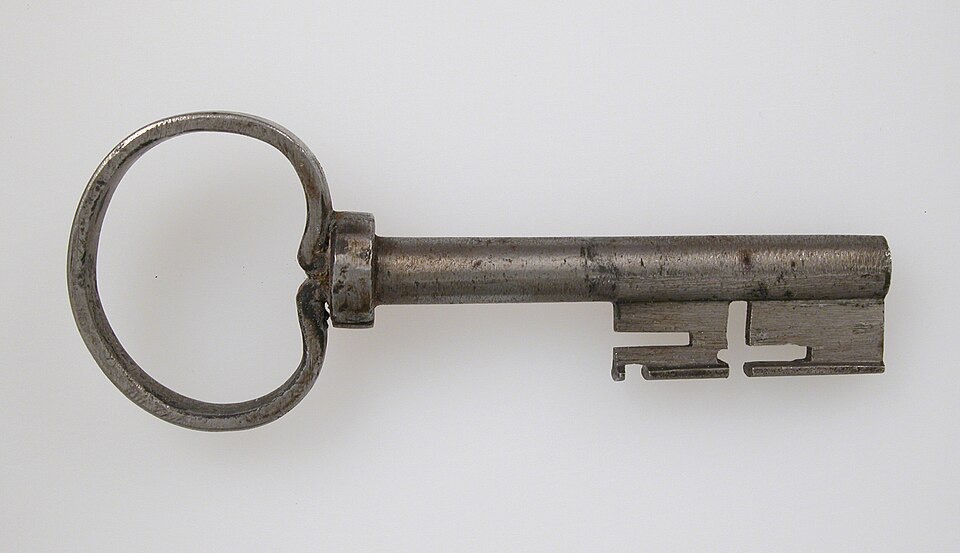
Visual AidWhat a key is, and is not
Photograph of an iron key forged in Germany in the 1400s, now in the Metropolitan Museum of Art — the kind of object this Knowledge Bank reaches for when it calls the tollbooth only a key. A key is genuinely powerless on its own: it opens nothing without a door, and once the door stands open it has finished its work. That is the reading the vanishing tollbooth rewards — the wonder it unlocked was already waiting in Milo’s ordinary world, so the key can move on to another child. The museum’s key opened some real German lock five centuries ago; which one, nobody now knows.
Iron key, German, 15th century; Metropolitan Museum of Art, New York, accession 87.11.56. Source: Wikimedia Commons, File:Key MET sf87-11-56s1.jpg, CC0.
Theme
The book’s central idea — that a curious mind finds the whole world full of wonder, curing boredom.
Climax
The staircase escape — the moment of greatest tension, where the demons and the armies of Wisdom collide.
Allegory
Freeing Rhyme and Reason restores sense and balance to the Kingdom of Wisdom — the mind — resolving the whole tale.
🧠Knowledge Bank question
1According to the Knowledge Bank, the tollbooth can safely move on to another child because it was ___.Ch.20
2Fill in each blank with the correct literary term.Ch.20
Word choices:climaxthemesettingrhyme- some words will not be used
The staircase escape is the story’s .
That learning cures boredom is the book’s .
3The climax is the moment of greatest tension in a story.Ch.20
4Freeing Rhyme and Reason completes the ___ that ran through the whole book.Ch.19
5The vanished tollbooth reveals the theme that wonder was waiting in Milo’s own ___.Ch.20
6A theme is the deeper idea or message behind a story.Ch.20
7The climax also heals the quarrel by forcing the two kings to ___.Ch.20
8Fill in each blank with the correct literary term.Ch.20
Word choices:allegoryclimaxnarratormotif- some words will not be used
Restoring sense and balance completes the book’s .
The rush down the staircase is the .
9The tollbooth vanishing suggests Milo no longer needs it to find wonder.Ch.20
10The clearest sign the theme has landed is that Milo now finds his own world ___.Ch.20
Part 4
Think Deeper
Four deeper challenges — no single-word recall. Read, weigh the evidence, and reason it out.
🧠Knowledge Bank · Attempting What First Seems Impossible
Learning Psychology · Growth Mindset
An impossible-looking task can produce two very different responses. A fixed view treats present ability as a final limit, while a growth mindset treats skill as something that develops through strategy, practice, and help. This does not mean every goal is achievable merely because someone believes in it. Sound judgment still considers evidence, risk, time, and available support. The useful shift is from “I cannot do this” to “What part can I learn next?” Large challenges become manageable through decomposition, dividing them into smaller actions that can be tested and revised. Progress also depends on feedback: mistakes reveal where a plan needs adjustment rather than proving that effort is worthless. Milo’s completed journey shows this process. He began without the knowledge or confidence required for the rescue, but each encounter taught a tool he later needed. Cooperation finally joins the divided kingdoms, showing that difficult achievements are rarely solitary. Rhyme and Reason’s lesson values courageous attempts guided by learning, not reckless certainty. The lasting reward is agency.
Visual AidDecomposition, then the feedback loop
Sequence diagram of the method the Knowledge Bank sets against the word impossible: decomposition splits the huge task into smaller parts, and the loop underneath — attempt, feedback, revise — turns each mistake into information instead of proof of failure. The drawing shows three parts where real challenges may split into dozens, and it does not claim every goal yields to this method; the Knowledge Bank keeps judgment about evidence, risk, and support in the picture. Notice where the loop begins — not with confidence, but with one part small enough to try.
Decomposition and feedback as described in standard accounts of learning psychology, including growth-mindset research after Carol Dweck. Drawn for Garden Heights Academy.
Imagine a boy climbing a staircase that seems to have no top, up into a castle floating in the clouds, to find two wise sisters who have waited a long time to be brought home. They thank him, and then they tell him a secret: they let him try to save them even though everyone knew it could not be done, because the best and biggest things a person ever does almost always look impossible right until the moment someone does them. Then the demons come howling up the stairs, and just as all seems lost, two kings who spent years refusing to speak charge to the rescue side by side, sweeping the monsters back. The sisters ride home in triumph, the whole land cheers — and the boy drives quietly back through a little tollbooth into his own room, where only an hour has passed, and looks around at his ordinary world as if seeing it, wide awake, for the very first time.
Original passage written for Garden Heights — not a quotation from the novel.
1Claim: “Part 8 argues that the real reward of Milo’s journey is a cured boredom and a curious mind, not treasure.” — choose the two details that best prove it.Claim & Evidence
2Milo at the START of the book, or Milo at the END of the book? Tap each detail to sort it — tap again to switch sides. You can keep tapping to change your answer.Sort into two
◄ Milo at the START of the bookMilo at the END of the book ►
3Match each cause to its result. For each cause, pick its result.Cause & Effect
Milo frees Rhyme and Reason→
The demons swarm the staircase→
The crisis unites the two kings→
Milo returns home changed→
🧠Knowledge Bank question
4Fill both blanks to complete the reasoning.Build the Argument
The Knowledge Bank argues that decomposition makes large challenges manageable because , and mistakes help progress because they .
Part 5
Standardized Test
Reading passage · Why Learning and Knowledge Matter · SAT & TOEFL-style practice
Read the passage — the highlighted words are tested — then answer. Tap an answer, then tap it again to confirm.
SATCentral Ideas — the passage's main point
SATDetail — a fact stated in the passage
SATWords in Context — a word's meaning in this passage
TOEFLFactual Information — a fact stated in the passage
TOEFLVocabulary — a tested word's meaning here
TOEFLInsert Text — where a sentence best fits
How Curiosity Changes a Mind
By the time Milo drives back through the tollbooth, he is not the boy who drove out. At the start he was bored by everything and sure learning was a pointless waste of time. He returns curious, eager, and awake — a quiet triumph, a victory better than gold, for that change is the true reward of his journey. The Lands Beyond, remember, are really a map of the mind, with regions for boredom, language, numbers, perception, and ignorance. Rescuing the princesses of sense and balance restores wisdom — good judgment itself — to the place where thinking happens.
Rhyme and Reason give Milo the book’s clearest lesson before he leaves. They confess that they let him attempt a rescue that was, strictly speaking, impossible. So many valuable things look impossible until the moment someone tries them anyway: learning to read once looked impossible to every reader who now does it without thinking. The lesson is not that nothing is hard, but that a curious, determined mind should attempt the worthwhile difficult thing rather than assume it cannot be done.
The final proof of Milo’s change comes when the tollbooth vanishes the next day, taking his only door to the Lands Beyond — and he is not heartbroken. He has discovered that his own ordinary world — the street outside his window, the people on it, the books on his shelf — is as full of wonder as any magic kingdom. That is Juster’s deepest reason learning matters: knowledge and curiosity do not just help you pass tests, for they transform how the whole world looks and feels. The real magic had come to live inside Milo’s own wide-awake mind. The tollbooth could safely move on to another child.
Original passage written for Garden Heights — not a quotation from the novel.
1What is the passage mainly about?SAT · Central Ideas
2The true reward of Milo’s journey is ___.SAT · Detail
3The Lands Beyond are really a kind of map of the ___.TOEFL · Factual Information
4Rhyme and Reason let Milo attempt a rescue that was ___.SAT · Detail
5The lesson is that a curious mind should attempt the worthwhile thing that is ___.TOEFL · Factual Information
6When the tollbooth vanishes, Milo feels ___.SAT · Detail
7Milo discovers that his own ordinary world is full of ___.TOEFL · Factual Information
8In the passage, triumph most nearly means ___.SAT · Words in Context
9In the passage, wisdom most nearly means ___.TOEFL · Vocabulary
10Insert Text (TOEFL). Look at the four squares [1]–[4] in the passage excerpt below. They show where the following sentence could be added: “In this way the magic tollbooth had simply done its job and was no longer needed.”
[1] Knowledge and curiosity do not just help you pass tests, for they transform how the whole world looks and feels. [2] The real magic had come to live inside Milo’s own wide-awake mind. [3] The tollbooth could safely move on to another child. [4]
Where would the sentence fit best?TOEFL · Insert Text
Part 6 · Optional
Creative Writing
A bonus challenge to practice your English. Take your time and have fun with it.
About This Section
This writing task is optional and is not part of your auto-graded score. The feedback below checks only the basics — length, spelling, and grammar — not whether your ideas are right or wrong. It is meant for classroom discussion and creative practice, so feel free to use your imagination!
Writing Task — Part 8 “Wonder in the Ordinary”
By the end, Milo finds his own everyday world full of things to wonder about. Write about something ordinary in your own life — a place, an object, a routine — that could be fascinating if you really looked closely. What is it, and what makes it more interesting than it first seems? 6–10 sentences. End with one question about it you would love to explore.
You can start with: “It seemed completely ordinary, until I really looked...”
0 / 40 words minimum
🗣 Teach It · Just for Fun (optional)
No right or wrong — tell someone nearby what happened in this part. Can’t find anyone? Tell yourself out loud. The moment you teach it, you truly understand it.
Part 8 Complete — You Finished the Book! 🎉
You finished Chapters 19–20 — the final part of The Phantom Tollbooth.
Here are your auto-graded results:
-
points out of 100
Teach it to someone
The best last step is to teach it. In your own words, explain what happened — retell a favorite scene, teach a character’s big choice, or sum up the main idea for a parent, friend, or classmate. When you can teach it clearly, you truly own it.
Independent study guide by Garden Heights. Not affiliated with or endorsed by Norton Juster. Contains original analysis only; no text from the novel is reproduced. Reference text: This workbook follows Norton Juster’s classic text (the standard Puffin edition sold worldwide). Revised 2023 UK editions change some wording and may not match the vocabulary studied here.
SAT® is a registered trademark of College Board, which is not affiliated with, and does not endorse, these materials. TOEFL® is a registered trademark of ETS. These materials are not endorsed or approved by ETS. Garden Heights is an independent provider of test-style reading practice.