New here? Just sign up with Google — your account includes Matilda, our gift book, forever.
The Secret Garden · Garden Heights
Part 8
for The Secret Garden · Part 8 · Chapters 26–27
8 Parts40 min
What Happens in Part 8
Colin knows he is well; Mr. Craven comes home and walks back with his son.
He is wellColin lectures on Magic while the others weed, saying a future scientific discoverer needs the practice, and Ben listens mostly to study his legs and shoulders. Then, halfway through a morning's work, Colin sets down his trowel, looks at his digging hand, and stands straight up: he is well. He throws out his arms, declares he will live forever, and says he wants to shout something thankful.
The DoxologyBen Weatherstaff dryly suggests the Doxology — a short hymn of praise sung in church. Colin has never been inside a church and asks what it is, so Dickon takes off his cap and sings it through, and the three children sing it again together. Ben's rough voice joins at the third line, and by the Amen his leathery cheeks are wet. Nobody notices that the door in the ivied wall has been pushed open.
Susan Sowerby arrivesSusan Sowerby has been listening in her blue cloak; Dickon had told her where the entrance was hidden. She tells Colin he is so like his mother that her heart jumped, and answers his anxious question about his father by saying the man must come home. She walks the garden, hears the story, feeds them from a basket, and calls Magic by another name: the Big Good Thing. Colin catches her cloak and wishes she were his mother too.
Coming homeTen years of wandering end for Mr. Craven in the Austrian Tyrol, where blue forget-me-nots loosen something and he almost feels alive — on the same day Colin shouted in the garden. Later he dreams his wife's voice calling from the garden, and wakes to a letter from Susan Sowerby telling him to come home. He walks the Long Walk, the door bursts open, and a tall boy crashes into his arms. Master and son cross the lawn together.
What We Will Learn
Section
What you will practice
Vocabulary
Words for stillness, stubbornness, and green growth: abiding, exultantly, obstinately, stagnant, verdure…
Literary Elements
Dramatic irony carried to the last page, a narrator who steps out of the story to argue with the reader, two separate plots braided into one meeting, and the resolution itself
Cross-Curricular
The life of Frances Hodgson Burnett (author) — a Manchester childhood, an emigrant girl who wrote for money, the real walled garden in Kent, and the ideas about thought and health that produced the novel’s ‘Magic’
Chapter Summary
Ch.
What happens
Chapter 26
“It’s Mother!” — Between Magic lectures and weeding, Colin suddenly understands that he is well and shouts it aloud. Ben Weatherstaff suggests the Doxology, Dickon sings it, and all four voices carry the second time through. Susan Sowerby has slipped in at the hidden door to listen. She tours the garden, feeds them, tells Colin that his likeness to his mother will win his father, and calls the Magic the Big Good Thing. When he says he wishes she were his mother, she answers that his own mother has never left this garden.
Chapter 27
In the Garden — The narrator argues that thoughts work on a body like sunlight or like poison, then follows Archibald Craven through ten years of European wandering. Beside a stream in the Austrian Tyrol, blue forget-me-nots quiet his mind; at the Lake of Como a dream sends him a voice, and Susan Sowerby’s letter arrives the next morning. He returns to Misselthwaite, hears from Mrs. Medlock that Colin is always in the garden, and is nearly knocked down at the ivied door by a running boy. Colin tells him everything and then walks home beside him across the lawn.
Part 1
Vocabulary
Study 10 key words from Chapters 26–27, then answer each question.
💬Knowledge Bank · Words That Carry an Accent
Linguistics · Yorkshire Dialect on the PageHalf the speech in these two chapters is not standard English at all. Burnett (author) wrote Ben Weatherstaff and the Sowerbys in broad Yorkshire and spelled it by ear: tha’ for you, mun for must, nowt for nothing, aye for yes. That is phonetic spelling — writing a sound rather than a dictionary form. Yorkshire is not sloppy English; it is a northern variety with its own old grammar, and tha descends from the same familiar thou that Shakespeare used for friends and family. Notice who speaks which way. Mary and Mr. Craven get clean schoolroom vocabulary — abiding, obstinately, verdure. Susan Sowerby gets the dialect, and she is the one person in the book everybody trusts. Writers usually reserve heavy accent for comic servants, so this choice is deliberate. When Burnett spells a word the way the moor says it, she is asking you to hear a place rather than correct it, which is the entire purpose of written dialect.
abidingadj.Ch.26
Lasting a long time without weakening
“The children held an abiding faith in what the garden was doing.”
exultantlyadv.Ch.26
In a way that shows triumphant joy
“Colin flung out his arms exultantly the moment he understood.”
reverencen.Ch.26
Deep respect, especially of a religious kind
“Ben proposed the hymn without a scrap of reverence in his voice.”
intrudern.Ch.26
Someone who comes into a place where they are not wanted
“Not one of the children felt that the visitor was an intruder.”
obstinatelyadv.Ch.27
In a stubborn way that refuses to change
“For ten years he obstinately shut out every rift of light.”
stagnantadj.Ch.27
Still, unmoving, and going stale
“His mind is compared to a stagnant pool that fresh water clears.”
forsakenadj.Ch.27
Abandoned and left alone for a long time
“He was drawn back toward the forsaken corner of his own grounds.”
suppressedadj.Ch.27
Held back and kept from being heard
“Suppressed laughter reached him through the thickness of the wall.”
verduren.Ch.27
Fresh green plant growth
“He tramped up into the soft verdure of the hills above the lake.”
broodedv.Ch.27
Hung heavily over something, or thought gloomily for a long time
“Darkness brooded over him so plainly that strangers stepped aside.”
ⓘ The vocabulary words in this list are selected to help you understand and complete this workbook. Some may not appear verbatim in the original novel.
🧠Knowledge Bank question
1According to the Knowledge Bank, Burnett (author) gives Mary schoolroom words like abiding and verdure while giving broad Yorkshire to Susan Sowerby in order to ___.Ch.26
2To do something ‘exultantly’ is to do it with ___.Ch.26
3‘Reverence’ means deep respect of a religious kind.Ch.26
4An ‘intruder’ is a person who ___.Ch.26
5Fill in each blank with the correct word.Ch.27
Word choices:obstinatelyverdurereverenceintruder- some words will not be used
For ten years he refused to let in any light.
He walked up into the thick of the hills.
6Water that is ‘stagnant’ is ___.Ch.27
7A place described as ‘forsaken’ is crowded with visitors.Ch.27
8‘Suppressed’ laughter is laughter that is ___.Ch.27
9Fill in each blank with the correct word.Ch.27
Word choices:broodedsuppressedabidingstagnant- some words will not be used
Gloom over him wherever he traveled.
He heard voices behind the ivy.
10‘Verdure’ means bare rock with nothing growing on it.Ch.27
Part 2
Comprehension
Show you understood what happens in Chapters 26–27.
📚Knowledge Bank · Writing Her Way Out of Poverty
Biography · A Manchester Girl in TennesseeThe woman who invented Misselthwaite grew up nothing like Mary Lennox. Frances Eliza Hodgson was born in Manchester in 1849, the daughter of an ironmonger — a dealer in metal goods and household hardware — who also worked in silver and who died when she was three. The shop failed slowly after that, the family moved to poorer and poorer streets in a mill city, and in 1865 her mother took the children across the Atlantic to relatives in New Market, Tennessee. Frances was not yet sixteen when they sailed. Tennessee had just come out of the Civil War and had no money either, so she decided her stories would earn what the household needed. She mailed them to American magazines and placed her first one in 1868, at eighteen. From that year until her death she supported her mother, her brothers, her own two sons, and eventually several houses by writing. Long before she was famous she was a working professional.
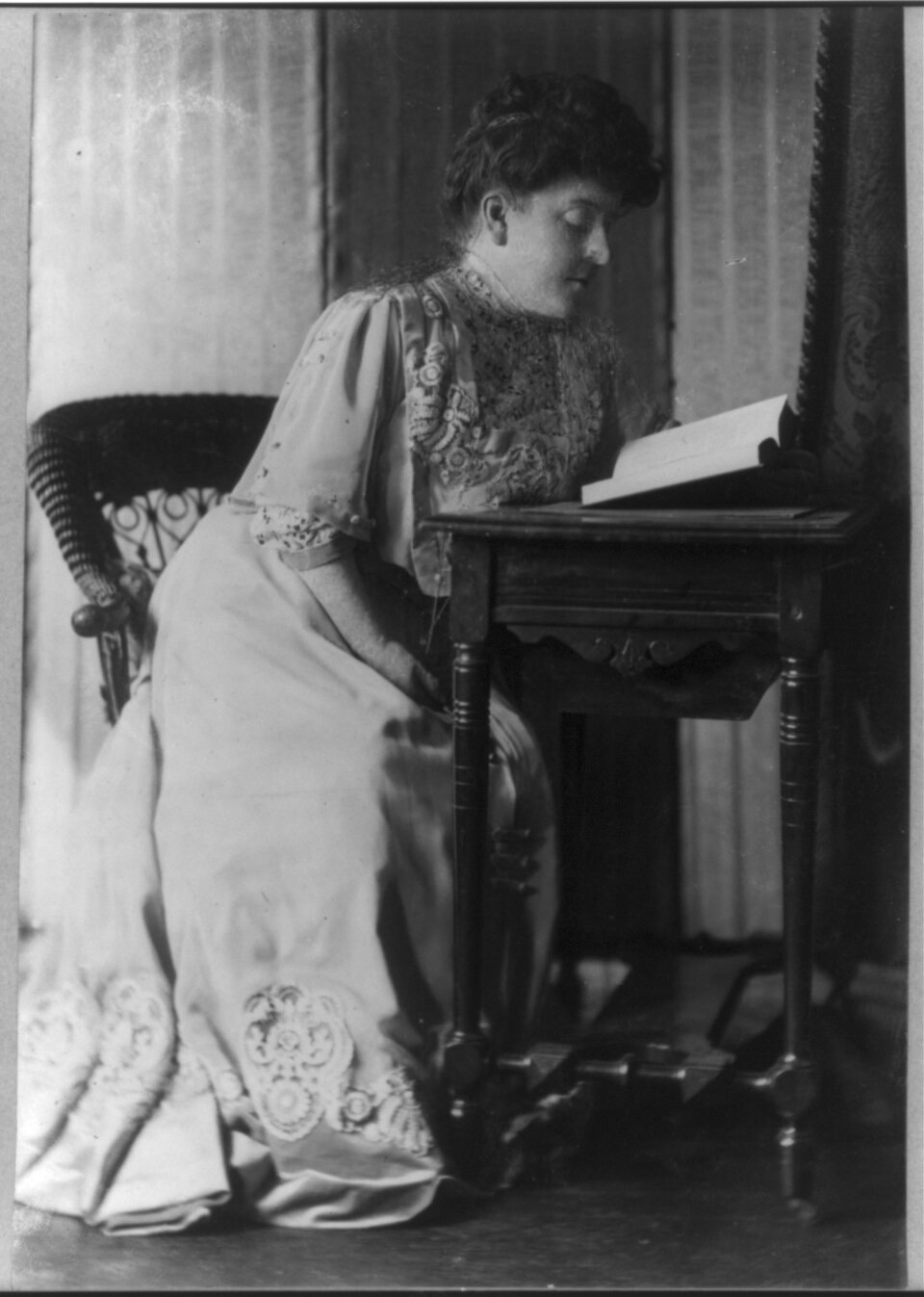
Visual AidThe writer at her table
Photograph of Frances Hodgson Burnett (author) at a small writing table, from the Library of Congress. The Knowledge Bank is about the working professional she had to become: a Manchester ironmonger’s daughter who sold her first story at eighteen and then supported a whole household by writing. This is a posed studio portrait made long after she was famous, so it shows none of the failing shop, the poorer streets or the Tennessee years, and a photograph cannot show earnings. Notice the ordinary furniture: a small table, a chair, and paper.
Frances Hodgson Burnett, full-length portrait, seated, reading at a table; photographic print, Library of Congress Prints and Photographs Division (LCCN 2004681682). Source: Wikimedia Commons, File:Frances Hodgson Burnett, full-length portrait, seated, reading at a table LCCN2004681682.jpg, public domain.
🧠Knowledge Bank question
1The Knowledge Bank explains that Frances Hodgson Burnett (author) began selling stories because ___.Ch.26
2Who walks in through the hidden door as the song ends?Ch.26
3It is Ben Weatherstaff who first suggests singing the Doxology.Ch.26
4What name does Susan Sowerby give to the Magic?Ch.26
5Write the numbers 1–5 in the boxes to show the correct order of events. Number 1 = what happens first.Chapters 26–27
Ben Weatherstaff’s rough voice joins the singing.
A voice in a dream calls Mr. Craven by his first name.
He stops his carriage at a cottage and hands over a coin.
Colin lays down his trowel and stands up on his feet.
A running boy bursts out through the door in the wall.
6What is Mr. Craven looking at when his mind first goes quiet?Ch.27
7Susan Sowerby’s letter tells Mr. Craven that Colin has recovered.Ch.27
8In the dream, where does the voice say that Lilias is?Ch.27
9How does Colin get back to the house at the end of the book?Ch.27
10Mrs. Medlock admits that she and the doctor cannot make Colin out.Ch.27
Part 3
Literary Elements
Understanding HOW and WHY Frances Hodgson Burnett tells the story across Chapters 26–27.
🎭Knowledge Bank · A Chapter That Argues With You
Authorial Craft · The Narrator Who Steps ForwardThe last chapter does not begin with a scene. It begins with an essay. The narrator stops the story to claim that discoveries keep arriving, that thoughts act on a body the way sunlight or poison does, and that a bad thought left in the mind behaves like an infection. Only after a rhymed couplet about roses and thistles does Burnett (author) let the plot start again. Critics call this intrusion — a narrator who leaves the world of the characters to address the reader directly — and it was far more common in 1911 than it is now. Modern editors would cut it, and something real would be lost, because those paragraphs tell you how to read the ending. Then watch what the chapter does at the wall. Burnett describes a tall boy, splendid color, gray eyes with black lashes, and lets the father gasp before anyone supplies a name. You are given the father’s eyes instead of the answer, and the power of that page lies entirely in what it briefly withholds.
Dramatic Irony
The reader has known for chapters that Colin is well; Mrs. Medlock, the doctor, and his father do not, and every line they speak is measured against what we know.
Authorial Intrusion
Chapter 27 opens with the narrator stepping out of the story to lecture the reader directly about thoughts, sunlight, and poison before the plot resumes.
Parallel Plots
Two recoveries run at the same time in different countries — a boy in a Yorkshire garden and his father beside an Alpine stream — and the book cuts between them until they meet.
Resolution
The closing chapter settles every open thread at once: the secret, the chair, the buried key, the absent father, and the household’s ignorance.
🧠Knowledge Bank question
1The Knowledge Bank explains that the last chapter opens with an essay instead of a scene, a move critics call ___.Ch.27
2Authorial intrusion means the narrator never addresses the reader directly.Ch.27
3Cutting between Colin in Yorkshire and his father in Europe is an example of ___.Ch.27
4The part of a story that settles every remaining question is the ___.Ch.27
5Fill in each blank with the correct literary term.Ch.27
Word choices:intrusionironyindexrhyme- some words will not be used
A narrator lecturing the reader about thoughts is authorial .
A father calling his healthy son an invalid is dramatic .
6Why does Burnett (author) delay naming the boy at the garden door?Ch.27
7Parallel plots have to take place in the same building as each other.Ch.27
8The hymn sung in a locked garden by four voices mainly marks ___.Ch.26
9Fill in each blank with the correct literary term.Ch.27
Word choices:resolutionparallelglossarypreface- some words will not be used
The final chapter provides the story’s .
Two recoveries in two countries are plots.
10Dramatic irony depends on the reader knowing more than a character does.Ch.27
Part 4
Think Deeper
Four deeper challenges — no single-word recall. Read, weigh the evidence, and reason it out.
💡Knowledge Bank · Why 1911 Was Not the Peak
Publishing History · A Quiet Book That LastedBooks do not always win in their own lifetime. When the novel appeared in 1911, Burnett (author) had been a celebrity for twenty-five years on the strength of a different story, and reviewers treated the new one as a pleasant minor work. It sold steadily without ever becoming an event. The obituaries that ran when she died in 1924 led with the earlier bestseller and gave the garden a line or two. For decades it stayed eclipsed. What rescued it was not a prize but a change in who chose books: cheap paperbacks, school reading lists, public librarians, and later a stage musical and several films put it in front of millions of children who decided for themselves. Today it is the book of hers that stays in print in dozens of languages, while the velvet-suited hero who once outshone it is largely forgotten. Nothing about the text changed in those fifty years. What changed was the audience.
Visual AidFifty years to the front shelf
Sequence diagram of the publishing history the Knowledge Bank traces: a pleasant minor work in 1911, obituaries in 1924 that lead with a different book, decades of steady sales in that book’s shadow, then paperbacks, school lists, librarians and films, and at last dozens of languages. The five panels compress fifty years and leave out the individual editions, and no arrow here is a sales figure. The drawing makes no claim about literary quality. Notice that the text never changed — every arrow is a change in who was allowed to choose books.
Reception history as set out in the Knowledge Bank: 1911 publication and reviews, the 1924 obituaries, and the later rise through paperbacks, school reading lists, libraries, stage and film. Drawn for Garden Heights Academy.
Two people are about to meet who have never really met, and neither of them knows it yet. One is ten years old, brown from a summer spent outdoors, and can beat a girl in a footrace across the grass. The other has spent a decade signing hotel registers all over Europe with the name of a house he cannot bear to live in. Between them stands a wall with ivy over the door and a key that was buried before the boy could walk. Part 8 closes that distance. It opens inside the garden, where the secret has grown too large to hold down — the laughter keeps escaping, the pretend invalid keeps getting heavier, and a woman in a blue cloak walks in through the hidden door and says out loud that the father must come home. Then the book turns and follows that father instead: a valley in the Austrian Tyrol, a stream, a mass of blue flowers, and a voice in a dream. He travels back to Yorkshire expecting the worst, and the ivied door is flung open from the inside. The last page of the novel is not a speech. It is two people walking across a lawn while the servants stare through a window.
Original passage written for Garden Heights — not a quotation from the novel.
1Claim: “Burnett (author) makes sure Mr. Craven begins to change before he has any evidence that his son is well.” — choose the two details that best prove it.Claim & Evidence
2Evidence the boy is well, or Evidence the household is fooled? Tap each detail to send it left or right.Sort into two
◄ Evidence the boy is wellEvidence the household is fooled ►
3Match each cause to its result. For each cause, pick its result.Cause & Effect
Colin glances down at his own hand digging→
Ben Weatherstaff proposes the Doxology dryly→
Susan Sowerby posts a letter to Italy→
Running feet reach the door in the ivy→
🧠Knowledge Bank question
4Fill both blanks to complete the reasoning.Build the Argument
The Knowledge Bank explains that the novel's standing rose long after 1911 because , which shows that the change came from .
Part 5
Standardized Test
The Garden at Great Maytham · Reading & Vocabulary · SAT & TOEFL-style practice
Read the passage — the highlighted words are tested — then answer. Tap an answer, then tap it again to confirm.
SATCentral Ideas — the passage's main point
SATInference — a conclusion the passage implies
SATWords in Context — a word's meaning in this passage
SATAuthor’s Purpose — what the author wants to achieve
TOEFLFactual Information — a fact stated in the passage
TOEFLInsert Text — where a sentence best fits
TOEFLVocabulary — a tested word's meaning here
The Garden at Great Maytham
Frances Hodgson Burnett was born in Manchester, England, in 1849, the daughter of an ironmonger — a dealer in metal goods and household hardware — who died when she was three. The shop failed by degrees, the family moved to poorer streets, and in 1865 her mother took the children across the Atlantic to relatives in Tennessee. Frances was not yet sixteen, the household had almost nothing, and she decided that her stories would have to earn what it needed. She placed her first one with an American magazine in 1868, at eighteen, and by her forties she was among the highest-paid writers in the English-speaking world.
In 1898 she leased Great Maytham Hall in Kent, a large brick house with an old walled enclosure that had gone derelict behind it. A robin, she always said, showed her where the doorway lay under the ivy. She had hundreds of roses planted along the brick, and she wrote out in the summerhouse through nine English summers while the verdure thickened around her. Her lease ran out in 1907 and she went back to New York, and within three years the garden had turned up in a book.
The story was serialized in an American magazine through 1910 and published as a novel in 1911. Sales were stagnant, decent enough but never rising. For the rest of her life her reputation rested on Little Lord Fauntleroy, the 1886 bestseller that had put a velvet suit on a generation of unwilling boys, and the obituaries printed after her death in 1924 said so plainly. The Secret Garden stayed eclipsed for roughly fifty years. Then teachers, librarians, paperback publishers, and eventually film-makers found it, and the quiet book outlasted the famous one.
Original passage written for Garden Heights — not a quotation from the novel.
1What is the main idea of the passage?SAT · Central Ideas
2According to the passage, the family crossed the Atlantic in ___.TOEFL · Factual Information
3The passage says the walled ground at Great Maytham was ___.TOEFL · Factual Information
4The passage suggests that Burnett wrote partly because ___.SAT · Inference
5Insert Text (TOEFL). Look at the four squares [1]–[4] in the excerpt below. They show where this sentence could be added: “The change came from readers rather than from critics.”
For fifty years after Burnett died, her name meant Little Lord Fauntleroy and little else. [1] Then, in the second half of the century, cheap paperback editions of The Secret Garden began turning up on school reading lists. [2] Teachers assigned it, children asked for it again, and publishers kept it in print year after year. [3] By the time a new film version reached theaters in 1993, reviewers were calling the novel her masterpiece. [4]
Where would the sentence fit best?TOEFL · Insert Text
6It can be inferred that the novel’s reputation was rebuilt by ___.SAT · Inference
7In the passage, verdure most nearly means ___.SAT · Words in Context
8In the passage, stagnant most nearly means ___.TOEFL · Vocabulary
9The word eclipsed in the passage is closest in meaning to ___.TOEFL · Vocabulary
10The author mentions the velvet suit mainly to ___.SAT · Author’s Purpose
Part 6 · Optional
Creative Writing
A bonus challenge to practice your English. Take your time and have fun with it.
About This Section
This writing task is optional and is not part of your auto-graded score. The feedback below checks only the basics — length, spelling, and grammar — not whether your ideas are right or wrong. It is meant for classroom discussion and creative practice, so feel free to use your imagination!
Writing Task — Part 8 “The News You Saved Up”
Colin could have sent word to his father at any time, but he lay awake planning how to deliver the news himself. Write about a time you kept good news back so that you could give it to someone in person — or a time you wish you had. Explain why the waiting mattered to you, what you imagined the moment would be like, and how it actually went. 6–10 sentences. End by saying whether the wait was worth it.
You can start with: “I knew for three whole days before I told anyone...”
0 / 40 words minimum
🗣 Teach It · Just for Fun (optional)
No right or wrong — tell someone nearby what happened in this part. Can’t find anyone? Tell yourself out loud. The moment you teach it, you truly understand it.
Part 8 Complete — You Finished the Book! 🎉
You finished Chapters 26–27 — the final part of The Secret Garden.
Independent study guide by Garden Heights. Not affiliated with or endorsed by Frances Hodgson Burnett. Contains original analysis only; no text from the novel is reproduced. Reference text: This workbook follows Frances Hodgson Burnett’s classic text (the standard Puffin edition sold worldwide). Revised 2023 UK editions change some wording and may not match the vocabulary studied here.