New here? Just sign up with Google — your account includes Matilda, our gift book, forever.
The Wednesday Wars · Garden Heights
Part 8
for The Wednesday Wars · Part 8 · June
8 Parts40 min
What Happens in Part 8
June brings a death, a camping trip, a bar mitzvah, and a homecoming on an airport tarmac.
A candle for KennedyJune begins badly. Robert Kennedy is shot in California in the first week and dies the next day, and Holling's sister Heather, recently home from her run at California, shuts herself in her room and plays one record over and over. Holling knocks, and the two walk to Saint Adelbert's and stand in line with everyone else to light a candle, something the September Holling would never have thought to do.
Camping in the CatskillsSchool is winding down, and Mrs. Baker, who learned on the last Wednesday in May that her husband was found alive, is cheerful about everything, including camping, which she dislikes. She takes the class into the Catskill Mountains anyway. They ride a bus, hike in with issued packs, and lose most of their utensils when Holling drops them, so cans are opened with a rock, which is how Mrs. Sidman cuts her fingers.
A pot of stewIt rains at midnight; they swim at a waterfall; Meryl Lee quietly halves Holling's chores and turns a miserable trip good. Then Mrs. Bigio arrives late with bug spray and groceries, delayed at the Catholic Relief Agency. She cooks thit bo kho, a Vietnamese beef stew, apologizing for the missing lemongrass, and Mai Thi comes to the pot to help finish it.
Strawberries on the tarmacAfterward Mrs. Bigio, whose husband was killed in Vietnam and who spent months unable to look at Mai Thi, offers her a room in her house, and Mai Thi says yes. A week later Holling watches Danny Hupfer's bar mitzvah and argues at home that manhood means choosing for yourself, not a good job and a hard nose. At the reception he asks Mrs. Baker about strawberries. Eleven days later the class watches Lieutenant Tybalt Baker step off his plane.
What We Will Learn
Section
What you will practice
Vocabulary
Homecoming, refuge, and growing up: reprieve, refugee, reconcile, tarmac, threshold…
Literary Elements
The denouement that pays off nine months of setup, allusion used as a character’s private language, and the shape of a coming-of-age novel
Cross-Curricular
Refugee resettlement — how relief agencies and ordinary sponsors moved families across the world, and what refugee children met in American classrooms
Chapter Summary
Ch.
What happens
June · Candles at Saint Adelbert’s
Another Killing — Robert Kennedy is shot in California and dies the next day. Heather locks herself in her room; Holling knocks, walks her to Saint Adelbert’s, and stands in line with her to light a candle among strangers who are crying too.
June · The Catskills
The Camping Trip — Mrs. Baker, cheerful now that her husband has been found alive, hauls the class into the mountains. Holling drops the utensils, the cans get opened with a rock, Mrs. Sidman cuts her fingers, it rains at midnight — and Meryl Lee makes it fun anyway.
June · A Pot of Stew
Mrs. Bigio’s Offer — The school cook arrives late from the Catholic Relief Agency with bug spray and groceries and makes thit bo kho with Mai Thi’s help. Then she describes the small house where she lives alone and asks Mai Thi to come live in it.
June · Strawberries on the Tarmac
Choosing, and Coming Home — At Danny Hupfer’s bar mitzvah Holling watches a friend be counted as a man and tells his father that manhood is about choosing for yourself. Eleven days later the class waits on an airfield, holding strawberries, as Lieutenant Baker’s plane lands.
Part 1
Vocabulary
Study 10 key words from June, then answer each question.
💬Knowledge Bank · Learning a Language at a Desk
Linguistics · Second-Language LearningA child dropped into a classroom in a new language is doing two jobs at once, and researchers who study the process describe both. The first job is playground English — greetings, jokes, the words for lunch and kickball — and most children pick that up startlingly fast, often sounding fluent within about a year. The second job is school English: reading a textbook chapter, arguing a point, writing an essay about a play. That kind of language usually takes five to seven years to build, which means a newcomer can joke easily in the hallway and still be lost in a history lesson. Many newcomers also pass through what linguists call a silent period, listening for weeks or months before risking speech, and silence is easily mistaken by classmates for slowness or sulking. Knowing the difference changes how you read a quiet student in the back row. What looks like a person with nothing to say is usually a person doing an enormous amount of work.
Visual AidTwo Englishes on one clock
Measure diagram of the two timetables the Knowledge Bank on second-language learning keeps apart: a silent period of weeks or months, playground English in about a year, and school English — the language of a textbook, an argument, an essay — taking five to seven years, drawn as a solid bar that fades across the range. These are averages from research, and any one student may be faster or slower. The drawing measures language, not intelligence, and it makes no claim about Mai Thi, whom Gary D. Schmidt (author) never lets a reader hear from directly. Notice how far apart the two bars end.
Conversational versus academic second-language proficiency and the silent period, as summarized in the Knowledge Bank. Drawn for Garden Heights Academy.
reprieven.June
A sudden relief from something feared or expected
“Word that the lieutenant was alive came as a reprieve after months of dread.”
refugeen.June
A person forced to leave home by war, disaster, or persecution
“Mai Thi reached the school as a refugee from a country at war.”
reconcilev.June
To bring people back into friendship after a conflict
“The stew is where Mrs. Bigio and Mai Thi finally reconcile.”
tarmacn.June
The paved surface of an airfield where planes park
“The whole class stood on the tarmac holding boxes of strawberries.”
exuberantadj.June
Overflowing with energy, excitement, and high spirits
“The swim below the waterfall left the campers exuberant and soaked.”
solemnadj.June
Serious and dignified, without any joking
“Danny read from the scroll in a solemn voice that did not shake.”
legacyn.June
Something handed down from one generation to the next
“His father spoke about the firm as a legacy waiting for Holling.”
riten.June
A formal ceremony marking an important step in life
“A bar mitzvah is the rite that counts a boy among the adults.”
thresholdn.June
The point of entry to a new stage or place
“The last week of school left Holling on the threshold of something.”
gratituden.June
A thankful feeling toward someone who has helped you
“Mai Thi accepted the offer with more gratitude than she could say.”
ⓘ The vocabulary words in this list are selected to help you understand and complete this workbook. Some may not appear verbatim in the original novel.
🧠Knowledge Bank question
1According to the Knowledge Bank, a solemn newcomer who jokes easily at lunch may still ___.June
2A ‘refugee’ is a person forced from home by war or disaster.June
3To ‘reconcile’ with someone is to ___.June
4The ‘tarmac’ at an airfield is ___.June
5Fill in each blank with the correct word.June
Word choices:reprieverefugeesolemnlegacy- some words will not be used
The news was a after months of fearing the worst.
Mai Thi came to the United States as a from the war.
6Someone who is ‘exuberant’ is quiet, tired, and withdrawn.June
7A ‘solemn’ moment is one that is ___.June
8A family business described as a ‘legacy’ is one that is ___.June
9Fill in each blank with the correct word.June
Word choices:thresholdgratitudetarmacrite- some words will not be used
A bar mitzvah puts a boy on the of adulthood.
Mai Thi accepted the offer with quiet .
10A ‘rite’ is a formal ceremony that marks a step in life.June
Part 2
Comprehension
Show you understood what happens in June.
🏠Knowledge Bank · Who Gets to Take a Child In
Civics · Foster Care and GuardianshipWhen Mrs. Bigio asks Mai Thi to come live with her, she is stepping into a legal system, not just making a kind offer. In the United States a child without parents is placed under the authority of a court, and an adult who wants to raise that child must be approved as a foster parent or appointed as a guardian. Approval usually means a home study: an interview, a look at the house, references, and a check of income and criminal records. Refugee children who arrived without parents added a second layer, because the relief agency that brought a child into the country stayed responsible for her, so a placement had to satisfy the agency as well as the state. Being a widow who cooks in a school kitchen would not disqualify Mrs. Bigio, but nothing in the process is automatic, and the paperwork cannot measure the thing the chapter is really about: a woman who lost a husband to a war choosing to build a family instead of a grudge.
Visual AidChildren an agency was responsible for
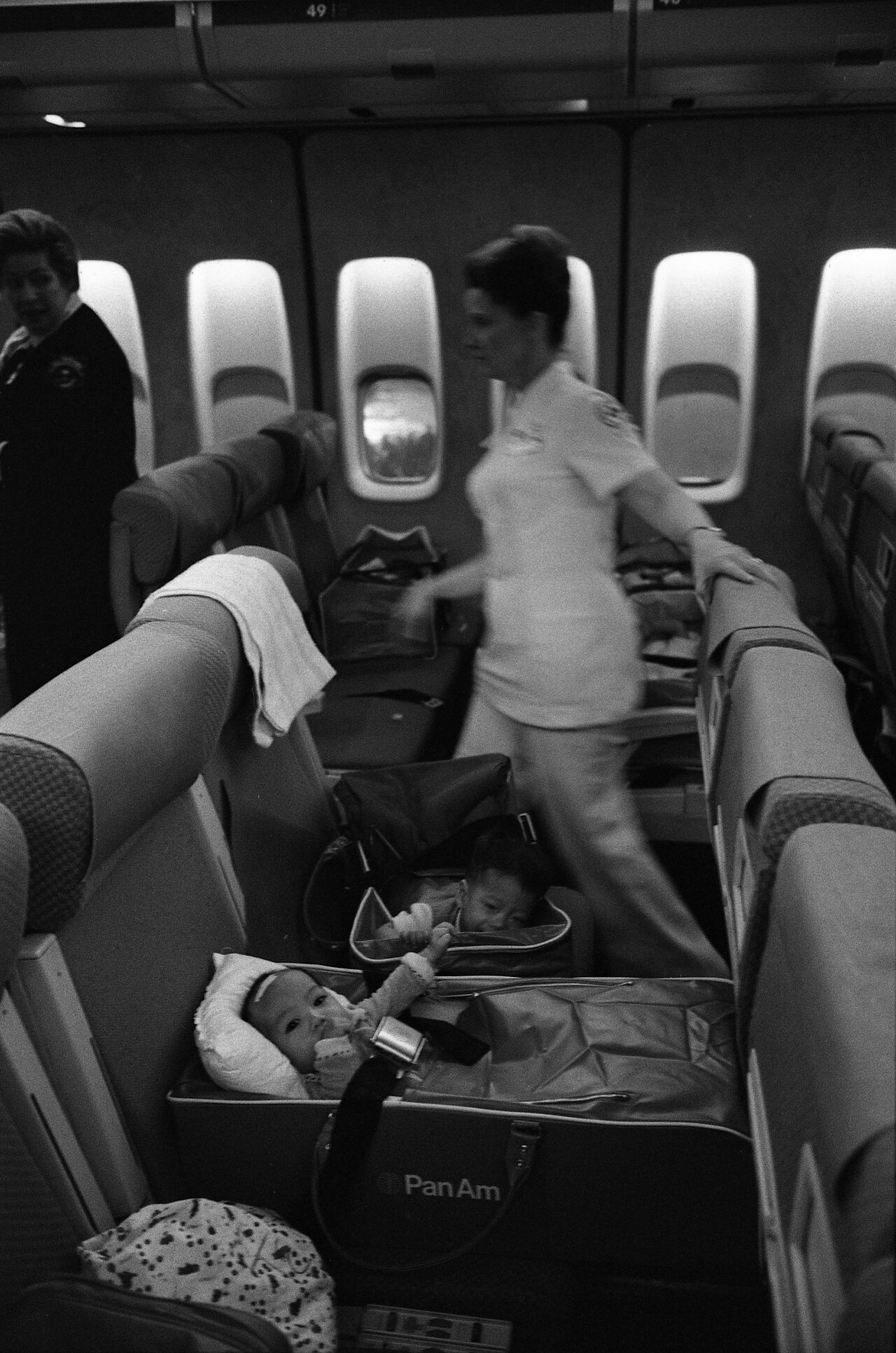
Photograph taken aboard an evacuation flight from Vietnam as it arrived at San Francisco on April 5, 1975, with infants belted into carry-cots on the seats. It shows the situation the Knowledge Bank on foster care and guardianship describes: children arriving in a new country without parents, in the care of a relief agency that stayed legally responsible for each of them long after the plane landed. This flight is from 1975, seven years after Holling’s school year, and none of these children is Mai Thi — what the photograph supplies is the paperwork behind Mrs. Bigio’s offer, which was never a simple matter of taking a child home.
Nurses and Vietnamese refugee children aboard an Operation Babylift flight on arrival at San Francisco International Airport, April 5, 1975; U.S. National Archives and Records Administration 23869151. Source: Wikimedia Commons, file "Nurses and Vietnamese Refugee Children on an Operation Babylift Flight" (NARA 23869151), public domain.
🧠Knowledge Bank question
1The Knowledge Bank explains that a home study for a foster placement usually includes ___.June
2What does Holling do when Heather shuts herself in her room?June
3Mrs. Baker takes the class on a camping trip into the Catskill Mountains.June
4How does the class end up opening its cans of food at the campsite?June
5Write the numbers 1–5 in the boxes to show the correct order of events. Number 1 = what happens first.June
Mrs. Bigio makes stew with Mai Thi and offers her a home.
The class waits on the tarmac with boxes of strawberries.
Holling walks Heather to Saint Adelbert’s to light a candle.
Holling attends Danny Hupfer’s bar mitzvah.
The class hikes to a campsite in the Catskill Mountains.
6Mrs. Bigio’s husband was killed in the war in Vietnam.June
7What does Mrs. Bigio cook for the class on the camping trip?June
8What does Mrs. Bigio offer Mai Thi after the meal?June
9Holling’s father agrees that becoming a man means choosing for yourself.June
10How does the novel end?June
Part 3
Literary Elements
Understanding HOW and WHY Gary D. Schmidt tells the story across June.
🎬Knowledge Bank · The Chapter After the Storm
Literature · DenouementMost of what happens in June is not new trouble; it is old trouble being untied. Critics borrow a French word for this last stretch of a story, denouement, which literally means an unknotting. The crisis has already passed, and the writer spends the remaining pages showing what it left behind. Notice how carefully the knots were tied earlier so that they could be loosened here: a soldier missing in the mountains, a cook who cannot look at a refugee, a sister gone west, a father with a blueprint for his son. Each is answered in June, and none of the answers would move a reader if the earlier chapters had not spent months pulling them tight. A weak ending simply announces that things worked out. A strong one makes you feel the distance between the September version of a character and the June version. So ask it of every thread in this chapter: who has actually changed.
Denouement
The unknotting after a story’s crisis — June exists to pay off nine months of setup, one thread at a time, from a missing soldier to a hard heart.
Allusion
A reference to another work — Holling reads Hamlet in June and uses Shakespeare the way other people use proverbs, to say what he cannot say plainly.
Bildungsroman
A coming-of-age novel that follows a young person toward an adult self — the year ends with Holling choosing instead of being handed a life.
🧠Knowledge Bank question
1According to the Knowledge Bank, a strong denouement differs from a weak one because it ___.June
2A novel that follows a young person growing toward an adult self is called a ___.June
3An allusion is a reference to another work of literature or history.June
4Holling borrowing a line from Hamlet to explain his own life is an example of ___.June
5A denouement is the moment of highest tension, when the main crisis breaks open.June
6Fill in each blank with the correct literary term.June
Word choices:denouementallusionrhymeglossary- some words will not be used
The unknotting after the crisis is the .
A nod to another writer’s work is an .
7Naming each chapter for a month mainly gives the novel a clear ___.June
8Mrs. Bigio’s change toward Mai Thi is an example of character development.June
9Which ending detail best shows that Holling has grown during the year?June
10Fill in each blank with the correct literary term.June
Word choices:bildungsromandevelopmentmarginfootnote- some words will not be used
A coming-of-age novel is a .
The change in Mrs. Bigio is character .
Part 4
Think Deeper
Four deeper challenges — no single-word recall. Read, weigh the evidence, and reason it out.
🎖Knowledge Bank · Why a War Year Fits in a Classroom
Literary History · The Newbery HonorGary D. Schmidt (author) teaches English in Michigan and set this novel in the school year that ran from September 1967 to June 1968, one of the loudest years in American life. He could have written a battlefield book. Instead he chose the smallest possible frame: one seventh grader, one classroom, and the Wednesday afternoons when everybody else leaves for religious instruction. The gamble is that a reader will feel history more sharply through a teacher who cannot say her husband’s name out loud than through a map of a war. In 2008 the American Library Association named the book a Newbery Honor, the runner-up distinction to the Newbery Medal, which has been awarded since 1922 for the most distinguished American book for children; Schmidt has taken Newbery Honors more than once. Notice what the small frame does to the comedy, too. Cream puffs and yellow tights sit in the same book as a missing soldier, exactly as they sat in the same year.
Picture a seventh grader who has spent an entire year being handed things he never asked for. Wednesday afternoons alone with a teacher he was sure hated him. Yellow tights with feathers on the seat. A sister who left. A war that kept arriving in the middle of the school day and taking people out of the room. June is the month when the handing stops and the choosing starts. A presidential candidate is shot in California, and a boy who used to think his sister was an idiot knocks on her door and walks her to a church full of strangers lighting candles. A school cook who lost her husband to the war sets down the grudge she has been carrying and offers her house to the Vietnamese girl she once could not look at. A father explains that becoming a man means landing a good job, and his son says out loud, for the first time, that it means choosing for yourself. Part 8 is the last stretch of the school year — and it ends on an airfield, with a whole class holding boxes of strawberries and watching a plane door.
Original passage written for Garden Heights — not a quotation from the novel.
1Claim: “June shows that the year’s wounds close because people decide to act, not because time simply passes.” — choose the two details that best prove it.Claim & Evidence
2Threads being tied up, or Holling choosing for himself? Tap each detail to send it left or right.Sort into two
◄ Threads being tied upHolling choosing for himself ►
3Match each cause to its result. For each cause, pick its result.Cause & Effect
Robert Kennedy is shot in California→
Mrs. Bigio arrives late from the Catholic Relief Agency→
Danny Hupfer is called up to read at his bar mitzvah→
Eleven days after a conversation about strawberries→
🧠Knowledge Bank question
4Fill both blanks to complete the reasoning.Build the Argument
According to the Knowledge Bank, Schmidt (author) chose one classroom rather than a battlefield because , and the American Library Association answered by naming the book .
Part 5
Standardized Test
Sponsored Into a New Country · Reading & Vocabulary · SAT & TOEFL-style practice
Read the passage — the highlighted words are tested — then answer. Tap an answer, then tap it again to confirm.
SATCentral Ideas — the passage's main point
SATWords in Context — a word's meaning in this passage
SATInference — a conclusion the passage implies
SATAuthor’s Purpose — what the author wants to achieve
TOEFLFactual Information — a fact stated in the passage
TOEFLInsert Text — where a sentence best fits
TOEFLVocabulary — a tested word's meaning here
Sponsored Into a New Country
When Vietnamese families walked off military planes onto an American tarmac in 1975, the federal government did not resettle them itself; it hired private voluntary agencies, among them Church World Service, and those agencies looked for sponsors. A sponsor could be a congregation, a company, or a single family. The promise was concrete: rent, groceries, winter coats, work, and a seat in the neighborhood school. Officials deliberately scattered the arrivals across all fifty states rather than a few cities, to spread the cost. Thousands of children woke up in towns where no one spoke their language.
The welcome was uneven. A national poll in May 1975 found that most Americans opposed admitting the refugees, in a year of high unemployment and of a war people wanted to forget. Children carried that resentment home from school: classmates who had watched the fighting on the evening news for a decade sometimes treated a refugee girl as though she came from the other side of it. Some of those classmates had lost a father, a brother, or a neighbor in Vietnam, and grief looks for somewhere to land.
Schools were unprepared, but they were changing. A 1974 Supreme Court decision, the Lau case, ruled that giving students who speak no English only ordinary English lessons is not equal education, and districts began building classes for English learners. Teachers gradually learned what researchers had found about learning English: playground talk may come within a year, while the English needed to read a textbook takes five to seven. What the children remember, though, is usually smaller than any policy, and they still speak of it with gratitude: one teacher who slowed down, one neighbor who knocked, one lunchroom cook who set down a plate.
Original passage written for Garden Heights — not a quotation from the novel.
1What is the main idea of the passage?SAT · Central Ideas
2According to the passage, who found sponsors for arriving families?TOEFL · Factual Information
3Why were the arrivals spread across all fifty states?TOEFL · Factual Information
4In the passage, <b>tarmac</b> most nearly means ___.SAT · Words in Context
5Insert Text (TOEFL). Look at the four squares [1]–[4] in the excerpt below. They show where this sentence could be added: “Not everyone approved of the work those sponsors had signed up for.”
A sponsor could be a congregation, a company, or a single family. [1] Thousands of children woke up in towns where no one spoke their language. [2] Some of those classmates had lost a father, a brother, or a neighbor in Vietnam. [3] Teachers gradually learned what researchers had found about learning English. [4]
Where would the sentence fit best?TOEFL · Insert Text
6In the passage, <b>gratitude</b> most nearly means ___.TOEFL · Vocabulary
7What can be inferred about why some classmates were cruel to refugee children?SAT · Inference
8Why does the passage end with a teacher, a neighbor, and a cook?SAT · Author’s Purpose
9In the passage, sponsor most nearly means ___.TOEFL · Vocabulary
10How does this passage best help explain Part 8?SAT · Inference
Part 6 · Optional
Creative Writing
A bonus challenge to practice your English. Take your time and have fun with it.
About This Section
This writing task is optional and is not part of your auto-graded score. The feedback below checks only the basics — length, spelling, and grammar — not whether your ideas are right or wrong. It is meant for classroom discussion and creative practice, so feel free to use your imagination!
Writing Task — Part 8 “The Plan Someone Else Made”
Holling ends the year telling his father that becoming a man is not about landing a job — it is about choosing for yourself. Think of a plan somebody has made for you: a sport, a subject, a career, a role in your family. Or think of a plan you have made for yourself that nobody else knows about yet. Write about it honestly. Explain whose plan it is, why that person wants it, what following it would cost you, and what you would choose if the choice were entirely yours. 6–10 sentences. End with the sentence you would say if you had to say it out loud.
You can start with: “Everybody already knows what I am supposed to become, but...”
0 / 40 words minimum
🗣 Teach It · Just for Fun (optional)
No right or wrong — tell someone nearby what happened in this part. Can’t find anyone? Tell yourself out loud. The moment you teach it, you truly understand it.
Part 8 Complete — You Finished the Book! 🎉
You finished June — the final part of The Wednesday Wars.
Independent study guide by Garden Heights. Not affiliated with or endorsed by Gary D. Schmidt. Contains original analysis only; no text from the novel is reproduced. Reference text: This workbook follows Gary D. Schmidt’s classic text (the standard Puffin edition sold worldwide). Revised 2023 UK editions change some wording and may not match the vocabulary studied here.