New here? Just sign up with Google — your account includes Matilda, our gift book, forever.
The Trumpet of the Swan · Garden Heights
Part 8
for The Trumpet of the Swan · Part 8 · Chapters 20–21
8 Parts40 min
What Happens in Part 8
The cob flies to Billings with the moneybag at his neck — and the delivery nearly ends in tragedy. The startled storekeeper, seeing a huge white bird plunging toward his shop, grabs a gun and fires; the cob is wounded in the shoulder, yet finishes his errand like the gentleman he has always claimed to be — the money delivered, the debt paid in full, a crowd gathering round the fallen hero. The storekeeper, mortified, keeps only what is owed; the cob’s wound heals; and he flies home with the one treasure he went for: his honor, restored. Then the book breathes out. Spring greens the Red Rock Lakes; Louis and Serena raise cygnets of their own; the zoo’s pledged cygnet is honorably remembered; and Sam Beaver, grown taller each chapter, keeps his notebooks and his questions. On quiet nights, over sleeping water, a trumpet lifts the old notes — a voice that was bought with a theft, paid for with work, and now belongs, completely, to the swan who plays it.
The costly delivery, and the greening-spring ending
Cross-Curricular
How birds really sing — the syrinx
Chapter Summary
Ch.
What happens
20–21
Billings, and the Greening Spring — the cob delivers the repayment and is shot and wounded by the startled storekeeper, yet completes the errand; debt paid, honor restored, wound healed; spring returns Louis and Serena to the wild lakes with cygnets of their own, and the trumpet plays on.
Part 1
Vocabulary
Study 10 key words from Chapters 20–21, then answer each question.
🧠Knowledge Bank · The Long Flight Home
Lexicology · The Long Flight Home
The book ends with swans returning to the wild, which points us toward one of nature’s great wonders: migration. Trumpeter swans travel with the seasons, flying south when northern lakes freeze and returning north each spring to the marshes where they will nest. What amazes scientists most is how they find their way, a skill called homing: birds navigate using the sun, the stars, landmarks below, and even the earth’s invisible magnetic field. A young swan often learns the route by following its parents, storing the map in memory for the rest of its life. This is why White’s ending feels so right and so deep: Louis does not merely settle somewhere pleasant — he returns to the very kind of wild, watery home his story began in, obeying the ancient seasonal pull that lives in every migrating swan.
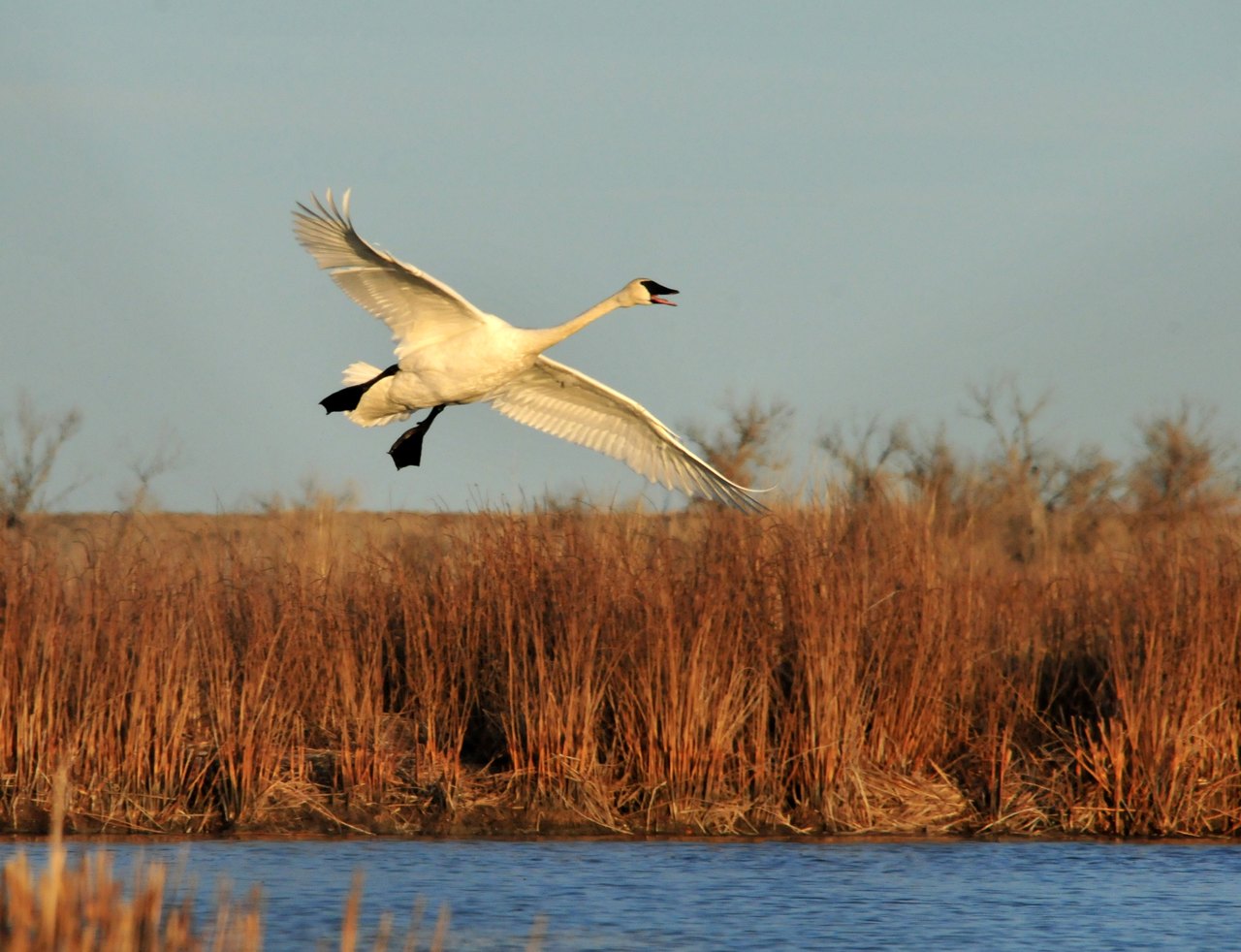
Visual AidComing back to the same water
Photograph of a trumpeter swan coming in to land at Seedskadee National Wildlife Refuge in Wyoming. The Knowledge Bank explains that trumpeters travel with the seasons, flying south when northern lakes freeze and returning north each spring to the marshes where they will nest, and that the skill of finding the way is called homing, using the sun, the stars, landmarks below, and the earth’s magnetic field. A young swan learns the route by flying it beside its parents.
Trumpeter swan landing, Seedskadee National Wildlife Refuge, Wyoming; U.S. Fish and Wildlife Service. Source: Wikimedia Commons, public domain.
startlev.Ch.20–21
To frighten suddenly
“The plunging swan startled the storekeeper badly.”
woundn.Ch.20–21
An injury that breaks the skin
“The shoulder wound healed as the weeks passed.”
mortifiedadj.Ch.20–21
Deeply ashamed and embarrassed
“The mortified storekeeper kept only what was owed.”
errandn.Ch.20–21
A short trip made to do a task
“The cob finished his errand despite the gunshot.”
restorev.Ch.20–21
To bring back to its proper state
“One delivery restored the family’s honor.”
healv.Ch.20–21
To become healthy again
“Wounds heal; broken promises take longer.”
generationn.Ch.20–21
All the young born in one period
“A new generation paddled behind Serena.”
cygnetn.Ch.20–21
A young swan
“One cygnet was pledged, honorably, to the zoo.”
renewaln.Ch.20–21
Beginning fresh; starting again
“Spring is the wild’s annual renewal.”
legacyn.Ch.20–21
What someone passes on to the future
“The trumpet’s song became the family legacy.”
ⓘ The vocabulary words in this list are selected to help you understand and complete this workbook. Some may not appear verbatim in the original novel.
🧠Knowledge Bank question
1According to the Knowledge Bank, the skill birds use to find their way is called ___.Ch.20–21
2Someone ‘mortified’ is deeply ashamed.Ch.20–21
3A short trip made to do a task is an ___.Ch.20–21
4To ‘restore’ something is to damage it further.Ch.20–21
5Fill in each blank with the correct word.Ch.20–21
Word choices:woundcygnetlegacyrenewal- some words will not be used
The shoulder healed as the weeks passed.
One was pledged, honorably, to the zoo.
6All the young born in one period are a ___.Ch.20–21
7‘Renewal’ means beginning fresh.Ch.20–21
8What someone passes on to the future is their ___.Ch.20–21
9Fill in the blanks with the correct words.Ch.20–21
Word choices:startleerrandmortifiedheal- some words will not be used
The storekeeper kept only what was owed.
Wounds ; broken promises take longer.
10To become healthy again is to ___.Ch.20–21
Part 2
Comprehension
Show you understood what happens in Chapters 20–21.
🧠Knowledge Bank · The Big Idea That Ran All Along
Narrative Logic · The Big Idea That Ran All Along
Now that the story is complete, a reader can finally name its theme — the big idea about life that runs, like an underground river, beneath all the events. From the first chapter to the last, White has been exploring one question: what does a creature do when it is born different, lacking something others take for granted. The answer the whole book gives is its theme: that determination, work, and love can turn a difference into a strength, and that a voice can be found even when it is not given. Look back and see how every chapter — the school, the camp, the hotel, the deal — was quietly serving this single idea. Learning to name a book’s theme is the reader’s highest skill, because it lets you carry the story’s wisdom into your own life.
🧠Knowledge Bank question
1The Knowledge Bank says the theme runs beneath the events like ___.Ch.20–21
2Despite his wound, the cob completes the delivery.Ch.20–21
3How much does the storekeeper finally keep?Ch.20–21
4What happens to the cob afterward?Ch.20–21
5Write the numbers 1–5 in the boxes to show the correct order of events in Chapters 20–21. Number 1 = what happens first.Ch.20–21
The wound heals; the cob flies home in honor.
The cob flies to Billings, moneybag at his neck.
The money is delivered and the debt paid in full.
Spring greens the lakes — cygnets, and the old song.
The startled storekeeper fires and wounds him.
6Louis and Serena settle in a city park for good.Ch.20–21
7What becomes of the pledge to the zoo?Ch.20–21
8How does Sam Beaver end the book?Ch.20–21
9The book’s final image is the trumpet’s song over sleeping water.Ch.20–21
10By the last page, the trumpet is best described as ___.Ch.20–21
Part 3
Literary Elements
Understanding HOW and WHY E.B. White tells the story across Chapters 20–21.
🧠Knowledge Bank · The Language of Spring
Literary Technique · The Language of Spring
To close his book, E.B. White fills the final pages with imagery — language that paints pictures for the senses, letting us see, hear, and feel a scene. He chooses the images of spring on purpose: melting ice, greening reeds, the cold sweet air of a northern marsh coming back to life. Spring is the season of return and new beginnings, so its images quietly tell us that Louis’s long struggle has bloomed into a fresh and hopeful life. Notice how White appeals to several senses at once, so the marsh feels real enough to step into. Strong imagery is how a writer lets a reader live inside a scene rather than simply read about it. Watch the pictures an author paints at a crucial moment, for the mood of those images is often the truest clue to a story’s deepest feeling.
Visual AidImagery: writing for the senses
Diagram for the Knowledge Bank on imagery. Each numbered row pairs one sense with one of the spring images the Knowledge Bank lists, and the card beneath names what they all add up to. No sentence from the book is quoted, because the point is the method rather than the wording. Notice that three different senses reach the same conclusion, which is why the ending feels so certain.
Imagery of spring, as described in the Knowledge Bank. Drawn for Garden Heights Academy.
Costly completion
The cob is wounded DOING the honorable thing — virtue priced at the moment of payoff.
Irony of the gunshot
The world, startled by honesty arriving by air, shoots at it — then stands mortified.
Greening-spring ending
Renewal as resolution: the exceptional folds back into the ordinary wild, accounts closed.
🧠Knowledge Bank question
1According to the Knowledge Bank, White chooses the images of spring because spring is the season of ___.Ch.20–21
2Fill in the blank with the correct literary term.Ch.20–21
Word choices:ironyrenewalsuspenseallusion- some words will not be used
Repayment greeted by gunfire is the book’s sharpest .
The spring ending resolves by , not triumph.
3The wound makes the cob’s honor believable because ___.Ch.20–21
4The ending resolves by triumph — Louis becomes famous forever.Ch.20–21
5The storekeeper keeping ONLY what is owed mirrors ___.Ch.20–21
6Ending with cygnets and the old song turns the story into ___.Ch.20–21
7White leaves several of the book’s promises unresolved at the end.Ch.20–21
8Fill in the blank with the correct literary term.Ch.20–21
Word choices:costlycheapsuddensecret- some words will not be used
The cob’s wounded delivery is a completion.
9The final trumpet song over sleeping water works as ___.Ch.20–21
10Across all 8 parts, the trumpet’s journey traces ___.Ch.20–21
Part 4
Think Deeper
Four deeper challenges — no single-word recall. Read, weigh the evidence, and reason it out.
🧠Knowledge Bank · Everything Louis Worked For
Ethical Reasoning · Everything Louis Worked For
The ending gathers up every reward Louis has earned: a mate who loves him, a debt honestly repaid, and a return to the wild home where he belongs. Look back and see how far Louis has come from the voiceless cygnet who feared he would always be alone. He did not win his place by luck or by magic; he won it through perseverance, honor, and love, one hard-earned step at a time. White’s gentle message glows in these last pages: your beginning does not decide your ending, and even a difference that looks like a wall can become a door. Louis proves that a life is not measured by what you were born without, but by the family, the honor, and the home you are brave enough and patient enough to build with your own two wings.
Think back over these chapters. Over Billings, a great white bird drops out of the morning sky toward a music store, a bag swinging at his neck — and a bang splits the street. Feathers, blood, a crowd; and then, astonishing everyone, the bird rises, finishes his errand, and lays two years of wages on the counter of the man who shot him. Far to the west, weeks later, the lakes turn green. Cygnets paddle behind a young swan who was once voiceless. And at night, over water where nothing is owed to anyone anymore, a trumpet plays.
Original passage written for Garden Heights — not a quotation from the novel.
1Claim: “The ending argues that honor is only complete when it costs something.” — choose the two details that best prove it.Claim & Evidence
2What the delivery costs, or What the delivery buys? Tap each detail to sort it — tap again to switch sides. You can keep tapping to change your answer.Sort into two
◄ What the delivery costsWhat the delivery buys ►
3Match each cause to its result. For each cause, pick its result.Cause & Effect
A white bird plunges toward a shopfront→
The wounded cob lays down the money→
The last account closes exactly even→
Spring greens the Red Rock Lakes→
🧠Knowledge Bank question
4Fill both blanks to complete the reasoning.Build the Argument
The Knowledge Bank says Louis did not win his place by luck or magic but through , and it closes with the message that your beginning .
Part 5
Standardized Test
Reading passage · How Birds Really Sing · SAT & TOEFL-style practice
Read the passage — the highlighted words are tested — then answer. Tap an answer, then tap it again to confirm.
SATCentral Ideas — the passage's main point
SATWords in Context — a word's meaning in this passage
SATDetail — a fact stated in the passage
SATText Connections — how two parts of the text relate
TOEFLFactual Information — a fact stated in the passage
TOEFLVocabulary — a tested word's meaning here
TOEFLInsert Text — where a sentence best fits
The Bird's Hidden Vocal Organ
A bird singing at dawn is playing an instrument no human orchestra owns. Deep in the chest, where the windpipe forks toward the lungs, birds carry the syrinx, a sound-box found in no other animal. Unlike the human larynx, which sits at the top of the windpipe, the syrinx sits at the fork, with a sound source on each branch, and songbirds control the two sides independently, each on its own, which is how a wood thrush can harmonize with itself and sing two notes at once. Air from the lungs vibrates delicate membranes, and tiny muscles, dozens of them in the best singers, tune the sound with astonishing speed.
Trumpeter swans add a plumbing marvel. Their windpipe does not run straight to the chest: it loops into a coil inside the breastbone before reaching the lungs, and this extra tubing lengthens and deepens the sound the way coiled brass deepens a French horn. The result is the loud, carrying, horn-like call that resonates across miles of water and gave the species its name. Which reveals the quiet biology beneath the novel’s fantasy: a real trumpeter is born with a built-in trumpet. Louis has lost that inner instrument, and the brass trumpet from Billings is not a whimsical accessory but a way to restore what his body failed to provide.
Original passage written for Garden Heights — not a quotation from the novel.
1What is the main idea of the passage?SAT · Central Ideas
2Where does the syrinx sit?TOEFL · Factual Information
3In the passage, to restore something is to ___.SAT · Words in Context
4How can a wood thrush sing two notes at once?SAT · Detail
5What is unusual about a trumpeter swan’s windpipe?TOEFL · Factual Information
6The coiled windpipe deepens the call the way ___.SAT · Detail
7In the passage, a call that resonates ___.TOEFL · Vocabulary
8What tunes a songbird’s sound with speed and precision?TOEFL · Factual Information
9The passage calls Louis’s brass trumpet ___.SAT · Text Connections
10Insert Text (TOEFL). Look at the four squares [1]–[4] in the excerpt below. They show where this sentence could be added: “By contrast, the human voice starts high in the throat, with a single sound source for the whole instrument.”
Birds sing with the syrinx, a sound-box set where the windpipe forks toward the lungs, and the human larynx is nothing like it. [1] The fork gives the syrinx a sound source on each branch, and songbirds work the two sides separately. [2] That is how a wood thrush can harmonize with itself, singing two notes at once. [3] Dozens of tiny muscles tune the sound with astonishing speed and precision. [4]
Where would the sentence fit best?TOEFL · Insert Text
Part 6 · Optional
Creative Writing
A bonus challenge to practice your English. Take your time and have fun with it.
About This Section
This writing task is optional and is not part of your auto-graded score. The feedback below checks only the basics — length, spelling, and grammar — not whether your ideas are right or wrong. It is meant for classroom discussion and creative practice, so feel free to use your imagination!
Writing Task — Part 8 “Paid For, Note by Note”
The trumpet was stolen, then earned, then truly owned. Write about something of YOURS that you had to earn before it felt fully yours — a skill, an instrument, a position on a team, someone’s trust. What was the debt, and how did you pay it? 6–10 sentences. End with the moment you knew it finally belonged to you.
You can start with: “At first it felt borrowed, like something I was only allowed to hold...”
0 / 40 words minimum
🗣 Teach It · Just for Fun (optional)
No right or wrong — tell someone nearby what happened in this part. Can’t find anyone? Tell yourself out loud. The moment you teach it, you truly understand it.
Part 8 Complete — You Finished the Book! 🎉
You finished Chapters 20–21 — the final part of The Trumpet of the Swan.
Here are your auto-graded results:
-
points out of 100
Teach it to someone
The best last step is to teach it. In your own words, explain what happened — retell a favorite scene, teach a character’s big choice, or sum up the main idea for a parent, friend, or classmate. When you can teach it clearly, you truly own it.
Independent study guide by Garden Heights. Not affiliated with or endorsed by E.B. White. Contains original analysis only; no text from the novel is reproduced. Reference text: This workbook follows E.B. White’s classic text (the standard Puffin edition sold worldwide). Revised 2023 UK editions change some wording and may not match the vocabulary studied here.
SAT® is a registered trademark of College Board, which is not affiliated with, and does not endorse, these materials. TOEFL® is a registered trademark of ETS. These materials are not endorsed or approved by ETS. Garden Heights is an independent provider of test-style reading practice.