New here? Just sign up with Google — your account includes Matilda, our gift book, forever.
Tuck Everlasting · Garden Heights
Part 4
for Tuck Everlasting · Part 4 · Chapters 10–13
8 Parts40 min
What Happens in Part 4
At the Tucks' cluttered house, Tuck explains the wheel of life — while the stranger steals off with their secret.
A makeshift homeInside the Tucks' house everything is makeshift and easy — a dusty parlor, a boys' loft, furniture mended instead of matched — and Winnie, raised in a spotless cottage, hardly knows what to feel. Over a supper of flapjacks she grows quietly homesick, as the family's warm, clumsy hospitality folds her in.
The wheel of lifeAt dusk, Tuck rows her onto the pond and gives the book its heart. Watch the water, he tells her: never still, always moving toward the sea, the way tadpoles become frogs, children grow up, old people die, new babies arrive. Life is a wheel, always turning, and dying is part of it — you cannot pick the pieces you like and leave the rest.
Rocks beside the roadBut the Tucks, he says, are no longer on the wheel. They are like rocks stuck beside the road, left behind while everything alive rolls past — as if to agree, the rowboat lodges in the weeds. While Tuck talks, the man in the yellow suit acts: slipping through the moonlight, he leads away the Tucks' old horse and rides for Treegap with the world's biggest secret.
What We Will Learn
Section
What you will practice
Vocabulary
Words of water and welcome: makeshift, loft, homesick, hospitality, current, drift, stranded…
Literary Elements
Extended metaphor, symbol, and theme
Cross-Curricular
Why a pond is a living cycle, and why stealing a horse was serious business in the 1880s
Chapter Summary
Ch.
What happens
10
A Different Kind of Home — Winnie tours the Tucks’ cluttered, comfortable house, so unlike her family’s spotless cottage.
11
Flapjacks — supper is warm and shapeless like the family itself; Winnie’s homesickness rises even inside their kindness.
12
The Rowboat — on the darkening pond, Tuck explains the wheel of life — and why being left off it is a curse, not a gift.
13
The Horse Thief — the man in the yellow suit quietly takes the Tucks’ horse and rides for Treegap with the secret.
Part 1
Vocabulary
Study 10 key words from Chapters 10–13, then answer each question.
🧠Knowledge Bank · How a Music Box Makes a Tune
Music · Boxes That Play Themselves
A music box is a small machine for storing a melody. Inside, a rotating metal cylinder carries dozens of tiny raised pins, each positioned to pluck one tooth of a steel comb as it turns. The teeth are cut to different lengths, and length determines pitch: longer teeth vibrate more slowly and sound lower. Because the pins are fixed, the tune cannot vary, and because the comb is metal, the sound decays quickly and sweetly. Swiss watchmakers developed the mechanism around 1800, applying the precision they already used for springs and gears, and for a century a music box was the only way most households could hear a tune on demand. That is worth pausing on. Before recording existed, a melody could only be carried by a person who remembered it or by an object built to repeat it, and only one of the two could be owned.
Visual AidInside a cylinder music box
Structure diagram of the mechanism the Knowledge Bank opens up: a turning cylinder whose fixed pins pluck the teeth of a steel comb, longer teeth sounding lower notes. Only four pins and five teeth are drawn where a real movement carries dozens, and the case, spring and gears are left out entirely. The drawing explains how any cylinder music box works — it is not a portrait of Mae Tuck’s, which the novel never takes apart.
Cylinder-and-comb mechanism as described in the Knowledge Bank and in standard accounts of Swiss music boxes, c. 1800 onward. Drawn for Garden Heights Academy.
makeshiftadj.Ch.10
Made quickly from whatever is at hand
“Every chair in the parlor was a makeshift repair.”
loftn.Ch.10
An open upper room beneath a roof
“The brothers slept in the loft above the kitchen.”
homesickadj.Ch.11
Sad because you miss your home
“In the middle of supper, Winnie suddenly felt homesick.”
hospitalityn.Ch.11
Warm, generous welcome given to guests
“The Tucks’ hospitality was clumsy but real.”
duskn.Ch.12
The dim time just after sunset
“Tuck rowed her out at dusk, when the pond turned to glass.”
currentn.Ch.12
Water moving steadily in one direction
“Beneath the still surface ran a slow current.”
driftv.Ch.12
To be carried along by water or air
“The rowboat began to drift toward the pond’s far end.”
strandedadj.Ch.12
Stuck fast, unable to move on
“The boat sat stranded in the thick weeds.”
mountv.Ch.13
To climb up onto a horse
“The stranger untied the horse and mounted in one smooth motion.”
retracev.Ch.13
To go back along the way you came
“He began to retrace the road toward Treegap.”
ⓘ The vocabulary words in this list are selected to help you understand and complete this workbook. Some may not appear verbatim in the original novel.
🧠Knowledge Bank question
1The Knowledge Bank explains that a music box must retrace exactly the same tune each time because ___.Ch.10
2A ‘loft’ is a cellar dug deep beneath a house.Ch.10
3Warm, generous welcome given to guests is called ___.Ch.11
4A ‘current’ is water moving steadily in one direction.Ch.12
5Fill in each blank with the correct word.Ch.11–12
Word choices:homesickduskmountmakeshift- some words will not be used
Even at the friendly table, Winnie felt .
Tuck rowed her onto the pond at , just after sunset.
6A boat carried along by the water is said to ___.Ch.12
7A ‘stranded’ boat moves easily wherever the water goes.Ch.12
8To climb up onto a horse is to ___ it.Ch.13
9Fill in the blanks with the correct words.Ch.12–13
Word choices:strandedretracecurrenthospitality- some words will not be used
The rowboat sat in the weeds near the bank.
The stranger began to the long road to Treegap.
10Beneath the pond’s glassy surface runs a slow, steady ___.Ch.12
Part 2
Comprehension
Show you understood what happens in Chapters 10–13.
🧠Knowledge Bank · A World Before Cars and Radios
Social History · Life in the 1880s
The rural America of the 1880s ran on horses, daylight and letters. Travel between a village and the nearest town meant a wagon and hours, so a journey of twenty miles (32.2 km) was a serious undertaking rather than an errand. Lighting came from kerosene lamps, water from a well or pump, and news from newspapers that arrived days late. The telegraph carried urgent messages between towns, but the telephone was barely a decade old and rare, and radio broadcasting did not exist. Photographs required a studio, a tripod and several seconds of perfect stillness, so most families owned very few. Historians emphasize what this did to distance: a person who moved away was often genuinely gone, reachable only by post, and a stranger’s account of themselves was almost impossible to verify. Understanding that isolation is essential to reading fiction of the period, because secrets kept then required no cleverness — only distance and silence.
Visual AidThe light every evening ran on
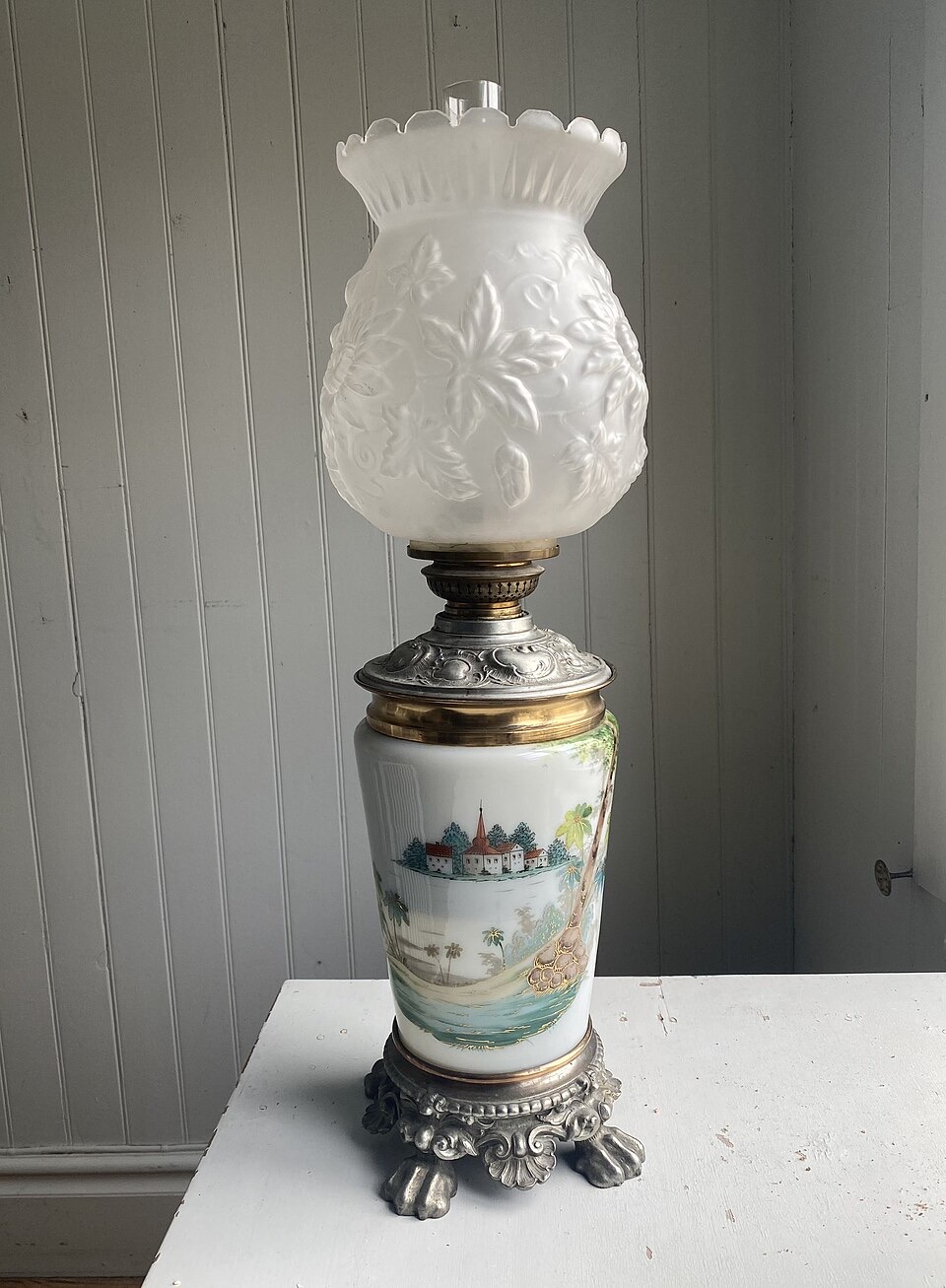
Photograph of a parlor kerosene lamp made in Sweden in the 1890s — the household technology the Knowledge Bank names first in its picture of the 1880s, when lighting came from a flame and a filled reservoir, not a switch. The painted body and frosted shade mark this as a fine parlor piece; most rooms burned far plainer lamps. It belongs to no one in the story — it shows the kind of light the Fosters’ evenings, and the Tucks’, actually happened by.
Parlor kerosene lamp, Karlskrona Lampfabrik, Sweden, c. 1890s; photograph by Svante Tirén. Source: Wikimedia Commons, File:A kerosene lamp produced by the factory of Karlskrona Lampfabrik in Sweden c. 1890s.jpg, CC0.
🧠Knowledge Bank question
1According to the Knowledge Bank, keeping a secret in the 1880s required only distance and silence because ___.Ch.10
2What does the family serve Winnie for supper?Ch.11
3During supper, Winnie feels completely at ease and never thinks of her family.Ch.11
4Where does Tuck take Winnie to explain the family’s secret?Ch.12
5Write the numbers 1–5 in the boxes to show the correct order of events. Number 1 = what happens first.Ch.10–13
The family shares a supper of flapjacks.
Tuck rows Winnie onto the pond at dusk.
The rowboat lodges fast in the weeds.
The stranger leads the horse away and rides for Treegap.
Winnie tours the cluttered, comfortable house.
6Tuck compares life to a turning wheel that includes both growing and dying.Ch.12
7In Tuck’s comparison, what are the Tucks like?Ch.12
8What happens to the rowboat during Tuck’s speech?Ch.12
9The man in the yellow suit buys a fresh horse from a Treegap farmer.Ch.13
10Why is losing the horse a serious blow to the Tucks?Ch.13
Part 3
Literary Elements
Understanding HOW and WHY Natalie Babbitt (author) tells the story across Chapters 10–13.
🧠Knowledge Bank · Making a Reader Wait on Purpose
Literary Craft · Suspense Through Delay
Suspense is manufactured by controlling information and time. Critics distinguish surprise, which lasts a moment, from suspense, which lasts as long as an outcome is pending, and note that suspense usually requires the reader to know more than a character rather than less. The commonest tool is delay: interrupt a scene at the point of maximum uncertainty, cut to something slower, and let the unanswered question run underneath. Writers reinforce this by shortening sentences as tension rises and lengthening them in the interruption, so the prose rhythm itself signals urgency and release. There is a limit. Delay that offers nothing new becomes padding, and readers detect it quickly. Effective interruptions therefore carry information the reader will need shortly, which is why a well-built digression feels irritating on a first reading and inevitable on a second. The best interruptions also change the reader’s understanding of the interrupted scene, so that returning to it feels less like resuming and more like arriving somewhere new.
Extended Metaphor
One comparison carried through a whole scene — life as a turning wheel of water, growth, and death.
Symbol
A thing that stands for an idea — the stranded rowboat is the Tucks’ own stuck life in miniature.
Theme
The idea a story argues — here, that change and death give life its meaning, and endless sameness is no gift.
🧠Knowledge Bank question
1The Knowledge Bank explains that a suspenseful delay avoids turning into padding when it ___.Ch.12
2Fill in the blank with the correct literary term.Ch.12
Word choices:symbolthemesimiledialogue- some words will not be used
The stranded rowboat, standing for the Tucks’ stuck life, is a .
The idea that change and death give life meaning is the book’s .
3Babbitt sets the wheel speech in a rowboat on moving water so that ___.Ch.12
4A symbol is an object or image that stands for a larger idea.Ch.12
5When Tuck calls the family ‘rocks beside the road,’ the image suggests they are ___.Ch.12
6The flapjack supper works as quiet characterization because it shows the Tucks are ___.Ch.11
7A story’s theme is the same thing as its plot summary.Ch.12
8Fill in the blank with the correct literary term.Ch.12
Word choices:extended metaphorsymbolsettingflashback- some words will not be used
Life pictured as a turning water-wheel across a whole scene is an .
9Cutting from Tuck’s gentle speech to the horse theft in the moonlight creates ___.Ch.13
10Which sentence best states the theme Tuck argues on the pond?Ch.12
Part 4
Think Deeper
Four deeper challenges — no single-word recall. Read, weigh the evidence, and reason it out.
🧠Knowledge Bank · When Meaning Well Is Not Enough
Ethics · Kidnapping and Good Intentions
Ethicists distinguish an act’s intention from its permissibility. Someone may act from genuine kindness and still commit a serious wrong, because certain acts violate a person’s standing regardless of motive. Immanuel Kant framed the test that is still quoted: never treat another person merely as a means to an end, always also as an end in themselves. Removing a person’s freedom of movement to protect a secret fails that test cleanly, however sincere the fear behind it. Law encodes the same judgment. Coercion is assessed by what was done to the victim, not by what the actor hoped, and a defense of good motive affects sentencing rather than guilt. The practical warning is that people who believe their cause is important are unusually likely to justify methods they would condemn in anyone else, which is why a sincere motive is the least reliable thing to trust.
Hold the evening in one frame. On the pond, an old-looking man who cannot die rows a child through the dusk, begging her to see that the water’s moving — the growing, the dying, the being replaced — is the whole point of being alive, while their little boat sits stuck in the weeds like the family itself. On the road, a man in a yellow suit rides a stolen horse toward town, carrying the same wonderful, terrible fact — and to him it is not a curse or a blessing. It is merchandise.
Original passage written for Garden Heights — not a quotation from the novel.
1Claim: “Tuck believes that living forever is a burden, not a blessing.” — choose the two details that best prove it.Claim & Evidence
2On the wheel (changing, alive), or Off the wheel (stuck, unchanging)? Tap each detail to sort it — tap again to switch sides. You can keep tapping to change your answer.Sort into two
◄ On the wheel (changing, alive)Off the wheel (stuck, unchanging) ►
3Match each cause to its result. For each cause, pick its result.Cause & Effect
The pond’s water is always slipping out toward the sea→
The rowboat drifts into the thick weeds→
The man in the yellow suit heard the whole story→
The Tucks’ only horse is led away in the night→
🧠Knowledge Bank question
4Fill both blanks to complete the reasoning.Build the Argument
In the Knowledge Bank's account, a kidnapping done out of genuine kindness is still wrong because , which shows that .
Part 5
Standardized Test
The Busy Life of a Still Pond · SAT & TOEFL-style practice
Read the passage — the highlighted words are tested — then answer. Tap an answer, then tap it again to confirm.
SATCentral Ideas — the passage's main point
SATWords in Context — a word's meaning in this passage
SATDetail — a fact stated in the passage
SATText Connections — how two parts of the text relate
TOEFLFactual Information — a fact stated in the passage
TOEFLVocabulary — a tested word's meaning here
TOEFLRhetorical Purpose — why the author included a detail
TOEFLInsert Text — where a sentence best fits
A Pond's Constant Turnover
At dusk, in the fading light just after sunset, a pond on a windless evening looks like the stillest thing in nature, yet it is one of the busiest places in any landscape. Water seeps in from springs and small streams, slides across the basin, and slips out the lower end, so that the pond you see today is not made of the same water as yesterday's. Even in a calm week, more water may be arriving from underground than any eye on the grassy bank can easily see. The dimming sky only deepens the disguise: the quieter the surface looks, the harder the water beneath it is working.
Beneath the surface, a slow current carries seeds, insects, and tiny creatures from one bank to the other. Mayflies hatch, dance a single day, and fall back to feed the fish; tadpoles thicken into frogs; weeds green, brown, and rot into the mud that feeds next summer's growth. Scientists call this constant replacement turnover, and it is the reason a pond stays healthy: fresh water, fresh lives, fresh food, season after season. The pond keeps nothing for long, not even its own water, and it is healthier for the refusal.
Let a makeshift raft, lashed together in an hour from spare planks and borrowed rope, drift too near the shallows, though, and it may end up stranded among the weeds while the water goes on without it. The same restless trading that traps a careless boat is exactly what keeps the whole pond clean and alive. A pond where the turning ever stopped would soon be scummed, sour, and silent. Stillness, in a pond, is only motion wearing a calm face.
Original passage written for Garden Heights — not a quotation from the novel.
1What is the passage mainly about?SAT · Central Ideas
2According to the passage, why is today’s pond “not made of the same water” as yesterday’s?TOEFL · Factual Information
3In the passage, dusk most nearly means ___.SAT · Words in Context
4What do the mayflies contribute to the pond’s cycle?SAT · Detail
5In the passage, “drift” means to ___.TOEFL · Vocabulary
6In the passage, makeshift most nearly means ___.SAT · Words in Context
7What does the passage say would happen to a pond where the turning stopped?TOEFL · Factual Information
8The final sentence calls stillness “motion wearing a calm face,” meaning that ___.TOEFL · Rhetorical Purpose
9Which of these best matches the passage’s idea of “turnover”?SAT · Text Connections
10Insert Text (TOEFL). Look at the four squares [1]–[4] in the excerpt below. They show where this sentence could be added: “Even a pond that has no visible stream still trades its water with the ground below.”
Water seeps in from springs and small streams, slides across the basin, and slips out the lower end. [1] Beneath the surface, a slow current carries seeds, insects, and tiny creatures from bank to bank. [2] Mayflies hatch, dance a single day, and fall back to feed the fish. [3] Scientists call this constant replacement turnover, and it is the reason a pond stays healthy. [4]
Where would the sentence fit best?TOEFL · Insert Text
Part 6 · Optional
Creative Writing
A bonus challenge to practice your English. Take your time and have fun with it.
About This Section
This writing task is optional and is not part of your auto-graded score. The feedback below checks only the basics — length, spelling, and grammar — not whether your ideas are right or wrong. It is meant for classroom discussion and creative practice, so feel free to use your imagination!
Writing Task — Part 4 “The Wheel and the Rock”
Tuck says life is a wheel that must keep turning — and that his family are like rocks beside the road, left out of it. Do you think he is right that living forever would be a burden? Argue YOUR answer. Use one piece of evidence from the pond scene and one example from your own life or imagination. Use at least two vocabulary words from this part.
You can start with: “If someone offered me a drink from that spring, I would...”
0 / 40 words minimum
🗣 Teach It · Just for Fun (optional)
No right or wrong — close the screen and tell someone nearby what happened in this part. Can’t find anyone? Tell yourself out loud. The moment you teach it, you truly understand it.
Part 4 Complete!
You finished Chapters 10–13 of Tuck Everlasting.
Here are your auto-graded results:
-
points out of 100
Teach it to someone
The best last step is to teach it. In your own words, explain what happened — retell a favorite scene, teach a character’s big choice, or sum up the main idea for a parent, friend, or classmate. When you can teach it clearly, you truly own it.
Independent study guide by Garden Heights. Not affiliated with or endorsed by Natalie Babbitt. Contains original analysis only; no text from the novel is reproduced. Reference text: This workbook follows Natalie Babbitt’s classic text (the standard Puffin edition sold worldwide). Revised 2023 UK editions change some wording and may not match the vocabulary studied here.
SAT® is a registered trademark of College Board, which is not affiliated with, and does not endorse, these materials. TOEFL® is a registered trademark of ETS. These materials are not endorsed or approved by ETS. Garden Heights is an independent provider of test-style reading practice.