New here? Just sign up with Google — your account includes Matilda, our gift book, forever.
Tuck Everlasting · Garden Heights
Part 8
for Tuck Everlasting · Part 8 · Chapters 23–25 & Epilogue
8 Parts40 min
What Happens in Part 8
In a storm, Winnie helps Mae escape; years later the Tucks find Winnie chose the wheel.
The midnight escapeThe last day is the hottest of all — stifling, with a great storm looming over Treegap. Winnie waits out the crawling hours, Jesse's little bottle hidden in her drawer, and at midnight slips out to the jail. As the storm breaks, thunder and rain swallow every sound of Miles working the window bars loose; Mae climbs out into the dark, and the goodbyes are quick and aching — a farewell that must last forever.
The decoyWinnie climbs in to curl up in the cot as the decoy. The trick is not found until morning, and the Tucks are gone — fugitives the county will never catch. Winnie, too young to punish, becomes the family's scandal and, secretly, the village children's hero.
The toad's giftThen one August day a dog menaces her old friend the toad — and Winnie, all at once sure, digs out Jesse's bottle and pours every last drop over the little creature. If she ever wants forever, she reasons, there is always more at the spring.
The epilogueThe Epilogue leaps to 1950: Mae and Tuck, unchanged, roll into a Treegap of gas stations and diners. The wood is gone — lightning took the great ash, and the hill was leveled flat. In the cemetery stands a weathered headstone: Winnie, dear wife and mother, died in 1948. She chose the wheel. Good girl, says Tuck. Leaving town, he stops to lift a foolish toad from the wheel-ruts, never guessing it has all the time in the world.
What We Will Learn
Section
What you will practice
Vocabulary
Words of endings: stifling, loom, fugitive, farewell, decoy, disgrace, headstone, epitaph…
Literary Elements
Resolution, the full-circle frame, and the epilogue
Cross-Curricular
Why endings give days — and stories — their meaning
Chapter Summary
Ch.
What happens
23
The Longest Day — stifling heat, a looming storm, and a girl waiting for midnight with a bottle in her drawer.
24
The Jailbreak — thunder masks the bars; Mae slips out; Winnie takes her place in the cot as the storm finally breaks.
25
The Toad Decides It — discovered and disgraced, Winnie pours the spring water over her toad — keeping her own choice for age seventeen.
Epi
Treegap, 1950 — the wood is gone; a headstone reads Dear Wife, Dear Mother; and Tuck, saying ‘Good girl,’ rescues one immortal toad.
Part 1
Vocabulary
Study 10 key words from Chapters 23–25 & Epilogue, then answer each question.
🧠Knowledge Bank · How a Village Becomes a Town
Geography · Places That Change
Settlements grow according to fairly predictable pressures. Geographers use the term urbanization for the shift of population from countryside to town, and they trace most growth to transport: a road, a railway or a river crossing lowers the cost of reaching a place, and businesses follow. Once enough people gather, a settlement gains services that draw more people still, a self-reinforcing loop economists call agglomeration. The reverse also happens. When a road is rerouted or an industry closes, a town can hollow out within a generation, leaving buildings sized for a population that has gone. Landscape historians read these traces directly, since a wide main street in a small village usually means it once held a market, and an oversized chapel means a congregation that has shrunk. Reading a settlement this way turns an ordinary street into a record of decisions made by people who are no longer there to explain.
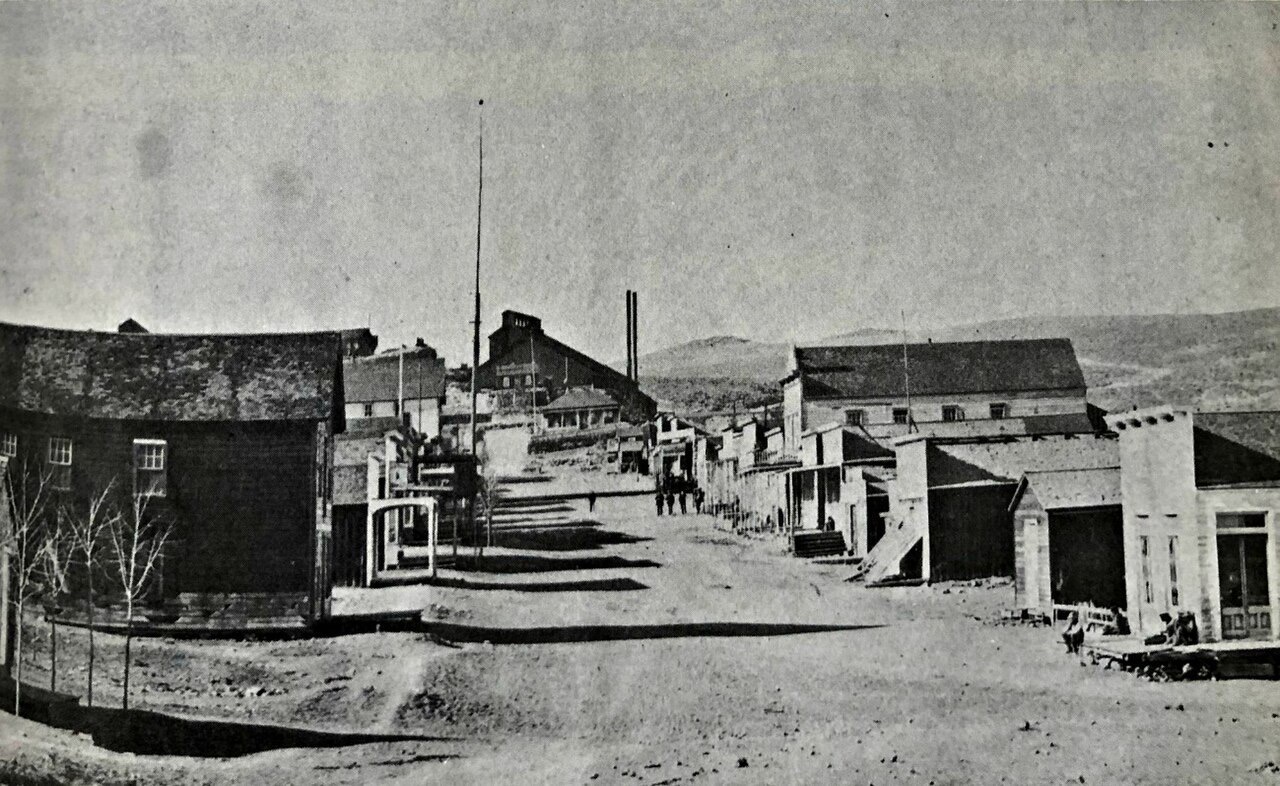
Visual AidA main street that boomed and vanished
Photograph of the main street of Candelaria, Nevada, in the early 1880s, reproduced from a printed book — hence the grain. Read it the way the Knowledge Bank reads settlements: a street this wide, with a mill looming at its head, was built for the crowds a silver strike gathers. The mines failed, the railroad was pulled up, and Candelaria emptied into a ghost town — the reverse loop the Knowledge Bank describes. The picture shows one Nevada mining camp, not Treegap; the resemblance it offers is the pattern, not the place.
Main street of Candelaria, Nevada, early 1880s; unknown photographer, reproduced in Stanley W. Paher, Nevada Ghost Towns and Mining Camps (1970), courtesy of the Estelle Funke Collection. Source: Wikimedia Commons, File:Main street Candelaria Nev c 1880.jpg, public domain.
stiflingadj.Ch.23
So hot and airless it is hard to breathe
“The stifling afternoon seemed to last a year.”
loomv.Ch.23
To rise up large and threatening
“All day the storm continued to loom in the west.”
fugitiven.Ch.24
A person fleeing from the law
“By dawn Mae was a fugitive, gone beyond catching.”
farewelln.Ch.24
An act of saying goodbye
“Their farewell had to be whispered and quick.”
decoyn.Ch.24
Something used to mislead a watcher
“Curled in the cot, Winnie made a perfect decoy.”
disgracen.Ch.25
Loss of respect; deep public shame
“To her family, the jailbreak was a disgrace.”
headstonen.Epi
The stone marker on a grave
“The old headstone was smooth and gray with years.”
ⓘ The vocabulary words in this list are selected to help you understand and complete this workbook. Some may not appear verbatim in the original novel.
🧠Knowledge Bank question
1According to the Knowledge Bank, a weathered, oversized chapel in a small village usually means ___.Ch.23
2If a storm ‘looms,’ it rises up large and threatening.Ch.23
3A person fleeing from the law is a ___.Ch.24
4A ‘decoy’ is meant to mislead whoever is watching.Ch.24
5Fill in each blank with the correct word.Ch.24–25
Word choices:farewelldisgracestiflingfugitive- some words will not be used
Their whispered had to last the Tucks forever.
Her furious family called the jailbreak a .
6The stone marker set over a grave is a ___.Epi
7An ‘epitaph’ is a speech given at a wedding.Epi
8To flatten something completely to the ground is to ___ it.Epi
9Fill in the blanks with the correct words.Epi
Word choices:weatheredepitaphloomdecoy- some words will not be used
The gray stone was by seventy years of rain.
Winnie’s read: Dear Wife, Dear Mother.
10A face worn and aged by sun, wind, and rain is ___.Epi
Part 2
Comprehension
Show you understood what happens in Chapters 23–25 & Epilogue.
🧠Knowledge Bank · Why People Live Longer Than They Used To
History of Medicine · Long Lives
Average life expectancy in 1880 was around forty in much of Europe and North America, and that figure is widely misread. It does not mean forty was old age; it means a great many children died young and pulled the average down. Someone who survived to twenty had a fair chance of reaching seventy. What changed afterwards was mostly not dramatic medicine but sanitation — clean piped water, sewers, milk inspection — followed by vaccination and, later, antibiotics. Demographers call the whole shift the epidemiological transition: infectious disease recedes and chronic disease takes its place as the main cause of death. The maximum human lifespan has barely moved; the oldest verified person reached 122. What has grown enormously is the share of people who get anywhere near it, which is a story about plumbing and public health far more than about medicine.
Visual AidThree bars, one misread number
Measure diagram of the three numbers the Knowledge Bank insists on keeping apart: the 1880 average of about forty, the seventy a person who reached twenty could fairly hope for, and the proven human maximum of 122 years. The bars share one scale, so their lengths can be compared directly; the figures are rounded, and every life behind the averages varied. Notice which bar barely moved in the century since — the ceiling — and which crowd grew: the people reaching near it, thanks mostly to clean water.
Figures as given in the Knowledge Bank; maximum verified age Jeanne Calment, 1875–1997; the pattern per standard historical demography. Drawn for Garden Heights Academy.
🧠Knowledge Bank question
1According to the Knowledge Bank, an average life expectancy of forty in 1880 mainly reflects ___.Ch.24
2What is Winnie’s exact role at the jail?Ch.24
3The escape is discovered within minutes of Mae climbing out.Ch.24
4How is Winnie treated after the trick is discovered?Ch.25
5Write the numbers 1–5 in the boxes to show the correct order of events. Number 1 = what happens first.Ch.23–Epi
Winnie pours the spring water over the threatened toad.
Under cover of the storm, Mae slips out and Winnie slips in.
Winnie waits out the stifling day with the bottle hidden away.
In 1950, Mae and Tuck find the headstone in the cemetery.
The morning discovery makes Winnie a scandal and a quiet hero.
6Winnie drinks the spring water herself the moment the dog appears.Ch.25
7What has happened to the wood by 1950?Epi
8What do the words on the headstone tell the Tucks?Epi
9Tuck is heartbroken and angry when he reads the dates on the stone.Epi
10What does Tuck do on the road out of Treegap?Epi
Part 3
Literary Elements
Understanding HOW and WHY Natalie Babbitt (author) tells the story across Chapters 23–25 & Epilogue.
🧠Knowledge Bank · What a Later Chapter Can Prove
Literary Craft · The Epilogue
An epilogue jumps forward in time after the main action has closed, and it exists to answer a question the plot cannot. Because it stands outside the story’s momentum, it is judged differently: readers forgive a slow epilogue but never a redundant one. Its usual job is to convert a choice into a consequence, showing what a decision actually produced once years had passed, which is the only proof a novel can offer that the decision mattered. Writers keep them short and concrete, resting on a few physical details rather than summary, because a landscape revisited does the comparison automatically. The device also alters the reading of everything before it, since knowing the outcome makes the earlier hesitation either brave or foolish. Ask what the epilogue chooses to show. Whatever it lingers on is what the author believes the book was about, and whatever it leaves out is a judgment that the question no longer matters.
Resolution
The settling of the story’s conflicts — escape completed, secret kept, and Winnie’s choice revealed at last.
Full-Circle Frame
An ending that returns to its beginning — fence, toad, and August heat, each transformed by what happened between.
Epilogue
A final scene set after the main story — Treegap, 1950, where a headstone finishes the tale.
🧠Knowledge Bank question
1The Knowledge Bank explains that an epilogue's usual job is to ___.Epi
2Fill in the blank with the correct literary term.Epi
Word choices:resolutionepilogueclimaxflashback- some words will not be used
A final scene set years after the main story is an .
The settling of a story’s conflicts is its .
3Winnie pouring the bottle over the toad works as her answer to Jesse because it ___.Ch.25
4A full-circle frame returns a story’s ending to images from its beginning.Epi
5Tuck’s two words at the grave — ‘Good girl’ — carry the novel’s theme because they ___.Epi
6The storm breaking at the very hour of the jailbreak is an example of ___.Ch.24
7In a well-made resolution, planted details from early chapters pay off at the end.Epi
8Fill in the blank with the correct literary term.Epi
Word choices:full-circle frameepiloguemotifpacing- some words will not be used
An ending that returns to the fence, the toad, and the heat of the opening is a .
9Making the destroyed wood ordinary — lightning and bulldozers, no magic — suggests that ___.Epi
10The last image — Tuck saving a toad he does not know is immortal — leaves the reader with ___.Epi
Part 4
Think Deeper
Four deeper challenges — no single-word recall. Read, weigh the evidence, and reason it out.
🧠Knowledge Bank · Why Endings Give Things Value
Philosophy · Time and Change
Philosophers disagree about what time is. One view holds that only the present exists and the future is genuinely open; another, sometimes called the block universe, holds that past, present and future all exist equally and our sense of flow is a feature of consciousness rather than of the world. Physics is more comfortable with the second, which makes the everyday feeling of passing time a puzzle rather than an obvious fact. The question connects to value. Several philosophers argue that scarcity is what makes things matter: an afternoon is precious partly because there are only so many, and a choice is weighty because taking one path closes another. If nothing were scarce and no path ever closed, it is unclear what would be left to choose. A life without limits would not be a longer version of this one; it would be a life in which no decision could cost anything, and therefore one in which nothing could be lost.
Stand with Mae and Tuck at the cemetery gate in 1950. The town has traded horses for engines; the wood is a memory under a flattened hill; and a gray stone says that the girl from the fence became a wife, a mother, and at last a name carved in granite — seventy-eight years, all of them used. In Tuck’s pocket of a world where nothing can end, those five carved words are the rarest thing there is: a finished story. He says ‘Good girl.’ And driving out of town, he stops to carry a small, stubborn toad out of the wagon-ruts — mercy from one deathless creature to another, though only the reader knows it.
Original passage written for Garden Heights — not a quotation from the novel.
1Claim: “Winnie’s choice to stay on the wheel was deliberate, not accidental.” — choose the two details that best prove it.Claim & Evidence
2Winnie’s finished life, or The Tucks’ endless one? Tap each detail to sort it — tap again to switch sides. You can keep tapping to change your answer.Sort into two
◄ Winnie’s finished lifeThe Tucks’ endless one ►
3Match each cause to its result. For each cause, pick its result.Cause & Effect
The storm finally breaks over the jail at midnight→
A small sleeper lies curled in Mae’s cot→
A dog corners the toad by the fence→
Lightning fells the ash and machines level the hill→
🧠Knowledge Bank question
4Fill both blanks to complete the reasoning.Build the Argument
According to the Knowledge Bank, several philosophers argue that things matter because they are , so a life without limits would be one in which .
Part 5
Standardized Test
Why Endings Matter · SAT & TOEFL-style practice
Read the passage — the highlighted words are tested — then answer. Tap an answer, then tap it again to confirm.
SATCentral Ideas — the passage's main point
SATDetail — a fact stated in the passage
SATWords in Context — a word's meaning in this passage
SATInference — a conclusion the passage implies
SATText Connections — how two parts of the text relate
TOEFLFactual Information — a fact stated in the passage
TOEFLInsert Text — where a sentence best fits
Why Endings Make Things Matter
Ask why a favorite song, a summer holiday, or a good story satisfies, and part of the answer is always the same: it ends. An ending gives an experience its shape, the way a frame completes a picture, and the mind uses that shape to decide what the whole thing meant. Every final page is a kind of farewell, a goodbye that tells the mind to add up what the whole was worth. Without a last note or a final page, there would be nothing to look back on and no whole to judge at all.
Psychologists who study happiness note that people savor things more when time is short — the last day of a trip, the final chapter of a book — because a limit turns moments from endless supply into treasure. People feel the last day loom ahead like a gathering cloud, and every remaining hour grows brighter. The same meal eaten every single day, or the same song played without pause, slowly loses the very sweetness that once made it worth choosing. Seasons work the same way: winter makes the first warm day precious, and a fruit that ripened all year round would soon be no occasion at all.
Games, too, depend on the final whistle, since a match that never ended could never be won, and a victory that never arrived would drain the play of its point. None of this makes endings painless; it makes them essential. A day is valuable partly because our days are numbered — and a story about people whose days are not numbered is, in the end, a story about why yours should be.
Original passage written for Garden Heights — not a quotation from the novel.
1What is the passage mainly about?SAT · Central Ideas
2The passage compares an ending to ___.SAT · Detail
3In the passage, loom most nearly means ___.SAT · Words in Context
4According to the passage, why does a limit turn moments into “treasure”?TOEFL · Factual Information
5What does the passage say winter does?SAT · Detail
6In the passage, a “victory” that never arrived would ___.TOEFL · Factual Information
7In the passage, a farewell is ___.SAT · Words in Context
8The final sentence suggests that stories about people with unlimited days are really about ___.SAT · Inference
9Which of these best applies the passage’s idea?SAT · Text Connections
10Insert Text (TOEFL). Look at the four squares [1]–[4] in the excerpt below. They show where this sentence could be added: “Even the sweetest experience, repeated without limit, fades into background.”
An ending gives an experience its shape, the way a frame completes a picture. [1] Psychologists note that people savor things more when time is short. [2] Seasons work the same way: winter makes the first warm day precious. [3] A day is valuable partly because our days are numbered. [4]
Where would the sentence fit best?TOEFL · Insert Text
Part 6 · Optional
Creative Writing
A bonus challenge to practice your English. Take your time and have fun with it.
About This Section
This writing task is optional and is not part of your auto-graded score. The feedback below checks only the basics — length, spelling, and grammar — not whether your ideas are right or wrong. It is meant for classroom discussion and creative practice, so feel free to use your imagination!
Writing Task — Part 8 “Dear Winnie”
Imagine Jesse returns to Treegap in 1950, after Tuck has seen the headstone, and writes one last letter to Winnie — a letter she can never read. What would he say about her choice, about the toad, and about his own endless seventeen? Keep his voice: playful on the surface, aching underneath. Use at least two vocabulary words from this part.
You can start with: “Dear Winnie, I came back to Treegap today, and they tell me you...”
0 / 40 words minimum
🗣 Teach It · Just for Fun (optional)
No right or wrong — tell someone nearby what happened in this part. Can’t find anyone? Tell yourself out loud. The moment you teach it, you truly understand it.
Part 8 Complete — You Finished the Book! 🎉
You finished Chapters 23–25 & Epilogue — the final part of Tuck Everlasting.
Here are your auto-graded results:
-
points out of 100
Teach it to someone
The best last step is to teach it. In your own words, explain what happened — retell a favorite scene, teach a character’s big choice, or sum up the main idea for a parent, friend, or classmate. When you can teach it clearly, you truly own it.
Independent study guide by Garden Heights. Not affiliated with or endorsed by Natalie Babbitt. Contains original analysis only; no text from the novel is reproduced. Reference text: This workbook follows Natalie Babbitt’s classic text (the standard Puffin edition sold worldwide). Revised 2023 UK editions change some wording and may not match the vocabulary studied here.
SAT® is a registered trademark of College Board, which is not affiliated with, and does not endorse, these materials. TOEFL® is a registered trademark of ETS. These materials are not endorsed or approved by ETS. Garden Heights is an independent provider of test-style reading practice.