New here? Just sign up with Google — your account includes Matilda, our gift book, forever.
What Happens in Part 6
A little mystery takes over these chapters, and Sachar keeps us guessing. The principal has found a strange card, and he sets out to discover who is responsible by questioning the three Erics — Eric Fry, Eric Bacon, and Eric Ovens — one after another. As the principal interrogates each boy, the suspense grows: who did it, and will the truth come out? It is a funny little detective story played out in a classroom. Then the mood softens for a gentler puzzle: Rondi, whose missing front teeth have been part of who she is, has finally grown new ones — and now she must decide whether she even wants to keep them. In both stories, Sachar holds a question open just long enough to keep us leaning in, showing how a good writer uses mystery and suspense to pull a reader right along.
What We Will Learn
Focus
What It Means
Mystery & Suspense
A question held open to keep us guessing
A Classroom Detective Story
The principal questioning the three Erics
A Gentle Puzzle
Rondi deciding about her new teeth
Chapter Summary
Chapter
Key Events
Ch. 20–23
The principal finds a mysterious card and questions the three Erics — Fry, Bacon, and Ovens — one by one, building suspense over who is responsible; and Rondi, whose missing front teeth were part of her identity, grows new ones and must decide whether to keep them
💭 Before You Read · Warm-Up (not scored)
There are no wrong answers here — just think, guess, and talk:
The principal keeps us guessing about who is responsible for the card. Why is not knowing the answer yet — the suspense — so exciting to read?
Rondi’s missing teeth were part of who she was, and now she must decide about her new ones. Why might someone feel unsure about a change to how they look?
Predict: as the principal questions each Eric, what clues do you think might finally reveal the truth?
Copyright Notice
This is an independent study guide created by Garden Heights Academy to support reading comprehension and literary analysis. It contains original analysis questions and does not reproduce any text from the novel. Wayside School Is Falling Down is a work by Louis Sachar. This guide is not affiliated with, authorized by, or endorsed by the author or any associated rights holder.
Part 1
Vocabulary
Study 10 key words from Chapters 20–23, then answer each question.
🧠Knowledge Bank · The Puzzle of Nothing
Mathematics · Zero and NothingThe strangest idea in mathematics may be nothing at all. People counted for thousands of years before anyone thought to write a symbol for an empty amount, and zero arrived late and was distrusted when it came, because how do you record a quantity of things when there are no things there? Wayside builds a joke out of that very riddle. The nineteenth story does not exist, and neither does the teacher said to work on it, yet the school keeps insisting on both, describing a floor, a room and a class made entirely of nothing. That is a fine mathematical tease, since the moment you say nothing is there you have given it a name. Some of the deepest questions start from an idea that looks completely empty.
trappedadj.Ch.20
Caught with no way out
“Allison is trapped in the strange class.”
escapev.Ch.21
To get free from a place or danger
“She finds a way to escape.”
disobeyv.Ch.21
To refuse to do what you are told
“Allison escapes by choosing to disobey.”
principaln.Ch.22
The head of a school
“Mr. Kidswatter is the principal.”
insultn.Ch.22
A rude, hurtful remark
“Someone wrote an insult about him.”
memoryn.Ch.20
Something you remember
“Allison feels her memories slipping away.”
reputationn.Ch.22
What people think someone is like
“Each Eric has an unfair reputation.”
judgev.Ch.22
To form an opinion about someone
“People judge the Erics by their looks.”
admirev.Ch.23
To think highly of; look up to
“People come to admire Rhondi’s smile.”
embarrassedadj.Ch.23
Feeling shy and uneasy about oneself
“Rhondi is embarrassed about her teeth.”
🧠Knowledge Bank question
1According to the Knowledge Bank, zero arrived late and was distrusted because ___.Ch.20
2To ‘escape’ is to —Ch.21
3Fill in each blank with the correct word.Chs. 20–23
Word choices:principalembarrassedmemoryescape- some words will not be used
Mr. Kidswatter, the school , is very upset.
Rhondi feels shy and about her new front teeth.
4To ‘disobey’ is to —Ch.21
5A ‘memory’ is something you remember.Ch.20
6To ‘admire’ someone is to —Ch.23
7Fill in each blank with the correct word.Chs. 20–23
Word choices:insultjudgetrappedadmire- some words will not be used
Somebody wrote a rude about the principal.
The three Erics show us not to people by their looks.
8A ‘reputation’ is —Ch.22
9An ‘insult’ is —Ch.22
10To be ‘trapped’ means to be completely free to leave.Ch.20
Part 2
Comprehension
How well do you understand Chapters 20–23?
🧠Knowledge Bank · The Withheld Answer
Reading Skill · Suspense and QuestionsA mystery works by raising a clear question and then refusing to answer it. When the principal lines up the three Erics and questions them one at a time about a card nobody will claim, an ordinary classroom becomes a small detective story: who did this, and why will nobody say? Sachar could tell us immediately. He does not, and that delay is the whole engine of suspense. Even the gentler story running alongside holds a question of its own, about a girl and a set of teeth she may or may not keep. Readers will follow a book almost anywhere so long as a question they care about stays open. Learning how writers plant questions and postpone answers uncovers one of storytelling’s best-kept secrets.
Visual AidA question held open
Diagram for the Knowledge Bank on suspense. The top box is the question the Knowledge Bank says the chapter raises; the two boxes below compare what the author could do with what he does. It does not tell you the answer either. Notice that the right-hand box is the slower one on purpose — the delay is the whole engine.
Question and delay as described in the Knowledge Bank. Drawn for Garden Heights Academy.
🧠Knowledge Bank question
1The Knowledge Bank says suspense works by ___.Ch.20
2What frightening thing starts happening to Allison there?Ch.20
3How does Allison finally escape?Ch.21
4How many boys named Eric are in the story?Ch.22
5Write the numbers 1–5 in the boxes to show the correct order across Part 6. Number 1 = what happens first.Chs. 20–23
Mr. Kidswatter hunts the Eric who insulted him.
Allison disobeys and escapes back to Mrs. Jewls.
Allison finds Miss Zarves’s class traps its students.
Rhondi worries about her teeth, then is admired.
Allison starts to be forgotten and loses memories.
6Why does Mr. Kidswatter question the Erics?Ch.22
7What is unfair about the three Erics?Ch.22
8What happens with Rhondi’s new teeth?Ch.23
9Allison escapes by obeying every one of Miss Zarves’s rules perfectly.Ch.21
10Both the Erics’ story and Rhondi’s story deal with being judged unfairly by appearance.Chs. 22–23
Part 3
Literary Elements
Understanding HOW and WHY Louis Sachar tells the story across Chapters 20–23.
🧠Knowledge Bank · The Book Winks
Literary Craft · MetafictionSometimes a story steps back and jokes about being a story. Critics call that metafiction, and it is a wink aimed straight at the reader. A book that skips a chapter and then talks about the missing one, or a school that lists a floor readers can plainly see is not there, is playing this game, inviting you to notice the machinery instead of hiding it. The trick pairs neatly with paradox, a statement that contradicts itself and turns out to be true anyway. A place that exists only by not existing sounds like plain nonsense, yet it says something honest about the people and things we quietly agree to overlook. When a book teases you about its own pages, look for the truth folded inside the joke.
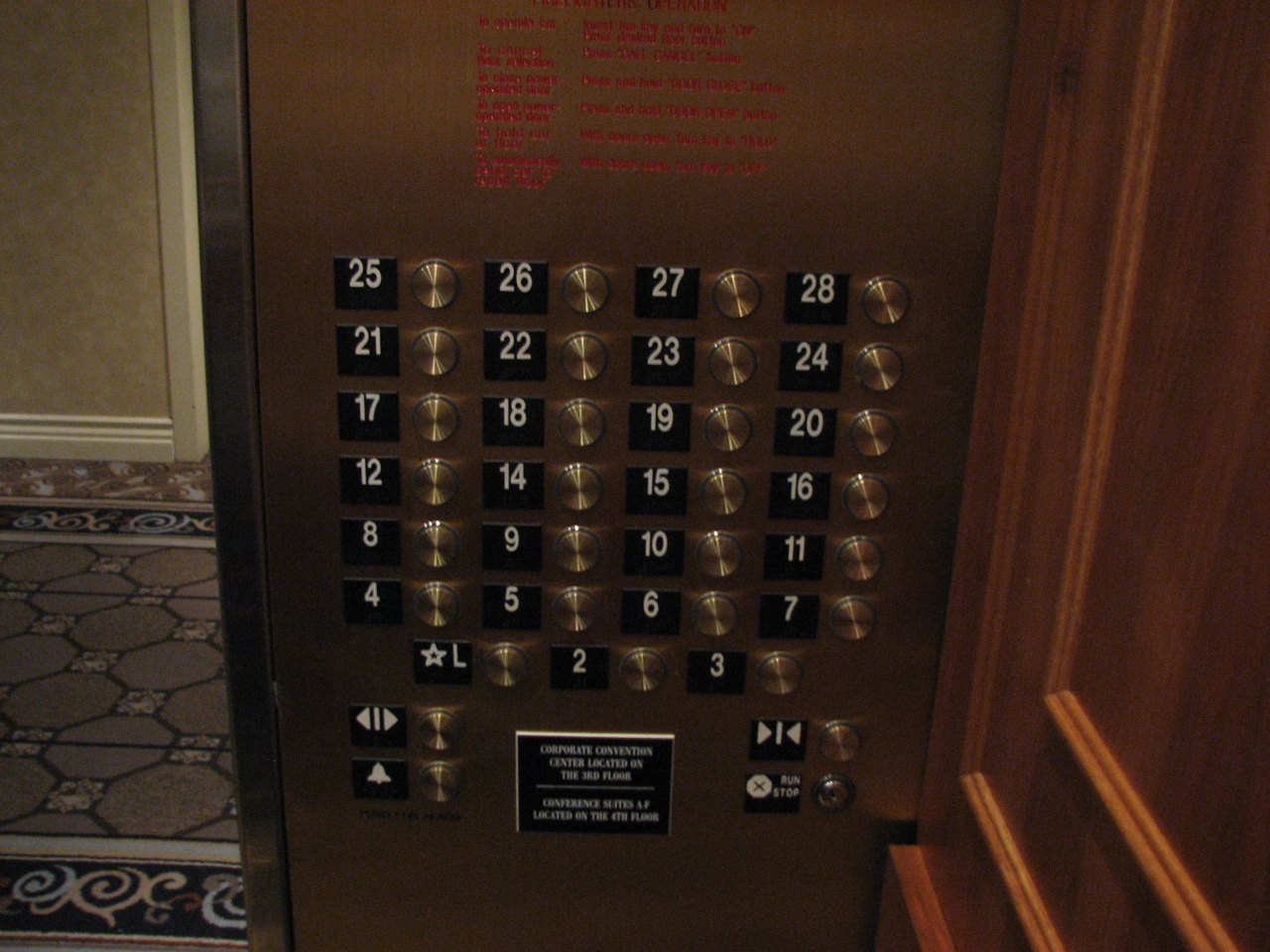
Visual AidA floor that everyone agrees is not there
Photograph of an elevator panel in a real building, where the buttons jump from 12 to 14. The Knowledge Bank explains that a place that exists only by not existing sounds like nonsense yet says something true about the things people quietly agree to overlook. The floor behind this panel is really there; it simply has no name. This elevator is not at Wayside School. Notice that nobody riding it thinks anything is missing — the agreement is so complete that the gap is invisible, which is exactly the joke the book plays with its nineteenth story.
Elevator panel with no button for 13. Source: Wikimedia Commons, public domain.
📚 Literary Devices in This Part · definitions & examples
A paradox seems to contradict itself but points to a truth (‘Forever Is Never’). A symbol is something that stands for a bigger idea (the forgotten class = being unseen). A theme is the story’s big message — here, do not judge by appearances.
🧠Knowledge Bank question
1According to the Knowledge Bank, metafiction is ___.Ch.21
2A theme is the big message or idea behind a story.Ch.22
3Fill in each blank with the correct word.Chs. 20–23
Word choices:paradoxthemerhymeindex- some words will not be used
‘Forever Is Never’ is a striking .
‘Do not judge by looks’ is the chapter’s .
4The forgotten class standing for the fear of being unseen is an example of a —Ch.20
5A paradox is meant to make the reader stop and think.Ch.21
6Fill in the blank with the correct word.Chs. 20–23
Word choices:symbolrhymesetting- some words will not be used
Miss Zarves’s forgotten class works as a for being unseen.
7The theme shared by the Erics and Rhondi is that we should not —Chs. 22–23
8The title ‘Forever Is Never’ fits Allison’s escape because staying forever would mean —Ch.21
9Fill in the blank with the correct word.Chs. 20–23
Word choices:paradoxrhymeplot- some words will not be used
A line like ‘forever is never’ that seems impossible yet true is a .
10Wrapping a real idea inside a fantasy puzzle mainly helps it —Chs. 20–21
Part 4
Think Deeper
Four deeper challenges — no single-word recall. Read, weigh the evidence, and reason it through.
🧠Knowledge Bank · Suspects and Labels
Thinking & Character · Reputation and BlameThree boys share one name, and each was long ago fitted with a nickname describing the opposite of who he really is. So when something goes wrong and a grown-up wants a culprit, those three are the ones lined up, chosen not by evidence but by reputation. Sachar lets us feel how heavy a label grows when you did not choose it and cannot shake it off. Being suspected is a punishment of its own, whatever the truth may turn out to be. Because this happens to boys we like, we grow more careful with the labels we hand out ourselves in a hallway or a lunchroom. Everybody deserves a second look rather than a snap verdict, and offering that look is the beginning of real fairness.
1Claim: “A little mystery keeps the reader guessing about the three Erics.” — choose the two details that best prove it.Claim & Evidence
2Shows the mystery being investigated, or just a detail? Tap each item to sort it — tap again to switch sides. You can keep tapping to change your answer.Sort into two
◄ The mystery investigatedJust a detail ►
3Match each cause to its result. For each cause, pick its result.Cause & Effect
The principal finds a strange card→
He begins to investigate→
Each Eric is suspected→
Clues are weighed→
🧠Knowledge Bank question
4Fill both blanks to complete the reasoning.Build the Argument
The Knowledge Bank says the three Erics are lined up because of , which shows that .
Part 5
Standardized Test
Don’t Judge by Appearances — SAT & TOEFL-style practice
Read the passage — the highlighted words are tested — then answer. Tap an answer, then tap it again to confirm.
SATWords in Context — a word's meaning in this passage
SATInference — a conclusion the passage implies
TOEFLFactual Information — a fact stated in the passage
TOEFLProse Summary — the three sentences that sum it up
TOEFLRhetorical Purpose — why the author included a detail
The Trouble With First Impressions
‘Don’t judge a book by its cover’ is one of the oldest pieces of advice there is, and for good reason. Our brains are built to form fast first impressions: within seconds of meeting someone, we decide whether they seem friendly, clever, or kind. This quick judging once helped our ancestors stay safe, but it often leads us badly astray. A person with a stern face or a bad reputation may be gentle; a plain, quiet classmate may be the most interesting friend you never made. The truth is that outward appearance tells us almost nothing about a person’s real character — their honesty, courage, and heart. Those things, the ones we truly admire, are revealed only over time, through actions, not looks. That is why wise people try to stay curious about others instead of deciding too soon. When you catch yourself judging a stranger by their clothes or face, it is worth pausing to remember: the most important parts of anyone are the parts you cannot see at first glance.
Original passage written for Garden Heights — not a quotation from the novel.
1What old advice does the passage begin with?TOEFL · Factual Information
2How fast do our brains form first “impressions”?TOEFL · Factual Information
3In the passage, a bad reputation is ___.SAT · Words in Context
4Why did fast judging once help our ancestors?TOEFL · Factual Information
5In the passage, things we truly admire are things we ___.SAT · Words in Context
6How is a person’s true character revealed?TOEFL · Factual Information
7Wise people stay “curious” about others, meaning they —SAT · Words in Context
8The passage suggests the most important parts of a person are —SAT · Inference
9This TOEFL task lists six sentences; choose the THREE that best capture the passage’s main ideas. The other three do not belong — they state minor details or ideas the passage does not present.TOEFL · Prose Summary
10This passage connects to Part 6 because —TOEFL · Rhetorical Purpose
Part 6 · Optional
Creative Writing
A bonus challenge to practice your English. Take your time and have fun with it.
About This Section
This writing task is optional and is not part of your auto-graded score. The feedback below checks only the basics — length, spelling, and grammar — not whether your ideas are right or wrong. It is meant for classroom discussion and creative practice, so feel free to use your imagination!
Writing Task — Part 6 “A Little Mystery”
The principal turns detective to solve the mystery of the card. Write your own very short mystery: something goes missing or something strange happens, and someone must figure out who or why. Or write about a time you had to solve a puzzle. Write at least 40 words.
You can start with: “Here is my little mystery…”
0 / 40 words minimum
🗣 Teach It · Just for Fun (optional)
No right or wrong — close the screen and tell someone nearby about the principal questioning the three Erics. Can’t find anyone? Tell yourself out loud. The moment you teach it, you truly understand it.
Part 6 Complete!
You finished Chapters 20–23 of Wayside School Is Falling Down.
Here are your auto-graded results:
-
points out of 100
Teach it to someone
The best last step is to teach it. In your own words, explain what happened — retell a favorite scene, teach a character’s big choice, or sum up the main idea for a parent, friend, or classmate. When you can teach it clearly, you truly own it.
Independent study guide by Garden Heights Academy. Not affiliated with or endorsed by the author or any rights holders. Contains original analysis only; no text from the novel is reproduced.
SAT® is a registered trademark of College Board, which is not affiliated with, and does not endorse, these materials. TOEFL® is a registered trademark of ETS. These materials are not endorsed or approved by ETS. Garden Heights is an independent provider of test-style reading practice.