New here? Just sign up with Google — your account includes Matilda, our gift book, forever.
Where the Red Fern Grows · Garden Heights
Part 5
for Where the Red Fern Grows · Part 5 · Chapters 11–13
8 Parts40 min
What Happens in Part 5
An icy rescue, a wager on a ghost coon, and a boy's death end the season in grief.
Through the iceBilly hunts straight through the winter and the hides mount up. Then a river coon, pressed hard, pulls the cruelest trick it knows: it leads the chase onto the frozen river, where the ice will carry a coon but not a hound. Little Ann breaks through. Billy hears the raw panic in Old Dan's voice before he sees anything, and finds her clinging to the edge, too cold to pull herself out.
The lantern hookHis first try fails and hope is nearly gone. Billy prays; moments later the wind sends his lantern over, and the sight of its wire handle gives him an idea. He bends the handle into a hook, fixes it to a long pole, strips off his clothes, wades in as far as a body can stand, snags her collar, and drags her to the bank. A fire and a long rubdown bring her back.
The Pritchards' betThe hounds' reputation spreads through the river country, helped along by a proud grandfather who retells every hunt at his store, and Billy hands his fur money to his father. Then the Pritchard boys turn up, broad-shouldered, mean-eyed Rubin and his brother Rainie, who wants to bet on everything. Rainie sneers out a two-dollar wager: the hounds cannot tree the ghost coon that no dog has ever put up a tree.
The fatal axeOn the hunt the old coon runs every trick in his book and vanishes, until Little Ann unravels the escape at an old gate post and the coon is treed. Billy climbs, then cannot make himself kill an animal that has outsmarted hunters for years. The Pritchards' hound jumps Old Dan and Little Ann; Rubin snatches Billy's axe to kill the dogs, trips, and falls on the blade. He dies, and days later Billy lays flowers on his grave.
What We Will Learn
Section
What you will practice
Vocabulary
River danger and a risky dare: treacherous, instinct, reputation, wager, bewildered…
Literary Elements
Foreshadowing that keeps its promises, mood that turns from lively to grim, and conflict with a frozen river — and then with the Pritchard boys
Cross-Curricular
The river-bottom forest — why bottomland sycamores grow into hollow giants, and how settlers used the big timber of the bottoms
Chapter Summary
Ch.
What happens
Chapter 11
Through the Ice — A winter coon leads the hunt onto the frozen river, and Little Ann breaks through. Guided by Old Dan’s frantic cries, Billy finds her, prays when his rescue fails, and then bends his lantern handle into a hook on a pole, wades the freezing water, and snags her collar. A fire and a rubdown save her life.
Chapter 12
The Two-Dollar Dare — The hounds’ fame spreads through the hills, Grandpa retells their hunts to every customer at his store, and Billy hands his fur money to Papa. Then Rainie Pritchard jeers out a two-dollar wager that the dogs cannot tree the ghost coon, and Grandpa puts up the money and tells Billy to take it.
Chapter 13
The Ghost Coon — On the Pritchard bottoms the old coon runs its tricks and vanishes, until Little Ann unravels the escape at an old gate post and the coon is treed. Billy refuses to kill it. A dogfight breaks out, Rubin runs at the hounds with Billy’s axe, trips, and falls on the blade — and the night ends in a death.
Part 1
Vocabulary
Study 10 key words from Chapters 11–13, then answer each question.
🧊Knowledge Bank · Why Moving Water Lies
Hydrology · River IceA frozen river is never one solid floor. Where the water sits slow and deep, ice can thicken until it holds a loaded wagon; where a current squeezes between rocks or slides over a riffle — a shallow, rippling stretch of riverbed — the moving water eats the ice from below and leaves a thin skin that looks exactly like the strong ice beside it. Hidden springs rising from the bottom do the same quiet damage, which is why old river families judged ice by where it lay, not by how white it looked. The second danger is time. Water that cold pulls heat out of a body far faster than winter air does, and within minutes hypothermia — the fall of the body’s core temperature — stiffens the muscles until swimming fails. The hands and paws quit first, which is why a dog can claw at the rim of a hole and still be unable to climb. On a winter river, the deadliest ice is the ice nobody thought to be testing.
Visual AidWhere a frozen river is thin
Structure diagram of the danger the Knowledge Bank explains: ice thickens over slow, deep water, but a riffle’s current and a spring rising from the bed both eat it from underneath, leaving a skin that from above looks exactly like the strong ice beside it. Thicknesses here are exaggerated so the three stretches can be told apart, and a real river varies at every bend. The drawing is a general section, not a map of the Illinois River or of any night in the novel; the lesson to carry away is that ice is judged by where it lies, not by how it looks.
River ice over pools, riffles and bottom springs, and cold-water heat loss, as described in standard cold-regions hydrology and ice-safety guidance. Drawn for Garden Heights Academy.
treacherousadj.Ch.11
Full of hidden danger; not to be trusted
“The river ice looked solid, but it was treacherous.”
instinctn.Ch.11
A natural sense an animal is born with, not taught
“Instinct usually kept Little Ann away from thin ice.”
circulationn.Ch.11
The movement of blood through the body
“Billy rubbed her cold legs to bring back circulation.”
rifflen.Ch.11
A shallow, rippling stretch of a river
“Below the riffle the current kept the ice dangerously thin.”
reputationn.Ch.12
The opinion people hold about someone
“The two hounds’ reputation spread all through the river country.”
wagern.Ch.12
A bet; money risked on a result
“Rainie offered a wager of two dollars against the dogs.”
surlyadj.Ch.12
Rude, unfriendly, and bad-tempered
“The Pritchard boys had a surly way of talking to strangers.”
tauntv.Ch.12
To mock someone with insulting words
“Rainie seemed to taunt everyone who crossed his path.”
peltn.Ch.12
The skin and fur of an animal
“Every stretched pelt in the smokehouse meant money for the family.”
bewilderedadj.Ch.13
Completely confused
“The vanishing trail left both hounds bewildered.”
ⓘ The vocabulary words in this list are selected to help you understand and complete this workbook. Some may not appear verbatim in the original novel.
🧠Knowledge Bank question
1According to the Knowledge Bank, the ice over a riffle is dangerous because ___.Ch.11
2An ‘instinct’ is a skill an animal must slowly be taught.Ch.11
3‘Circulation’ is the movement of ___.Ch.11
4A ‘riffle’ is a stretch of river that is ___.Ch.11
5Fill in each blank with the correct word.Ch.12
Word choices:reputationwagerrifflepelt- some words will not be used
The hounds’ spread all through the hills.
Rainie offered a of two dollars.
6A ‘surly’ person is ___.Ch.12
7To ‘taunt’ someone is to mock them with insulting words.Ch.12
8A ‘pelt’ is an animal’s ___.Ch.12
9Fill in each blank with the correct word.Ch.13
Word choices:bewilderedcirculationtauntsurly- some words will not be used
Billy rubbed her legs to bring back .
The vanishing trail left the hounds .
10‘Reputation’ means the opinion people hold about someone.Ch.12
Part 2
Comprehension
Show you understood what happens in Chapters 11–13.
🌳Knowledge Bank · The Hollow-Tree Hotel
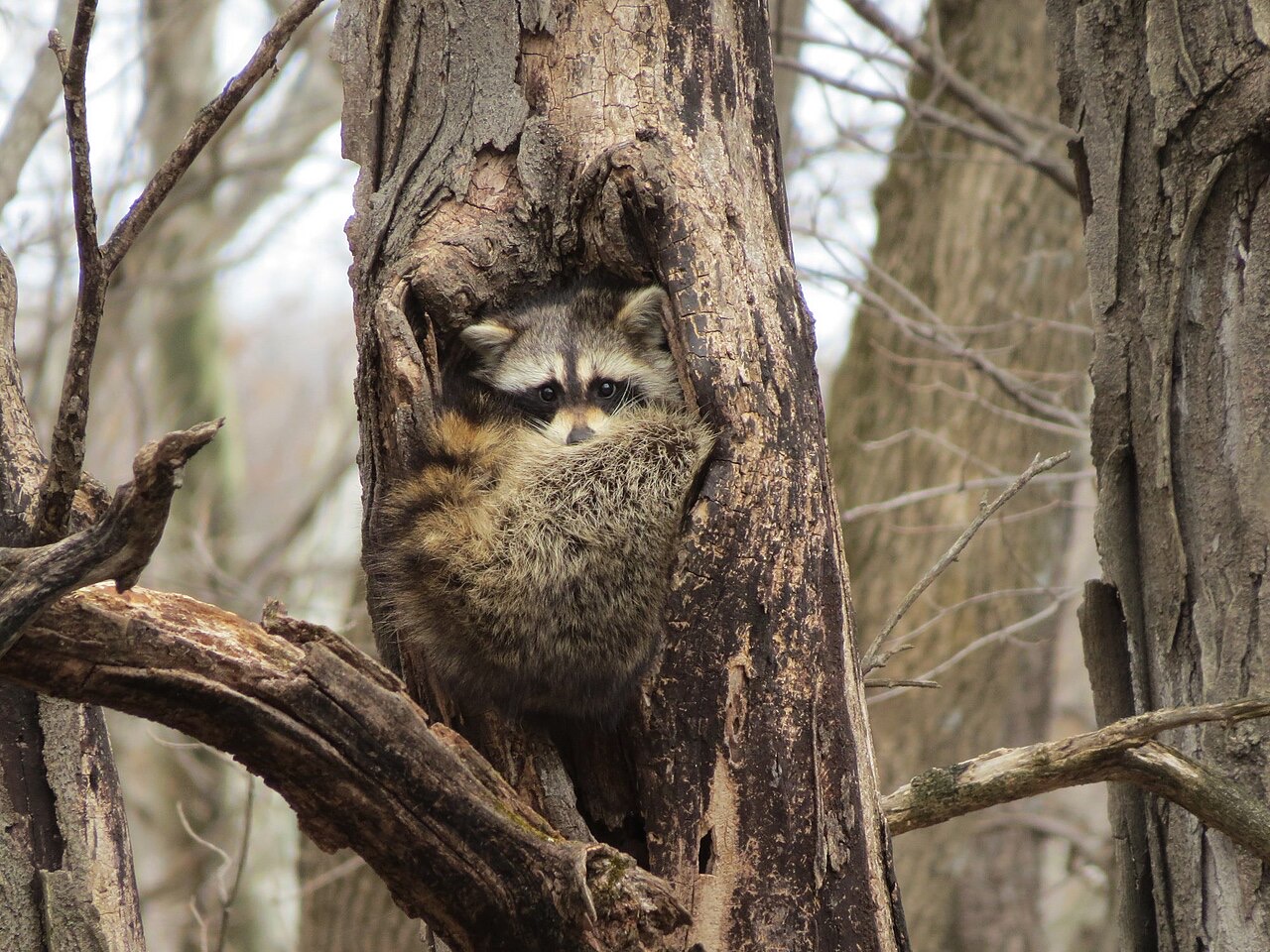
Ecology · Den TreesA hollow tree is not a dying tree — it is working forest housing. The hollow begins when a storm rips off a big limb and fungi enter the wound, slowly digesting the heartwood, the dead central column that stiffens a trunk but carries no water. The living outer wood keeps growing, so over decades the tree stays green while its center opens into a dry, sheltered chamber. Foresters call the result a den tree, and a single big one is a crowded address: squirrels in the upper knotholes, owls in the broken top, honeybees walling a side cavity with comb, bats folded behind loose bark, and larger furbearers denned deep in the trunk. Because a usable hollow can take a century to form, den trees cannot be replaced by young woods, and modern wildlife managers mark them to be left standing when timber is cut. In the bottoms Billy hunts, the giant hollow sycamores are the apartment houses of the whole forest.
Visual AidThe tenant at the door
Photograph of a raccoon in the mouth of a hollow trunk on a national wildlife refuge in Iowa — a den tree in use, which is exactly what the Knowledge Bank is about. Notice that the tree is alive: the wound has healed over into a rim while the living outer wood kept growing, and the dry chamber inside is what the fungi left of the heartwood. One picture cannot show the century such a hollow takes to form, nor the squirrels, owls, bees and bats that share a big one. The tree is not the sycamore of the story, and this raccoon is not being hunted.
Raccoon resting in a tree cavity, Port Louisa National Wildlife Refuge, Iowa; photograph by Jessica Bolser, U.S. Fish and Wildlife Service, April 2019. Source: Wikimedia Commons, File:Raccoon resting in a tree cavity (40663787313).jpg, public domain.
🧠Knowledge Bank question
1The Knowledge Bank explains that a hollow opens inside a living tree when ___.Ch.11
2What gives Billy the idea that finally saves Little Ann?Ch.11
3Little Ann breaks through the ice while a coon leads the chase onto the frozen river.Ch.11
4Who does the most to spread the two hounds’ fame?Ch.12
5Write the numbers 1–5 in the boxes to show the correct order of events. Number 1 = what happens first.Chapters 11–13
The Pritchard boys offer a two-dollar wager over the ghost coon.
A winter coon leads the chase onto the frozen river.
Rubin trips while running with the axe and falls on the blade.
Little Ann unravels the ghost coon’s trick at an old gate post.
Billy bends his lantern handle into a hook and saves Little Ann.
6Billy’s grandfather refuses to let him accept the Pritchards’ bet.Ch.12
7Where does Little Ann finally solve the ghost coon’s vanishing trick?Ch.13
8Why does Billy refuse to kill the ghost coon?Ch.13
9Rainie Pritchard stays calm and takes charge after Rubin is hurt.Ch.13
10How does Rubin Pritchard die?Ch.13
Part 3
Literary Elements
Understanding HOW and WHY Wilson Rawls tells the story across Chapters 11–13.
🗣Knowledge Bank · How a Story Travels
Folklore · Oral StorytellingBefore radios reached the hill country, news moved by mouth, and the country store was its newspaper. Men trading eggs and fur lingered by the stove, and whoever held the floor shaped the news the way a craftsman shapes wood — choosing where to pause, what to stretch, what to save for last. Folklorists call this oral tradition, and its favorite American form is the tall tale, a story that grows a little taller with every telling. A reputation built this way is a living thing: each reteller polishes it, and nobody can check the original. That is the machine that makes Billy’s hounds famous. Grandpa retails every hunt across his counter, customers carry the story up their own hollows, and by the time it reaches the next valley the two dogs are half legend. The ghost coon is the same machine running in reverse — an animal no one can tree becomes a story every hunter tells, until a two-dollar wager feels like a challenge to the whole tradition.
Foreshadowing
Grandpa’s warning about winter river tricks comes true on the ice, and the uneasy, darkening ghost-coon night keeps its own grim promise.
Mood
Rawls (author) lets the feeling of the story turn — lively winter hunts, then dread on the river, then horror on the Pritchard bottoms.
Conflict
Person against nature on the frozen river; person against person once the Pritchards and their wager walk into the story.
🧠Knowledge Bank question
1According to the Knowledge Bank, a reputation carried by oral tradition keeps growing because ___.Ch.11
2Mood is the feeling a piece of writing stirs in the reader.Ch.11
3Billy fighting the frozen river to save Little Ann is which kind of conflict?Ch.11
4The sneering two-dollar wager sets up which kind of conflict?Ch.12
5Fill in each blank with the correct literary term.Ch.11
Word choices:foreshadowingmoodrhymedialogue- some words will not be used
Grandpa’s warning hints at danger to come: .
The shift from lively hunts to dread changes the .
6Person-versus-person conflict means a character struggles against a storm or a river.Ch.12
7Rawls (author) slows the pace and darkens the details before Rubin’s fall mainly to build ___.Ch.13
8Fill in each blank with the correct literary term.Ch.13
Word choices:conflictforeshadowingsimileglossary- some words will not be used
Billy against the icy river is person-versus-nature .
The strange, uneasy stillness before the accident works as .
9The wager between Billy and the Pritchard boys is an external conflict.Ch.12
10Which event is the clearest example of person-versus-nature conflict?Ch.11
Part 4
Think Deeper
Four deeper challenges — no single-word recall. Read, weigh the evidence, and reason it out.
🧠Knowledge Bank · The Coon Billy Would Not Kill
Ethics · Hunting ChoicesHunting cultures have carried a rough code for centuries, and its center is the idea of fair chase: the game must have a real chance to escape, or the hunt is just killing. Out of that code grows a stranger custom — the worthy opponent. An animal that beats hunters honestly, season after season, earns a kind of standing, and many old hunters would sooner lose a wager than shoot it off a limb. Billy’s refusal in the ghost-coon tree sits squarely inside that tradition: the old coon played by the rules for years and won, so killing him now would feel like cheating a rival who never cheated. Rubin, standing below, sees only two dollars in a tree. The same night, the same coon, two boys — and two entirely different answers to the oldest question in hunting: what do you owe the thing you hunt.
Picture a boy standing on a frozen riverbank in the middle of a winter night, his clothes piled behind him on the ice, gripping a long pole with a bent lantern handle wired to the end of it. Out where the current has chewed the ice thin, his little hound is clawing at the rim of a black hole in the river, and every splash sounds weaker than the one before. That is one night from this part. Here is another: a moonlit bottomland on an unfriendly family’s land, a raccoon that hunters have chased for years without ever treeing, two dollars riding on the outcome, and two sneering boys walking behind Billy with a big blue hound of their own. Part 5 is where the hunting stops being a game. The dogs’ fame spreads through the hills, the hides pile up, and the money goes quietly into his father’s hand — but the river nearly takes Little Ann, and the ghost-coon bet takes something that can never be handed back.
Original passage written for Garden Heights — not a quotation from the novel.
1Claim: “Part 5 shows that the hounds survive and succeed only because their gifts are combined — Old Dan’s grit is nothing without Little Ann’s brains, and hers is nothing without his.” — choose the two details that best prove it.Claim & Evidence
2Happens on the frozen river, or Happens on the ghost-coon night? Tap each detail to send it left or right.Sort into two
◄ Happens on the frozen riverHappens on the ghost-coon night ►
3Match each cause to its result. For each cause, pick its result.Cause & Effect
Grandpa warns about winter river tricks→
Old Dan raises a strange, urgent cry→
The Pritchard boys sneer out a two-dollar wager→
Rubin runs at the hounds with the axe→
🧠Knowledge Bank question
4Fill both blanks to complete the reasoning.Build the Argument
Billy leaves the ghost coon alive because , which shows that he follows .
Part 5
Standardized Test
Giants by the River · Reading & Vocabulary · SAT & TOEFL-style practice
Read the passage — the highlighted words are tested — then answer. Tap an answer, then tap it again to confirm.
SATCentral Ideas — the passage's main point
SATInference — a conclusion the passage implies
SATAuthor’s Purpose — what the author wants to achieve
SATWords in Context — a word's meaning in this passage
TOEFLFactual Information — a fact stated in the passage
TOEFLVocabulary — a tested word's meaning here
Giants by the River
Along the rivers of eastern Oklahoma there once grew forests unlike any on the hills above them. Every few years a river climbed over its banks, and each flood spread a fresh layer of sediment across the valley floor, building soil that ran deep, dark, and rich. Those floods were treacherous, drowning fences and carrying livestock away, yet each one left the valley richer. With that soil beneath them and water within easy reach of their roots, bottomland trees grew to sizes their hillside cousins could not match. The champion was the American sycamore, a white-barked giant whose trunk could spread wider than a farm wagon.
Old sycamores hold a famous secret: many of the largest are hollow. When a storm tears away a great limb, fungus enters the wound and slowly consumes the dead wood at the center, while the living outer layers keep right on growing. The result is a tree thriving and empty at the same time, its heart replaced by a dry chamber roomy enough to stand inside. Wildlife moves into these cavities — squirrels, owls, honeybees, and furbearers whose thick pelts trappers sold — and pioneer families put the giants to work as well, turning hollow trunks into smokehouses, animal pens, and even temporary homes.
The same richness that grew the giants doomed most of them. The most fertile cropland in any valley lay beneath the big timber, so settlers cleared the bottoms first, and sawmills turned centuries-old trunks into lumber, barrel staves, and firewood. By the early twentieth century the ancient bottomland forest had dwindled to scattered patches. A stand of true giants became something worth traveling far to see, and a hollow den tree takes a century or more to form again.
Original passage written for Garden Heights — not a quotation from the novel.
1What is the main idea of the passage?SAT · Central Ideas
2According to the passage, bottomland soil is rich because ___.TOEFL · Factual Information
3How can a sycamore be hollow and still alive?TOEFL · Factual Information
4The passage suggests that when a hollow giant is cut down, the animals that denned in it ___.SAT · Inference
5According to the passage, pioneer families used hollow trunks as ___.TOEFL · Factual Information
6Why does the author compare a sycamore trunk to a farm wagon?SAT · Author’s Purpose
7The passage suggests settlers cleared the bottoms first because ___.SAT · Inference
8In the passage, sediment most nearly means ___.SAT · Words in Context
9In the passage, pelts most nearly means ___.TOEFL · Vocabulary
10In the passage, treacherous most nearly means ___.TOEFL · Vocabulary
Part 6 · Optional
Creative Writing
A bonus challenge to practice your English. Take your time and have fun with it.
About This Section
This writing task is optional and is not part of your auto-graded score. The feedback below checks only the basics — length, spelling, and grammar — not whether your ideas are right or wrong. It is meant for classroom discussion and creative practice, so feel free to use your imagination!
Writing Task — Part 5 “The Line You Would Not Cross”
Billy climbs the tree, looks at the old ghost coon, and cannot make himself kill it — even with two dollars and his pride riding on the outcome, and two boys jeering below. Write about a time you refused to do something other people expected of you, or watched someone else refuse. Describe what was at stake, what you decided, and what it cost you. 6–10 sentences. End with whether you would draw the line in the same place again.
You can start with: “Everyone was waiting for me to do it, and I stood there...”
0 / 40 words minimum
🗣 Teach It · Just for Fun (optional)
No right or wrong — close the screen and tell someone nearby what happened in this part. Can’t find anyone? Tell yourself out loud. The moment you teach it, you truly understand it.
Part 5 Complete!
You finished Chapters 11–13 of Where the Red Fern Grows.
Independent study guide by Garden Heights. Not affiliated with or endorsed by Wilson Rawls. Contains original analysis only; no text from the novel is reproduced. Reference text: This workbook follows Wilson Rawls’s classic text (the standard Puffin edition sold worldwide). Revised 2023 UK editions change some wording and may not match the vocabulary studied here.