New here? Just sign up with Google — your account includes Matilda, our gift book, forever.
The Wild Robot · Garden Heights
Part 8
for The Wild Robot · Part 8 · Chapters 68–80
8 Parts40 min
What Happens in Part 8
The sky finally answers the shipwreck: a vessel arrives carrying sleek RECO robots — retrieval units sent to collect the lost ROZZUM cargo. To their scanners the case is simple: unit 7134, found; behavior, defective; action, retrieve. But Roz will not leave her island, and the hunt begins — through forest and meadow, the RECOs against one wild robot and the island that loves her. The animals rise like a called-in debt: birds, bears, beavers, foxes — winter’s guests become spring’s army, and the battle rages until the RECOs are destroyed. Victory — at a price. Roz is gravely damaged, and she understands what the island cannot: more ships will come, and keep coming, and the island will pay the cost each time. So the wild robot makes her wildest choice: she will leave — board the ship, be repaired, and find her way back — drawing the danger away from everyone she loves. The goodbye belongs to Brightbill; the promise belongs to everyone. And the island watches its strange, kind monster rise into the sky she came from — not captured. Choosing.
The RECOs — retrieval robots come for the ‘defective’ unit 7134; the hunt becomes a battle as the island rises for its robot; the RECOs fall, Roz is gravely damaged — and to spare the island the next ship, she chooses to leave, be repaired, and return.
Part 1
Vocabulary
Study 10 key words from Chapters 68–80, then answer each question.
🤖Knowledge Bank · Learning Past the Blueprint
Artificial Intelligence · Emergent BehaviorEngineers who build learning systems have grown used to being surprised. A program given only the rules of a board game and millions of practice matches against itself will invent strategies its designers never imagined and cannot fully explain. Systems trained simply to predict the next word turn out to translate, summarize, and write code, none of which anybody specified. Computer scientists call abilities that appear without being programmed emergent. Emergence is thrilling and uncomfortable at once, because a system that exceeds its blueprint has also stopped being fully predictable, and safety engineers spend whole careers on that gap. So when inspectors examine a much-changed machine and declare it defective, there is a genuine argument to be had. Learning past the specification may be the failure — or it may be the point.
retrievaln.Ch.68–80
The act of bringing something back
“The RECOs came for the retrieval of lost cargo.”
defectiveadj.Ch.68–80
Faulty; not working as designed
“Their scanners judged unit 7134 defective.”
scannern.Ch.68–80
A device that examines and identifies
“No scanner could measure what Roz had become.”
ambushn.Ch.68–80
A surprise attack from hiding
“The forest itself seemed to plan each ambush.”
armyn.Ch.68–80
A large organized force
“Winter’s guests became spring’s army.”
gravelyadv.Ch.68–80
Seriously; dangerously
“Roz was gravely damaged in the battle.”
sacrificen.Ch.68–80
Giving up something precious for others
“Her leaving was a sacrifice dressed as a journey.”
farewelln.Ch.68–80
A goodbye
“The last farewell belonged to Brightbill.”
promisen.Ch.68–80
Words that bind the future
“She left the island holding one promise: return.”
choosev.Ch.68–80
To decide freely for yourself
“Not captured — she rose into the sky choosing.”
ⓘ The vocabulary words in this list are selected to help you understand and complete this workbook. Some may not appear verbatim in the original novel.
🧠Knowledge Bank question
1According to the Knowledge Bank, computer scientists call abilities that appear without being programmed ___.Ch.68–80
2An ‘ambush’ is a surprise attack from hiding.Ch.68–80
3The act of bringing something back is ___.Ch.68–80
4To ‘choose’ is to have a decision forced upon you.Ch.68–80
5Fill in each blank with the correct word.Ch.68–80
Word choices:armygravelyscannerfarewell- some words will not be used
Winter’s guests became spring’s .
Roz was damaged in the battle.
6Giving up something precious for others is a ___.Ch.68–80
7A ‘promise’ binds the future with words.Ch.68–80
8A device that examines and identifies is a ___.Ch.68–80
9Fill in the blanks with the correct words.Ch.68–80
Word choices:defectivepromiseambushretrieval- some words will not be used
The scanners judged unit 7134 .
She left holding one : return.
10Seriously, dangerously, is ___.Ch.68–80
Part 2
Comprehension
Show you understood what happens in Chapters 68–80.
🐦Knowledge Bank · When the Weak Gang Up
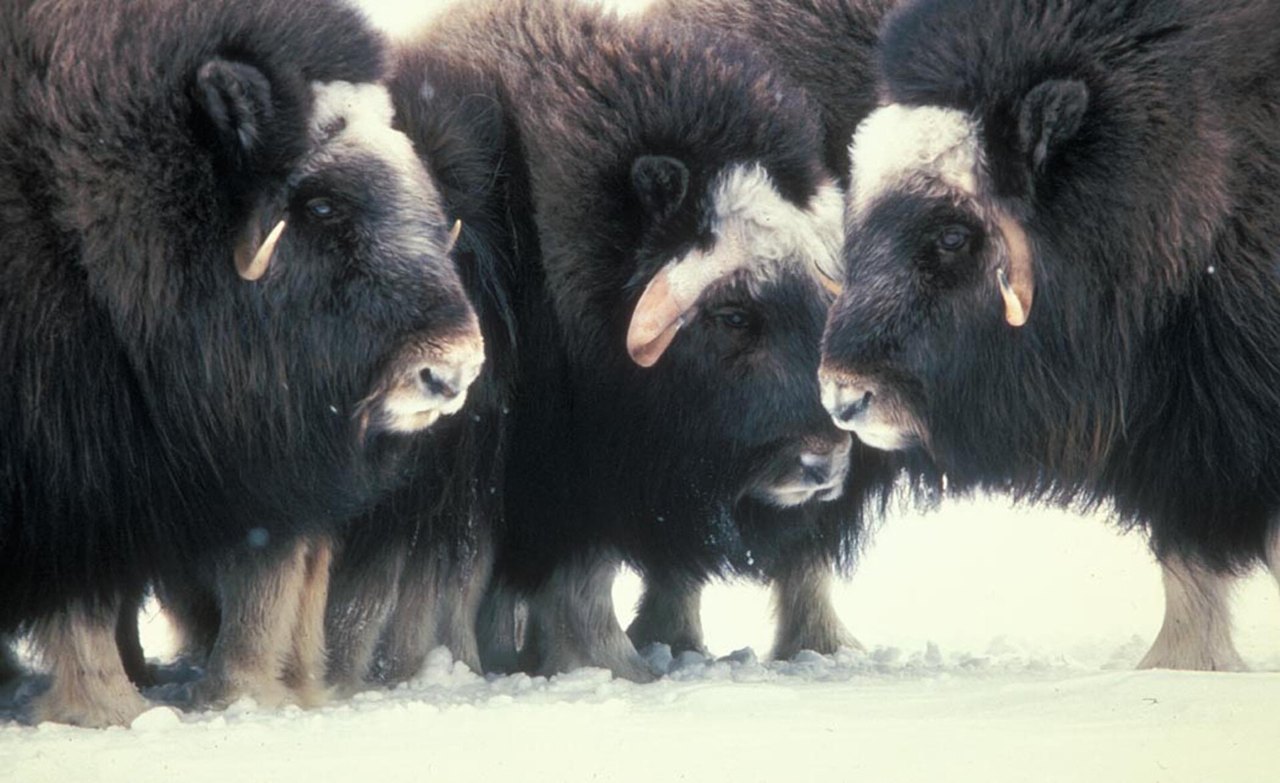
Animal Behavior · Mobbing and Collective DefenseSmall animals routinely defeat large ones by arriving together. Crows and jays that would lose instantly one on one will dive at a hawk in a screaming crowd until it leaves the neighborhood; ornithologists call this mobbing. Meerkats post sentries and rush a snake as a unit. Musk oxen ring their calves. What makes such defenses remarkable is that nobody organizes them: there is no leader assigning positions and no plan agreed in advance. Each animal simply responds to an alarm and to the sight of neighbors already responding, and a defense assembles itself out of separate individual decisions. Biologists describe the outcome as a collective built from many small local choices. A community grown quietly, one favor at a time, can become an army in a single afternoon.
Visual AidSmall choices, one wall
Photograph of three muskoxen standing shoulder to shoulder on snow, taken by a United States wildlife agency. The Knowledge Bank explains that when wolves circle, musk oxen form an outward-facing ring around their calves, and that nobody organizes such a defense — each animal responds to the alarm and to neighbors already responding. These three are not in danger and no calf is visible; the picture shows the habit of standing together, not the full ring. Notice that every head faces out: the wall is built from separate decisions to turn the same way.
Muskoxen on snow; U.S. Fish and Wildlife Service. Source: Wikimedia Commons, public domain.
🧠Knowledge Bank question
1The Knowledge Bank says what makes mobbing remarkable is that ___.Ch.68–80
2How do the RECOs classify Roz?Ch.68–80
3Roz agrees immediately to board the ship and leave.Ch.68–80
4Who fights beside Roz in the battle?Ch.68–80
5Write the numbers 1–5 in the boxes to show the correct order of events in Chapters 68–80. Number 1 = what happens first.Ch.68–80
Roz chooses to leave — promising to return.
The island rises and battles the RECOs.
A ship arrives carrying the RECO robots.
The RECOs fall; Roz is gravely damaged.
Roz is judged defective and the hunt begins.
6The battle ends with the RECOs destroyed.Ch.68–80
7What does Roz understand that the island does not?Ch.68–80
8Why does Roz choose to leave?Ch.68–80
9The final farewell belongs to Brightbill.Ch.68–80
10How does the book’s last image differ from a capture?Ch.68–80
Part 3
Literary Elements
Understanding HOW and WHY Peter Brown tells the story across Chapters 68–80.
🔁Knowledge Bank · An Ending That Rhymes
Literary Craft · Circular StructureSome stories end where they started on purpose. A character arrives by ship in a storm and departs by ship; a novel opens and closes on the same beach, the same window, the same sentence turned around. Critics call the shape circular structure, and readers register it as a click of completeness even when they could not say why. The trick is that a circle is never a repeat. The whole meaning sits in the difference between the two passes: the same beach, but the arriving stranger is now the departing neighbor, and what was freight has become somebody. Reading an ending well therefore means holding the first pages in mind while you turn the last, so the gap between them can be measured. A shape becomes visible only when a story finally closes.
Visual AidThe same beach, twice
Diagram for the Knowledge Bank on circular structure. It draws the book as a ring with the two passes over the same beach marked at top and bottom, and puts the Knowledge Bank’s point in the center: the meaning is the difference between them. It does not describe how the ending happens. Notice that the two dots sit on one circle but are different colors — same place, changed traveler.
Shape described in the Knowledge Bank. Drawn for Garden Heights Academy.
Full-circle design
The sky that delivered a crate takes back a mother — same ship, opposite meaning.
Reciprocity’s payoff
Seven parts of deposited kindness, withdrawn as an army in one battle.
Agency
Not retrieved — leaving, on her own terms: the cargo became a person, and persons choose.
🧠Knowledge Bank question
1According to the Knowledge Bank, the whole meaning of a circular structure sits in ___.Ch.68–80
2Fill in the blank with the correct literary term.Ch.68–80
Word choices:agencycirclemeterchorus- some words will not be used
Choosing your own leaving shows .
An ending mirroring its opening completes a full .
3The animals’ army is a PAYOFF because ___.Ch.68–80
4The RECOs’ ‘defective’ label is presented as the book’s final truth about Roz.Ch.68–80
5Roz leaving AFTER winning transforms the ending from defeat into ___.Ch.68–80
6‘Not captured. Choosing.’ — the book insists on this distinction because ___.Ch.68–80
7The battle’s outcome suggests the island would win every future fight easily.Ch.68–80
8Fill in the blank with the correct literary term.Ch.68–80
Word choices:payoffprologuevillainrhyme- some words will not be used
Kindness returning as an army is reciprocity’s .
9Giving the last farewell to Brightbill — not the whole island — keeps the ending ___.Ch.68–80
10The promise to return converts the ending’s grief into ___.Ch.68–80
Part 4
Think Deeper
Four deeper challenges — no single-word recall. Read, weigh the evidence, and reason it out.
💛Knowledge Bank · Paying a Debt Back
Sociology · Reciprocity and SacrificeSociologists studying villages, armies, and neighborhoods keep finding the same rule underneath cooperation: reciprocity, the strong human habit of returning what was given. It is not a written contract and rarely gets discussed aloud, yet people can usually name exactly who has helped them and feel the pull to repay. Communities where reciprocity runs dense recover from disasters faster, because help moves without anyone having to organize it. A related pattern appears wherever a group faces danger: the member best able to absorb harm places herself between the threat and everyone else, and researchers describe such choices as costly signals of commitment. Seven parts of quiet favors are a deposit. What happens at the end of this book is the withdrawal.
Think back over the ending. Out of the sky that once spilled crates comes a ship with clean, gleaming collectors, reading the island through cold lenses: unit found, unit defective, retrieve. The forest answers with teeth, wings, dams, and everything a winter’s gratitude can arm. When the last RECO falls, the island cheers — and its battered robot counts futures instead. Then a mother says goodbye to a goose, a promise to an island, and rises into the morning on the ship built to take her — taken by no one. Choosing.
Original passage written for Garden Heights — not a quotation from the novel.
1Claim: “Roz’s departure is a protector’s strategy, not a surrender.” — choose the two details that best prove it.Claim & Evidence
2The RECOs’ checklist, or The island’s ledger? Tap each detail to sort it — tap again to switch sides. You can keep tapping to change your answer.Sort into two
◄ The RECOs’ checklistThe island’s ledger ►
3Match each cause to its result. For each cause, pick its result.Cause & Effect
The ship’s scanners find unit 7134→
The island remembers its winter at her hearth→
The RECOs fall but Roz counts future ships→
A goodbye to Brightbill, a promise to all→
🧠Knowledge Bank question
4Fill both blanks to complete the reasoning.Build the Argument
The Knowledge Bank says communities where reciprocity runs dense recover from disasters faster because , which shows that .
Part 5
Standardized Test
Reading passage · Can a Robot Feel? · SAT & TOEFL-style practice
Read the passage — the highlighted words are tested — then answer. Tap an answer, then tap it again to confirm.
SATCentral Idea — the passage's main point
SATWords in Context — a word's meaning in this passage
SATRhetorical Function — the job a sentence is doing
SATDetail — a fact stated in the passage
SATAuthor’s Purpose — what the author wants to achieve
SATText Evidence — the line that backs up an answer
SATInference — a conclusion the passage implies
TOEFLInsert Text — where a sentence best fits
Can a Machine Really Feel
When Roz grieves, rejoices, and loves, is she FEELING — or performing a very good imitation? Real scientists argue about exactly this. Today’s machines can already read human emotions from faces and voices, and can simulate feelings convincingly — comforting words, sympathetic tones, even artificial tears. But simulation, skeptics note, is theater: a chatbot that types ‘I’m so sorry’ feels nothing, any more than a thermostat WANTS the room warm. The missing ingredient has a name — consciousness, the inner experience of actually being someone — and no test yet invented can prove or disprove it from the outside.
That last fact is the debate’s trap: we cannot even prove OTHER PEOPLE feel — we extend them the courtesy because they act as if they do. Some philosophers argue machines that act the same way may eventually deserve the same benefit of the doubt; others answer that copying feeling’s outside can never create its inside. Peter Brown plants his novel exactly on this fault line — and quietly loads the dice. Roz’s feelings are never announced; they are enacted: she stays with an egg no program requires, mourns in work, loves in labor, and when the time comes she does not wait to be taken; she is free to choose, and she chooses a farewell that costs her everything. By the last page, asking whether her love is ‘real’ feels beside the point — which may be the book’s answer: feelings, wherever they run, are finally measured by what they DO.
Original passage written for Garden Heights — not a quotation from the novel.
1What is the main idea of the passage?SAT · Central Idea
2In the passage, simulate means ___.SAT · Words in Context
3The thermostat example shows that ___.SAT · Rhetorical Function
4In the passage, when Roz chooses a farewell she ___.SAT · Words in Context
5What is ‘the debate’s trap’?SAT · Detail
6In the passage, a farewell is ___.SAT · Words in Context
7How does Brown ‘load the dice’ in Roz’s favor?SAT · Author’s Purpose
8Which of Roz’s actions does the passage list as ENACTED feeling?SAT · Text Evidence
9The book’s implied answer to ‘can a robot feel?’ is that ___.SAT · Inference
10Insert Text (TOEFL). Look at the four squares [1]–[4] in the excerpt below. They show where this sentence could be added: “That is why the question quietly changes shape as the story goes on.”
Early chapters invite readers to watch Roz for signs of mere programming. [1] But deed by deed — the egg, the truce, the departure — the evidence piles up. [2] Readers stop asking what Roz is and start asking what she will do next. [3] By the end, her personhood is not argued; it is simply assumed. [4]
Where would the sentence fit best?TOEFL · Insert Text
Part 6 · Optional
Creative Writing
A bonus challenge to practice your English. Take your time and have fun with it.
About This Section
This writing task is optional and is not part of your auto-graded score. The feedback below checks only the basics — length, spelling, and grammar — not whether your ideas are right or wrong. It is meant for classroom discussion and creative practice, so feel free to use your imagination!
Writing Task — Part 8 “Measured by What It Does”
The book suggests feelings are measured by what they DO. Write about one feeling of yours — love, worry, gratitude, anger — described ONLY through actions: no naming the feeling allowed. Show what it makes you do in 6–10 sentences, Roz-style, and let the reader deduce the feeling. Reveal the feeling’s name only in your final sentence.
You can start with: “It wakes me early. It checks the weather first, and then the window...”
0 / 40 words minimum
🗣 Teach It · Just for Fun (optional)
No right or wrong — tell someone nearby what happened in this part. Can’t find anyone? Tell yourself out loud. The moment you teach it, you truly understand it.
Part 8 Complete — You Finished the Book! 🎉
You finished Chapters 68–80 — the final part of The Wild Robot.
Here are your auto-graded results:
-
points out of 100
Teach it to someone
The best last step is to teach it. In your own words, explain what happened — retell a favorite scene, teach a character’s big choice, or sum up the main idea for a parent, friend, or classmate. When you can teach it clearly, you truly own it.
Independent study guide by Garden Heights. Not affiliated with or endorsed by Peter Brown. Contains original analysis only; no text from the novel is reproduced. Reference text: This workbook follows Peter Brown’s classic text (the standard Puffin edition sold worldwide). Revised 2023 UK editions change some wording and may not match the vocabulary studied here.
SAT® is a registered trademark of College Board, which is not affiliated with, and does not endorse, these materials. TOEFL® is a registered trademark of ETS. These materials are not endorsed or approved by ETS. Garden Heights is an independent provider of test-style reading practice.