New here? Just sign up with Google — your account includes Matilda, our gift book, forever.
Because of Winn-Dixie · Garden Heights
Part 1
for Because of Winn-Dixie · Part 1 · Chapters 1–4
8 Parts40 min
What Happens in Part 1
Ten-year-old India Opal Buloni has just moved to the little town of Naomi, Florida, where her father is the new preacher. Sent to the Winn-Dixie supermarket for tomatoes, rice, and macaroni-and-cheese, Opal comes home instead with a big, ragged, smiling stray dog who has turned the produce aisle upside down. To save him from the pound she claims him on the spot and names him after the store itself. Back at the Friendly Corners Trailer Park, Opal convinces her kind, quiet father — whom she calls the preacher — that the dog is one of the ‘Less Fortunate’ the church should help. Winn-Dixie gets a bath, a brushing, and a family. Most important of all, Opal finally gathers the courage to ask the preacher about the mother who left when Opal was three — and he gives her ten things about her mama, one for each year Opal has been alive. Opal memorizes the list like a treasure.
What We Will Learn
Section
What you will practice
Vocabulary
Words of errands and animals: errand, produce, stray, fortunate, memorize, constellation…
Literary Elements
First-person narrator, simile, and motive
Cross-Curricular
How stray dogs survive, what animal shelters do, and where Florida sits on the map
Chapter Summary
Ch.
What happens
1
The Supermarket Dog — a stray wrecks the produce aisle; Opal claims him and names him Winn-Dixie.
2
Convincing the Preacher — Opal presents Winn-Dixie as one of the ‘Less Fortunate’; her father lets him stay.
3
A Bath and a Story — Opal scrubs the dog and tells him her own story: a new town, a busy father, a mother who left.
4
Ten Things About Mama — the preacher lists ten things about Opal’s mother, and Opal memorizes every one.
Part 1
Vocabulary
Study 10 key words from Chapters 1–4, then answer each question.
🧠Knowledge Bank · How a Stray Dog Survives
Lexicology · How a Stray Dog Survives
A stray dog is one that lives without a home, and staying alive takes clever work. Strays learn to read people quickly, because a friendly face might mean food and a scowling one might mean a kick. Over time a dog that survives near humans grows bold and eager, wagging and pressing close to win a scrap or a scratch. Some dogs even seem to smile, pulling back their lips in a soft, submissive grin that says ‘I am no danger.’ When Winn-Dixie bounds up the produce aisle grinning at Opal, he is doing exactly what a smart stray does — choosing the person most likely to be kind. His whole survival has depended on one risky, hopeful skill: reaching out to a stranger and hoping for trust.
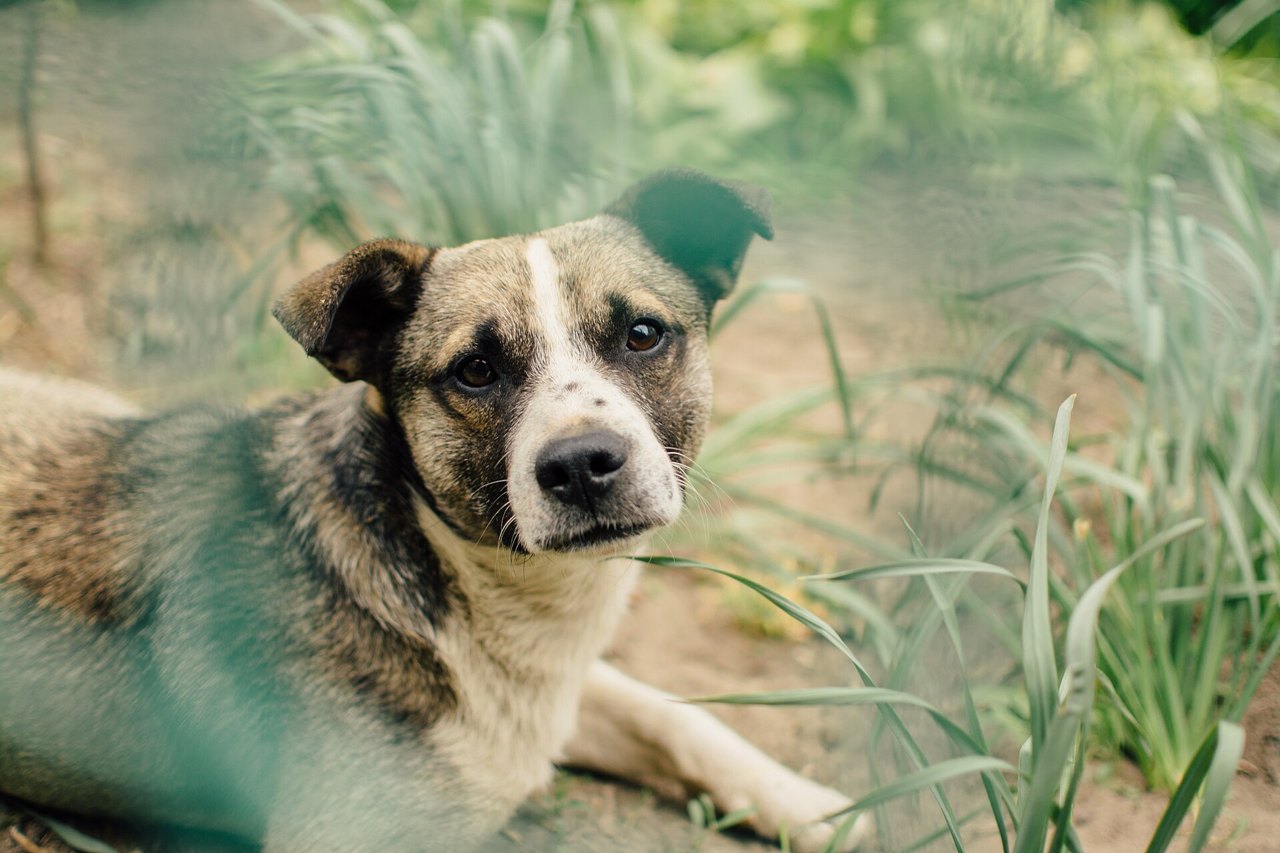
Visual AidA face that asks for trust
Photograph of a mixed-breed dog lying in the grass and looking up at the camera, taken in 2015. The Knowledge Bank explains that a stray survives by reading people quickly and by choosing the person most likely to be kind. This dog is not Winn-Dixie, and nothing tells us whether it has a home. Notice the eyes and the cocked ears — this is the look the Knowledge Bank means, a risky, hopeful reach toward a stranger.
Dog in the grass, photograph by Rodion Kutsaev, 2015 (Unsplash). Source: Wikimedia Commons, CC0.
errandn.Ch.1
A short trip to do a small job for someone
“Opal’s simple errand for groceries changed her whole summer.”
producen.Ch.1
Fresh fruits and vegetables sold in a store
“The dog skidded through the produce section, scattering tomatoes.”
strayn.Ch.1
An animal that has no home or owner
“The manager shouted that the stray had to go.”
poundn.Ch.1
A shelter where lost or stray animals are kept
“Calling the pound would mean the dog might never come out.”
fortunateadj.Ch.2
Lucky; blessed with good things
“The church tried to help people who were less fortunate.”
exceptionn.Ch.2
A case that does not follow the usual rule
“The trailer park had a no-dogs rule, so Winn-Dixie needed an exception.”
tremblev.Ch.3
To shake slightly, often from fear or cold
“The big dog would tremble at the first rumble of a storm.”
memorizev.Ch.4
To learn something so well you can repeat it exactly
“Opal worked to memorize all ten things about her mama.”
constellationn.Ch.4
A named group of stars in the night sky
“Her mama could point out every constellation in the sky.”
congregationn.Ch.2
The group of people who attend a church
“The new congregation met in a little building with folding chairs.”
ⓘ The vocabulary words in this list are selected to help you understand and complete this workbook. Some may not appear verbatim in the original novel.
🧠Knowledge Bank question
1According to the Knowledge Bank, a stray dog's smile is ___.Ch.1
2In a supermarket, the ‘produce’ section sells fresh fruits and vegetables.Ch.1
3An animal with no home or owner is called a ___.Ch.1
4If you are ‘fortunate,’ you have very bad luck.Ch.2
5Fill in each blank with the correct word.Ch.1–4
Word choices:memorizepounderrandconstellation- some words will not be used
The manager threatened to send the dog to the .
Opal repeated the list until she could every item.
6A case that does not follow the usual rule is an ___.Ch.2
7To ‘tremble’ means to stand perfectly still and calm.Ch.3
8A named group of stars in the night sky is a ___.Ch.4
9Fill in the blanks with the correct words.Ch.1–2
Word choices:congregationstrayproducetremble- some words will not be used
The whole gathered for the Sunday service.
Tomatoes rolled everywhere when the dog raced through the aisle.
10To learn something so well you can repeat it exactly is to ___ it.Ch.4
Part 2
Comprehension
Show you understood what happens in Chapters 1–4.
🧠Knowledge Bank · Reading Between the Lines
Narrative Logic · Reading Between the Lines
Good readers do more than see the words on a page — they infer, which means figuring out what the author has not said straight out. DiCamillo rarely tells us how Opal feels; instead she shows small actions, and we add them up like clues in a puzzle. When Opal instantly claims a filthy stray and gives it a name, we can infer that she is lonely and hungry for something of her own to love. When she memorizes the ten things about her mama, we sense a longing she never speaks. That patient, thoughtful adding-up, done line by line across a whole book, is the skill we call inference. Opal tells you plainly what people do and leaves you to work out what it cost.
Visual AidWhat Opal does, and what we can tell
Diagram for the Knowledge Bank on reading between the lines. The left boxes are two things Opal does; the right boxes are what the Knowledge Bank says we can tell from them. The book never writes the right-hand side. Notice the little word on each arrow: so. That is the whole skill of inference in one word.
Actions and inferences named in the Knowledge Bank. Drawn for Garden Heights Academy.
🧠Knowledge Bank question
1The Knowledge Bank says that when Opal claims a filthy stray and names it, we can infer that she ___.Ch.1
2How does Opal stop the manager from calling the pound?Ch.1
3Opal and her father have lived in Naomi, Florida all of Opal’s life.Ch.1–3
4Opal wins the preacher over by describing Winn-Dixie as ___.Ch.2
5Write the numbers 1–5 in the boxes to show the correct order of events in Chapters 1–4. Number 1 = what happens first.Ch.1–4
Opal claims the stray and names him Winn-Dixie.
The preacher agrees that Winn-Dixie can stay.
The preacher tells Opal ten things about her mother.
Opal gives Winn-Dixie a bath and tells him her story.
A big dog wrecks the produce aisle at the supermarket.
6Opal calls her father ‘the preacher’ instead of ‘Daddy.’Ch.2
7What happened to Opal’s mother?Ch.3–4
8Why does Opal ask for exactly ten things about her mother?Ch.4
9One of the ten things is that Opal’s mama could name every constellation.Ch.4
10What does Opal do with the list of ten things?Ch.4
Part 3
Literary Elements
Understanding HOW and WHY Kate DiCamillo tells the story across Chapters 1–4.
🧠Knowledge Bank · How DiCamillo Opens a Heart
Literary Technique · How DiCamillo Opens a Heart
This whole story is told by Opal herself, in the first person — the voice that uses the words I and me. Because we ride inside Opal’s head, her wishes and worries become our own, and we trust her the way we trust a friend sharing a secret. That closeness is a choice the author makes on purpose. A first-person narrator can only report what she herself sees and feels, so we learn about the preacher or the missing mama slowly, exactly as Opal does. The gap makes us lean in and read carefully. Notice how a plain, honest child’s way of talking can carry more feeling than any grand speech, and you have found the quiet power of voice.
First-person narrator
The story is told by ‘I’ — Opal herself — so we see Naomi only through her eyes and feelings.
Simile
A comparison using like or as — the preacher retreating from hard subjects is compared to a turtle drawing into its shell.
Motive
The hidden reason behind an action — Opal claims a stray because she, too, is new, lonely, and hoping to belong.
🧠Knowledge Bank question
1According to the Knowledge Bank, a first-person narrator can only report ___.Ch.1–4
2Fill in the blank with the correct literary term.Ch.2
Word choices:similemotivesettingdialogue- some words will not be used
Comparing the preacher to a turtle in its shell is a .
Opal’s loneliness is the hidden behind claiming the dog.
3The turtle comparison helps readers understand that the preacher ___.Ch.2
4A simile is a comparison that uses the words ‘like’ or ‘as.’Ch.1–4
5When Opal claims a stray dog the moment she meets him, the scene mainly reveals ___.Ch.1
6The mood of these opening chapters is best described as ___.Ch.1–4
7Naming the dog ‘Winn-Dixie’ after the store is a detail that fixes the story in an everyday, real-feeling world.Ch.1
8Fill in the blank with the correct literary term.Ch.1–4
Word choices:first-personthird-personrhymeflashback- some words will not be used
A story told by ‘I’ uses a narrator.
9DiCamillo reveals the missing mother a little at a time instead of all at once. The main effect is to ___.Ch.3–4
10The list of ten things works powerfully as an ending for Chapter 4 because it ___.Ch.4
Part 4
Think Deeper
Four deeper challenges — no single-word recall. Read, weigh the evidence, and reason it out.
🧠Knowledge Bank · Why Claim a Stray
Ethical Reasoning · Why Claim a Stray
Ask yourself why a girl would rush to keep a scruffy, unknown dog she has only just met. Opal has moved to a new town where she knows no one, and her father, buried in his work and his own sadness, can feel as far away as her lost mother. Loneliness like that aches, and a warm, eager animal offers what she is missing most — company that will never leave. By choosing Winn-Dixie, Opal is really choosing to fill an empty place in her heart. This is a quiet lesson worth carrying: sometimes we reach out to another creature not because it is perfect, but because both of us are hungry for the same thing, a sense of belonging.
Think back over the chapters. Opal walks into a supermarket for three grocery items and walks out with a dog. She talks her quiet father into keeping him by using the church’s own words. She washes the dog, tells him everything — and then finally asks the question she has carried for seven years. By the end of Chapter 4, Opal owns two new treasures: a big smiling dog, and a list of ten facts about a mother she cannot remember.
Original passage written for Garden Heights — not a quotation from the novel.
1Claim: “Opal needs Winn-Dixie just as much as Winn-Dixie needs Opal.” — choose the two details that best prove it.Claim & Evidence
2Opal, or The preacher? Tap each detail to sort it — tap again to switch sides. You can keep tapping to change your answer.Sort into two
◄ OpalThe preacher ►
3Match each cause to its result. For each cause, pick its result.Cause & Effect
A big stray wrecks the produce aisle and the manager threatens the pound→
Opal calls the dog one of the ‘Less Fortunate’→
Winn-Dixie listens to Opal’s whole story without judging→
Opal turns ten without a single memory of her mother→
🧠Knowledge Bank question
4Fill both blanks to complete the reasoning.Build the Argument
The Knowledge Bank says Opal reaches for the dog because , which shows that .
Part 5
Standardized Test
Reading passage · How Stray Dogs Survive · SAT & TOEFL-style practice
Read the passage — the highlighted words are tested — then answer. Tap an answer, then tap it again to confirm.
SATCentral Ideas — the passage's main point
SATWords in Context — a word's meaning in this passage
SATDetail — a fact stated in the passage
SATInference — a conclusion the passage implies
SATText Structure & Purpose — how the passage is built, and why
TOEFLFactual Information — a fact stated in the passage
TOEFLVocabulary — a tested word's meaning here
TOEFLInference — what the passage implies
How a Stray Dog Survives
No one owns a stray dog, so a stray must solve every problem by itself. Food is the first problem, and the smartest strays solve it by watching people. They learn which doors lead to kitchens, which bins hold supper, and which shops smell of bread and meat. The second problem is safety, and here a stray’s best tool is not its teeth but its face: a dog that looks friendly is fed, while a dog that growls is chased away or sent to the pound. Scientists who study city strays report that the most successful ones are gentle, patient, and bold all at once — bold enough to walk right up to a stranger, gentle enough not to frighten anyone. A fortunate stray that finds a kind human may follow that person for days. In the end, what a stray searches for is not really food at all. It is a permanent home — a person, a porch, and a name of its own.
Original passage written for Garden Heights — not a quotation from the novel.
1What is the main idea of the passage?SAT · Central Ideas
2In the passage, a fortunate stray is ___.SAT · Words in Context
3According to the passage, a stray’s best tool for safety is ___.TOEFL · Factual Information
4In the passage, the pound is ___.TOEFL · Vocabulary
5Which problem does the passage say a stray must solve FIRST?SAT · Detail
6The passage says scientists found the most successful strays are ___.TOEFL · Factual Information
7In the passage, permanent most nearly means ___.SAT · Words in Context
8Why does a stray that looks friendly do better than one that growls?SAT · Inference
9According to the last sentences, what is a stray really searching for?TOEFL · Inference
10The author organizes the passage mainly by ___.SAT · Text Structure & Purpose
Part 6 · Optional
Creative Writing
A bonus challenge to practice your English. Take your time and have fun with it.
About This Section
This writing task is optional and is not part of your auto-graded score. The feedback below checks only the basics — length, spelling, and grammar — not whether your ideas are right or wrong. It is meant for classroom discussion and creative practice, so feel free to use your imagination!
Writing Task — Part 1 “Ten Things”
Opal asks for ten things about her mama so she can know her. Now it is your turn: write about someone important to you — a family member or a friend — and give three to five things about them that someone else could not learn just by looking. For each thing, add one sentence explaining why it matters to you. Write 6–10 sentences in your own words.
You can start with: “There are many things to know about ______, but the first one is...”
0 / 40 words minimum
🗣 Teach It · Just for Fun (optional)
No right or wrong — close the screen and tell someone nearby what happened in this part. Can’t find anyone? Tell yourself out loud. The moment you teach it, you truly understand it.
Part 1 Complete!
You finished Chapters 1–4 of Because of Winn-Dixie.
Here are your auto-graded results:
-
points out of 100
Teach it to someone
The best last step is to teach it. In your own words, explain what happened — retell a favorite scene, teach a character’s big choice, or sum up the main idea for a parent, friend, or classmate. When you can teach it clearly, you truly own it.
Independent study guide by Garden Heights. Not affiliated with or endorsed by Kate DiCamillo. Contains original analysis only; no text from the novel is reproduced. Reference text: This workbook follows Kate DiCamillo’s classic text (the standard Puffin edition sold worldwide). Revised 2023 UK editions change some wording and may not match the vocabulary studied here.
SAT® is a registered trademark of College Board, which is not affiliated with, and does not endorse, these materials. TOEFL® is a registered trademark of ETS. These materials are not endorsed or approved by ETS. Garden Heights is an independent provider of test-style reading practice.