New here? Just sign up with Google — your account includes Matilda, our gift book, forever.
📚
Garden Heights Academy
Members sign in to continue.
Wonder · Garden Heights Academy
Part 4
for Wonder · Part 4 · Narrated by Jack
a novel by R.J. Palacio
30 min6 Parts
This workbook is built on a solid pedagogical foundation, effectively integrating content and language learning based on the CLIL framework (Content and Language Integrated Learning), elevated by our unique 5th C — Connection — and an integrated Standardized Test section that weaves every SAT & TOEFL question type right into the novel, so learners build real test skills easily, naturally, and with fun.
💭 Before You Read · Just for Fun
No right or wrong answers — just think or chat about it: Have you ever gone along with a group even though you privately disagreed — what was the pressure like? What is the difference between a real apology and the word “sorry”? And can one person really change what a whole room does?
What Happens in Part 4
Jack Will explains his side of things. Mr. Tushman first asked him to befriend Auggie, and Jack was nervous — but he came to genuinely like him. When Summer’s clue makes Jack realize Auggie overheard him at Halloween, he is filled with regret. In winter, when Julian mocks Auggie once too often, Jack punches him and is suspended. Jack and Auggie make up and become true friends — but Julian’s group starts a quiet war of nasty notes against them.
What We Will Learn
Literary Element
What It Means
Internal Conflict
A struggle that happens inside a character’s own mind
Flashback
A scene that jumps back to an earlier time
Climax
The most intense, turning-point moment of a story
Chapter Summary
In This Part
Key Events
Jack’s Side
Jack reveals he was first asked to befriend Auggie but grew to truly like him
Regret
Summer’s clue makes Jack realize Auggie overheard him at Halloween
The Punch
Jack hits Julian for insulting Auggie and is suspended
The War
Julian’s group begins leaving cruel notes for Jack and Auggie
Copyright Notice
Independent study guide by Garden Heights Academy. Not affiliated with or endorsed by R.J. Palacio or Alfred A. Knopf. No text from the novel is reproduced. Students should read the original book.
Part 1
Vocabulary
Study 10 key words from Part Four (Jack), then answer each question.
🧠Knowledge Bank · The Pull of the Group
Lexicology · The Pull of the Group
Jack betrays Auggie to fit in with the popular crowd, then deeply regrets it. Scientists who study young people find that peer pressure is especially powerful in the school years, when belonging can feel almost as important as breathing. Palacio shows the truth behind the research: good people sometimes make bad choices to fit in — and growing up means finding the courage to make thingsright. The young brain feels social rejection almost like physical pain, which is what makes Jack’s later choice to stand by Auggie so hard, and so brave. The terms loyalty and consequence mark separate stages in the action, so neither can replace the other. Each of these words marks a different distance from the crowd, which is the exact measurement this section is asking a reader to take.
ⓘ Vocabulary words are selected to help you understand and complete this workbook. Some may not appear verbatim in the novel.
regretn.Pt.4
A feeling of being sorry about something you did
“Jack is filled with regret over his Halloween words.”
guiltn.Pt.4
The bad feeling of having done something wrong
“Guilt keeps Jack awake at night.”
conflictn.Pt.4
A struggle or problem, between people or inside a person
“Jack feels a conflict between fitting in and doing right.”
apologizev.Pt.4
To say you are sorry
“Jack wants to apologize to Auggie.”
loyaltyn.Pt.4
Faithful support for a friend
“Jack finally chooses loyalty to Auggie.”
consequencen.Pt.4
A result of an action
“Suspension is the consequence of the fight.”
reconcilev.Pt.4
To become friends again after a quarrel
“Jack and Auggie reconcile and grow closer.”
tauntv.Pt.4
To tease in a cruel way
“Julian likes to taunt Auggie.”
couragen.Pt.4
Bravery; doing what is right despite fear
“It takes courage for Jack to defend his friend.”
suspendv.Pt.4
To make a student stay out of school for a time as punishment
“The school decides to suspend Jack for the fight.”
🧠Knowledge Bank question
1According to the Knowledge Bank, what does growing up mean after a choice like Jack's?Pt.4
2“Guilt” is the good feeling you get after helping someone.Pt.4
3A struggle inside a person, or between people, is a —Pt.4
4Fill in each blank with the correct word.Pt.4
Word choices:apologizeconsequencetauntloyalty- some words will not be used
To say you are sorry is to
A result of an action is a
5To “reconcile” means to become friends again after a quarrel.Pt.4
6Julian likes to tease Auggie cruelly. He likes to — him.Pt.4
7Doing what is right even when you are afraid takes —Pt.4
8To “suspend” a student means to make them stay out of school for a time.Pt.4
9Fill in each blank with the correct word.Pt.4
Word choices:loyaltyguiltreconcilecourage- some words will not be used
Faithful support for a friend is
The bad feeling of doing wrong is
10After their quarrel, Jack and Auggie become friends again. They —Pt.4
Part 2
Comprehension
How well do you understand Part Four (Jack)?
🧠Knowledge Bank · Cause and Effect in Jack’s Story
Narrative Logic · Cause and Effect in Jack’s Story
Part 4 is full of causes and effects: Jack’s Halloween words hurt Auggie; Summer’s clue brings regret; Julian’s cruelty leads to the punch. Trace how one action leads to the next. Jack’s Side: Jack reveals he was first asked to befriend Auggie but grew to truly like him. Regret: Summer’s clue makes Jack realize Auggie overheard him at Halloween. The Punch: Jack hits Julian for insulting Auggie and is suspended. The War: Julian’s group begins leaving cruel notes for Jack and Auggie. Jack Will explains his side of things. Mr. Tushman first asked him to befriend Auggie, and Jack was nervous — but he came to genuinely like him. When Summer’s clue makes Jack realize Auggie overheard him at Halloween, he is filled with regret. Regret arrives only once Jack understands what Auggie actually heard.
🧠Knowledge Bank question
1According to the Knowledge Bank, what should a reader trace through Part 4?Pt.4
2Jack ends up genuinely liking Auggie.Pt.4
3What makes Jack realize Auggie overheard him at Halloween?Pt.4
4How does Jack feel once he understands what he did?Pt.4
5Put these events from Part 4 in the correct order. Write 1–4 (1 = first).Pt.4
Jack grows to truly like Auggie.
Summer’s clue reveals Jack’s Halloween mistake.
Jack punches Julian and is suspended.
Mr. Tushman asks Jack to befriend Auggie.
6Jack punches Julian for insulting Auggie.Pt.4
7What is Jack’s punishment for the fight?Pt.4
8What does Julian’s group do after Jack and Auggie become friends again?Pt.4
9Jack and Auggie reconcile and become real friends.Pt.4
10What does Jack come to understand about his earlier behavior?Pt.4
Part 3
Literary Elements
Understanding HOW and WHY R.J. Palacio writes Part Four (Jack) the way she does.
🧠Knowledge Bank · Conflict, Flashback, and Climax
Literary Technique · Conflict, Flashback, and Climax
Palacio shows Jack’s internalconflict (fitting in versus doing right), uses flashback to explain the past, and builds to a climax when Jack finally punches Julian. Ethics — consequence and forgiveness: Jack is suspended AND forgiven — the book holds both; a ready debate: can a punishment be deserved and a person still be good? Language — the grammar of apology: linguists find real apologies NAME the act and OWN it without “if” or “but” — Jack’s repair of the friendship follows the formula exactly. Jack and Auggie make up and become true friends — but Julian’s group starts a quiet war of nasty notes against them. Jack betrays Auggie to fit in — the pull the famous Asch experiments measured, when most people sided with an obviously wrong group rather than stand alone. Fiction and psychology arrive at the same finding by different routes.
Visual AidEach thing causes the next
Diagram for the Knowledge Bank on conflict, flashback, and climax. It lays Part 4’s causes along one line and then draws the flashback as an arrow running the other way, because that is the only part of the sequence a reader receives out of order. It does not claim the punch was justified. Notice that the explanation arrives after the damage — which is exactly why Jack’s part had to be told second.
Sequence described in the Knowledge Bank. Drawn for Garden Heights Academy.
📚 Literary Devices in This Part · definitions & examples
Internal conflict is a struggle inside a character’s own mind. Jack struggles between fitting in with the crowd and doing what is right.A flashback is a scene that jumps back to an earlier time. Jack looks back to explain how he first met and befriended Auggie.The climax is the most intense, turning-point moment of a story. In Part 4, it is the moment Jack punches Julian.
The questions below are mixed — not grouped by device. Decide which device each one is about.
🧠Knowledge Bank question
1According to the Knowledge Bank, what do linguists find that real apologies do?Pt.4
2A flashback shows events from earlier than the main moment.Pt.4
3Fill in the blanks with the correct words.Pt.4
Word choices:climaxturningflashbacksetting- some words will not be used
The most intense moment of a story is the
A climax is a big
4Jack looking back to explain why he first befriended Auggie is a —Pt.4
5A climax is a high, turning-point moment of a story.Pt.4
6Fill in the blanks with the correct words.Pt.4
Word choices:internalconflictsettingclimax- some words will not be used
A struggle inside the mind is an
This kind of inner struggle is a
7The most intense moment — Jack punching Julian — is the —Pt.4
8Internal conflict is a struggle inside a character’s own mind.Pt.4
9Fill in the blanks with the correct words.Pt.4
Word choices:flashbackearlierclimaxsetting- some words will not be used
A scene that jumps back in time is a
A flashback shows events from
10The punch is the loudest moment of Jack’s part — but his real turning point happened earlier and quietly. Which moment, and why?Part 4
Part 4
Think Deeper
Four deeper challenges — no single-word recall. Read, weigh the evidence, and reason it through.
🧠Knowledge Bank · Mistakes and Second Chances
Ethical Reasoning · Mistakes and Second Chances
Jack does something hurtful but earns Auggie’s forgiveness. Palacio lets a likeable character make a real mistake because moral growth is not about being perfect; it is about recognizing harm, accepting consequences, and choosing better. Jack’s part shows that a good person can still do something hurtful — and then put it right. Palacio writes the social pressure of middle school honestly: Jack wants to belong, fears Julian’s judgment, and must learn that kindness costs something when the crowd is cruel. Internal Conflict: A struggle that happens inside a character’s own mind. Flashback: A scene that jumps back to an earlier time. Climax: The most intense, turning-point moment of a story. In winter, when Julian mocks Auggie once too often, Jack punches him and is suspended. The punch is wrong, and it is also the first time Jack picks a side out loud.
Visual AidMended, and the mend left showing
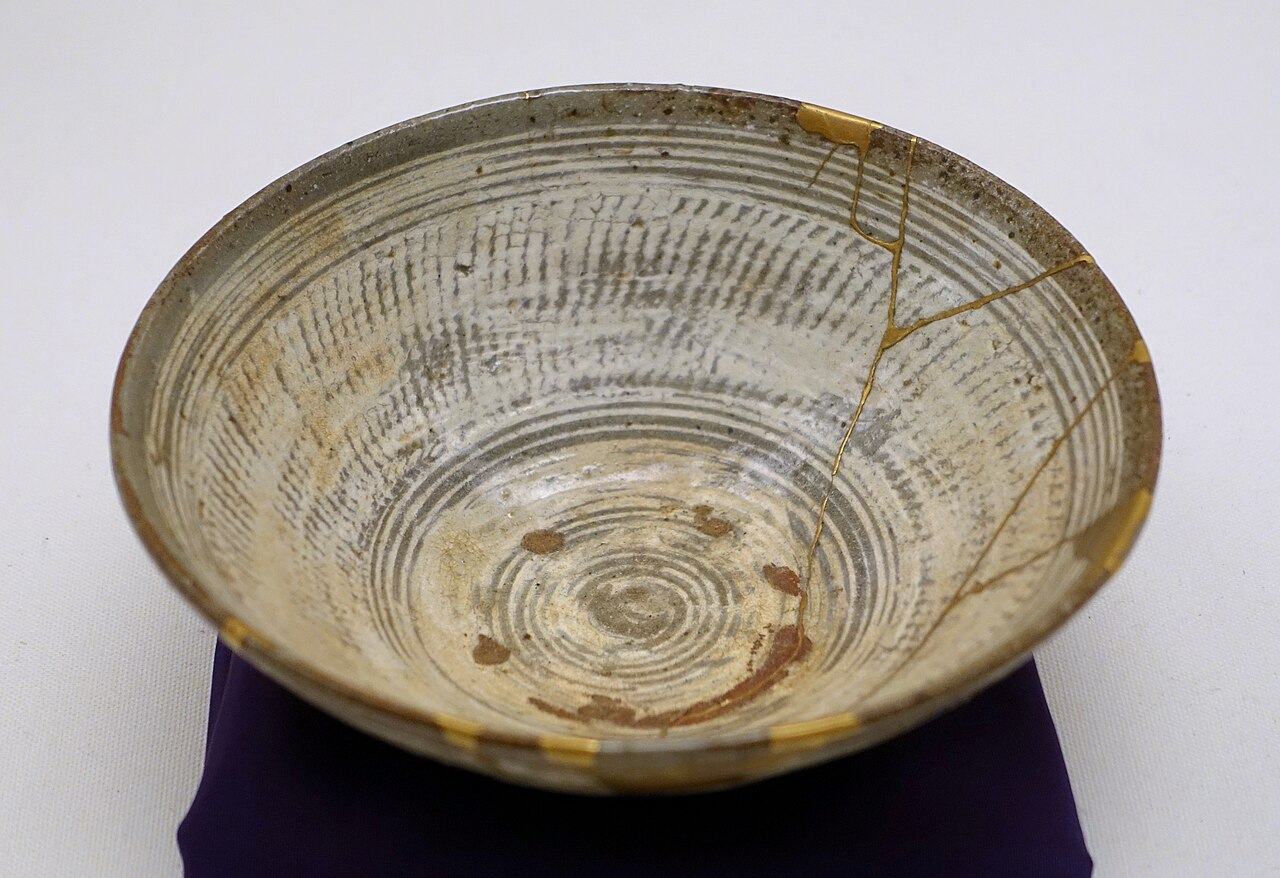
Photograph of a Korean tea bowl about five hundred years old, repaired with lacquer and gold in the Japanese method called kintsugi. The Knowledge Bank explains that moral growth is not about being perfect but about recognizing harm and putting it right; this is an object that was broken, mended, and then kept. It has no connection to the novel. Notice that the repair was not hidden. The gold makes the break the most visible thing on the bowl, and the bowl is in a museum anyway.
Tea bowl, Korea, Joseon dynasty, 16th century, repaired with gold lacquer; Ethnological Museum, Berlin. Source: Wikimedia Commons, CC0.
1Claim: “Jack truly regrets hurting Auggie.” — choose the two details that best prove it.Claim & Evidence
2Does it hurt or heal the friendship? Tap each item to sort it — tap again to switch sides. You can keep tapping to change your answer.Sort into two
◄ Hurts itHeals it ►
3Match each cause to its result. For each cause, pick its result.Cause & Effect
Jack doesn’t recognize Auggie’s costume→
Auggie overhears him at Halloween→
Summer’s whispered clue reaches Jack→
Jack takes Auggie’s side against Julian→
🧠Knowledge Bank question
4Fill both blanks to complete the reasoning.Build the Argument
The Knowledge Bank argues that Palacio lets a likeable character do real harm because , which shows that .
Part 5
Standardized Test · Inference & Author’s Purpose
Part 4 trains the two “reading between the lines” skills — Inference (what must be true even if unstated) and Author’s Purpose (why a detail is there) — plus Vocabulary in Context and Factual Detail, in the styles the SAT and TOEFL use. Read the passage (the highlighted words are tested below), then choose the answer best supported by the text.
Read the passage — the highlighted words are tested — then answer. Tap an answer, then tap it again to confirm.
SATWords in Context — a word's meaning in this passage
SATCentral Ideas — the passage's main point
TOEFLVocabulary — a tested word's meaning here
TOEFLFactual Information — a fact stated in the passage
TOEFLInference — what the passage implies
TOEFLInsert Text — where a sentence best fits
Asch and the Pressure to Conform
In the 1950s, psychologist Solomon Asch ran one of the most famous experiments ever devised. He showed groups of students two cards: one with a single line, one with three lines of obviously different lengths. The task was almost insultingly easy — say which line matched. But there was a trick: every person in the group except one was an actor, and on certain rounds the actors deliberately gave the same wrong answer, one after another, before the real subject’s turn came. The results startled the world.
Three out of four subjects chose to conform at least once — they publicly named a line they could SEE was wrong, simply because the majority had named it first. Interviews afterward revealed two pressures at work, and a quiet regret once the trick was explained: the fear of standing out (“they will think something is wrong with me”), and creeping self-doubt — “can seven people really be mistaken?” The pressure was strongest when the group was unanimous — when not a single voice disagreed. But Asch’s most hopeful discovery is the least famous — when he planted just ONE actor who answered honestly, the spell broke: with a single ally in the room, subjects’ wrong answers collapsed to a quarter of what they had been, a large consequence from one small act. One visible dissenter — even a stranger — freed nearly everyone else to trust their own eyes; courage, the experiment suggests, is not just a private virtue. It is contagious.
Original passage written for Garden Heights — not a quotation from the novel.
1In the passage, “regret” most nearly means —SAT · Words in Context
2In the passage, “consequence” most nearly means —TOEFL · Vocabulary
3According to the passage, what task were the subjects given?TOEFL · Factual Information
4According to the passage, how many subjects conformed at least once?TOEFL · Factual Information
5As used in the passage, the word “unanimous” most nearly means —SAT · Words in Context
6According to the passage, what were the TWO pressures the interviews revealed?TOEFL · Factual Information
7The passage most strongly suggests that a student who laughs at a cruel joke may be —TOEFL · Inference
8Insert Text (TOEFL). Look at the four squares [1]–[4] in the passage excerpt below. They show where the following sentence could be added: “The subjects were not confused about the lines; they were afraid of the room.”
[1] Three out of four subjects chose to conform at least once — they publicly named a line they could SEE was wrong, simply because the majority had named it first. [2] Interviews afterward revealed two pressures at work: the fear of standing out, and creeping self-doubt. [3] The pressure was strongest when the group was unanimous — when not a single voice disagreed. [4]
Where would the sentence fit best?TOEFL · Insert Text
9According to the passage, what happened when one actor answered honestly?TOEFL · Factual Information
10Which statement best expresses the central idea of the passage?SAT · Central Ideas
Part 6 · Optional
Creative Writing
A bonus challenge to practice your English.
About This Section
This writing task is optional and not part of your auto-graded score. Feedback checks length, spelling, and grammar only.
Writing Task — Part 4 “Jack’s Apology”
Write the apology Jack would give Auggie, OR describe a time you had to admit you were wrong. Use the idea of internal conflict — show the struggle inside. Write at least 40 words.
You can start with: “I kept practicing the words in my head, because I knew that what I’d said had hurt him, and…”
0 / 40 words minimum
🗣 Teach It · Just for Fun (optional)
No right or wrong — close the screen and tell someone nearby what happened in this part. Can’t find anyone? Tell yourself out loud. The moment you teach it, you truly understand it.
Part 4 Complete!
You finished Part Four (Jack) of Wonder.
Here are your auto-graded results:
-
points out of 100
Teach it to someone
The best last step is to teach it. In your own words, explain what happened — retell a favorite scene, teach a character’s big choice, or sum up the main idea for a parent, friend, or classmate. When you can teach it clearly, you truly own it.
SAT® is a registered trademark of College Board, which is not affiliated with, and does not endorse, these materials. TOEFL® is a registered trademark of ETS. These materials are not endorsed or approved by ETS. Garden Heights is an independent provider of test-style reading practice.