New here? Just sign up with Google — your account includes Matilda, our gift book, forever.
A Long Walk to Water · Garden Heights
Part 1
for A Long Walk to Water · Part 1 · Chapters 1–2
8 Parts40 min
What Happens in Part 1
Two stories begin: Nya's daily walk for water in 2008, and eleven-year-old Salva's flight when war reaches his school in 1985.
Nya's Long WalkIn 2008, eleven-year-old Nya makes her long walk to water: hours of heat under a fierce sun, a plastic container light on the way out and heavy all the way back, and — this morning — a thorn driven deep into her bare foot, one more toll on a road she cannot refuse.
Gunfire at SchoolIn 1985, in the village of Loun-Ariik, eleven-year-old Salva Dut sits in a schoolroom learning Arabic. His family is Dinka; his father is a respected man with cattle, and Salva daydreams of his brothers and the milk waiting at home. Then gunfire tears the day open: the war between the northern government and the southern rebels, two years old already, has reached his corner of Sudan.
Running AloneThe teacher orders the boys into the bush — not toward the villages, where the soldiers will go. Salva runs until his legs give out, without mother, father, sisters, or brothers, then falls in with a stream of people walking away from the fighting, some of them neighbors from Loun-Ariik. He searches every face for family and finds none.
Left BehindThe next day armed rebels surround the group, wave the men aside to carry their supplies, and march them away; one rebel decides Salva is not yet a man and sends him with the women and children. That night the group shelters in a barn, and by morning it is empty — a boy alone is slow, and slow is dangerous. Salva is eleven, alone in a war.
What We Will Learn
Section
What you will practice
Vocabulary
War, flight, and a long dry road: rebel, chaos, flee, trudge, abandon…
Literary Elements
A dual narrative running two children twenty-three years apart, setting stamped with a place and a year, and historical fiction built on a real boy’s life
Cross-Curricular
Sudan’s civil wars — why the north and the south went to war in 1983, and how the fighting reached a village school by 1985
Chapter Summary
Ch.
What happens
Chapter 1
Gunfire at School — In 2008, Nya walks toward the pond with an empty plastic container, heat above her and thorns underfoot — a walk measured in hours, made on bare feet. In 1985, Salva sits through an Arabic lesson in Loun-Ariik and daydreams of home until gunfire erupts outside. The teacher shouts for the boys to run into the bush, away from their villages, and Salva flees without his family.
Chapter 2
Left Behind — Nya steps on a thorn, and the pain of digging it out becomes one more toll on a walk she cannot skip. Salva joins a river of people walking away from the fighting — some from his own village, none from his family. Armed rebels stop the group, load the men with supplies and take them away, and send Salva — not yet a man — to the women and children. The group sleeps in a barn; at dawn Salva wakes to find that everyone has gone on without him.
Part 1
Vocabulary
Study 10 key words from Chapters 1–2, then answer each question.
📚Knowledge Bank · Why School Was in Arabic
Language · A Country of Many TonguesSalva’s first scene hides a history lesson in plain sight: a Dinka boy being drilled in Arabic, a language nobody in his village speaks at home. Sudan holds one of the most complicated language maps in Africa — more than a hundred tongues, with Arabic dominant in the north and languages like Dinka, Nuer, and Shilluk spoken across the south. After independence in 1956, the government in Khartoum made Arabic the language of schools, courts, and offices, so a southern child’s education began in a stranger’s words. Many southerners heard that policy as a message: your languages, and the people who speak them, come second. A bright Dinka student could stumble simply because the test spoke a language his parents never used, and government jobs flowed to fluent Arabic speakers. When South Sudan won its own independence in 2011, it chose English for its schools instead. Language did not cause the civil war by itself, but it was one of the wedges — and in this book, a boring lesson quietly shows who held the power.
dronev.Ch.1
To talk or hum in a low, flat, unbroken way
“The teacher’s voice droned on in Arabic while Salva daydreamed.”
scorchingadj.Ch.1
Burning hot
“Nya crossed the scorching ground with nothing on her feet.”
rebeln.Ch.1
A person who takes up arms against his or her own government
“Rebels from the south had been fighting the government for two years.”
chaosn.Ch.1
Total confusion and disorder
“One burst of gunfire threw the schoolroom into chaos.”
fleev.Ch.1
To run away from danger
“The teacher ordered the boys to flee into the bush.”
franticadj.Ch.1
Wild with fear or worry
“Frantic people poured out of the village as the shooting went on.”
trudgev.Ch.2
To walk slowly and heavily, as if very tired
“Nya trudged on through the heat even after the thorn pierced her foot.”
wearyadj.Ch.2
Worn out; very tired
“The weary walkers took shelter in a barn for the night.”
abandonv.Ch.2
To leave a person or thing behind, not meaning to return
“Salva realized the group had abandoned him while he slept.”
huddlev.Ch.2
To crowd close together in a small space
“The travelers huddled together on the floor of the barn.”
ⓘ The vocabulary words in this list are selected to help you understand and complete this workbook. Some may not appear verbatim in the original novel.
🧠Knowledge Bank question
1The Knowledge Bank explains why a lesson that seemed a mere drone of Arabic drills carried real power. After independence in 1956, the government in Khartoum ___.Ch.1
2‘Scorching’ describes ground or weather that is burning hot.Ch.1
3A ‘rebel’ is someone who fights against ___.Ch.1
4‘Chaos’ means ___.Ch.1
5Fill in each blank with the correct word.Ch.1
Word choices:fleechaosdronescorching- some words will not be used
The teacher told the boys to into the bush.
Gunfire threw the schoolroom into .
6A ‘frantic’ person is calm, slow, and unhurried.Ch.1
7To ‘trudge’ is to walk ___.Ch.2
8‘Weary’ means worn out and very tired.Ch.2
9Fill in each blank with the correct word.Ch.2
Word choices:abandonwearyfrantictrudge- some words will not be used
The group decided to the sleeping boy.
The walkers slept in a barn.
10To ‘huddle’ is to ___.Ch.2
Part 2
Comprehension
Show you understood what happens in Chapters 1–2.
🔍Knowledge Bank · How the War Began
History · The Second Sudanese Civil WarThe gunfire that empties Salva’s school did not come from nowhere. Sudan was really two regions under one flag: a largely Muslim, Arabic-speaking north that held the capital, Khartoum, and nearly all the power, and a south of many peoples and faiths that held very little of it. A first civil war had already burned from 1955 to 1972, ending in a peace agreement that promised the south the right to govern itself. In 1983 the government canceled the south’s hard-won self-rule and imposed Islamic law — the religious law of the north — on the whole country, just as leaders were maneuvering to control the oil newly discovered under southern land. Southern soldiers mutinied and formed the Sudan People’s Liberation Army, and by 1985 the fighting between government troops and rebels had spread deep into the south. The fighting would grind on for twenty-two years and cost roughly two million lives. Salva’s school day ends the way it does because his village finally sat in the path of that war.
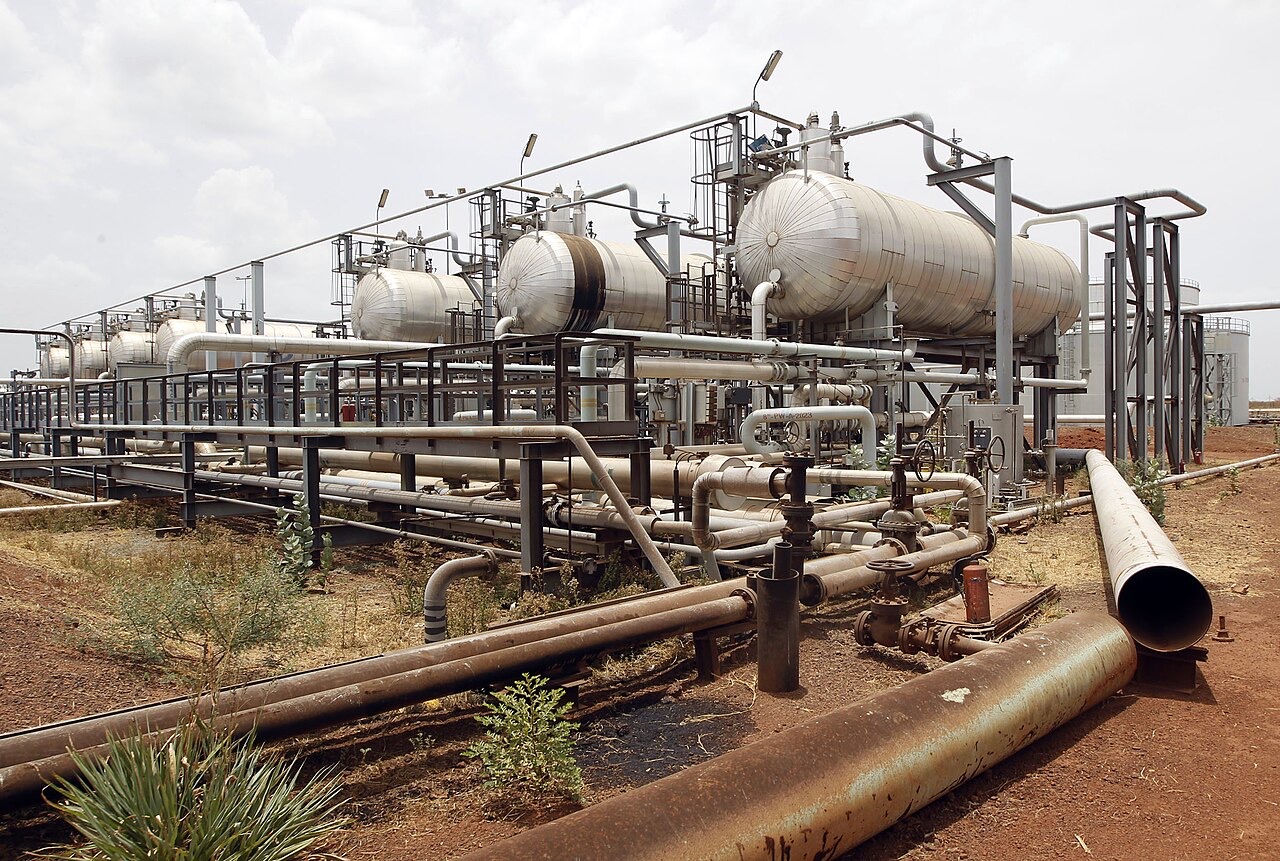
Visual AidThe oil under the quarrel
Photograph of an oil processing facility in Unity State, in what is now South Sudan, taken in 2012. The tanks and pipelines stand on exactly the kind of southern land the Knowledge Bank describes: in 1983, as leaders in Khartoum maneuvered to control oil newly discovered under the south, the government canceled the south’s self-rule — one of the sparks of the war that empties Salva’s school. The picture shows machinery, not a battle, and it was taken almost thirty years after 1985; no scene of the novel happens here. Notice how the pipes run away toward the horizon: the oil itself left the south, and that is much of what the fighting was about.
Oil processing facility in Unity State, South Sudan; Voice of America photograph, 2012. Source: Wikimedia Commons, File:Oil processing facility in South Sudan, 2012.jpg, public domain.
🧠Knowledge Bank question
1According to the Knowledge Bank, the government canceled the south's self-rule at the very moment that ___.Ch.1
2What does the teacher order the boys to do?Ch.1
3Salva’s story takes place more than twenty years before Nya’s.Chapters 1–2
4What language is Salva’s class taught in?Ch.1
5Write the numbers 1–5 in the boxes to show the correct order of events. Number 1 = what happens first.Chapters 1–2
Salva runs into the bush, away from his home village.
Salva joins a crowd of people walking away from the fighting.
Salva wakes in a barn and finds himself completely alone.
Gunfire interrupts the Arabic lesson at Salva’s school.
Armed rebels separate the men from the women and children.
6When the rebels stop the group, Salva is sent to the side with the men.Ch.2
7What do the rebels make the men in the group do?Ch.2
8Why does the group leave Salva behind in the barn?Ch.2
9In 2008, Nya’s task is to walk for hours to fetch water for her family.Ch.1
10What does Nya carry on her walk to fetch water?Ch.1
Part 3
Literary Elements
Understanding HOW and WHY Linda Sue Park tells the story across Chapters 1–2.
🎭Knowledge Bank · Two Children, One Page
Authorial Craft · The Dual NarrativeLinda Sue Park (author) makes an unusual bargain with her reader. Every chapter opens with a short section about Nya in 2008, then hands the page to Salva in 1985, and for most of the book the two stories never touch. Why build a novel this way? First, the gap itself teaches: twenty-three years separate the storylines, yet a child is still walking all day for dirty water, which quietly argues that war’s damage outlives the war. Second, the structure plants a question no reader can put down — how will these two lives meet? — and an unspoken promise that they will. That waiting is engineered suspense. Watch how the sections echo each other: both children walk, both thirst, both endure. A dual narrative earns its keep when neither strand makes full sense without the other, and the meaning lives in the connection.
Dual Narrative
Two stories run side by side — Nya in 2008 and Salva in 1985 — and each chapter opens with Nya before handing the page to Salva.
Setting
Linda Sue Park (author) stamps every section with a place and a year, because in this book when and where you stand decides what happens to you.
Historical Fiction
Salva Dut is a real person and the war is real history; the novel builds fiction’s scenes and feelings on a scaffold of fact.
🧠Knowledge Bank question
1The Knowledge Bank explains that the twenty-three-year gap between the two storylines quietly argues that ___.Chapters 1–2
2The two narratives in this book happen during the same year.Chapters 1–2
3The labels naming southern Sudan and a year at the start of each section establish the story’s ___.Ch.1
4Because Salva Dut is a real person caught in real events, the novel is best called ___.Ch.1
5Fill in each blank with the correct literary term.Chapters 1–2
Word choices:settingdual narrativedialoguemoral- some words will not be used
The year 1985 and a village school are part of the story’s .
Two storylines woven together form a .
6Historical fiction may invent characters as long as the history around them stays true.Ch.2
7What is one effect of opening every chapter with Nya before returning to Salva?Chapters 1–2
8A story’s setting includes both its place and its time.Ch.1
9Fill in each blank with the correct literary term.Chapters 1–2
Word choices:historical fictionsuspensebiographyrhyme- some words will not be used
A made-up girl set among real events belongs to .
Not knowing whether Salva will find his family builds .
10The author opens Nya’s story with an ordinary chore and Salva’s with gunfire mainly to ___.Ch.1
Part 4
Think Deeper
Four deeper challenges — no single-word recall. Read, weigh the evidence, and reason it out.
💡Knowledge Bank · A Village Between Two Armies
History · Southern Sudan in 1985When you weigh Part 1’s choices, picture what 1985 looked like in a Dinka farming village. The war rarely arrived as two armies meeting on a battlefield; it arrived as a raid — government troops or allied militias sweeping through, or SPLA rebels passing and taking what an army on foot needs: food, carriers, and recruits. A village’s wealth walked on hooves and could be stolen; its sons could be marched off to fight. There were no telephones and no news reports, so a family’s first warning was often the sound of gunfire itself, and people scattered in whatever direction was away. That is why Salva’s teacher sends the boys into the bush, why the rebels take the grown men, and why frightened neighbors will not slow down for someone else’s child. Every hard choice in these chapters is the arithmetic of survival.
Visual AidHow the war reached a village
Sequence diagram of the arithmetic the Knowledge Bank lays out: with no telephones and no news reports, a village’s first warning was gunfire itself; a raid took food, carriers, and grown men; and people scattered in whatever direction was away. The four panels compress raids by both sides — government troops, allied militias, and SPLA rebels — into one pattern, and no single village lived it in exactly this order. The drawing shows a pattern of the real war, not any scene from the novel; the raid that empties Salva’s school is Linda Sue Park (author)’s telling of it.
Raid pattern of the Second Sudanese Civil War, as summarized in standard histories of the conflict. Drawn for Garden Heights Academy.
Picture a schoolroom with mud walls, somewhere in southern Sudan in 1985. A teacher is drilling his class in Arabic — a language none of the boys speaks at home — and an eleven-year-old named Salva is only half listening, dreaming of the walk home and the evening bowl of milk. Then the lesson stops mid-sentence, because outside there is a sound like popping, and then like thunder, and the teacher is shouting one instruction that makes no sense and perfect sense at the same time: run into the bush — not home. Away from your families, because that is where the soldiers are going. Twenty-three years later, in the same land, a girl named Nya is doing something that looks nothing like war and is quietly shaped by it: carrying an empty plastic container away from her home, hour after hour, toward the only water her family has. Part 1 is two children setting out on two long walks, and neither one of them chose the road.
Original passage written for Garden Heights — not a quotation from the novel.
1Claim: “Part 1 shows that in war, the first and greatest danger is separation — from family, from home, and from anyone responsible for you.” — choose the two details that best prove it.Claim & Evidence
2Salva’s sudden emergency, or Nya’s slow emergency? Tap each detail to send it left or right.Sort into two
◄ Salva’s sudden emergencyNya’s slow emergency ►
3Match each cause to its result. For each cause, pick its result.Cause & Effect
Gunfire reaches the school in Loun-Ariik→
Soldiers are expected to head for the villages→
A rebel decides Salva is not yet a man→
A lone child could slow the group or draw danger→
🧠Knowledge Bank question
4Fill both blanks to complete the reasoning.Build the Argument
The Knowledge Bank explains that in 1985 a village's first warning of the war was often the sound of gunfire itself, because , which explains why .
Part 5
Standardized Test
Sudan’s Second Civil War · Reading & Vocabulary · SAT & TOEFL-style practice
Read the passage — the highlighted words are tested — then answer. Tap an answer, then tap it again to confirm.
SATCentral Ideas — the passage's main point
SATInference — a conclusion the passage implies
SATWords in Context — a word's meaning in this passage
TOEFLFactual Information — a fact stated in the passage
TOEFLVocabulary — a tested word's meaning here
Sudan’s Second Civil War
When Sudan became independent in 1956, it was really two regions bound under one flag. The north, governed from the capital city of Khartoum, was largely Arabic-speaking and Muslim, while the south was home to hundreds of ethnic groups with their own languages and mostly Christian or traditional beliefs. Nearly all of the new nation’s power, money, and schools stayed in the north, and many southerners felt they had traded one distant ruler for another. A first civil war between the regions ended in 1972 with a promise of autonomy — the right of the south to manage many of its own affairs.
That promise lasted barely a decade. In the late 1970s, drilling teams discovered oil in the south, and leaders in Khartoum grew determined to control the land it lay beneath. In 1983 the government canceled the south’s self-rule and imposed Islamic law — the religious law of the north’s Muslim majority — on the entire country. In response, southern soldiers mutinied — refused to obey their commanders — and formed a rebel force called the Sudan People’s Liberation Army, and the second civil war began, plunging the south into chaos.
The fighting lasted twenty-two years, until a peace agreement was signed in 2005. It became one of the deadliest wars of its century: about two million people died, most of them not in battle but from the hunger and disease that follow armies. Millions more were displaced, forced to abandon their homes and set out for safer regions or neighboring countries. Because raids could strike villages far from any battlefield, families often fled at a moment’s notice with nothing at all. In 2011 the south voted to separate and became South Sudan, the world’s newest nation.
Original passage written for Garden Heights — not a quotation from the novel.
1What is the main idea of the passage?SAT · Central Ideas
2According to the passage, the north and the south differed mainly ___.TOEFL · Factual Information
3The passage says the first civil war ended with ___.TOEFL · Factual Information
4According to the passage, what did the government do in 1983?TOEFL · Factual Information
5What role did oil play in the conflict?SAT · Inference
6According to the passage, how did most of the two million victims die?TOEFL · Factual Information
7Why does the passage say families often fled with nothing at all?SAT · Inference
8In the passage, chaos most nearly means ___.SAT · Words in Context
9In the passage, imposed most nearly means ___.TOEFL · Vocabulary
10In the passage, abandon most nearly means ___.SAT · Words in Context
Part 6 · Optional
Creative Writing
A bonus challenge to practice your English. Take your time and have fun with it.
About This Section
This writing task is optional and is not part of your auto-graded score. The feedback below checks only the basics — length, spelling, and grammar — not whether your ideas are right or wrong. It is meant for classroom discussion and creative practice, so feel free to use your imagination!
Writing Task — Part 1 “The Morning Everything Changed”
Salva’s ordinary school day ends with him running from everything he knows. Write about a moment when your ordinary routine was suddenly interrupted — a move, an emergency, surprising news — or imagine one. Describe what the ordinary day looked like first, what changed, and what you carried with you, in your hands or in your head. 6–10 sentences. End with one thing that stayed the same even after everything changed.
You can start with: “The day started like any other, and then...”
0 / 40 words minimum
🗣 Teach It · Just for Fun (optional)
No right or wrong — close the screen and tell someone nearby what happened in this part. Can’t find anyone? Tell yourself out loud. The moment you teach it, you truly understand it.
Part 1 Complete!
You finished Chapters 1–2 of A Long Walk to Water.
Independent study guide by Garden Heights. Not affiliated with or endorsed by Linda Sue Park. Contains original analysis only; no text from the novel is reproduced. Reference text: This workbook follows Linda Sue Park’s classic text (the standard Puffin edition sold worldwide). Revised 2023 UK editions change some wording and may not match the vocabulary studied here.