A Long Walk to Water cover
Garden Heights

A Long Walk to Water

This workbook is for Garden Heights members. Sign in to continue.

Sign in with Google →
New here? Just sign up with Google — your account includes Matilda, our gift book, forever.
A Long Walk to Water · Garden Heights

Part 3

for A Long Walk to Water · Part 3 · Chapters 6–7
8 Parts40 min
What Happens in Part 3

Akeer falls dangerously ill at Nya's lake camp, while a lion takes Marial and Salva's group reaches the Nile.

Fear at CampAt the 2008 dry-season camp near the great lake, Nya's family digs into damp clay for water. Camp is a different kind of work and a different kind of fear: whenever her father and brother Dep go out hunting, her mother waits in dread, because the land is contested and men from rival groups have met there with violence.

Akeer's SicknessThen a closer trouble arrives: Akeer, Nya's little sister, doubles over with cramps, and the cramps become a sickness her family cannot stop. A hard question opens before them: the nearest clinic is days of walking away, and Akeer is very small. Is the journey itself more dangerous than the illness?

Uncle's RifleIn 1985, Uncle Jewiir, lately a soldier, takes Salva into his care. He has no news of Salva's family, but with one shot of his army rifle he brings down a young antelope — Salva's first real meal since his flight, so rich his stomach rebels all night. After a month the group enters the land of the Atuot, the people of the lion, where one ten-hour march toward a hoped-for water hole finds nothing.

Lion and NileSalva walks beside Marial by day; at night the boys sleep close to Uncle's gun. One night Uncle shakes Salva awake, apologizing, unable to finish his sentence; morning confirms that Marial is gone, taken by a lion without a sound. Grieving, Salva now stays within arm's reach of the rifle. Uncle gives him a destination — east, to Ethiopia — and the part ends among reeds at the Nile, the widest water Salva has ever seen.

What We Will Learn
SectionWhat you will practice
VocabularyLoss, land, and endurance: reunion, scarce, prey, grief, ordeal
Literary ElementsA parallel narrative running twenty-three years apart, foreshadowing in lion country, and cliffhanger chapter endings that hand dread from one chapter to the next
Cross-CurricularDesert-survival physiology — what dehydration does to a walking body, how long a person lasts without water, and why sips must be rationed
Chapter Summary
Ch.What happens
Chapter 6Uncle’s Rifle — At the lake camp, Nya’s mother lives in fear whenever the men go out hunting, for the land around the water is contested. In 1985, Uncle Jewiir takes charge of Salva’s group, feeds everyone with a young antelope brought down by his army rifle, and leads them into the land of the Atuot — the people of the lion. After a ten-hour march that finds no water, Uncle wakes Salva in the night with words he cannot bring himself to finish.
Chapter 7What the Night Took — The truth comes with morning: a lion took Marial from the sleeping camp without a sound. Salva carries his grief forward, keeping close to Uncle and the rifle, and Uncle gives him a destination to walk toward — Ethiopia. In Nya’s time, little Akeer’s stomach cramps become a dangerous sickness, and her family must weigh a days-long walk to a clinic against waiting at home. The chapter closes with Salva’s group at the bank of the Nile.
Part 1
Vocabulary
Study 10 key words from Chapters 6–7, then answer each question.
🦁Knowledge Bank · How a Lion Chooses
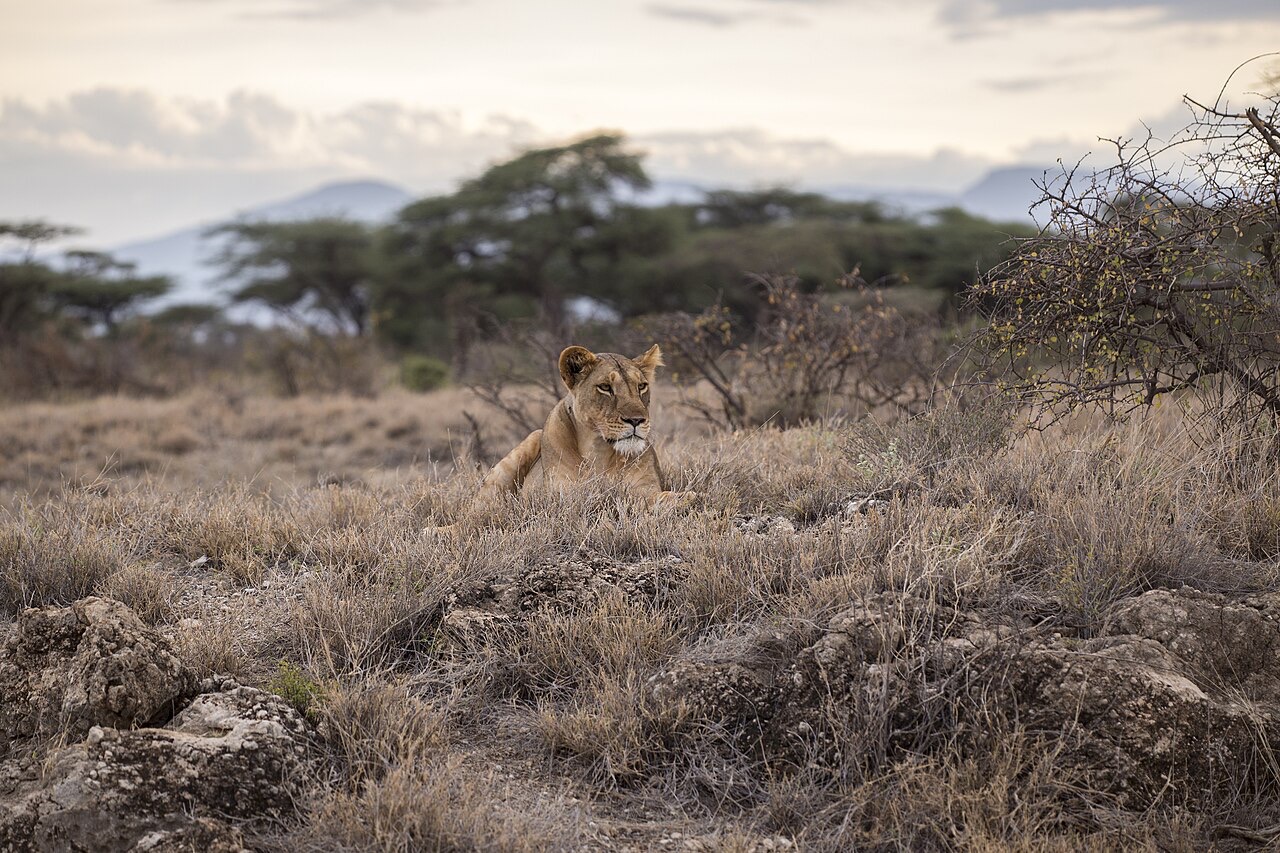
Zoology · Lion PredationLions are ambush hunters. They rarely chase strong, alert adults across open ground; instead they study a moving group, mark whoever is small, tired, or on the edge, and strike where the risk is lowest. Most attacks come after dark, because a lion’s eyes gather roughly six times more light than a human’s, making night the hour when the hunter sees and the hunted cannot. That is why the land of the Atuot — grassland thick with game — was crossed with such dread, and why a column of exhausted, sleeping travelers is exactly what a nocturnal predator hopes to find. Field studies in East Africa add the numbers: lions fail in roughly three of every four hunts, and an injured hunter starves, so they consistently test a herd for the limping, the small, and the stragglers rather than gamble on a healthy adult. Guards, fires, and a single rifle change the arithmetic, because predators abandon hunts that look costly. A watchful group is dangerous; a silent, sleeping one is simply prey.
Visual AidThe hunter the grass hides
A lioness lying almost flat in tall dry grass among rocks, only her head and shoulders visible, with acacia trees and hills behind
Photograph of a lioness resting low in dry East African grassland — taken in Kenya in 2015, not in the land of the Atuot, which no photographer walked with Salva’s group. See how little of her the grass shows: this is the ambush hunter the Knowledge Bank describes, one that studies a moving group and strikes where the risk is lowest, most often after dark, when her eyes gather roughly six times more light than a human’s. The picture cannot show the KB’s hardest fact — that a watchful group is dangerous to her, and a silent, sleeping one is simply prey.
Lioness resting low in dry grassland, Kenya; photograph by Bram Vranckx, 2015, via Unsplash. Source: Wikimedia Commons, File:African-landscape-lion (Unsplash).jpg, CC0.
reunionn.Ch.6
A coming together again after time apart
“The reunion with Uncle gave Salva a reason to keep walking.”
scarceadj.Ch.6
Hard to find; not enough to go around
“Water grew scarce as the group moved through the dry country.”
preyn.Ch.6
An animal hunted by another animal for food
“A sleeping traveler could become a lion’s prey.”
vigilantadj.Ch.6
Watchful and alert for danger
“Uncle stayed vigilant through the darkest hours of the night.”
terrainn.Ch.6
The land and its natural features
“The terrain ahead was flat, dry, and open to the sun.”
griefn.Ch.7
Deep sorrow after a loss
“Salva’s grief for Marial had no safe place to go.”
endurev.Ch.7
To keep going through something hard
“Salva learned he could endure more than he had believed.”
vastadj.Ch.7
Enormous in size or area
“A vast stretch of dry land waited somewhere beyond the river.”
makeshiftadj.Ch.7
Put together quickly from whatever is at hand
“Reeds by the water could become makeshift boats.”
ordealn.Ch.7
A severe and testing experience
“Each day of the walk was an ordeal of heat and hunger.”

ⓘ The vocabulary words in this list are selected to help you understand and complete this workbook. Some may not appear verbatim in the original novel.

🧠Knowledge Bank question
1According to the Knowledge Bank, when a lion tests a herd for prey, it looks for ___.Ch.6
2An animal described as ‘prey’ is an animal that hunts others for food.Ch.6
3Someone who is ‘vigilant’ is ___.Ch.6
4‘Terrain’ means ___.Ch.6
5Fill in each blank with the correct word.Ch.6
Word choices:scarcegriefvigilantvast- some words will not be used
Water was as the group crossed the dry country.
Salva carried his for Marial in silence.
6‘Vast’ means ___.Ch.7
7To ‘endure’ hardship is to keep going through it without giving up.Ch.7
8A ‘makeshift’ boat is one built quickly from whatever materials are at hand.Ch.7
9Fill in each blank with the correct word.Ch.7
Word choices:reunionordealmakeshiftprey- some words will not be used
The with his uncle gave Salva new strength.
The dry country ahead promised the hardest yet.
10‘Grief’ means ___.Ch.7
Part 2
Comprehension
Show you understood what happens in Chapters 6–7.
🧭Knowledge Bank · One Calm Adult
Survival · Group LeadershipSurvival researchers keep finding the same pattern: in a disaster, the group with one calm, experienced leader outlives the group without one. A leader turns a crowd’s panic into a plan — when to walk, when to rest, who keeps watch. The pattern repeats from shipwrecks to mountain accidents: panic spreads through a leaderless crowd in seconds, while one steady voice issuing small, concrete instructions can hold dozens of frightened people together. Uncle Jewiir brings three assets the boys around him lack: military training, a rifle, and a stated destination. The rifle matters twice over, since one shot can feed a whole column and can turn a stalking lion aside. But his greatest tool is direction: naming Ethiopia gives every brutal day a purpose, and human beings endure almost anything better when they know what it is for. Hope, in a walking group, is not a mood. It is a form of discipline.
Visual AidWhat one calm adult adds
What one calm adult addsThree boxes on the left, military training that reads danger and sets watches, one rifle for food and for turning lions aside, and a named destination, Ethiopia, giving each day a purpose, send arrows into a central box for Uncle Jewiir, one calm, experienced adult with a plan. An arrow leads on to a box for the plan: walk, rest, watch, panic becomes order. Notes say the pattern repeats from shipwrecks to mountain accidents, and that hope in a walking group is a form of discipline.WHAT ONE CALM, EXPERIENCED ADULT ADDSMILITARY TRAININGreads danger, sets watchesONE RIFLEfood — and lions turned asideA NAMED DESTINATIONEthiopia: each day has a purposeUNCLE JEWIIRone calm, experiencedadult with a planTHE PLANwalk, rest, watch:panic becomes orderthe pattern repeats from shipwrecks to mountain accidents — one steady voice, small concrete instructionshope, in a walking group, is a form of discipline
Structure diagram of the survival pattern the Knowledge Bank reports: three assets — military training, one rifle, a named destination — flow into a single calm, experienced adult, and out of him comes a plan that turns panic into order. The boxes simplify on purpose: Uncle Jewiir also carries kinship, humor, and the authority of a full Dinka name, none of which fit in a diagram. The drawing claims no numbers; it maps why researchers keep finding that the group with one steady leader outlives the group without one.
Disaster-survival leadership findings as summarized in studies of shipwreck and mountain-accident groups. Drawn for Garden Heights Academy.
🧠Knowledge Bank question
1The Knowledge Bank explains that Uncle Jewiir's greatest tool as a leader is ___.Ch.6
2The land of the Atuot is feared because of its ___.Ch.6
3Marial is taken by the lion in the middle of the day, while the group walks.Ch.7
4After Marial is lost, why does Salva stay close to Uncle?Ch.7
5Write the numbers 1–5 in the boxes to show the correct order of events. Number 1 = what happens first.Chapters 6–7
  • A single rifle shot brings down a young antelope, and everyone eats.
  • Salva learns a lion took Marial and stays close to Uncle’s rifle.
  • Uncle takes charge of the group and promises to look after Salva.
  • The travelers reach the bank of the Nile.
  • Uncle wakes Salva in the night with news he cannot finish.
6Salva’s group changes course to go around the land of the Atuot.Ch.6
7Where does Uncle say he will lead Salva?Ch.7
8What sickness strikes Akeer?Ch.7
9Akeer’s family must weigh a long walk to a clinic against treating her at home.Ch.7
10Where has the group arrived as Chapter 7 ends?Ch.7
Part 3
Literary Elements
Understanding HOW and WHY Linda Sue Park tells the story across Chapters 6–7.
🎭Knowledge Bank · Two Stories, One Thirst
Authorial Craft · Dual NarrativeLinda Sue Park (author) builds this book from two timelines that take turns: Nya’s in 2008 and Salva’s beginning in 1985, twenty-three years apart. Each chapter opens with a short, dated slice of Nya’s day, set apart in its own typeface, before handing the page back to Salva. The structure does quiet work. Both threads circle the same scarce thing — water — so every trip Nya makes for it deepens what Salva’s thirst means, and the reader begins asking how two stories a generation apart could possibly touch. The alternation also works like a pressure valve: whenever Salva’s thread becomes almost unbearable, the book steps away to Nya’s quieter hardship, giving readers room to breathe before returning — film editors use the same trick and call it cross-cutting. Park (author) sharpens the machine with cliffhangers: Chapter 6 ends on words Uncle cannot finish. Trust the design — parallel lines in this book are drawn so that they finally converge.
Parallel Narrative
Two storylines take turns on the page — Nya’s in 2008 and Salva’s in 1985 — each one deepening what the other’s thirst and danger mean.
Foreshadowing
The dread surrounding the Atuot’s lion country is planted before anything happens — so when the night takes Marial, the reader realizes the warning was there all along.
Cliffhanger
Chapter 6 ends with Uncle waking Salva and failing to finish his sentence — the chapter break itself becomes part of the shock.
🧠Knowledge Bank question
1The Knowledge Bank explains that the switch to Nya's chapters works like a pressure valve because it ___.Ch.6
2Ending Chapter 6 with news Uncle cannot finish saying is ___.Ch.6
3A cliffhanger ends a chapter at a moment of unresolved danger or suspense.Ch.6
4The talk of lion country, heard before Marial vanishes, works as ___.Ch.6
5A parallel narrative means one narrator tells all events in a single straight line.Ch.7
6Fill in each blank with the correct literary term.Ch.6
Word choices:foreshadowingparallelcliffhangerrhyme- some words will not be used
Early talk of the lion country is .
Nya’s and Salva’s alternating stories form a narrative.
7Which struggle ties the 1985 thread to the 2008 thread?Ch.7
8Foreshadowing gives readers hints about events that have not yet happened.Ch.6
9Leaving Marial’s death offstage, told in a few plain words, is ___.Ch.7
10Fill in each blank with the correct literary term.Ch.7
Word choices:cliffhangermoodsimileforeshadowing- some words will not be used
Chapter 6’s unfinished sentence is a classic .
The watchful, silent nights build an uneasy .
Part 4
Think Deeper
Four deeper challenges — no single-word recall. Read, weigh the evidence, and reason it out.
💡Knowledge Bank · Weighing the Cost of Going On
Reasoning · Survival ChoicesPart 3 keeps asking what survival is allowed to cost. Uncle spends a bullet — scarce and irreplaceable — on an antelope, betting calories now against danger later. The group crosses lion country because the only road to safety runs straight through risk. Salva loses Marial and must decide what to do with a grief that cannot be allowed to slow his feet. And in Nya’s time, a family weighs a sick child against a clinic that is days of walking away. Economists give this kind of thinking a name — opportunity cost, the value of whatever you give up by choosing — and on the trail it is paid in calories, bullets, daylight, and grief. The four challenges below ask you to reason the way these characters must: state a claim, back it with evidence, sort pressures from comforts, and connect each cause to its true effect. Bring reasons, not feelings — on this walk, every choice is a calculation.

Picture a column of people asleep on open ground, in a country whose grass is tall enough to hide a lion. No fences, no walls, no doors — only the dark, the small sounds of the night, and one man lying with a rifle within reach. A boy of eleven sleeps in that column, near his best friend, nearer still to his uncle. When he is shaken awake, the night has already taken something without a sound — no scream, no struggle, just an empty place where his friend had been. Part 3 is about what a boy does with a loss like that: he gets up, and he walks. Twenty-three years later, in the same thirsty country, a small girl named Akeer drinks the only water her family has, and her own body begins to turn against her. Two stories, one hard lesson: in this land, water decides everything — who eats, who moves, who lives.

Original passage written for Garden Heights — not a quotation from the novel.
1Claim: “Part 3 argues that on this walk, survival is a group project — no one lasts long alone.” — choose the two details that best prove it.Claim & Evidence
2Raises the danger, or Builds trust and hope? Tap each detail to send it left or right.Sort into two
◄ Raises the dangerBuilds trust and hope ►
3Match each cause to its result. For each cause, pick its result.Cause & Effect
Uncle served as a soldier in the war
The route crosses the land of the Atuot
A lion takes Marial in the night
The only water Akeer has is unsafe to drink
🧠Knowledge Bank question
4Fill both blanks to complete the reasoning.Build the Argument
Uncle's choice to spend a scarce bullet on an antelope is a sound survival decision because , which shows that .
Part 5
Standardized Test
The Body’s Water Budget · Reading & Vocabulary · SAT & TOEFL-style practice
The Body’s Water Budget

A walking human body is, before anything else, a machine for holding its temperature near 98.6 degrees Fahrenheit (37 degrees Celsius). Every step your muscles take produces heat, and on a hot day the only way out for that heat is sweat. As sweat evaporates from the skin, it carries heat away with it — which is why a person hiking in extreme heat can lose about one liter (about one quart) of water every hour. The system works — but only as long as there is water to spend.

The trouble is that the body has no storage tank. Lose just 2 percent of your body weight as water and thirst sets in; at 4 percent, muscles weaken and attention begins to deteriorate; by 6 percent, headache, dizziness, and a racing heartbeat arrive. Beyond a 10 percent loss, sweating can shut down and the blood thickens until the heart struggles to push it; heatstroke — the failure of the body's cooling system — is close behind. A resting person in mild weather can endure about three days without water, but someone walking under desert sun may collapse within a single afternoon.

This is why, where water is scarce, experienced desert travelers conserve it instead of drinking it. The gut absorbs only about one liter per hour, so a gulped supply is mostly wasted; small, steady sips replenish the blood at the same rate the body can use it. Wise travelers also spend less: they walk in the early morning or at night, rest in shade through the hottest hours, and keep clothing on, since covered skin loses sweat more slowly. In a place where the next water may be days away, discipline is not caution — it is survival.

Original passage written for Garden Heights — not a quotation from the novel.
1What is the main idea of the passage?SAT · Central Ideas
2According to the passage, sweating cools the body because ___.TOEFL · Factual Information
3The passage says a person hiking in extreme heat can lose about ___ each hour.TOEFL · Factual Information
4According to the passage, thirst begins when water losses reach about ___ of body weight.TOEFL · Factual Information
5The passage states that beyond a 10 percent loss, ___.TOEFL · Factual Information
6Compared with a resting person in mild weather, someone walking under desert sun ___.SAT · Inference
7Why do small sips work better than gulping a large amount at once?SAT · Inference
8In the passage, scarce most nearly means ___.SAT · Words in Context
9In the passage, replenish most nearly means ___.TOEFL · Vocabulary
10In the passage, endure most nearly means ___.SAT · Words in Context
Part 6 · Optional
Creative Writing
A bonus challenge to practice your English. Take your time and have fun with it.
About This Section

This writing task is optional and is not part of your auto-graded score. The feedback below checks only the basics — length, spelling, and grammar — not whether your ideas are right or wrong. It is meant for classroom discussion and creative practice, so feel free to use your imagination!

Writing Task — Part 3 “The Person Who Got You Through”

When Salva loses Marial, what keeps him walking is not courage alone — it is Uncle: a steady presence with a rifle, a plan, and a promise. Write about a time when one person’s presence helped you through something hard — a relative, a coach, a friend, even a stranger. Describe what you were facing, what that person actually did or said, and how it changed what you believed you could do. 6–10 sentences. End by telling what you would say to that person now.

You can start with: “The hardest part was not the thing itself...”
0 / 40 words minimum
🗣 Teach It · Just for Fun (optional)

No right or wrong — close the screen and tell someone nearby what happened in this part. Can’t find anyone? Tell yourself out loud. The moment you teach it, you truly understand it.

Garden Heights

Part 3 Complete!

You finished Chapters 6–7 of A Long Walk to Water.

Here are your auto-graded results:

-
points out of 100
🗣 Teach It · Just for Fun (optional)
Move on to Part 4 →

Independent study guide by Garden Heights. Not affiliated with or endorsed by Linda Sue Park. Contains original analysis only; no text from the novel is reproduced. Reference text: This workbook follows Linda Sue Park’s classic text (the standard Puffin edition sold worldwide). Revised 2023 UK editions change some wording and may not match the vocabulary studied here.