New here? Just sign up with Google — your account includes Matilda, our gift book, forever.
A Long Walk to Water · Garden Heights
Part 7
for A Long Walk to Water · Part 7 · Chapters 15–16
8 Parts40 min
What Happens in Part 7
Chosen from the camp lists, Salva flies to a new life in Rochester — then learns his father is alive.
Named for AmericaBy Chapter 15 Salva has spent years behind camp fences in Kenya — Kakuma, isolated as a prison, then Ifo, where food is short, work is scarce, and the days blur. Now twenty-two, he learns two life-changing things from Michael, an aid worker from Ireland: how to read English and how to play volleyball. Then a rumor sweeps the camp: America will take in some of the young men the aid workers call the Lost Boys of Sudan.
Rochester, New YorkLists of chosen names appear outside the camp office, and again and again Salva reads other people's names — until at last he finds his own, beside the words Rochester, New York. In Nairobi the chosen boys are photographed, examined by doctors, and given papers and more new clothes than Salva has ever owned.
First SnowThree airplanes carry him out of Africa — to Frankfurt in Germany, to New York City, and finally to Rochester — and before the last landing he bundles into all his winter clothing, jacket, gloves, and hat, for a cold he has never felt. At the airport he meets Chris and Louise, the American couple who will be his new family, and steps out into frigid air and his first snow.
Email and BoreholeChapter 16 is the slow work of arrival — English word by word, school, winter. After six years in Rochester, an email from a cousin in Zimbabwe cracks his life open: Salva's father is alive, treated at a UN clinic in Sudan. In 2009, Nya's borehole — a narrow drilled well — yields brown water; Dep explains it must be drilled deeper and will run clear in a few days. Then men clear land nearby, and Nya's father smiles at her questions.
What We Will Learn
Section
What you will practice
Vocabulary
Words for leaving and arriving: rumor, eligible, resettle, sponsor, frigid…
Literary Elements
Juxtaposition that sets a desert camp beside a snowbound city, pacing that folds six years into a line, and objects that grow into symbols
Cross-Curricular
US refugee resettlement — how a program chose some 3,800 Lost Boys, and what ninety days of official help can and cannot do
Chapter Summary
Ch.
What happens
Chapter 15
Lists at the Camp Office — Years grind past in Kenyan refugee camps, first Kakuma and then Ifo, where an Irish aid worker named Michael teaches Salva to read English and to play volleyball. Word spreads that America will take in thousands of the young men now called the Lost Boys, and lists of chosen names go up outside the camp office — until one day Salva’s own name is there, beside the words Rochester, New York. In Nya’s village, the borehole at last brings up water — brown and muddy — and Dep explains that the drilling must keep going deeper.
Chapter 16
Snow, School, and an Email — After photographs, medical exams, and travel papers in Nairobi, three flights carry Salva through Frankfurt and New York City to Rochester, where he pulls on strange heavy winter clothes and meets Chris and Louise, his new American family. He throws himself at English, enters school, and after six years receives an email from a cousin in Zimbabwe: his father is alive, at a United Nations clinic in Sudan. Near the well site, men begin clearing a patch of land; when Nya asks what it is for, her father only smiles and tells her to wait and see.
Part 1
Vocabulary
Study 10 key words from Chapters 15–16, then answer each question.
📚Knowledge Bank · The List of 3,800
History · The Lost Boys ProgramThe young men crowding the camp bulletin board were part of something historic. Around 2000 and 2001, the United States agreed to resettle roughly 3,800 young Sudanese refugees whom aid workers called the Lost Boys — most of them orphaned or separated from their families by civil war. Selection moved slowly: the United Nations refugee agency referred names, American officers held interviews to confirm each boy’s story, and doctors screened every candidate before a single ticket was issued. Priority went to young people with no parents or relatives left to care for them, which is one reason so few girls were chosen — camp custom placed girls inside foster families, hiding them from a program searching for those who stood alone. History then closed the door almost as fast as it opened: after the terrorist attacks of September 2001, American resettlement flights froze for months, stranding boys whose names had already been posted. Every list on that board was a roll call of the unaccompanied.
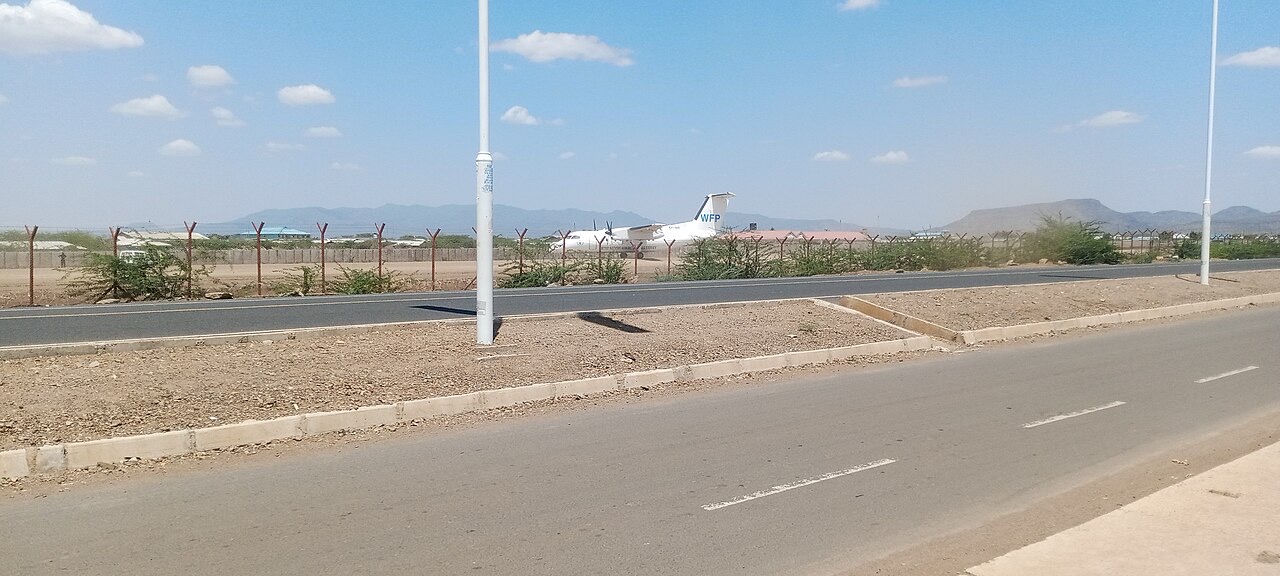
Visual AidThe airstrip beside the camp
Photograph of the airstrip at Kakuma, in Kenya’s dry northwest — the camp where the Knowledge Bank’s list of 3,800 was posted on bulletin boards. The white plane belongs to the World Food Programme, the UN agency that flies food and aid workers into remote camps; planes like it were also the machines that finally carried chosen boys away, and the flights that froze after September 2001 were exactly this fragile link. The picture was taken from the roadside in 2024, decades after Salva’s time; the camp itself sprawls out of frame. Notice the emptiness around the fence — everything at Kakuma arrives from somewhere else.
A World Food Programme plane at the Kakuma airstrip, Turkana County, Kenya; photograph by PrinceMKey, 2024. Source: Wikimedia Commons, File:A Humanitarian Plane landing at Kakuma Air Strip.jpg, CC0.
rumorn.Ch.15
A story passed from person to person without proof
“A rumor about America raced from tent to tent through the camp.”
eligibleadj.Ch.15
Qualified and allowed to be chosen
“Only some of the young men were eligible for the resettlement lists.”
orphann.Ch.15
A child whose parents have died
“Many of the Lost Boys were orphans of the long civil war.”
monotonousadj.Ch.15
So unchanging that it becomes dull
“Camp life was monotonous: the same dust, the same lines, the same days.”
resettlev.Ch.15
To help someone make a permanent home in a new country
“America agreed to resettle thousands of the young refugees.”
sponsorn.Ch.16
A person or group that agrees to help a newcomer settle
“A sponsor family in Rochester agreed to take Salva in.”
frigidadj.Ch.16
Bitterly, painfully cold
“Frigid air met the boys the moment the airplane doors opened.”
dazedadj.Ch.16
Too stunned or confused to think clearly
“After three long flights, Salva walked off the last plane dazed.”
adjustv.Ch.16
To slowly get used to new conditions
“It took months to adjust to snow, school, and English.”
clinicn.Ch.16
A small medical center where patients are treated
“His father was being cared for at a United Nations clinic.”
ⓘ The vocabulary words in this list are selected to help you understand and complete this workbook. Some may not appear verbatim in the original novel.
🧠Knowledge Bank question
1According to the Knowledge Bank, the program to resettle the Lost Boys chose very few girls because ___.Ch.15
2‘Eligible’ means qualified and allowed to be chosen.Ch.15
3An ‘orphan’ is a child whose ___.Ch.15
4‘Monotonous’ days are days that are ___.Ch.15
5Fill in each blank with the correct word.Ch.15
Word choices:resettlerumorfrigidsponsor- some words will not be used
America agreed to thousands of the young men.
A about the lists raced through the camp.
6‘Frigid’ describes weather that is warm and gentle.Ch.16
7A ‘sponsor’ is someone who ___.Ch.16
8‘Dazed’ means thinking quickly and clearly.Ch.16
9Fill in each blank with the correct word.Ch.16
Word choices:adjustdazedeligiblemonotonous- some words will not be used
Salva worked hard to to his new life.
He walked off the last plane and blinking.
10A ‘clinic’ is a place where people go to ___.Ch.16
Part 2
Comprehension
Show you understood what happens in Chapters 15–16.
🔍Knowledge Bank · Ninety Days to Stand
Civics · Sponsors and CaseworkersNo refugee arrives in America alone at the curb. A resettlement agency — a charity working under government contract — meets each newcomer at the airport, unlocks an apartment stocked with donated furniture, and assigns a caseworker to untangle documents, school enrollment, and medical care. For roughly ninety days the agency helps with rent and bills; after that, adults are expected to work. The machinery dates to the Refugee Act of 1980, the law that turned an improvised welcome into a permanent national system braiding federal money, local charities, and volunteer goodwill. Around this official system stand volunteers: church groups and host families — a sponsor can be as ordinary as a couple like Chris and Louise who simply say yes to a stranger. The help is real but strictly temporary, and part of every plane ticket is a loan the newcomer must repay. American resettlement hands out a beginning, not a finished life — a bargain counted in days.
Visual AidNinety days to stand
Sequence diagram of the machinery the Knowledge Bank describes, run left to right: an agency meets the newcomer at the airport, an apartment waits stocked with donated furniture, a caseworker untangles documents, school, and medical care — and at about day 90 the help ends and adults must work. The four boxes simplify a process that bends for every family, and the diagram does not show the volunteers — sponsors like Chris and Louise — who stand around the official system. Notice the last italic line: even the plane ticket is a loan.
The United States resettlement process under the Refugee Act of 1980, as described by the U.S. Office of Refugee Resettlement. Drawn for Garden Heights Academy.
🧠Knowledge Bank question
1The Knowledge Bank explains that the Refugee Act of 1980 ___.Ch.15
2What does Michael, the aid worker from Ireland, teach Salva?Ch.15
3Salva’s name finally appears on a list posted at the camp.Ch.15
4When Salva finds his name on a list, where is he going?Ch.15
5Write the numbers 1–5 in the boxes to show the correct order of events. Number 1 = what happens first.Chapters 15–16
An email brings news that Salva’s father is still alive.
During the journey, Salva puts on heavy winter clothes.
Chris and Louise greet Salva at the Rochester airport.
In Nairobi the chosen boys get medical exams and travel papers.
Salva finds his own name on a posted list at the camp office.
6The first water from the new borehole in Nya’s village runs clear and clean.Ch.15
7What does Dep tell Nya about the muddy brown water?Ch.15
8Where does Salva’s airplane stop between Africa and New York?Ch.16
9Salva’s host parents in Rochester are named Chris and Louise.Ch.16
10Six years after arriving, what news reaches Salva by email?Ch.16
Part 3
Literary Elements
Understanding HOW and WHY Linda Sue Park tells the story across Chapters 15–16.
🎭Knowledge Bank · Six Years in One Sentence
Craft · Time on the PageWatch the clock in this part. Six years of camp life pass in a handful of paragraphs, yet one airplane journey stretches across pages of roaring engines, sweet cold soda, and strange heavy clothes. Writers call the fast stretches summary and the slowed-down moments scene, and choosing between them is the craft of pacing. Linda Sue Park (author) spends words the way her characters spend water: only where life changes. The camp years, which felt endless to live, fall nearly silent on the page, while a first taste of snow earns its own moment. Psychologists would side with her bookkeeping: novelty stretches remembered time, which is why a first flight fills pages of memory while a thousand identical camp days compress into almost none. Notice, too, what the leap forward does to the book’s shape — Salva’s story lands only a few years short of Nya’s, and the two narratives begin bending toward each other. Endurance is real, but on the page it takes one sentence.
Juxtaposition
Two worlds sit side by side on the page — a fenced desert camp and a snowbound American city — so that each one exposes what the other lacks.
Pacing
Years vanish in a sentence while a single airplane ride fills pages: Linda Sue Park (author) speeds and slows time to show the reader what matters most.
Symbolism
Objects carry meaning beyond themselves: a posted list is a door out of the camp, and heavy winter clothes are a new life a boy must learn to wear.
🧠Knowledge Bank question
1According to the Knowledge Bank, a first flight can fill pages of memory while a thousand camp days shrink to almost none because ___.Ch.16
2Covering six years in a single line while one airplane ride fills pages is a choice about ___.Ch.16
3Pacing refers to the order in which characters are first introduced.Ch.15
4In this part, the posted list works best as a symbol of ___.Ch.15
5A symbol is an object that stands only for itself and nothing more.Ch.15
6Fill in each blank with the correct literary term.Ch.16
Word choices:juxtapositionpacingglossaryfootnote- some words will not be used
Setting camp dust beside falling snow is .
Six years passing in one sentence is a choice of .
7The heavy winter clothes Salva must wear act mainly as ___.Ch.16
8Juxtaposition means placing two things side by side so readers compare them.Ch.16
9Which sentence below shows juxtaposition most clearly?Ch.16
10Fill in each blank with the correct literary term.Ch.16
Word choices:symbolmotifindexcaption- some words will not be used
The winter coat he must learn to wear is a .
Water returning in both stories forms a .
Part 4
Think Deeper
Four deeper challenges — no single-word recall. Read, weigh the evidence, and reason it out.
💡Knowledge Bank · Snow, Switches, and Small Mysteries
Culture · Arrival ShockPeople who study migration say that arrival comes in waves. First is wonder — airplanes, electric light, water pouring from a wall. Then comes the hard middle, when every small task turns strange: a stove with no fire, a moving staircase, cold that stings like an insult. Researchers call this culture shock, and it fades only through slow adjustment — school, work, language, friends. The classic model draws those waves as a curve: a honeymoon of wonder, a deep trough of frustration and homesickness, then a slow climb toward feeling at home that often takes a year or more. The deeper question is what anyone owes anyone. Refugees are often told to feel gratitude, and most do; but a country that resettles people also owes them patience, fairness, and a real chance to work. As you weigh Part 7’s challenges, ask what Salva gives his new country as well as what it gives him. Help that respects both sides of the bargain is not charity — it is dignity.
Picture a sheet of paper tacked to a board outside a camp office in Kenya. It holds a column of typed names, and around it presses a crowd of young men who have been waiting — not for hours, but for years. Most will read to the bottom of the page and walk away in silence, exactly as they did the last time, because this is how a new life is handed out: a page at a time, to a lucky few. Then one day the name Salva has been searching for is there — his own — beside a word he has never heard before: Rochester. What follows is a journey stranger than any walk across a desert. A ride to Nairobi. Three airplanes. A cup of sweet, ice-cold soda above the clouds. Clothes heavier than any he has ever worn, for a kind of cold he cannot yet imagine. And at the end of it, a family of smiling strangers in a world gone completely white. Part 7 is a door opening — and the long, cold work of walking through it.
Original passage written for Garden Heights — not a quotation from the novel.
1Claim: “Part 7 argues that being chosen for America is a beginning full of work, not a happy ending.” — choose the two details that best prove it.Claim & Evidence
2The waiting years, or The new life? Tap each detail to send it left or right.Sort into two
◄ The waiting yearsThe new life ►
3Match each cause to its result. For each cause, pick its result.Cause & Effect
Lists of chosen names go up at the camp office→
His name appears beside the words Rochester, New York→
Winter waits at the end of the flights→
A cousin in Zimbabwe sends a sudden email→
🧠Knowledge Bank question
4Fill both blanks to complete the reasoning.Build the Argument
The Knowledge Bank argues that arrival in a new country moves in waves because , which shows that .
Part 5
Standardized Test
A First Winter in America · Reading & Vocabulary · SAT & TOEFL-style practice
Read the passage — the highlighted words are tested — then answer. Tap an answer, then tap it again to confirm.
SATCentral Ideas — the passage's main point
SATInference — a conclusion the passage implies
SATWords in Context — a word's meaning in this passage
TOEFLFactual Information — a fact stated in the passage
TOEFLVocabulary — a tested word's meaning here
A First Winter in America
A refugee's journey does not end when the airplane lands. In the United States, a resettlement agency — a charity working under government contract — meets each newcomer at the airport and drives the family to an apartment already stocked with donated furniture, secondhand dishes, and a hot meal. A caseworker then walks them through the paperwork of a new life: identity documents, medical checkups, school enrollment, and job applications. For roughly ninety days, the agency helps pay rent and bills while the newcomers find their feet. After that short runway, families are expected to begin supporting themselves.
For many newcomers, the city itself is stranger than the paperwork. A person who has cooked over open fires must decode a gas stove; someone who has never seen a thermostat, an escalator, or a frozen sidewalk may meet all three in a single week. Agencies answer with orientation classes that cover bus routes, bank accounts, grocery labels, and the unwritten rules of American schools. English lessons matter most of all, because language unlocks everything else — a job interview, a doctor's question, a joke shared across a fence. Volunteers and host families fill the gaps, explaining the small mysteries no class remembers to teach; a family that makes that helping promise official is called a sponsor.
The bargain runs in both directions. Most refugees take a first job within months, whatever their old skills were, and part of every airfare is a loan the newcomer must repay. In return, study after study finds that refugees learn the language, start businesses, and pay taxes at remarkable rates. What carries people through the icy weeks of that first frigid winter is the plain memory of everything they have already survived.
Original passage written for Garden Heights — not a quotation from the novel.
1What is the main idea of the passage?SAT · Central Ideas
2For about how long does the agency help pay rent and bills?TOEFL · Factual Information
3The stove, thermostat, and escalator are examples of ___.SAT · Inference
4Why does the passage call English lessons the most important service?SAT · Inference
5What do volunteers and host families do, according to the passage?TOEFL · Factual Information
6What does the passage say about a refugee’s airfare?TOEFL · Factual Information
7The phrase ‘the bargain runs in both directions’ means ___.SAT · Inference
8In the passage, sponsor most nearly means ___.SAT · Words in Context
9In the passage, orientation most nearly means ___.TOEFL · Vocabulary
10In the passage, frigid most nearly means ___.SAT · Words in Context
Part 6 · Optional
Creative Writing
A bonus challenge to practice your English. Take your time and have fun with it.
About This Section
This writing task is optional and is not part of your auto-graded score. The feedback below checks only the basics — length, spelling, and grammar — not whether your ideas are right or wrong. It is meant for classroom discussion and creative practice, so feel free to use your imagination!
Writing Task — Part 7 “The Newcomer”
Salva steps off his last airplane into a world where the air, the language, and even the clothes are new. Write about a time you were the newcomer — at a new school, team, neighborhood, or country. Describe two things that confused you at first, one person who helped you the way Chris and Louise helped Salva, and one thing you brought from your old life that helped you stand. 6–10 sentences. End with the advice you would give the next newcomer.
You can start with: “On my first day, the smallest things were the strangest...”
0 / 40 words minimum
🗣 Teach It · Just for Fun (optional)
No right or wrong — tell someone nearby what happened in this part. Can’t find anyone? Tell yourself out loud. The moment you teach it, you truly understand it.
Part 7 Complete!
You finished Chapters 15–16 of A Long Walk to Water.
Independent study guide by Garden Heights. Not affiliated with or endorsed by Linda Sue Park. Contains original analysis only; no text from the novel is reproduced. Reference text: This workbook follows Linda Sue Park’s classic text (the standard Puffin edition sold worldwide). Revised 2023 UK editions change some wording and may not match the vocabulary studied here.