New here? Just sign up with Google — your account includes Matilda, our gift book, forever.
A Wrinkle in Time · Garden Heights
Part 2
for A Wrinkle in Time · Part 2 · Chapters 3–4
8 Parts40 min
What Happens in Part 2
Calvin finds a home with the Murrys, then three guides whisk the children to Uriel to glimpse the shadow their father fights.
The Murry kitchenCalvin walks home with Meg into a house unlike his own: Mrs. Murry cooking dinner over a Bunsen burner in her laboratory, twins arguing, warmth everywhere. He telephones his mother to say he will not be home, admitting she probably will not notice. Meg helps him with math homework several grades above her own; her father taught her shortcuts as games. Calvin confesses his easy popularity is a costume; he has been lonely for years, hiding what he really is.
The word tesseractAfter dinner Calvin reads to Charles Wallace upstairs while Meg sits with her mother, who quietly admits how much she misses her husband, and how much the word tesseract, spoken by a stranger in the night, has unsettled her. Outside, Meg tells Calvin the truth she never says at school: her father is a physicist who vanished a year ago on secret government work, and the town whispers that he simply left them. Calvin says he never believed it.
Time to goThen Charles Wallace arrives with news that it is time to go. Mrs Whatsit and Mrs Who appear, and behind them a third presence, Mrs Which, who does not fully take shape because materializing exhausts her. Instantly the children are torn out of the world and set down on Uriel, a planet circling the star Malak inside the spiral nebula Messier 101, by wrinkling space. Their father is not here; they have stopped to rest and to be shown something.
The shadow above UrielMrs Whatsit takes a magnificent winged form, the children climb onto her back, and she carries them over gardens where beautiful creatures sing. Higher and higher she flies, until the air thins and the children must breathe through fragrant flowers she gathers for them. From the summit they look out at the stars and see a shadow, cold and dark, spreading across the sky and blotting out the light. That, the three tell them, is what Mr. Murry is fighting.
Foreshadowing, the Black Thing as symbol, and L’Engle’s sensory imagery
Cross-Curricular
Light-years — how astronomers measure space, and why looking out is looking back
Chapter Summary
Ch.
What happens
Chapter 3
Mrs Which — Calvin finds warmth in the Murry house, Meg reveals her father vanished a year ago on secret work, and a third visitor arrives who cannot fully take shape.
Chapter 4
The Black Thing — The children wrinkle space to Uriel, ride the transformed Mrs Whatsit over singing gardens, and from a mountaintop see a shadow swallowing the stars.
Part 1
Vocabulary
Study 10 key words from Chapters 3–4, then answer each question.
🧠Knowledge Bank · Words of Wonder and Shadow
Lexical Semantics · Words of Wonder and Shadow
These four words are all about how solid a thing is. To materialize is to take solid, visible form: Mrs Which never fully materializes, because it tires her. A shimmer is a soft, wavering gleam of light: the third visitor arrived as little more than a shimmer. Tangible means real enough to be touched or felt: the warmth of the Murry kitchen felt almost tangible to Calvin. L’Engle is careful about that one — the kitchen is the only thing in Part 2 anybody can actually hold on to. Dread is deep fear of something coming: a cold dread settled over Meg on the mountaintop. Line them up and they run from most solid to least. The kitchen is tangible; the visitors shimmer; Mrs Which barely materializes at all; and dread, the least solid thing on the list, is the one that turns out to be heaviest.
materializev.Ch.3
To take solid, visible form
“Mrs Which never fully materializes, because it tires her.”
shimmern./v.Ch.3
A soft, wavering gleam of light
“The third visitor arrived as little more than a shimmer.”
tangibleadj.Ch.3
Real enough to be touched or felt
“The warmth of the Murry kitchen felt almost tangible to Calvin.”
dreadn.Ch.4
Deep fear of something coming
“A cold dread settled over Meg on the mountaintop.”
radiantadj.Ch.4
Shining brightly; glowing
“Uriel spread out below them, radiant and green.”
sereneadj.Ch.4
Calm, peaceful and untroubled
“The singing creatures moved in serene circles.”
ascendv.Ch.4
To climb or rise upward
“Mrs Whatsit continued to ascend until the air thinned.”
dwindlev.Ch.4
To shrink steadily away
“The breathable air began to dwindle as they rose.”
ominousadj.Ch.4
Threatening; hinting at harm to come
“The shadow across the stars looked deeply ominous.”
obscurev.Ch.4
To hide from view; to darken
“The Black Thing began to obscure the light of the stars.”
ⓘ The vocabulary words in this list are selected to help you understand and complete this workbook. Some may not appear verbatim in the original novel.
🧠Knowledge Bank question
1The Knowledge Bank explains that when tangible, shimmer, materialize, and dread are lined up from most solid to least, ___.Ch.3
2A ‘shimmer’ is a soft, wavering gleam of light.Ch.3
3Something ‘tangible’ can be ___.Ch.3
4‘Dread’ means a cheerful sense of excitement.Ch.4
5Fill in each blank with the correct word.Ch.4
Word choices:radiantascendobscurekitchen- some words will not be used
Uriel spread out below them, green and .
Mrs Whatsit began to toward the mountaintop.
6A ‘serene’ scene is ___.Ch.4
7To ‘dwindle’ is to ___.Ch.4
8Something ‘ominous’ hints that harm is coming.Ch.4
9Fill in each blank with the correct word.Ch.4
Word choices:obscuredreadserenepolite- some words will not be used
The Black Thing began to the light of the stars.
A cold settled over Meg.
10To ‘obscure’ something is to ___ it.Ch.4
Part 2
Comprehension
Show you understood what happens in Chapters 3–4.
🧠Knowledge Bank · From a Warm Kitchen to a Cold Star
Narrative Causality · From a Warm Kitchen to a Cold Star
The events of Chapters 3–4 become clearer when readers separate a character’s motive from the obstacle encountered and the response that follows. Calvin walks home with Meg and steps into a house unlike his own: Mrs. Murry cooking dinner over a Bunsen burner in her laboratory, twins arguing, warmth everywhere. He telephones his mother to say he will not be home, and admits she probably will not notice. Waiting for dinner, Meg helps Calvin with math homework several grades above her own, because her father once taught her shortcuts as games. Calvin confesses that his easy popularity at school is a costume; he has been lonely for years, hiding what he really is. After dinner he reads to Charles Wallace upstairs while Meg sits with her mother, who quietly admits how much she misses her husband — and how much the word tesseract, spoken by a stranger in the night, has unsettled her. Following motive through response reveals why “From a Warm Kitchen to a Cold Star” forms a consequential sequence.
🧠Knowledge Bank question
1According to the Knowledge Bank, the events of Chapters 3–4 become clearer when readers separate ___.Ch.3
2Meg helps Calvin with homework in ___.Ch.3
3Calvin admits that his popularity at school hides real loneliness.Ch.3
4Meg tells Calvin her father disappeared while ___.Ch.3
5Write the numbers 1–5 in the boxes to show the correct order of events. Number 1 = what happens first.Chapters 3–4
The children are carried to the planet Uriel.
Meg tells Calvin her father vanished a year ago.
From the mountaintop they see the shadow.
Calvin has dinner with the Murry family.
Mrs Which arrives without fully taking shape.
6Mrs Which appears in a full, solid human body like the others.Ch.3
7Uriel orbits a star called Malak, which sits inside ___.Ch.4
8Mrs Whatsit changes into a creature that can ___.Ch.4
9The children breathe through flowers because the air thins as they climb.Ch.4
10The shadow the children see from the mountaintop is ___.Ch.4
Part 3
Literary Elements
Understanding HOW and WHY Madeleine L'Engle (author) tells the story across Chapters 3–4.
🧠Knowledge Bank · The Black Thing as a Symbol
Narrative Technique · The Black Thing as a Symbol
The craft of Part 2 works through foreshadowing, symbol, and imagery, each shaping how readers judge the new conflict. When L’Engle finally shows the enemy, she does not show a villain. There is no fortress, no army, no face — only a shadow spreading across the stars and putting them out. The Black Thing is a symbol: a concrete image standing in for an idea far too large to draw. The idea is evil itself, and the picture L’Engle chooses tells you what she thinks evil does. It does not build anything or announce itself; it simply blots out what was already shining. Notice how carefully she prepares the contrast. The children have just flown over gardens where creatures sing, through air so sweet they need flowers to breathe it — every detail warm, alive, generous. That authorial design makes “The Black Thing as a Symbol” a lesson in deliberate suspense.
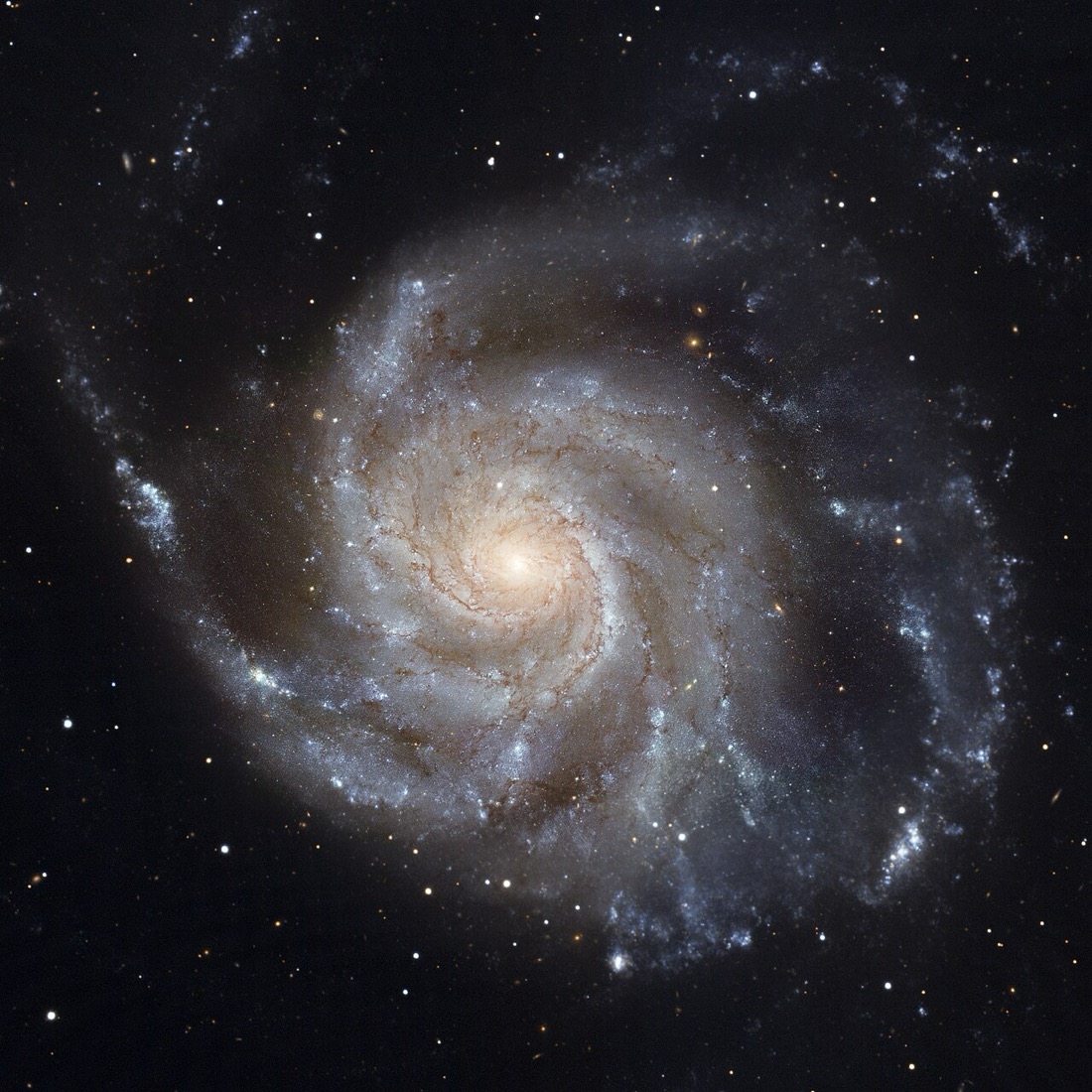
Visual AidThe real galaxy the guides name
Hubble Space Telescope photograph of Messier 101, the Pinwheel Galaxy, seen face-on from about 21 million light-years away — the real address L’Engle gives for the planet Uriel. The bright blue clumps along the arms are places where new stars are forming. Nothing in this picture is the Black Thing: the shadow across the stars is L’Engle’s invention, and this sky is unshadowed.
Messier 101, NASA/ESA Hubble Space Telescope, 2009 release; image credit NASA, ESA, K. Kuntz (JHU), F. Bresolin (University of Hawaii), J. Trauger (JPL), J. Mould (NOAO), Y.-H. Chu (University of Illinois) and STScI. Source: Wikimedia Commons, File:Hubble Image of M101 (2009-07-2477).jpg, public domain.
Foreshadowing
Hints planted early — the word tesseract, Charles Wallace’s urgency — that warn of the danger still to come.
Symbol
The Black Thing — a shadow blotting out stars — stands for evil itself, pictured as the swallowing of light.
Imagery
Sensory writing: warm fields, singing gardens, thinning air, and flowers the children breathe through on the mountain.
🧠Knowledge Bank question
1According to the Knowledge Bank, L'Engle's picture of the Black Thing suggests that evil ___.Ch.3
2Fill in each blank with the correct literary term.Ch.3
Word choices:foreshadowingsymbolsettingrhyme- some words will not be used
A hint planted early about later danger is .
The Black Thing standing for evil itself is a .
3Foreshadowing gives readers hints about events still to come.Ch.3
4The Black Thing mainly stands for ___.Ch.4
5Thin air, gardens of song and warm fields are examples of ___.Ch.4
6Imagery is language that appeals to the reader’s senses.Ch.4
7L’Engle (author) shows Uriel’s beauty first so that the shadow ___.Ch.4
8Fill in each blank with the correct literary term.Ch.4
Word choices:imagerysymbolnarratorclimax- some words will not be used
Language written for the senses is .
A shadow that stands for evil is a .
9A symbol must always be explained to readers before it can work.Ch.4
10The clearest sign that evil is described by absence is that it ___.Ch.4
Part 4
Think Deeper
Four deeper challenges — no single-word recall. Read, weigh the evidence, and reason it out.
🧠Knowledge Bank · Light-Years and the Size of Space
Astronomy · Light-Years and the Size of Space
When Mrs Which announces that the children are standing on a world orbiting a star called Malak, inside the spiral nebula catalogued as Messier 101, L’Engle is borrowing a real address from a real sky — and the numbers behind it are staggering. Astronomers gave up on kilometers for such distances long ago and switched to the light-year, which is not a unit of time but of distance: how far light travels in one year. Light is the fastest thing there is, crossing roughly 300,000 kilometers (186,420 miles) every second, so a single light-year works out to about 9.5 trillion kilometers. Even our nearest neighboring star, Proxima Centauri, sits more than four light-years away — and Messier 101, which astronomers now call the Pinwheel Galaxy rather than a nebula, lies roughly 21 million light-years off. Hold those two facts together for a moment. The children are told their address in a single sentence, and that sentence covers a gap light itself needs twenty-one million years to cross.
Visual AidHow far is far? Five distances on one ruler
Scale drawing on a logarithmic ruler: every step to the right is ten times farther, which is the only way five distances this different can share one drawing. On an ordinary ruler the Moon’s bar would be thinner than a hair. The figures are rounded, and the distance to M101 is an estimate astronomers still refine — recent measurements put it near 21 million light-years.
Distances from NASA (Moon, Sun, Proxima Centauri) and the NASA/ESA Hubble release on Messier 101 (2009). Drawn for Garden Heights Academy.
Picture a warm kitchen where a scientist mother stirs stew over a Bunsen burner, a boy who has never felt wanted anywhere finally feels at home, and a girl admits out loud that her father has been missing for a year. Then picture that same night cracking open: a shimmer in the dark, a third strange visitor who cannot quite hold a shape, and a single instant in which the whole world folds away. When the children can breathe again they are standing in a field of impossible spring on a planet no telescope on Earth has ever named, riding the back of a winged creature over gardens of singing flowers. And then they climb higher, past the last of the light, and see it — a stain spreading across the stars, swallowing them one by one. Nobody has to explain what it is. Charles Wallace goes gray. Meg cannot look away. Somewhere behind that darkness, their father is fighting.
Original passage written for Garden Heights — not a quotation from the novel.
1Claim: “Part 2 shows that the children’s mission is far larger than finding one missing father.” — choose the two details that best prove it.Claim & Evidence
2Belongs to the warmth of Uriel, or Belongs to the shadow over the stars? Tap each detail to sort it — tap again to switch sides. You can keep tapping to change your answer.Sort into two
◄ Belongs to the warmth of UrielBelongs to the shadow over the stars ►
3Match each cause to its result. For each cause, pick its result.Cause & Effect
Mrs. Murry hears the word tesseract→
Calvin steps into the Murry kitchen→
Mrs Whatsit takes her winged form→
The air grows thin near the summit→
🧠Knowledge Bank question
4Fill both blanks to complete the reasoning.Build the Argument
The Knowledge Bank argues that the light-year is a unit of distance, not time, because , which shows that .
Part 5
Standardized Test
Reading passage · Light-Years and the Scale of Space · SAT & TOEFL-style practice
Read the passage — the highlighted words are tested — then answer. Tap an answer, then tap it again to confirm.
SATCentral Ideas — the passage's main point
SATDetail — a fact stated in the passage
SATWords in Context — a word's meaning in this passage
SATInference — a conclusion the passage implies
SATText Connections — how two parts of the text relate
TOEFLFactual Information — a fact stated in the passage
TOEFLVocabulary — a tested word's meaning here
TOEFLProse Summary — the three sentences that sum it up
Measuring the Sky in Light-Years
When Mrs Which announces that the children stand on a world circling a star called Malak, inside the spiral nebula catalogued as Messier 101, she is naming a real address in a real sky. The trouble is the distance. Space is so immense that kilometers dwindle into uselessness almost at once, shrinking to nothing the way millimeters would for measuring the gap between two cities. So astronomers use a different ruler, the light-year: despite the name it measures distance, not time, and since light moves about 300,000 kilometers (186,420 miles) every second, one light-year works out to roughly 9.5 trillion kilometers.
Those numbers grow quickly. Proxima Centauri, the closest star to our Sun, lies just over four light-years away, and the center of our own galaxy is about 26,000 light-years off. Messier 101, which astronomers today call the Pinwheel Galaxy rather than a nebula, sits roughly 21 million light-years from Earth, so light itself would need 21 million years to make that crossing. This is why L'Engle must invent a way of folding space: no engine, however powerful, could carry three children that far in a human lifetime.
A stranger consequence hides inside the light-year: it turns every telescope into a time machine. Because light needs time to reach us, we never perceive a distant object as it is now; we only ever see it as it was when the light left. The most tangible example is the sunlight warming your hands, something you can actually feel: it is about eight minutes old, and the starlight in a clear night sky may have set out centuries ago, from stars that could have died since. To look far out into space is always to look far back into the past.
Original passage written for Garden Heights — not a quotation from the novel.
1What is the passage mainly about?SAT · Central Ideas
2A light-year is a unit of ___.TOEFL · Factual Information
3Light travels about ___ every second.SAT · Detail
4Proxima Centauri lies just over ___ away.SAT · Detail
5In the passage, dwindle most nearly means ___.SAT · Words in Context
6Why must L’Engle (author) invent a way of folding space?TOEFL · Factual Information
7In the passage, tangible most nearly means ___.TOEFL · Vocabulary
8Prose Summary (TOEFL).This passage explains the light-year and what the speed of light means for what we see in the night sky. This TOEFL task lists six sentences; choose the THREE that best capture the passage’s main ideas. The other three do not belong — they state minor details or ideas the passage does not present.TOEFL · Prose Summary
9The starlight we see tonight ___.SAT · Inference
10How does this passage best help explain Part 2?SAT · Text Connections
Part 6 · Optional
Creative Writing
A bonus challenge to practice your English. Take your time and have fun with it.
About This Section
This writing task is optional and is not part of your auto-graded score. The feedback below checks only the basics — length, spelling, and grammar — not whether your ideas are right or wrong. It is meant for classroom discussion and creative practice, so feel free to use your imagination!
Writing Task — Part 2 “Looking Out Is Looking Back”
The light reaching us from a distant galaxy set out millions of years ago, so every telescope looks into the past. Write about what it feels like to imagine distances that large — and why L’Engle (author) might place a shadow at the far end of one. 6–10 sentences. End with what the Black Thing makes you think evil is like.
You can start with: “The light I am looking at tonight left its star before anyone was alive to name it...”
0 / 40 words minimum
🗣 Teach It · Just for Fun (optional)
No right or wrong — close the screen and tell someone nearby what happened in this part. Can’t find anyone? Tell yourself out loud. The moment you teach it, you truly understand it.
Part 2 Complete!
You finished Chapters 3–4 of A Wrinkle in Time.
Here are your auto-graded results:
-
points out of 100
Teach it to someone
The best last step is to teach it. In your own words, explain what happened — retell a favorite scene, teach a character’s big choice, or sum up the main idea for a parent, friend, or classmate. When you can teach it clearly, you truly own it.
Independent study guide by Garden Heights. Not affiliated with or endorsed by Madeleine L'Engle. Contains original analysis only; no text from the novel is reproduced. Reference text: This workbook follows Madeleine L'Engle’s classic text (the standard Puffin edition sold worldwide). Revised 2023 UK editions change some wording and may not match the vocabulary studied here.
SAT® is a registered trademark of College Board, which is not affiliated with, and does not endorse, these materials. TOEFL® is a registered trademark of ETS. These materials are not endorsed or approved by ETS. Garden Heights is an independent provider of test-style reading practice.