New here? Just sign up with Google — your account includes Matilda, our gift book, forever.
A Wrinkle in Time · Garden Heights
Part 5
for A Wrinkle in Time · Part 5 · Chapter 7
8 Parts40 min
What Happens in Part 5
At CENTRAL Central Intelligence the man with red eyes tests the children, and Charles Wallace opens his mind to find Father.
The green corridorThe children walk into CENTRAL Central Intelligence holding hands, Meg in the middle. The green marble corridor is lined with identically dressed men at identical desks; to Meg they have the blank sameness of strangers crowded into a subway car. Papers go to a machine, a wall dissolves, and the three pass through a chamber of gigantic humming computers toward the man with red eyes, waiting on a raised dais beneath a light that pulses in time with his stare.
The first testHe speaks without moving his lips, straight into their minds, plainly annoyed that Calvin came at all. His offer sounds generous: on Camazotz nobody carries the burden of thought or decision, so everyone is happy. When Meg objects that alike and equal are different things, he orders them to chant the multiplication tables in his rhythm. Charles Wallace bellows nursery rhymes, Calvin recites the Gettysburg Address, Meg screams for her father; the rhythm breaks, and he coolly says they passed.
Only a mouthpieceCharles Wallace darts onto the platform and hits him, then announces what he has sensed: this man is not the true power, only a mouthpiece for something speaking through him. Curious, he looks into the red eyes and starts glazing over; Meg tackles him free. Dinner appears, a full turkey meal that Meg and Calvin taste perfectly well. To Charles Wallace it is dry sand: the flavor comes from the man's mind, and he will not let that mind in.
The final tradeSo the man makes his final trade: open up, and you will learn where your father is. Charles Wallace agrees over Meg's protests and stares into the red eyes until his pupils thin away and his eyes go wholly, emptily blue. Then he praises the excellent dinner and calls his sister belligerent and uncooperative, and Meg knows that whoever is speaking, it is not her brother.
What We Will Learn
Section
What you will practice
Vocabulary
Control & sameness words: conformity, automaton, monotonous, compel, defiance…
Literary Elements
Symbolism, allusion, and the motif of eyes that runs through the whole chapter
Cross-Curricular
Social Studies — how real one-party states enforce sameness and sell it as safety
Chapter Summary
Ch.
What happens
Chapter 7 · first half
Into CENTRAL Central Intelligence — the marble corridor of identical men, the room of machines, the man on the dais who speaks mind to mind, and the multiplication tables broken by nursery rhymes, the Gettysburg Address and a scream for Father.
Chapter 7 · second half
The Dinner and the Surrender — Charles Wallace strikes the man and names him a mouthpiece, the turkey tastes of sand, and Charles Wallace trades his own mind for news of his father and comes back with empty blue eyes.
Part 1
Vocabulary
Study 10 key words from Chapter 7, then answer each question.
🧠Knowledge Bank · The Language of Sameness
Lexical Semantics · The Language of Sameness
Four words, and every one of them describes a person being turned into a thing. Conformity is behaving the same way as everyone else in a group: Camazotz demands total conformity from every citizen. An automaton is a person who acts mechanically, without will: the men at the desks moved like an automaton. A dais is a raised platform for an important seat: the man with red eyes waited on a low dais. To pulsate is to throb with a steady beat: the light above him seemed to pulsate slowly. Notice the order the chapter puts them in. The pulse comes first, the automaton second, and the dais — the one word about power rather than people — sits at the far end of the room where nobody has to look at it. That is the frightening part: Camazotz does not need anyone to be watching.
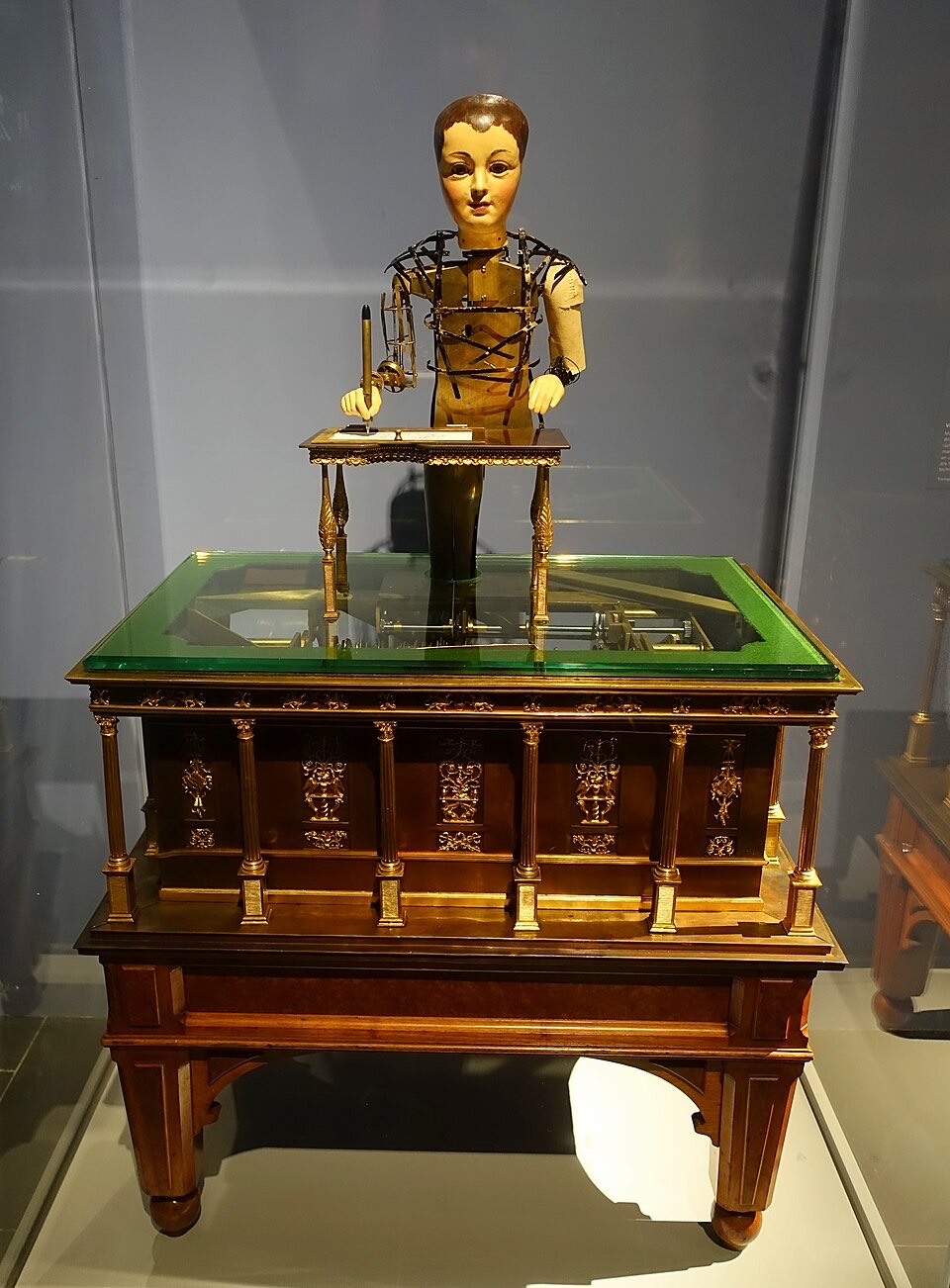
Visual AidA real automaton
Photograph of a writing automaton made in London around 1800 and attributed to Henri Maillardet, now in the Metropolitan Museum of Art. Brass cams turning inside the cabinet move the arm so that the figure draws pictures and writes out verses. This is what the word automaton meant before it meant a person: a figure that moves without choosing to. The men at the desks on Camazotz are people, not machines; the photograph shows the object the word comes from.
The Draughtsman-Writer, attributed to Henri Maillardet, London, c. 1800; Metropolitan Museum of Art, New York. Photograph by Daderot, 2020. Source: Wikimedia Commons, File:The Draughtsman-Writer by Henry Maillardet, England, London, c. 1800, brass, steel, wood, fiber - Metropolitan Museum of Art - New York City - DSC07127.jpg, public domain.
conformityn.Ch.7
Behaving the same way as everyone else in a group
“Camazotz demands total conformity from every citizen.”
automatonn.Ch.7
A person who acts mechanically, without will
“The men at the desks moved like an automaton.”
daisn.Ch.7
A raised platform for an important seat
“The man with red eyes waited on a low dais.”
pulsatev.Ch.7
To throb with a steady beat
“The light above him seemed to pulsate slowly.”
monotonousadj.Ch.7
Dull because it never changes
“His monotonous counting tugged at their minds.”
telepathyn.Ch.7
Communication from one mind to another
“He used telepathy instead of opening his mouth.”
syntheticadj.Ch.7
Made by artificial means, not natural
“The turkey dinner was entirely synthetic food.”
belligerentadj.Ch.7
Eager to argue and fight; hostile
“He called Meg belligerent and uncooperative.”
defiancen.Ch.7
Bold refusal to obey
“Charles Wallace shouted rhymes in open defiance.”
compelv.Ch.7
To force someone to do something
“The rhythm tried to compel them to obey.”
ⓘ The vocabulary words in this list are selected to help you understand and complete this workbook. Some may not appear verbatim in the original novel.
🧠Knowledge Bank question
1According to the Knowledge Bank, what sets dais apart from conformity, automaton and pulsate in this group of words?Ch.7
2An ‘automaton’ acts mechanically, as if it had no will of its own.Ch.7
3A ‘dais’ is a ___.Ch.7
4To ‘pulsate’ is to throb with a steady beat.Ch.7
5Fill in each blank with the correct word.Ch.7
Word choices:monotonousconformitydefiancesynthetic- some words will not be used
The rhythm of the tables was and dulling.
Camazotz demands total from everyone.
6‘Telepathy’ is communication that happens ___.Ch.7
7Something ‘synthetic’ is made by artificial means rather than found in nature.Ch.7
8A ‘belligerent’ person is ___.Ch.7
9Fill in each blank with the correct word.Ch.7
Word choices:defiancecompeltelepathydais- some words will not be used
Charles Wallace shouted rhymes in of the man.
The man could not them to obey at first.
10To ‘compel’ someone means to ___.Ch.7
Part 2
Comprehension
Show you understood what happens in Chapter 7.
🧠Knowledge Bank · Inside CENTRAL
Narrative Causality · Inside CENTRAL
Part 5 raises a specific threat, answers it through character action, and leaves an altered aftermath. The children walk into CENTRAL Central Intelligence holding hands, Meg in the middle. The green marble corridor is lined with identically dressed men at identical desks, and Meg thinks they have the blank sameness of strangers crowded into a subway car. Papers are handed to a machine, a wall dissolves, and the three of them pass through a chamber of gigantic humming computers toward the man with red eyes, who waits on a raised dais beneath a light that pulses in time with his stare. He speaks without moving his lips, straight into their minds, and he is plainly annoyed that Calvin has come along at all. His offer sounds generous: on Camazotz nobody carries the burden of thought or decision, and everyone is therefore happy. That progression explains how “Inside CENTRAL” produces lasting consequence.
Visual AidA plan of CENTRAL Central Intelligence
Plan drawn from the order Chapter 7 gives, left to right as the children walk, with the five stages numbered. Three details are set the way the chapter sets them, not the way a diagram might guess: the man is SEATED in a chair, the chair stands on a RAISED platform, and the light hangs directly ABOVE his head, keeping time with his eyes. He is turned toward the children, because they walk to him and he speaks to them on arrival. The book states no sizes, so nothing is to scale and the rows of desks are a pattern rather than a count. The solid slab, the plan view and the small figures are drawn for clarity; Camazotz is invented, and this is the map of a scene rather than of a place.
Sequence of rooms as described in A Wrinkle in Time, Chapter 7. Drawn for Garden Heights Academy.
🧠Knowledge Bank question
1The Knowledge Bank explains that Part 5 is built in a three-step sequence. What are the three steps, in order?Ch.7
2How does the man with red eyes speak to the children?Ch.7
3The man first tries to take control by having the children chant the multiplication tables in rhythm.Ch.7
4What does Calvin recite to keep his own mind free?Ch.7
5Write the numbers 1–5 in the boxes to show the correct order of events. Number 1 = what happens first.Chapter 7
A turkey dinner appears, but it tastes of sand to Charles Wallace.
Rhymes, a famous speech and a scream break the rhythm.
Charles Wallace looks into the red eyes and is taken over.
The man on the dais orders them to chant the multiplication tables.
The children pass down the marble corridor of identical men.
6Charles Wallace decides the man on the dais is the true power behind Camazotz.Ch.7
7Why does the turkey taste like sand to Charles Wallace?Ch.7
8What does the man offer Charles Wallace in exchange for his surrender?Ch.7
9Meg pulls Charles Wallace away the first time his eyes begin to glaze over.Ch.7
10How do we know Charles Wallace has been taken over at the end?Ch.7
Part 3
Literary Elements
Understanding HOW and WHY Madeleine L'Engle (author) tells the story across Chapter 7.
🧠Knowledge Bank · A Feast Made of Sand
Narrative Technique · A Feast Made of Sand
Part 5 layers symbolism, allusion, and motif so that an ordinary detail carries later significance. Symbolism is an object or image that stands for an idea larger than itself, and Chapter 7 hands the reader one of the cleanest examples in the novel: a turkey dinner that Meg and Calvin taste perfectly well and that Charles Wallace can only experience as dry sand. L’Engle is careful about the mechanics. The food is synthetic, and its flavor is not in the food at all — it is supplied by the man’s mind to any mind that has opened to him. Meg and Calvin have partly let him in without noticing; Charles Wallace has bolted the door, so he gets the raw truth of the meal. Read that as a picture of the whole planet. That authorial design makes “A Feast Made of Sand” a lesson in deliberate irony.
Symbolism
A feast that tastes of sand: comfort with nothing in it, which is Camazotz’s whole offer.
Allusion
Calvin reaches for the Gettysburg Address — a real speech about a free people — as a weapon against the rhythm.
Motif
Eyes recur throughout: the red glow, the pupils that thin away, the blue emptiness at the end.
🧠Knowledge Bank question
1The Knowledge Bank explains that the same turkey dinner tastes like sand to Charles Wallace but not to Meg and Calvin because ___.Ch.7
2Calvin reciting the Gettysburg Address is an example of allusion.Ch.7
3Eyes appear again and again in this chapter, gathering meaning. That makes eyes a ___.Ch.7
4Fill in each blank with the correct literary term.Ch.7
Word choices:symbolismallusionmotifepilogue- some words will not be used
A feast that tastes of sand is .
Quoting the Gettysburg Address is an .
5The pulsing light above the man’s head mainly stands for ___.Ch.7
6An allusion is any long quotation copied word for word into a story.Ch.7
7Why does L’Engle (author) have Calvin reach for that particular speech?Ch.7
8Charles Wallace’s eyes turning wholly blue completes the chapter’s ___.Ch.7
9Fill in each blank with the correct literary term.Ch.7
Word choices:motifsymbolismrhymeappendix- some words will not be used
Eyes that return with new meaning form a .
A pulsing light standing for one rhythm is .
10The nursery rhymes Charles Wallace shouts work as allusions because they ___.Ch.7
Part 4
Think Deeper
Four deeper challenges — no single-word recall. Read, weigh the evidence, and reason it out.
Camazotz is invented, but the machinery L’Engle gives it was copied from history. Scholars use the word totalitarian for a government that tries to control not only a country’s laws but its citizens’ habits, art, friendships and beliefs. The term was born in Italy in the 1920s, coined by opponents of Benito Mussolini as an insult and then adopted with pride by his supporters, who boasted of a state that would leave nothing outside itself. An ordinary dictator wants obedience and will settle for it. A totalitarian state wants agreement, from everyone, all the time — and so it works hardest of all on sameness. One party is permitted and the rest are banned. Read the chapter with that in mind and the red-eyed man’s pitch stops sounding like villainy. He offers rest. He tells the children that on Camazotz nobody is unhappy, nobody is different, and nobody has to decide anything ever again — which is the sales pitch, and also the danger.
Imagine a hallway of green marble so long that the far end is only a rumor, and lining it, desk after desk, men who could be copies of one another — same suit, same posture, same small nod as you pass. Nobody stops you. Nobody hurries you. A wall simply thins and opens, and beyond it stands a room of enormous humming machines, and beyond those, on a raised platform, a man sits under a light that throbs like a slow heartbeat. His eyes glow faintly red, and they keep time with the light. He does not open his mouth. His voice arrives inside your head anyway, warm and reasonable, offering to take away every worry you have ever carried. All you have to do is stop thinking your own thoughts. Meg holds Charles Wallace’s hand on one side and Calvin’s on the other, and for the length of this chapter that grip is the only thing standing between the three of them and a world where nobody has ever had to decide anything.
Original passage written for Garden Heights — not a quotation from the novel.
1Claim: “Chapter 7 shows that Camazotz takes minds by persuasion and comfort rather than by force.” — choose the two details that best prove it.Claim & Evidence
2The man’s way of taking a mind, or The children’s way of keeping one? Tap each detail to sort it — tap again to switch sides. You can keep tapping to change your answer.Sort into two
◄ The man’s way of taking a mindThe children’s way of keeping one ►
3Match each cause to its result. For each cause, pick its result.Cause & Effect
The children chant in time with the light→
Charles Wallace strikes the man on the dais→
Charles Wallace refuses to open his mind→
He looks into the red eyes at last→
🧠Knowledge Bank question
4Fill both blanks to complete the reasoning.Build the Argument
The Knowledge Bank argues that, once you know the history, the red-eyed man's pitch stops sounding like villainy because , which shows that .
Part 5
Standardized Test
Reading passage · One Rhythm for Everyone · SAT & TOEFL-style practice
Read the passage — the highlighted words are tested — then answer. Tap an answer, then tap it again to confirm.
SATCentral Ideas — the passage's main point
SATDetail — a fact stated in the passage
SATInference — a conclusion the passage implies
SATWords in Context — a word's meaning in this passage
SATText Connections — how two parts of the text relate
TOEFLFactual Information — a fact stated in the passage
TOEFLVocabulary — a tested word's meaning here
The Machinery of Totalitarian Control
Camazotz, where every house is identical and every child bounces a ball to the same beat, is invented, but the fear behind it was not. L’Engle (author) was writing after the Second World War, when real governments had tried to control not only their countries’ laws but their citizens’ opinions. Scholars call such a system totalitarian, from an Italian word meaning total; the term was coined in the 1920s by opponents of Benito Mussolini as an insult, then adopted proudly by his supporters. An ordinary dictatorship is satisfied with obedience; a totalitarian state wants something harder: agreement, from everyone, all the time.
To manufacture that agreement, such governments work hardest on conformity, every citizen thinking and acting alike. One party is legal and every other banned, while newspapers, films and textbooks must carry the approved account of the world; work that does not is suppressed and its makers silenced. The state could also compel children to join its youth organizations, such as the Soviet Young Pioneers or the Hitler Youth, so that they absorbed the official story alongside arithmetic. Enormous parades filled public squares with bodies moving in unison, a living picture of a nation with a single will.
These systems are hard to resist because they rarely present themselves as cruel. Their posters show smiling workers and healthy children; their speeches promise order, safety and an end to worry. Sameness is offered as a gift: if everyone thinks alike, there can be no quarrels, no envy, no hard choices. The cost is never mentioned: what a citizen hands over for a quiet life is the right to think a thought nobody else has thought — the bargain the man with red eyes offers the Murry children.
Original passage written for Garden Heights — not a quotation from the novel.
1What is the passage mainly about?SAT · Central Ideas
2The word ‘totalitarian’ comes from an Italian word meaning ___.TOEFL · Factual Information
3Who first used the term, according to the passage?SAT · Detail
4How does a totalitarian state differ from an ordinary dictatorship?TOEFL · Factual Information
5The Young Pioneers and the Hitler Youth are given as examples of ___.SAT · Detail
6The mass parades are described as a picture of ___.TOEFL · Factual Information
7According to the passage, such states usually present themselves as ___.SAT · Inference
8In the passage, conformity most nearly means ___.SAT · Words in Context
9In the passage, compel most nearly means ___.TOEFL · Vocabulary
10How does this passage best help explain Part 5?SAT · Text Connections
Part 6 · Optional
Creative Writing
A bonus challenge to practice your English. Take your time and have fun with it.
About This Section
This writing task is optional and is not part of your auto-graded score. The feedback below checks only the basics — length, spelling, and grammar — not whether your ideas are right or wrong. It is meant for classroom discussion and creative practice, so feel free to use your imagination!
Writing Task — Part 5 “The Bargain”
The man with red eyes offers an end to worry, in exchange for the right to think your own thoughts. Write about a time you were tempted to go along with everyone else to make things easier — what was being offered, what would you have given up, and what did you finally do? 6–10 sentences. End with what you think the trade is really worth.
You can start with: “It would have been so much easier to just agree with them...”
0 / 40 words minimum
🗣 Teach It · Just for Fun (optional)
No right or wrong — close the screen and tell someone nearby what happened in this part. Can’t find anyone? Tell yourself out loud. The moment you teach it, you truly understand it.
Part 5 Complete!
You finished Chapter 7 of A Wrinkle in Time.
Here are your auto-graded results:
-
points out of 100
Teach it to someone
The best last step is to teach it. In your own words, explain what happened — retell a favorite scene, teach a character’s big choice, or sum up the main idea for a parent, friend, or classmate. When you can teach it clearly, you truly own it.
Independent study guide by Garden Heights. Not affiliated with or endorsed by Madeleine L'Engle. Contains original analysis only; no text from the novel is reproduced. Reference text: This workbook follows Madeleine L'Engle’s classic text (the standard Puffin edition sold worldwide). Revised 2023 UK editions change some wording and may not match the vocabulary studied here.
SAT® is a registered trademark of College Board, which is not affiliated with, and does not endorse, these materials. TOEFL® is a registered trademark of ETS. These materials are not endorsed or approved by ETS. Garden Heights is an independent provider of test-style reading practice.