New here? Just sign up with Google — your account includes Matilda, our gift book, forever.
A Wrinkle in Time · Garden Heights
Part 6
for A Wrinkle in Time · Part 6 · Chapters 8–9
8 Parts40 min
What Happens in Part 6
The rescue becomes a fight for Charles Wallace's mind: he leads Meg and Calvin to Father, then they flee without him.
Not his own voiceCharles Wallace, who faced the man with the red eyes unafraid, returns with his own face but a voice both his and not his. Calmly eating turkey, he says the man is their friend, Mrs Whatsit, Mrs Who and Mrs Which the real enemies, and Camazotz happy because everyone is alike. Meg grips his arm and will not let go; Calvin tries argument, poetry, and finally a silly pet name, which alone makes the small face flicker, for a second.
The Prime CoordinatorHe names himself the Prime Coordinator; behind him stands IT, the Boss to Charles. Showing off new powers, he slides walls open by rearranging the empty space in solid things, passing a caged boy who cries at every bounce of his ball, the price of once bouncing out of time. A wall opens on a round transparent column holding Meg's father, silent and unreachable. Meg beats at it uselessly; Charles Wallace, bored, greets his long-sought father with an insulting nickname.
Through the columnRemembered in time, Mrs Who's spectacles let Meg step through the column like fog. Her father cannot see her; she puts them on him, and they emerge together. The reunion Meg has imagined for four years lasts a minute: Charles Wallace announces IT is displeased and marches them to the domed building. On a dais under the dome lies IT: a living brain with no body, face or eyes, its rhythm pushing at heartbeat and breath until thinking is hard.
Sameness is not equalityMeg fights back with her own things — nursery rhymes, multiplication tables, the Declaration of Independence, the periodic table — and the rhythm absorbs each. When IT claims perfect equality because everyone is identical, Meg finds the book's heart: sameness and equality are entirely different. But Father cannot destroy IT without destroying the boy inside, and Meg is slipping. Calvin shouts at him to tesser, and Mr. Murry seizes his daughter and tears the three off Camazotz, leaving Charles Wallace behind.
What We Will Learn
Section
What you will practice
Vocabulary
Words of trance and control: transparent, conformity, hypnotic, pulsate, surrender…
Literary Elements
IT as symbol, the motif of rhythm, and the antagonist finally seen
Cross-Curricular
Psychology — hypnosis, suggestion, and what protects a mind
Chapter Summary
Ch.
What happens
Chapter 8
The Transparent Column — Charles Wallace, speaking for IT, preaches the comfort of sameness over turkey; Meg and Calvin fail to hold him, the man with the red eyes names himself Prime Coordinator, and a wall finally opens on a clear column with Mr. Murry sealed inside.
Chapter 9
IT — Mrs Who’s spectacles carry Meg through the column to her father; then IT is revealed as a naked pulsing brain, Meg’s defenses are swallowed one by one, and her father tessers her away with Charles Wallace still under the beat.
Part 1
Vocabulary
Study 10 key words from Chapters 8–9, then answer each question.
🧠Knowledge Bank · Words of Trance and Control
Lexical Semantics · Words of Trance and Control
These four words track one long losing fight. Transparent means clear enough to see straight through: her father stood sealed in a transparent column. Conformity is behaving exactly like everyone around you: Camazotz calls conformity happiness. Relentless means never stopping, never easing: the relentless beat pushed at the walls. Futile means producing no useful result at all: holding his arm proved futile. Set them in that order and you have Meg’s whole experience of Camazotz. She can see her father and cannot reach him; she is told that sameness is joy; the beat never lets up; and the one thing she tries with her own hands does not work. Each word is a little smaller in hope than the one before it. That is not an accident of the plot; it is the design. L’Engle spends a whole part teaching the reader how it feels to be outmatched.
transparentadj.Ch.8
Clear enough to see straight through
“Her father stood sealed in a transparent column.”
conformityn.Ch.8
Behaving exactly like everyone around you
“Camazotz calls conformity happiness.”
relentlessadj.Ch.8
Never stopping, never easing
“The relentless beat pushed at the walls.”
futileadj.Ch.8
Producing no useful result at all
“Holding his arm proved futile.”
reconditionv.Ch.8
To retrain someone until they behave correctly
“The boy with the ball was being reconditioned.”
indignantadj.Ch.9
Angry at something felt to be unfair
“Meg was indignant at her brother’s rudeness.”
pulsatev.Ch.9
To beat with a strong, steady rhythm
“The brain seemed to pulsate on its dais.”
hypnoticadj.Ch.9
Holding attention so strongly that the will goes slack
“The rhythm was hypnotic rather than loud.”
disembodiedadj.Ch.9
Separated from any body
“IT was a disembodied brain.”
surrenderv.Ch.9
To give up control to another
“Charles Wallace chose to surrender.”
ⓘ The vocabulary words in this list are selected to help you understand and complete this workbook. Some may not appear verbatim in the original novel.
🧠Knowledge Bank question
1According to the Knowledge Bank, why are transparent, conformity, relentless and futile presented in that particular order?Ch.8
2‘Conformity’ means behaving differently from everyone around you.Ch.8
3Something ‘relentless’ never ___.Ch.8
4An effort that is ‘futile’ produces no useful result.Ch.8
5Fill in each blank with the correct word.Ch.8
Word choices:transparentconformityreciterelentless- some words will not be used
Her father stood inside a column.
Camazotz demands total .
6Someone who is ‘indignant’ feels angry at something ___.Ch.9
7Something ‘hypnotic’ holds attention so strongly that the will goes slack.Ch.9
8‘Disembodied’ means separated from a ___.Ch.9
9Fill in each blank with the correct word.Ch.9
Word choices:surrenderpulsatehypnoticindignant- some words will not be used
Meg felt the rhythm inside her chest.
Charles Wallace had chosen to .
10To ‘recondition’ someone is to ___ them until they behave correctly.Ch.8
Part 2
Comprehension
Show you understood what happens in Chapters 8–9.
🧠Knowledge Bank · The Boy Who Said Yes
Narrative Causality · The Boy Who Said Yes
Careful sequence reading reveals the textual evidence, the structural pivot, and the resulting consequence in Chapters 8–9. Part 6 is where the rescue stops being a journey and becomes a fight for one small boy’s mind. Charles Wallace, who walked into the man with the red eyes without fear, comes back out wearing his own face and speaking with a voice that is his and not his. He eats his turkey dinner calmly and tells Meg and Calvin that the man with the red eyes is their friend, that Mrs Whatsit, Mrs Who and Mrs Which are the real enemies, and that everyone on Camazotz is happy for one simple reason: everyone is exactly alike. Meg seizes his arm and will not let go, and Calvin tries to call the true Charles Wallace back with words — with argument, with poetry, and finally with a silly pet name, which is the only thing that makes the small face flicker at all, and only for a second. Reading evidence around the pivot turns “The Boy Who Said Yes” into meaningful convergence.
🧠Knowledge Bank question
1The Knowledge Bank explains that in Part 6 the rescue changes from ___.Ch.8
2What title does the man with the red eyes give himself?Ch.8
3Meg and Calvin grip Charles Wallace’s arm to pull the real boy back, but he shakes them off with unnatural strength.Ch.8
4According to Charles Wallace, why is everyone on Camazotz happy?Ch.8
5Write the numbers 1–5 in the boxes to show the correct order of events. Number 1 = what happens first.Chapters 8–9
A wall opens on a transparent column with Mr. Murry inside.
IT’s rhythm nearly takes Meg, and her father tessers them away.
The children pass a boy punished for bouncing his ball out of time.
Charles Wallace praises the man with the red eyes over dinner.
Meg puts on the spectacles and steps through the column.
6The boy bouncing the ball in his cell is being rewarded for excellent behavior.Ch.8
7How does Meg finally reach her father inside the column?Ch.9
8What is IT revealed to be?Ch.9
9Charles Wallace greets his father warmly and respectfully.Ch.9
10How does Part 6 end?Ch.9
Part 3
Literary Elements
Understanding HOW and WHY Madeleine L'Engle (author) tells the story across Chapters 8–9.
🧠Knowledge Bank · Why a Beat, Not a Speech
Narrative Technique · Why a Beat, Not a Speech
The pressure of Chapters 8–9 is crafted through symbol, rhythm, and antagonist working in combination. L’Engle could have given IT a magnificent voice and a persuasive argument. She gives it a pulse instead, and the choice is exactly right. An argument, however clever, wakes the questioning mind up; it is something to disagree with. A monotonous rhythm does the opposite. Alert attention is built to notice change, so a signal that never changes gives it nothing to do, and it gradually stands down — which is why every traditional trance induction, from a repeated phrase to a swinging weight to a slow drum, is built on repetition rather than reasoning. Notice what Meg instinctively reaches for when the beat starts working on her heart and lungs: not a counter-argument but hard mental labor — multiplication tables, the periodic table, square roots. That authorial design makes “Why a Beat, Not a Speech” a lesson in deliberate perspective.
Visual AidTwo signals, two minds
Pattern diagram, not a recording. The top row is a signal that repeats exactly; the bottom row is one that keeps changing. Attention is built to notice change, so the first gives it nothing to do and the second wakes it. The rows illustrate the Knowledge Bank’s argument about IT’s pulse; they measure nothing, and the beat in the novel is L’Engle’s invention.
Illustrates the habituation of attention to an unchanging stimulus, a standard finding in introductory psychology. Drawn for Garden Heights Academy.
Symbol
IT is a brain with no body: intelligence stripped of heart, warmth and love.
Motif (rhythm)
A pulse repeats across Part 6 — bouncing balls, breathing walls, IT’s beat.
Antagonist
The force working against the hero. Here it is finally seen, and it is not a person.
🧠Knowledge Bank question
1According to the Knowledge Bank, why would a clever argument have been a weaker weapon for IT than a steady pulse?Ch.9
2Fill in each blank with the correct literary term.Ch.9
Word choices:motifantagonistsymbolrhyme- some words will not be used
The pulsing beat that keeps returning is a .
The force working against Meg is the .
3The antagonist of a story must always be a single human villain.Ch.9
4Bouncing balls, breathing walls and IT’s pulse together form a ___.Ch.8
5The brain shape of IT most strongly suggests ___.Ch.9
6A motif is a detail that repeats and gathers meaning across a story.Ch.8
7Why does L’Engle (author) give IT a steady pulse instead of a voice?Ch.9
8Fill in each blank with the correct literary term.Ch.9
Word choices:antagonistsymbolnarratorclimax- some words will not be used
The force opposing the heroes is the .
A brain without a body is a of cold reason.
9A symbol is an object that stands only for itself and nothing more.Ch.9
10Charles Wallace’s surrender matters most because ___.Ch.9
Part 4
Think Deeper
Four deeper challenges — no single-word recall. Read, weigh the evidence, and reason it out.
🧠Knowledge Bank · The Beat That Does Your Thinking
Cross-Curricular Context · Supporting Spine · The Psychology of Suggestion
IT does not argue with Charles Wallace. It does not threaten him or bribe him. It simply pulses — and that choice is far better psychology than L’Engle is usually given credit for. Researchers who study hypnosis describe it as a state of narrowed attention and heightened suggestibility: the person is not asleep and not unconscious, but their critical, questioning, argue-back faculty has gone quiet, so that a suggestion arrives without being inspected first. The oldest and most reliable way to produce that state is a steady, monotonous input — a repeated phrase, a swinging weight, a metronome, a drumbeat. Monotony gives the alert part of the mind nothing to work on. That is exactly what IT is doing to Charles Wallace. It never wins an argument with him because it never has one; it supplies a rhythm until the part of him that would have argued goes quiet. And it is why Meg’s counter-attack, when it comes, is not a better argument either. It is a nursery rhyme, the periodic table, the Declaration of Independence — noise deliberately chosen to break a beat.
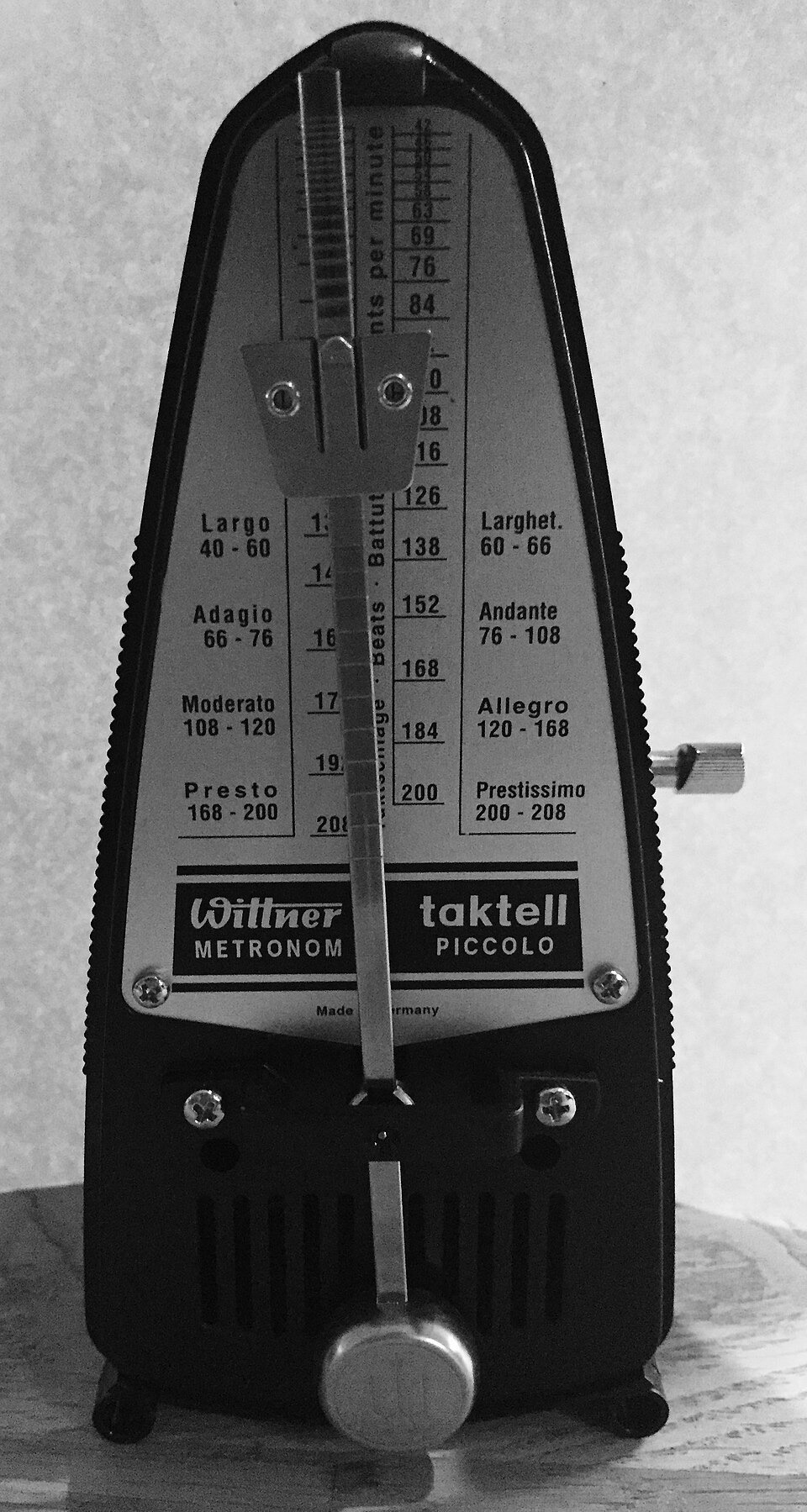
Visual AidThe instrument the Knowledge Bank names
Photograph of an ordinary mechanical metronome. Wind it, set the sliding weight, and the arm swings and clicks at a rate that never varies — the steadiest signal a person can easily make, which is why it turns up in every list of ways to hold attention still. The picture shows a music-practice tool, not a hypnotist’s device, and IT’s pulse in the novel is L’Engle’s invention, not a metronome.
Wittner Taktell Piccolo metronome; photograph by Benoît Prieur, 2015. Source: Wikimedia Commons, File:Metronome Wittner Taktell.jpg, CC0.
Picture a boy of five sitting down to turkey as though nothing at all has happened. His face is the face his sister has loved since the day he was born, and the voice coming out of it is almost his — almost, the way a photograph is almost a person. He explains, kindly, that the man with the red eyes is a friend and that the three ladies are the danger. Meg grabs his arm and holds on until her fingers ache, and the small boy shakes her off with a strength that no small boy should have. Down corridor after corridor he leads them, opening walls by shuffling their atoms aside, past a child bouncing a ball and screaming on every bounce, until a cell opens on a round clear column with a man sealed inside it. Then the dome. Then the thing under the dome: a brain lying on a platform, naked and pulsing, beating out a rhythm that reaches into Meg’s chest and tries to take over the job of her heart.
Original passage written for Garden Heights — not a quotation from the novel.
1Claim: “Part 6 shows that IT conquers by lowering resistance rather than by using force.” — choose the two details that best prove it.Claim & Evidence
2Belongs to Camazotz, or Belongs to the Murrys? Tap each detail to sort it — tap again to switch sides. You can keep tapping to change your answer.Sort into two
◄ Belongs to CamazotzBelongs to the Murrys ►
3Match each cause to its result. For each cause, pick its result.Cause & Effect
Charles Wallace walks in curious and willing→
A boy bounces his ball out of rhythm→
Meg remembers the spectacles she was given→
IT’s pulse reaches Meg’s heartbeat→
🧠Knowledge Bank question
4Fill both blanks to complete the reasoning.Build the Argument
The Knowledge Bank argues that IT never wins an argument with Charles Wallace because , which shows that .
Part 5
Standardized Test
Reading passage · Hypnosis, Suggestion and the Borrowed Will · SAT & TOEFL-style practice
Read the passage — the highlighted words are tested — then answer. Tap an answer, then tap it again to confirm.
SATCentral Ideas — the passage's main point
SATDetail — a fact stated in the passage
SATWords in Context — a word's meaning in this passage
SATInference — a conclusion the passage implies
SATText Connections — how two parts of the text relate
TOEFLFactual Information — a fact stated in the passage
TOEFLProse Summary — the three sentences that sum it up
TOEFLVocabulary — a tested word's meaning here
The Truth About Hypnosis
Hypnosis is widely misunderstood. In films it is a trick with a swinging watch, after which the victim will do anything, but researchers describe something far less theatrical. Hypnosis is usually defined as a state of narrowed attention and raised suggestibility: the person is awake and aware, but the part of the mind that normally inspects an idea before accepting it has gone quiet, so a suggestion arrives without being challenged first. That quieting is the whole effect: it is not sleep, and it gives nobody a switch that operates another person.
What reliably produces the state is repetition. The oldest induction methods share one feature, a steady, repeated input: a repeated phrase, a swinging weight, a metronome, a drum. Alert attention exists to notice change, and a monotonous signal offers none, so the watchful part of the mind finds nothing to work on and gradually stands down. Anthropologists studying drumming and chanting report the same pattern across cultures: a relentless rhythm, never pausing, moves people toward an absorbed, trance-like state, and crowds moving in time begin to feel less like individuals and more like one body.
What protects a mind? The first safeguard is genuine mental effort: rhythm captures attention that is idle, but a mind busy with demanding, deliberate work does not surrender to the beat or fall into step. The second is prior intention, since studies find that people are far more susceptible to suggestions they were already willing to follow, and remarkably resistant to ones that violate their own values. Suggestibility is not obedience, which is why the person in danger is not the stubborn one but the curious one who steps forward, certain of being clever enough to look and walk away.
Original passage written for Garden Heights — not a quotation from the novel.
1What is the passage mainly about?SAT · Central Ideas
2According to the passage, hypnosis is best described as ___.TOEFL · Factual Information
3The passage says a suggestion gets through because ___.SAT · Detail
4In the passage, relentless most nearly means ___.SAT · Words in Context
5Which is given as a traditional induction method?TOEFL · Factual Information
6What do anthropologists report about sustained rhythm?SAT · Detail
7According to the passage, what resists a rhythmic pull?SAT · Inference
8Prose Summary (TOEFL).This passage explains what hypnosis actually is, how rhythm produces it, and what protects a mind against it. This TOEFL task lists six sentences; choose the THREE that best capture the passage’s main ideas. The other three do not belong — they state minor details or ideas the passage does not present.TOEFL · Prose Summary
9In the passage, surrender most nearly means ___.TOEFL · Vocabulary
10How does this passage best help explain Part 6?SAT · Text Connections
Part 6 · Optional
Creative Writing
A bonus challenge to practice your English. Take your time and have fun with it.
About This Section
This writing task is optional and is not part of your auto-graded score. The feedback below checks only the basics — length, spelling, and grammar — not whether your ideas are right or wrong. It is meant for classroom discussion and creative practice, so feel free to use your imagination!
Writing Task — Part 6 “The Beat You Fell Into”
IT does not shout at Charles Wallace. It simply keeps a rhythm until matching it feels easier than not matching it. Write about a time you found yourself carried along by a group, a routine or a rhythm — a chant, a crowd, a habit, a scroll that would not stop — and only noticed afterwards. What pulled you in, when did you realize, and what broke the spell? 6–10 sentences. End with the one thing you would keep in your head next time, the way Meg kept her multiplication tables.
You can start with: “I did not decide to join in; I just noticed, some time later, that I already had...”
0 / 40 words minimum
🗣 Teach It · Just for Fun (optional)
No right or wrong — close the screen and tell someone nearby what happened in this part. Can’t find anyone? Tell yourself out loud. The moment you teach it, you truly understand it.
Part 6 Complete!
You finished Chapters 8–9 of A Wrinkle in Time.
Here are your auto-graded results:
-
points out of 100
Teach it to someone
The best last step is to teach it. In your own words, explain what happened — retell a favorite scene, teach a character’s big choice, or sum up the main idea for a parent, friend, or classmate. When you can teach it clearly, you truly own it.
Independent study guide by Garden Heights. Not affiliated with or endorsed by Madeleine L'Engle. Contains original analysis only; no text from the novel is reproduced. Reference text: This workbook follows Madeleine L'Engle’s classic text (the standard Puffin edition sold worldwide). Revised 2023 UK editions change some wording and may not match the vocabulary studied here.
SAT® is a registered trademark of College Board, which is not affiliated with, and does not endorse, these materials. TOEFL® is a registered trademark of ETS. These materials are not endorsed or approved by ETS. Garden Heights is an independent provider of test-style reading practice.