New here? Just sign up with Google — your account includes Matilda, our gift book, forever.
A Wrinkle in Time · Garden Heights
Part 7
for A Wrinkle in Time · Part 7 · Chapters 10–11
8 Parts40 min
What Happens in Part 7
Frozen after the tesser and furious at her father, Meg is healed by Ixchel's eyeless beasts while Charles Wallace stays behind.
Frozen on arrivalMeg comes back to herself on the far side of the tesser, and the first thing she knows is cold. She cannot move a finger; her body feels like stone, and for a while she is convinced she is dying. She hears her father and Calvin talking above her, and the terrible fact arrives slowly: Charles Wallace is not with them. IT held him too tightly to be pulled through.
Her father's storyMr. Murry explains: he was the second person to try tessering, the first traveler never returned, and he aimed for Mars but landed on Camazotz, shut inside a transparent column until his children came. He warns that experimenters with space and time barely understand what they handle. None of it satisfies Meg. Half frozen and bitterly disappointed, she lashes out at the father she believed would fix everything, for abandoning Charles Wallace and nearly letting the Black Thing take her.
The beasts arriveThen three tall gray creatures, soft-furred and many-tentacled, cross the plain. They have no eyes. One gathers Meg up despite Mr. Murry's protest, and its warm touch begins working on her almost at once. The beasts take all three home, where Meg is rubbed with warm, sweet-smelling oil, fed a fragrant liquid she cannot name, and sung to in music beyond description; she sleeps and wakes healed. After trying and rejecting several names, she calls the creature Aunt Beast.
Light without eyesAunt Beast says the planet may be called Ixchel; it circles Camazotz's sun and also fights the Dark Thing. In return Meg tries explaining light, sun, stars and seeing — and cannot. The beasts have no word or need for it; they know day from night by warmth, and the stars in a way Meg cannot follow. Still angry and desperate to return for her brother, a voice sounds in the dark: Mrs Whatsit, Mrs Who and Mrs Which have come.
What We Will Learn
Section
What you will practice
Vocabulary
Cold, damage, and healing words: paralyzed, rigid, tentacle, relinquish, perceive…
Literary Elements
Situational irony, Aunt Beast as a foil to IT, and the fallible father revealed
Cross-Curricular
Sensing the world without sight — echoes, touch, vibration and warmth
Chapter Summary
Ch.
What happens
Chapter 10
Absolute Zero — Meg wakes on a strange gray planet frozen and unable to move; her father explains the tesseract project and his accidental arrival on Camazotz, and Meg turns on him in fury for leaving Charles Wallace behind. Three tall, sightless, tentacled creatures come toward them, and one lifts her up.
Chapter 11
Aunt Beast — the beasts carry the three to shelter. One of them warms Meg with oil, feeds her, and sings her whole again; Meg names her Aunt Beast. Meg tries and fails to explain light and seeing to creatures without eyes — and then a familiar voice announces that the Mrs Ws have arrived.
Part 1
Vocabulary
Study 10 key words from Chapters 10–11, then answer each question.
🧠Knowledge Bank · Words for Freezing and Healing
Lexical Semantics · Words for Freezing and Healing
Two of these four words freeze a body and two describe what happens in a mind. Paralyzed means unable to move or feel — which is how Meg wakes on the gray plain, cold and unable to lift a hand. Rigid means stiff and unbending; her arms and legs might as well be carved from stone. Fury is wild, violent anger, and she turns all of it on her father for leaving Charles Wallace behind. Deliberate means done slowly and on purpose, after careful thought, which is exactly what Mr. Murry insists on when she wants to act now. The pairing is the point. Meg’s body is stiff and her temper is not, and the cure for both turns out to be the same thing — slowness. Nothing on Ixchel is done quickly, and that is the first kindness anyone has shown her since Camazotz.
paralyzedadj.Ch.10
Unable to move or feel any part of the body
“Meg woke on the gray plain paralyzed and bitterly cold.”
rigidadj.Ch.10
Stiff and unbending; unable to be moved
“Her arms and legs lay rigid, as though carved from stone.”
furyn.Ch.10
Wild, violent anger
“Meg turned on her father in fury for leaving Charles Wallace.”
deliberateadj.Ch.10
Done slowly and on purpose, after careful thought
“Mr. Murry insisted on a deliberate choice rather than a rushed one.”
tentaclen.Ch.10
A long, flexible limb used to feel or grasp
“The creature reached for her with a waving tentacle.”
relinquishv.Ch.11
To give something up or let it go
“What the Black Thing damages, it will not relinquish easily.”
nourishmentn.Ch.11
Food that keeps a body alive and healthy
“Aunt Beast gave her a warm, fragrant nourishment to drink.”
perceivev.Ch.11
To become aware of something through the senses
“The beasts perceive the world without using eyes at all.”
soothev.Ch.11
To calm, comfort, or ease pain
“The song of the beasts did more to soothe her than sleep.”
futileadj.Ch.11
Useless; producing no result at all
“Meg’s attempt to describe light proved futile.”
ⓘ The vocabulary words in this list are selected to help you understand and complete this workbook. Some may not appear verbatim in the original novel.
🧠Knowledge Bank question
1According to the Knowledge Bank, why does it matter that paralyzed and rigid are paired with fury and deliberate in this word set?Ch.10
2Something ‘rigid’ is stiff and will not bend.Ch.10
3‘Fury’ is best described as ___.Ch.10
4A ‘deliberate’ decision is one made carelessly and in a hurry.Ch.10
5Fill in each blank with the correct word.Ch.10
Word choices:tentacleparalyzedsoothefutile- some words will not be used
She lay on the cold gray ground.
The creature reached out one long .
6To ‘relinquish’ something is to ___ it.Ch.11
7‘Nourishment’ means food that keeps a body alive.Ch.11
8To ‘perceive’ something is to ___.Ch.11
9Fill in each blank with the correct word.Ch.11
Word choices:futilesootherigidfury- some words will not be used
The song began to her damaged mind.
Explaining sight to the beasts was .
10An effort that is ‘futile’ is ___.Ch.11
Part 2
Comprehension
Show you understood what happens in Chapters 10–11.
🧠Knowledge Bank · Frozen, Furious, and Carried Away
Narrative Causality · Frozen, Furious, and Carried Away
The narrative’s growing tension gives way to a crucial revelation and redirects the story’s direction. Meg comes back to herself on the far side of the tesser, and the first thing she knows is cold. She cannot move a finger; her body feels like stone, and she is convinced for a while that she is dying. She hears her father and Calvin talking somewhere above her, and the terrible fact arrives slowly: Charles Wallace is not with them. IT held him too tightly to be pulled through. Mr. Murry tells them what he can — that he was the second person to try tessering, that the first traveler never came back, that he aimed for Mars and landed on Camazotz, where he was shut inside a transparent column until his children came to find him. The accumulated tension makes “Frozen, Furious, and Carried Away” a genuine story threshold.
🧠Knowledge Bank question
1According to the Knowledge Bank, what does Mr. Murry reveal about his own tessering?Ch.10
2Why is Charles Wallace not with the others?Ch.10
3Mr. Murry says he was the second person to attempt tessering, and the first never returned.Ch.10
4Where had Mr. Murry meant to travel, and where did he actually land?Ch.10
5Write the numbers 1–5 in the boxes to show the correct order of events. Number 1 = what happens first.Chapters 10–11
Meg turns on her father in fury over Charles Wallace.
Meg wakes frozen and rigid on a gray plain.
Aunt Beast heals Meg, and the Mrs Ws arrive.
Three sightless, tentacled beasts approach and lift her.
Mr. Murry explains the tesseract project to Calvin.
6Meg thanks her father calmly for rescuing her from IT.Ch.10
7What is most startling about the creatures who approach them?Ch.10
8How does Aunt Beast begin to heal Meg?Ch.11
9What does Meg fail to explain to the beasts?Ch.11
10Aunt Beast tells Meg that Ixchel circles the same sun as Camazotz.Ch.11
Part 3
Literary Elements
Understanding HOW and WHY Madeleine L'Engle (author) tells the story across Chapters 10–11.
🧠Knowledge Bank · The Blind Who See Best
Narrative Technique · The Blind Who See Best
As the story nears its end, irony, foil, and characterization turn earlier details into consequences. L’Engle builds Part 7 on a reversal she has been preparing for chapters. On Camazotz everything is visible — identical houses in identical rows, children bouncing balls in perfect time, a brain on a dais in a bright round room — and all that visibility conceals a total blindness: nobody there perceives anything at all, because IT does the perceiving for them. Ixchel is the mirror image. It is gray, dim and colourless, its inhabitants have no eyes, and the reader’s first instinct, like Meg’s, is pity or fear. Then the situational irony lands. These sightless creatures immediately and accurately perceive what is wrong with Meg — not her cold, but the specific injury the Black Thing did to her — while her father, who can see her perfectly well, can only stand there and apologize. That authorial design makes “The Blind Who See Best” a lesson in deliberate structure.
Visual AidAn animal that sees with its nose
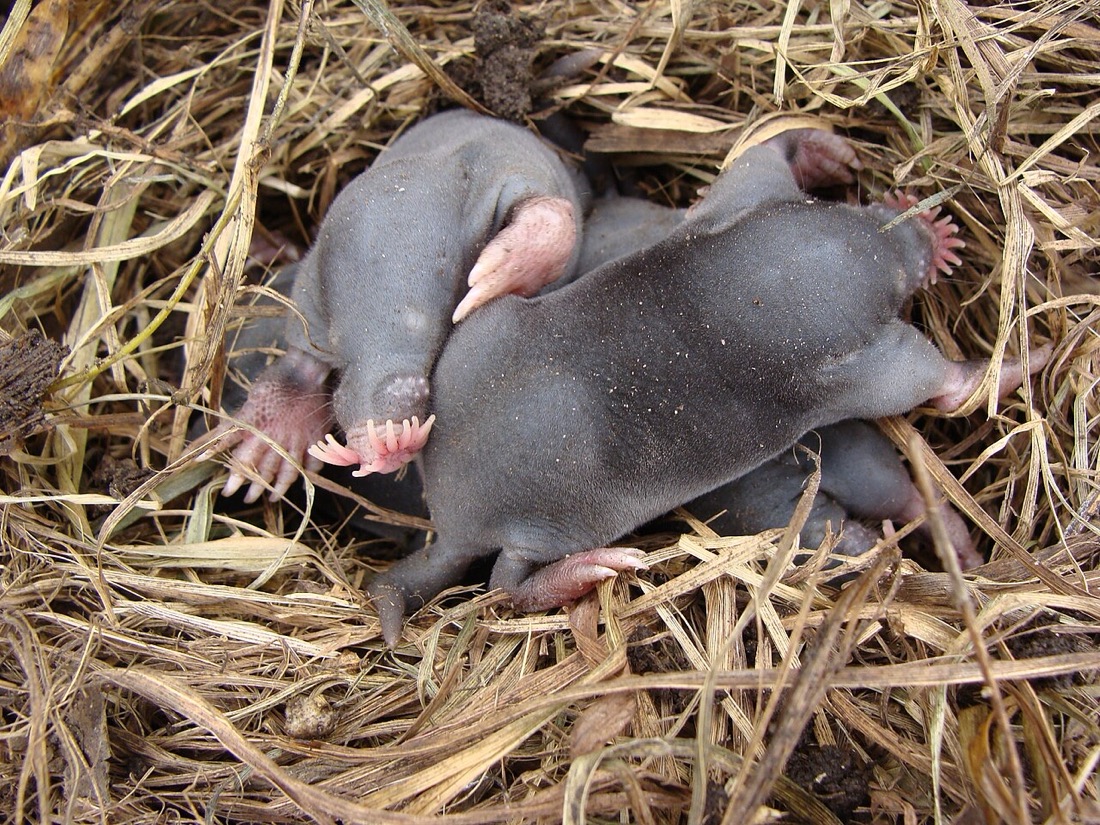
Photograph of young star-nosed moles in a nest under a compost heap, 2009. The pink fringe on the snout is the ‘star’: twenty-two fleshy rays packed with touch receptors, which the nearly blind mole uses to find food faster than a human eye can follow. These are real animals of the kind the Knowledge Bank describes; Aunt Beast and the people of Ixchel are invented, and nothing in the novel looks like a mole.
Star-nosed moles (Condylura cristata); photograph by Hillbraith, 2009. Source: Wikimedia Commons, File:Baby star-nosed moles.jpg, public domain.
Situational irony
The beings who cannot see are the ones who understand Meg most completely — and the seeing girl is the one who cannot explain herself.
Foil
Aunt Beast against IT: both take Meg over entirely, but one absorbs her will and the other gives it back to her.
Characterization
Mr. Murry stops being the answer to everything and becomes a tired, limited man who could not save his own son.
🧠Knowledge Bank question
1The Knowledge Bank explains that the situational irony of Part 7 lies in ___.Ch.11
2Aunt Beast works mainly as a ___ for IT.Ch.11
3Situational irony is the gap between what we expect and what actually happens.Ch.11
4Meg’s outburst at her father chiefly develops ___.Ch.10
5Fill in each blank with the correct literary term.Ch.11
Word choices:foilsituational ironyrhymeglossary- some words will not be used
Blind creatures who perceive most is .
Aunt Beast set against IT is a .
6Both IT and Aunt Beast take complete charge of Meg, but they differ because ___.Ch.11
7A foil is a character whose contrast makes another character’s qualities clearer.Ch.11
8Meg’s fury at her father is meant to show that she has stopped loving him.Ch.10
9Fill in each blank with the correct literary term.Ch.10
Word choices:characterizationfoilprologuenarrator- some words will not be used
Mr. Murry shown as fallible is .
Aunt Beast beside IT works as a .
10The chapter title ‘Absolute Zero’ matters most because it ___.Ch.10
Part 4
Think Deeper
Four deeper challenges — no single-word recall. Read, weigh the evidence, and reason it out.
🧠Knowledge Bank · Seeing Without Eyes
Cross-Curricular Context · Supporting Spine · The Senses
Meg meets creatures with no eyes and assumes they must be missing something. Biologists would call that a failure of imagination. Perception is simply the business of gathering information about the world, and eyes are one instrument among many. Bats and dolphins use echolocation, broadcasting sound and reconstructing their surroundings from the echoes with enough precision to catch prey in absolute darkness. Snakes in the pit-viper family carry heat detectors on the face and hunt by the warmth a body gives off. The star-nosed mole, effectively blind, feels its way through the soil with a fringe of twenty-two rays crowded with touch receptors, and identifies food faster than a human being can register that anything moved. Meg’s mistake is one the book keeps making her repeat. She judges Aunt Beast by what is missing and has to be shown, again, that a difference is not a deficiency — which is the same lesson she has been refusing to learn about her brother, her father, and herself.
Visual AidEcholocation: sound out, echo back
Diagram, not to scale. A bat sends out a call, the sound bounces off whatever is ahead, and the time the echo takes to return tells the bat how far away it is — perception with no light at all. The bat and the moth are drawn as a circle and a square on purpose: the drawing shows the geometry, not the animals. Aunt Beast is invented and uses no method the book names.
Echolocation as described by the Smithsonian National Museum of Natural History and standard biology references. Drawn for Garden Heights Academy.
Picture a girl lying on gray ground under a gray sky, so cold she cannot tell where her body ends. She has just been dragged through something that nearly unmade her. Her brother is not here. Her father, the man she crossed a universe to reach, is talking quietly nearby and cannot make any of it right, and she hates him a little for that. Then something enormous comes across the plain toward her. It is taller than a man, covered in soft fur, and it waves tentacles instead of hands. Where its eyes should be there is nothing at all — not closed lids, not sockets, simply an absence. Every instinct she has says run, and she cannot move. It bends down and picks her up. And the moment it touches her, the cold begins to go out of her, and she understands, without being able to explain it, that she is safe in the arms of the most frightening-looking thing she has ever met.
Original passage written for Garden Heights — not a quotation from the novel.
1Claim: “Part 7 argues that understanding does not depend on sight.” — choose the two details that best prove it.Claim & Evidence
2Evidence that Meg is broken down in Part 7, or Evidence that Meg is built back up in Part 7? Tap each detail to sort it — tap again to switch sides. You can keep tapping to change your answer.Sort into two
◄ Evidence that Meg is broken down in Part 7Evidence that Meg is built back up in Part 7 ►
3Match each cause to its result. For each cause, pick its result.Cause & Effect
Meg wakes rigid and freezing→
Mr. Murry explains and cannot fix it→
A sightless creature lifts her up→
Meg cannot describe light to the beasts→
🧠Knowledge Bank question
4Fill both blanks to complete the reasoning.Build the Argument
The Knowledge Bank argues that Meg's assumption about the eyeless beasts is a failure of imagination because , which shows that .
Part 5
Standardized Test
Reading passage · Knowing the World Without Eyes · SAT & TOEFL-style practice
Read the passage — the highlighted words are tested — then answer. Tap an answer, then tap it again to confirm.
SATCentral Ideas — the passage's main point
SATDetail — a fact stated in the passage
SATInference — a conclusion the passage implies
SATWords in Context — a word's meaning in this passage
SATText Connections — how two parts of the text relate
TOEFLFactual Information — a fact stated in the passage
TOEFLVocabulary — a tested word's meaning here
How the Blind Brain Rewires Itself
The creatures of Ixchel have no eyes, and Meg assumes this makes them poorer than she is; biology suggests otherwise. Sight is only one way to perceive what is nearby. A bat hunting in total darkness sends out high clicks and builds, from each returning echo, a picture sharp enough to catch a moth in flight. Pit vipers carry heat-sensing organs between eye and nostril and strike accurately in a pitch-black burrow, and the star-nosed mole, functionally blind, wears twenty-two fleshy rays around its snout packed with more than twenty-five thousand touch receptors.
Humans are less impressive, but the same principle applies. People who lose their sight often develop acute hearing and touch — not because the ears improve but because the brain rearranges what it does with the signals. In people blind from early childhood the visual cortex — the part of the brain that handles sight — does not fall idle; it takes up new work, responding to sound, touch, and braille. Some blind people teach themselves echolocation, clicking the tongue to sense doorways, walls and open space; researchers conclude that the brain will compensate, reassigning territory to whichever senses bring news.
None of this makes sight unimportant; it makes it particular. Vision is a superb instrument for certain questions — color, distance, movement — and useless for others, which is why sighted people read a mood from a voice, and why a calm voice can soothe a frightened child in the dark. When Meg tries to explain sun and stars to Aunt Beast she fails, but that is no sign the beasts are limited: they know day from night by warmth. Eyes deliver one version of the world, but neither the only version nor always the truest.
Original passage written for Garden Heights — not a quotation from the novel.
1What is the passage mainly about?SAT · Central Ideas
2A hunting bat locates a moth in darkness by ___.TOEFL · Factual Information
3According to the passage, pit vipers sense a warm animal using ___.SAT · Detail
4How many fleshy rays surround the star-nosed mole’s snout?TOEFL · Factual Information
5The passage says a blind person’s hearing sharpens mainly because ___.SAT · Inference
6In people blind from childhood, the visual cortex ___.SAT · Detail
7Human echolocation described in the passage involves ___.TOEFL · Factual Information
8In the passage, perceive most nearly means ___.SAT · Words in Context
9In the passage, soothe most nearly means ___.TOEFL · Vocabulary
10How does the passage BEST help explain Meg’s failure with Aunt Beast?SAT · Text Connections
Part 6 · Optional
Creative Writing
A bonus challenge to practice your English. Take your time and have fun with it.
About This Section
This writing task is optional and is not part of your auto-graded score. The feedback below checks only the basics — length, spelling, and grammar — not whether your ideas are right or wrong. It is meant for classroom discussion and creative practice, so feel free to use your imagination!
Writing Task — Part 7 “The Rescue That Wasn’t Enough”
Meg crosses a universe to find her father, and when she finally reaches him he cannot make things right — and she is furious with him for it. Write about a time you counted on an adult, a friend, or a plan to solve something for you, and it did not work out that way. What did you expect? What actually happened, and how did you feel about the person involved? 6–10 sentences. End with what you had to start doing for yourself afterward.
You can start with: “I was sure that once I reached them, everything would be fine...”
0 / 40 words minimum
🗣 Teach It · Just for Fun (optional)
No right or wrong — tell someone nearby what happened in this part. Can’t find anyone? Tell yourself out loud. The moment you teach it, you truly understand it.
Part 7 Complete!
You finished Chapters 10–11 of A Wrinkle in Time.
Here are your auto-graded results:
-
points out of 100
Teach it to someone
The best last step is to teach it. In your own words, explain what happened — retell a favorite scene, teach a character’s big choice, or sum up the main idea for a parent, friend, or classmate. When you can teach it clearly, you truly own it.
Independent study guide by Garden Heights. Not affiliated with or endorsed by Madeleine L'Engle. Contains original analysis only; no text from the novel is reproduced. Reference text: This workbook follows Madeleine L'Engle’s classic text (the standard Puffin edition sold worldwide). Revised 2023 UK editions change some wording and may not match the vocabulary studied here.
SAT® is a registered trademark of College Board, which is not affiliated with, and does not endorse, these materials. TOEFL® is a registered trademark of ETS. These materials are not endorsed or approved by ETS. Garden Heights is an independent provider of test-style reading practice.