New here? Just sign up with Google — your account includes Matilda, our gift book, forever.
The Boxcar Children · Garden Heights Academy
Part 1
for The Boxcar Children · Part 1 · Chapters 1–2
a novel by Gertrude Chandler Warner
30 min5 Parts
This workbook is built on a solid pedagogical foundation, effectively integrating content and language learning based on the CLIL framework (Content and Language Integrated Learning), elevated by our unique 5th C — Connection — and an integrated Standardized Test section that weaves every SAT & TOEFL question type right into the novel, so learners build real test skills easily, naturally, and with fun.
What Happens in Part 1
Four orphaned children run away in the night rather than let anyone take little Benny away.
Four aloneHenry, Jessie, Violet, and five-year-old Benny Alden have lost their parents. They are alone in the world, and they have nowhere to go. One warm night they are hungry and very tired.
The bakeryThey stop at a bakery. The baker's wife gives them bread and lets them sleep there. But Henry and Jessie overhear her plan. She means to send Benny away to a Children's Home.
Slipping awayThe children will not be split up. In the dark they slip away without a sound, and they take Benny with them. Staying together matters more to them than a warm bed does.
The grandfather they fearThey have one relative left, a grandfather they have never met. They believe he is unkind, so they do not go to him. Instead they set off alone, walking by night and sleeping by day.
What We Will Learn
Literary Element
What It Means
Character
The people (or animals) a story is about — here, the four Alden children
Setting
The time and place of a story — a town at night and the open country
Conflict
The main problem the characters must solve — having no home and fearing being split up
Chapter Summary
Chapter
Key Events
Ch.1
The Four Hungry Children — the orphans buy bread and shelter at a bakery, then run away when they learn Benny will be sent to a Children’s Home
Ch.2
Night Is Turned into Day — the children travel by night and sleep by day so no one will find them, resting in a haystack
Copyright Notice
Independent study guide by Garden Heights Academy. Not affiliated with or endorsed by Gertrude Chandler Warner or Albert Whitman & Company. No text from the novel is reproduced. Students should read the original book. Reference edition: this workbook follows the standard Albert Whitman & Company edition (the 1942 text) — the version sold in bookstores today. Early 1924-text reprints differ substantially and will not match this workbook’s chapters.
Part 1
Vocabulary
Study 10 key words from Chapters 1–2, then answer each question.
🧠Knowledge Bank · Why a Boxcar?
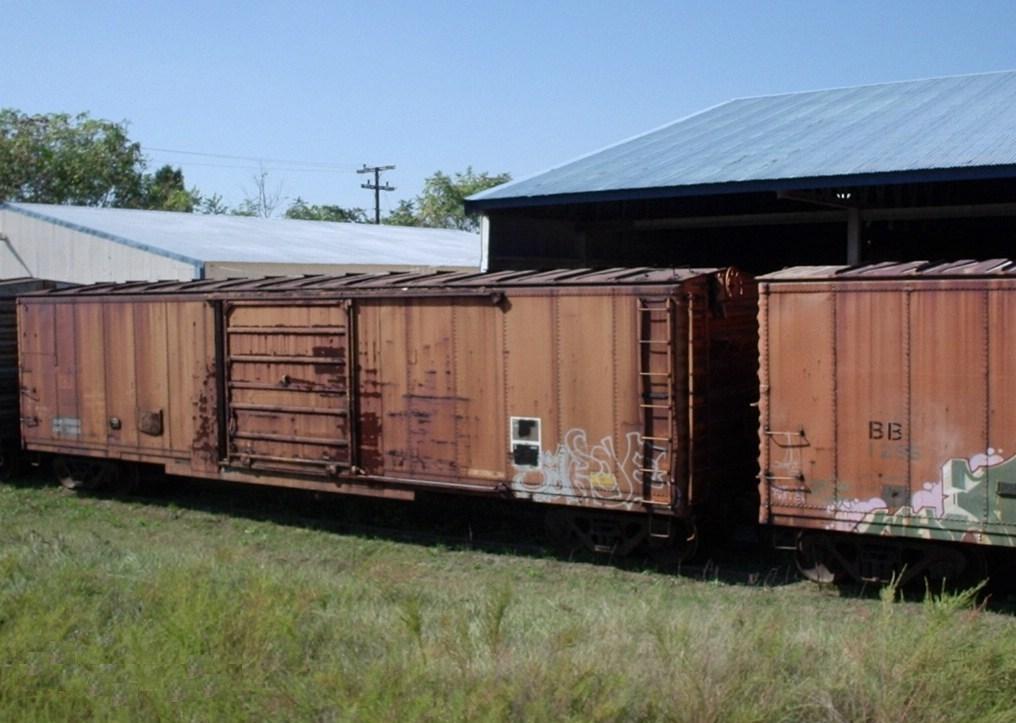
Background · Author HistoryA boxcar is a big enclosed freight car that rolls along railroad tracks, its wooden walls and sliding door built to guard cargo from rain, wind, and thieves. In the early 1900s freight trains carried most goods, so nearly every town grew up beside a set of tracks. Author Gertrude Chandler Warner lived right next to those tracks in Putnam, Connecticut, and she spent hours watching the long trains rumble past. She often daydreamed about climbing inside an empty boxcar and turning it into a snug little house. Notice how that childhood wish shapes the story: because a real boxcar is sturdy, roomy, and weather-tight, it makes a sensible shelter for four children with nowhere else to go.
Visual AidThe kind of car the children lived in
Photograph of an enclosed railroad freight car of the sort the Knowledge Bank describes. You can see the two things that make a boxcar a shelter: solid walls all the way round, and one wide sliding door instead of windows. This car is a museum piece in daylight on level track, not an old one rusting in a wood, and it is metal rather than the wooden car the story imagines. Look at the size of the door. That is how four children and a dog could climb in, and how they could shut the weather out behind them.
ⓘ Vocabulary words are selected to help you understand and complete this workbook. Some may not appear verbatim in the novel.
wearyadj.Ch.1
Very tired
“After walking for hours the weary children could hardly stand.”
bakeryn.Ch.1
A shop where bread and cakes are baked and sold
“Warm light shone from the little bakery on the corner.”
peerv.Ch.1
To look closely or hard at something
“They stopped to peer through the bakery window.”
orphann.Ch.1
A child whose parents have died
“The four children were orphans with no home of their own.”
anxiousadj.Ch.1
Worried and uneasy
“Jessie felt anxious that someone might find them.”
fortunateadj.Ch.2
Lucky
“They were fortunate to find a safe place to rest.”
journeyn.Ch.2
A trip from one place to another
“Their journey took them far from the town.”
sheltern.Ch.2
A place that protects you from weather or danger
“They looked for shelter before the rain came.”
dawnn.Ch.2
The first light of the morning
“At dawn the children stopped to sleep in the hay.”
faintadj.Ch.2
Weak and dizzy
“Benny felt faint because he had not eaten.”
🧠Knowledge Bank question
1According to the Knowledge Bank, where did Warner get the idea of a boxcar home?Ch.1
2A “bakery” is a place where cars are fixed.Ch.1
3To “peer” into the bakery window means to —Ch.1
4Fill in each blank with the correct word.Ch.1
Word choices:orphanwearybakerydawn- some words will not be used
A child whose parents have died is an
After their long walk the four children were
5Someone who is “anxious” feels calm and relaxed.Ch.1
6The children were lucky to find a safe place to rest. They were —Ch.2
7A trip from one place to another is a —Ch.2
8A “shelter” is a place that protects you from bad weather or danger.Ch.2
9Fill in each blank with the correct word.Ch.2
Word choices:dawnfaintjourneyshelter- some words will not be used
The first light of the morning is called
With no food, Benny felt weak and
10Benny had not eaten and felt weak and dizzy. He felt —Ch.2
Part 2
Comprehension
How well do you understand Chapters 1–2?
🧠Knowledge Bank · Reading for Who, Where, and Why
Reading StrategyEvery strong reader begins a story by asking three questions: who are these people, where are they, and why do they act as they do? In the opening pages the answers arrive fast: four Alden children, alone at night, fleeing the only town they know. The trickiest is nearly always why, because a writer often shows a feeling instead of naming it. Warner never says plainly that the children fear being separated; she lets their choices reveal it. When you notice a puzzling choice and ask what is driving it, you are making an inference — a smart guess built from clues in the text. Practice that habit, and the children’s choices will begin to feel perfectly logical.
Visual AidThree questions every reader asks
Structure diagram of the three questions the Knowledge Bank tells you to ask, with the hardest one marked. Drawing them as three equal boxes makes them look like a checklist, which they are not: a good reader asks all three at once and keeps asking as the chapter goes on. The drawing describes a reading habit, not anything that happens in Part 1. Notice which box is highlighted. Who and where are usually answered on the page, but why is the one the writer leaves for you to work out.
Who, where and why as a reading habit, and inference, as set out in the Knowledge Bank. Drawn for Garden Heights Academy.
🧠Knowledge Bank question
1The Knowledge Bank says the hardest of the three reading questions is —Ch.1
2The four children’s parents are still alive.Ch.1
3What do the children buy at the bakery?Ch.1
4Why do Henry and Jessie decide to run away from the baker’s wife?Ch.1
5Put these events from Part 1 in the correct order. Write 1–4 (1 = first).Ch.1–2
Henry and Jessie overhear the plan to send Benny away.
The four hungry children stop outside a bakery at night.
The children slip away in the night and run off.
The baker’s wife lets them sleep in the bakery.
6To avoid being seen, the children travel at night and sleep during the day.Ch.2
7Who is the youngest of the four children?Ch.1
8Who is the oldest child and acts as the leader?Ch.1
9The children are afraid to go to their grandfather because they think he is unkind.Ch.1
10Where do the children rest during their journey?Ch.2
Part 3
Literary Elements
Understanding HOW and WHY Gertrude Chandler Warner writes Chapters 1–2 the way she does.
🧠Knowledge Bank · Warner’s Word-Craft: The Quiet ‘Fortunate’
Language · Understatement SpotlightFour children have lost both parents and wander alone — a frightening situation — yet Warner keeps her words calm, gentle, and even cheerful. When a kind baker hands them bread, she calls the children fortunate, as if a warm loaf settles everything. Deliberately saying less than a moment could allow is called understatement, and Warner leans on it throughout the book. That quiet voice matches the Aldens themselves, who meet trouble without panic and simply get on with the next task. The plain, hopeful words make the children seem brave rather than pitiful, and they let the reader feel safe even in hardship. Watch how a writer’s gentle tone can turn a sad tale into a warm, comforting adventure.
📚 Literary Devices in This Part · definitions & examples
Character means a person or animal in a story. The four children — Henry, Jessie, Violet, and Benny — are the main characters of this book.Setting is the time and place of a story. In Part 1 the setting moves from a town at night to the open countryside.Conflict is the main problem the characters must solve. The children’s conflict is that they have no home, little food, and fear being separated.
The questions below are mixed — not grouped by device. Decide which device each one is about.
🧠Knowledge Bank question
1According to the Knowledge Bank, understatement means a writer —Ch.1–2
2The setting is the time and place where a story happens.Ch.1–2
3Fill in each blank with the correct word.Ch.1–2
Word choices:settingconflictproblemmood- some words will not be used
The woods and boxcar where they live are the
The children’s struggle to survive alone is a .
4The children’s struggle to stay safe and fed on their own is a —Ch.1–2
5A problem is a difficulty the characters must solve.Ch.1–2
6Fill in each blank with the correct word.Ch.1–2
Word choices:problemsettingconflicttheme- some words will not be used
Having no home and no parents is the children’s
The lonely woods where they hide is the .
7Being orphans with nowhere safe to go is the children’s main —Ch.1–2
8The place and time a story happens is its —Ch.1–2
9Fill in each blank with the correct word.Ch.1–2
Word choices:conflictproblemsettingplot- some words will not be used
The children’s fight to survive alone is a
The woods and boxcar are the story’s .
10The lonely woods setting mainly makes the children’s situation feel —Ch.1–2
Part 4
Think Deeper
Four deeper challenges — no single-word recall. Read, weigh the evidence, and reason it through.
🧠Knowledge Bank · A Family That Sticks Together
Ethical Inquiry · A Family That Sticks TogetherThe heart of Part 1 is loyalty — the choice to stay together no matter what. The Aldens could have knocked on a stranger’s door, but they fear that grown-ups would split them up and send them to separate homes. So they give up the warmth of a cozy bakery and slip back into the night, choosing each other over comfort. Notice how the oldest, Henry, quietly takes charge while the others trust him, and how even little Benny is never left behind. Their teamwork is not merely sweet; it is what keeps them safe, because four children who guard one another are stronger than one child alone. Ask yourself what the family gains by refusing to be divided.
1Claim: “The children run away to keep their little family together.” — choose the two details that best prove it.Claim & Evidence
2Shows why the children run away, or just a detail of the scene? Tap each item to sort it — tap again to switch sides. You can keep tapping to change your answer.Sort into two
◄ Why they run awayJust a detail ►
3Match each cause to its result. For each cause, pick its result.Cause & Effect
The children are orphaned and alone→
A bakery takes them in→
Henry and Jessie overhear a plan to split them→
They want to stay together→
🧠Knowledge Bank question
4Fill both blanks to complete the reasoning.Build the Argument
The Knowledge Bank says the Aldens give up a warm bakery because , which shows that .
Part 5
Standardized Test · Vocabulary in Context & Main Idea
Part 1 practices exam reading skills — Vocabulary in Context, Main Idea, Inference, and Author’s Purpose — in the styles the SAT and TOEFL use. Read the passage (the highlighted words are tested below), then choose the answer best supported by the text.
Read the passage — the highlighted words are tested — then answer. Tap an answer, then tap it again to confirm.
SATWords in Context — a word's meaning in this passage
SATInference — a conclusion the passage implies
SATCentral Ideas — the passage's main point
SATRhetorical Purpose — why the author put a sentence there
SATText Structure & Purpose — how the passage is built, and why
TOEFLFactual Information — a fact stated in the passage
TOEFLInference — what the passage implies
How a Thunderstorm Forms
A thunderstorm begins with warm, wet air rising from the ground on a hot afternoon. As this air climbs, it cools and forms a cloud that can tower many kilometers into the sky. Inside the cloud, tiny water drops and ice crystals bump together and build up a huge electric charge. When the charge grows strong enough it leaps free as lightning, a spark so hot that it makes the air explode — and that sudden blast is the thunder we hear. Because light travels faster than sound, we see the flash before the rumble reaches us, so counting the seconds between them shows how distant the storm is. A far-off storm sounds faint, while a close one cracks. A single storm can unleash heavy rain, fierce wind, and even hail in just a few minutes. Sensible people never ignore the warning signs; they find shelter indoors or in a car and wait, even when the noise makes them anxious. A thunderstorm is brief but powerful, and treating it with respect is the surest way to stay safe.
Original passage written for Garden Heights — not a quotation from the novel.
1As used in the passage, the word “anxious” most nearly means —SAT · Words in Context
2The passage suggests that thunder heard from far away means the storm is —SAT · Inference
3According to the passage, what makes the sound of thunder?TOEFL · Factual Information
4As used in the passage, the word “faint” most nearly means —SAT · Words in Context
5According to the passage, why do we see the lightning before we hear the thunder?TOEFL · Factual Information
6As used in the passage, the word “brief” most nearly means —SAT · Words in Context
7Which statement best expresses the central idea of the passage?SAT · Central Ideas
8The passage mainly urges readers to treat a thunderstorm with —SAT · Rhetorical Purpose
9The passage most strongly suggests that if the gap between the flash and the rumble grows longer, the storm is —TOEFL · Inference
10Why does the author explain counting the seconds between the flash and the rumble?SAT · Text Structure & Purpose
Part 6 · Optional
Creative Writing
A bonus challenge to practice your English.
About This Section
This writing task is optional and not part of your auto-graded score. Feedback checks length, spelling, and grammar only.
Writing Task — Part 1 “The First Night”
Use setting to describe the four children’s first night on their own. What do they see, hear, and feel as they walk away from the bakery in the dark? Write at least 40 words.
You can start with: “As the last light went out in the bakery window, the four children stepped quietly into the dark street and…”
0 / 40 words minimum
🗣 Teach It · Just for Fun (optional)
No right or wrong — close the screen and tell someone nearby what happened in this part. Can’t find anyone? Tell yourself out loud. The moment you teach it, you truly understand it.
Part 1 Complete!
You finished Chapters 1–2 of The Boxcar Children.
Here are your auto-graded results:
-
points out of 100
Teach it to someone
The best last step is to teach it. In your own words, explain what happened — retell a favorite scene, teach a character’s big choice, or sum up the main idea for a parent, friend, or classmate. When you can teach it clearly, you truly own it.
SAT® is a registered trademark of College Board, which is not affiliated with, and does not endorse, these materials. TOEFL® is a registered trademark of ETS. These materials are not endorsed or approved by ETS. Garden Heights is an independent provider of test-style reading practice.