New here? Just sign up with Google — your account includes Matilda, our gift book, forever.
📚
Garden Heights Academy
Members sign in to continue.
The Boxcar Children · Garden Heights Academy
Part 2
for The Boxcar Children · Part 2 · Chapters 3–4
a novel by Gertrude Chandler Warner
30 min5 Parts
This workbook is built on a solid pedagogical foundation, effectively integrating content and language learning based on the CLIL framework (Content and Language Integrated Learning), elevated by our unique 5th C — Connection — and an integrated Standardized Test section that weaves every SAT & TOEFL question type right into the novel, so learners build real test skills easily, naturally, and with fun.
What Happens in Part 2
A thunderstorm drives the children into the woods, where an old boxcar becomes their home.
Into the woodsA thunderstorm catches the children on the road. They run deep into the woods to get out of the rain. There they find an old boxcar, a railroad freight car left behind to rust.
Making it homeThey shelter inside all night. In the morning they decide to stay. Jessie sweeps the floor clean, they pile up soft beds of pine needles, and they find a clear brook nearby for water.
Henry finds workHenry walks to the town of Silver City to look for work. Kind Dr. Moore hires him to do odd jobs around his garden. Henry works hard all day long.
Two surprisesHenry comes back with two happy surprises: food for supper, and money he earned himself. The children now have a home, clean water, and a way to buy what they need.
What We Will Learn
Literary Element
What It Means
Plot
The order of events that make up a story
Imagery
Describing words that help you picture, hear, or feel a scene
Mood
The feeling a story gives the reader, such as scary or cozy
Chapter Summary
Chapter
Key Events
Ch.3
A New Home in the Woods — a storm sends the children into the woods, where they find an abandoned boxcar and turn it into a cozy home
Ch.4
Henry Has Two Surprises — Henry finds work in Silver City with Dr. Moore and brings home food and money
Copyright Notice
Independent study guide by Garden Heights Academy. Not affiliated with or endorsed by Gertrude Chandler Warner or Albert Whitman & Company. No text from the novel is reproduced. Students should read the original book. Reference edition: this workbook follows the standard Albert Whitman & Company edition (the 1942 text) — the version sold in bookstores today. Early 1924-text reprints differ substantially and will not match this workbook’s chapters.
Part 1
Vocabulary
Study 10 key words from Chapters 3–4, then answer each question.
🧠Knowledge Bank · Life Before Refrigerators
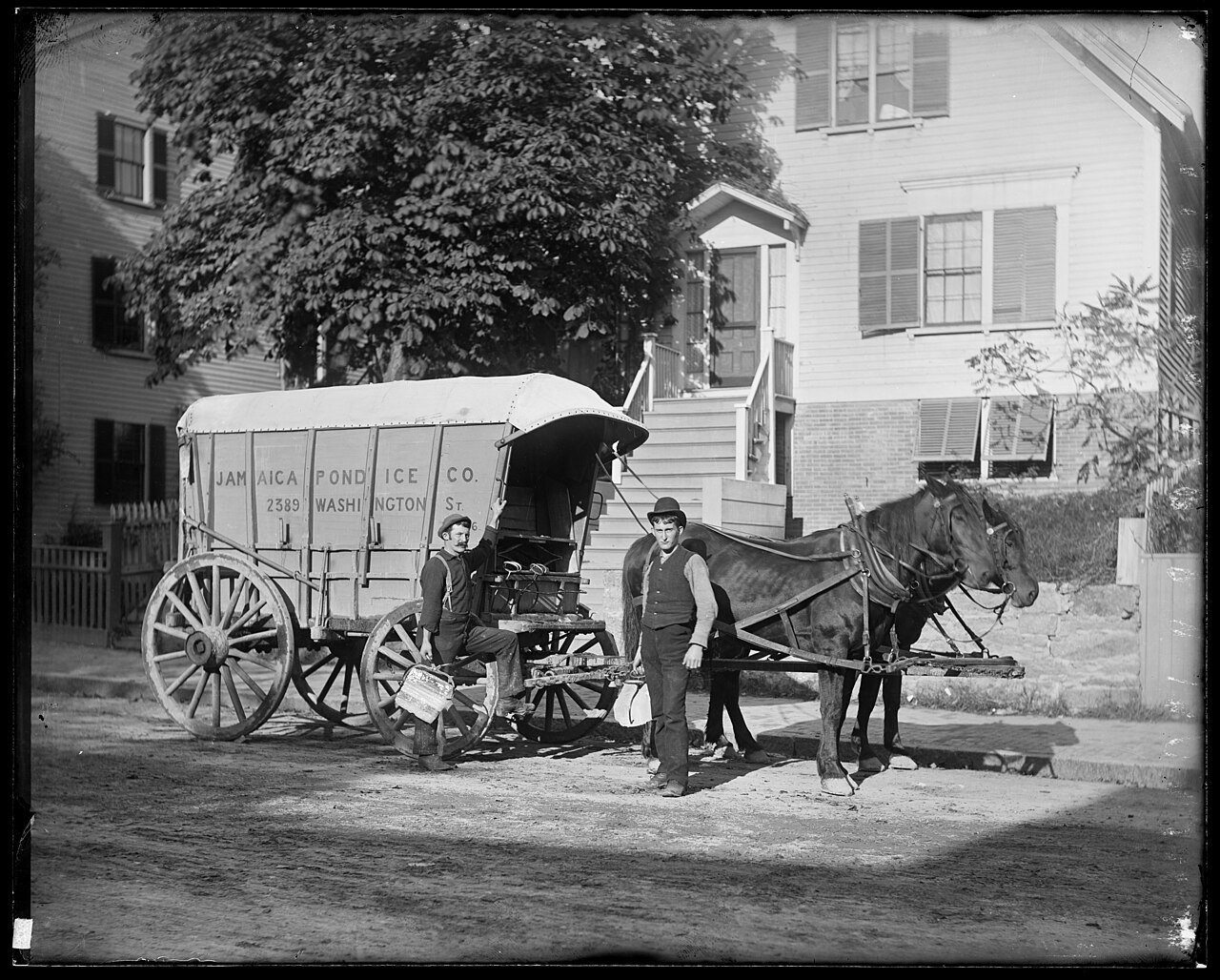
Background · HistoryBefore electric refrigerators, keeping food cold was a daily puzzle. Most families owned an icebox — an insulated wooden cabinet cooled by a heavy block of ice that an iceman delivered by horse-drawn wagon. As the ice slowly melted, it drew heat away from the milk and butter stored inside, and the drips ran into a tray below. Country families without an iceman used other clever tricks: a cool root cellar dug into the earth, or a spring house built over cold running water. That is exactly the science the Alden children borrow when they wedge their milk into the chilly brook. Because cold water constantly carries warmth away, a shaded, running stream becomes a natural, no-cost refrigerator.
Visual AidThe man who brought the cold
Photograph of an iceman and his helper with a horse-drawn wagon in Boston, taken for a newspaper in the early twentieth century. This is the delivery the Knowledge Bank describes: a heavy block cut with tongs and carried indoors to the icebox, where it slowly melted and drew the heat away. The photograph shows the delivery, not the icebox itself, and a city round like this one was far busier than a country route. Notice the tongs. Ice had to be carried by hand into every kitchen, which is why families in the country looked for colder water instead.
Iceman and helper with a Jamaica Pond Ice Co. wagon, Boston, Massachusetts; Library of Congress. Source: Wikimedia Commons, public domain.
ⓘ Vocabulary words are selected to help you understand and complete this workbook. Some may not appear verbatim in the novel.
boxcarn.Ch.3
A railroad freight car that carries goods
“The children found an old boxcar resting in the woods.”
abandonedadj.Ch.3
Left empty and no longer used
“The abandoned boxcar had been forgotten for years.”
thunderstormn.Ch.3
A storm with thunder, lightning, and rain
“A thunderstorm sent the children running for cover.”
sturdyadj.Ch.3
Strong and solidly built
“The sturdy walls of the boxcar kept out the wind.”
brookn.Ch.3
A small stream of water
“A clear brook ran close to their new home.”
cozyadj.Ch.3
Warm and comfortable
“Beds of pine needles made the boxcar cozy.”
errandn.Ch.4
A short trip to do a small job
“Henry ran an errand to buy milk and bread.”
wagesn.Ch.4
Money paid for work
“Henry earned good wages for a hard day’s work.”
grocern.Ch.4
A person who sells food
“The grocer sold Henry milk, cheese, and bread.”
gratefuladj.Ch.4
Feeling thankful
“The children were grateful for the food Henry brought.”
🧠Knowledge Bank question
1According to the Knowledge Bank, how did an icebox keep food cold?Ch.3
2Something “abandoned” is brand new and often used.Ch.3
3The boxcar’s walls are strong and solidly built. They are —Ch.3
4Fill in each blank with the correct word.Ch.3
Word choices:thunderstormbrookcozywages- some words will not be used
The children ran from a
They drank fresh water from a
5A “cozy” place is warm and comfortable.Ch.3
6A short trip to do a small job, such as buying milk, is an —Ch.4
7The money Henry is paid for his work is called his —Ch.4
8A “grocer” is a person who sells food.Ch.4
9Fill in each blank with the correct word.Ch.4
Word choices:gratefulgrocersturdyerrand- some words will not be used
Henry bought food from the
The children were thankful, or
10The children felt thankful for the food Henry brought home. They felt —Ch.4
Part 2
Comprehension
How well do you understand Chapters 3–4?
🧠Knowledge Bank · Following the Plot
Narrative Logic · Following the PlotA plot is the order of events in a story: what happens first, next, and last. Part 2 is full of busy steps as the children turn a bare boxcar into a home: they sweep it, gather pine needles for beds, hang the wash, and search for water. If you jumble those steps in your memory, the chapter turns confusing. A helpful trick is to notice sequence words such as first, then, after, and finally, which act like signposts through the action. Each task makes the next one possible — you cannot cook until you have water, and you cannot sleep well until you have beds. Track that chain, and you will watch a bare boxcar become a real home.
Visual AidOne step makes the next one possible
Sequence diagram of the order of work the Knowledge Bank asks you to track, with the sequence words underneath. Real chapters are messier than four boxes: the children do several jobs at once, and Henry's trip to town overlaps everything else. The drawing shows why order matters, not a timetable of the chapter. Notice that each box depends on the one before it. That is what makes this a chain rather than a list, and it is why jumbling the steps makes the chapter hard to follow.
Plot order and the sequence words first, then, after and finally, as set out in the Knowledge Bank. Drawn for Garden Heights Academy.
🧠Knowledge Bank question
1The Knowledge Bank says sequence words such as first and then act like —Ch.3
2The children find an old boxcar in the woods.Ch.3
3What do the children decide to do with the boxcar?Ch.3
4Who keeps the boxcar clean and tidy?Ch.3
5Put these events from Part 2 in the correct order. Write 1–4 (1 = first).Ch.3–4
The children clean the boxcar and make it their home.
The children find the abandoned boxcar.
Henry walks to Silver City to look for work.
A thunderstorm begins and the children run into the woods.
6Henry stays at the boxcar and never looks for work.Ch.4
7Where does Henry go to find work?Ch.4
8Who hires Henry to do odd jobs?Ch.4
9Henry brings home food and money to surprise the others.Ch.4
10How do the children get fresh water near the boxcar?Ch.3
Part 3
Literary Elements
Understanding HOW and WHY Gertrude Chandler Warner writes Chapters 3–4 the way she does.
🧠Knowledge Bank · Warner’s Word-Craft: A ‘Cozy’ Boxcar
Language · Connotation SpotlightWords carry two kinds of meaning: their dictionary sense, and the feelings that cling to them, which we call connotation. An old freight car sitting in the woods could easily sound grim — rusty, abandoned, lonely. Yet Warner chooses warm words like cozy, snug, and home, and instantly the same boxcar feels inviting. Compare cozy with a colder word such as cramped: both could describe a small space, but one hugs you while the other pushes you away. Because Warner leans on gentle words, the reader stops seeing junk and starts seeing a shelter worth loving. Writers pick their words on purpose, knowing the right shading can make a rickety old boxcar feel like the safest, most welcoming haven.
📚 Literary Devices in This Part · definitions & examples
Plot is the order of events that make up a story — what happens first, next, and last.Imagery is describing words that help you picture, hear, smell, or feel a scene, such as the soft pine needles or the splashing brook.Mood is the feeling a story gives the reader. Part 2 moves from a frightening storm to a warm, safe, cozy feeling inside the boxcar.
The questions below are mixed — not grouped by device. Decide which device each one is about.
🧠Knowledge Bank question
1According to the Knowledge Bank, connotation is —Ch.3–4
2The plot is the sequence of events in a story.Ch.3–4
3Fill in each blank with the correct word.Ch.3–4
Word choices:plotimagerymoodsetting- some words will not be used
The order of events in the story is its
Words that help us see and hear the storm create .
4Warner’s words that make us see the rain and dark woods are —Ch.3–4
5Imagery is language that appeals to the five senses.Ch.3–4
6Fill in each blank with the correct word.Ch.3–4
Word choices:moodimageryplottheme- some words will not be used
The cozy, hopeful feeling inside the boxcar is the
Vivid word-pictures of the storm are .
7The cozy, safe feeling of the boxcar home is the story’s —Ch.3–4
8The events in order — storm, boxcar, home — make up the —Ch.3–4
9Fill in each blank with the correct word.Ch.3–4
Word choices:imageryplotmoodsetting- some words will not be used
Vivid pictures of the storm and woods are
The order of events is the story’s .
10The warm mood inside the boxcar mainly makes readers feel the children are —Ch.3–4
Part 4
Think Deeper
Four deeper challenges — no single-word recall. Read, weigh the evidence, and reason it through.
🧠Knowledge Bank · From Fear to Comfort
Ethical Inquiry · From Fear to ComfortPart 2 traces a quiet journey — the children travel from fear to comfort without leaving the woods. At first the boxcar is strange and a little scary, especially during the thunderstorm that drives them inside. But as they clean it and fill it with small comforts, their fear melts into safety. Notice that the change is not magic; it is earned through work. Every job — sweeping the floor, softening the beds, sharing a meal — adds another thread of belonging. Warner shows a real truth: a place becomes a home not because it is fancy, but because people care for it and for one another. Ask what turns a cold, empty space into a treasured refuge.
1Claim: “The children turn an abandoned boxcar into a real home.” — choose the two details that best prove it.Claim & Evidence
2Shows the children making a home, or just a detail of the scene? Tap each item to sort it — tap again to switch sides. You can keep tapping to change your answer.Sort into two
◄ Making a homeJust a detail ►
3Match each cause to its result. For each cause, pick its result.Cause & Effect
A thunderstorm strikes→
They find an abandoned boxcar→
Morning comes→
They want it cozy→
🧠Knowledge Bank question
4Fill both blanks to complete the reasoning.Build the Argument
The Knowledge Bank says the boxcar stops feeling scary because , which shows that .
Part 5
Standardized Test · Vocabulary in Context & Inference
Part 2 practices exam reading skills — Vocabulary in Context, Inference & Main Idea — in the styles the SAT and TOEFL use. Read the passage (the highlighted words are tested below), then choose the answer best supported by the text.
Read the passage — the highlighted words are tested — then answer. Tap an answer, then tap it again to confirm.
SATWords in Context — a word's meaning in this passage
SATInference — a conclusion the passage implies
SATRhetorical Purpose — why the author put a sentence there
SATText Structure & Purpose — how the passage is built, and why
TOEFLFactual Information — a fact stated in the passage
TOEFLProse Summary — the three sentences that sum it up
TOEFLInference — what the passage implies
The Old Art of Upcycling
Long before recycling had a name, families wasted almost nothing. A broken cup became a spoon holder, a cracked barrel became a stool, and worn clothes were cut down into warm quilts. Turning old objects into useful new ones is called upcycling, and it is one of the oldest household skills of all. Upcycling saves money, but it also protects the planet, since every object given a second life is one less thing dug from the earth or burned in a heap. The trick is to look at an abandoned item and picture what it could become rather than what it once was. A little cleaning can restore a rusty tin or a muddy jar until it is nearly as good as new. A clever mind can convert a sturdy wooden crate into a shelf, or a worn tire into a swing. The materials cost nothing because someone else already discarded them. Best of all, an upcycled object carries a small story, and that makes it more precious than anything bought in a shop.
Original passage written for Garden Heights — not a quotation from the novel.
1As used in the passage, the word “abandoned” most nearly means —SAT · Words in Context
3According to the passage, what is upcycling?TOEFL · Factual Information
4As used in the passage, the word “sturdy” most nearly means —SAT · Words in Context
5According to the passage, how does upcycling protect the planet?TOEFL · Factual Information
6As used in the passage, the word “precious” most nearly means —SAT · Words in Context
7This TOEFL task lists six sentences; choose the THREE that best capture the passage’s main ideas. The other three do not belong — they state minor details or ideas the passage does not present.TOEFL · Prose Summary
9The passage most strongly suggests that a person who upcycles looks at a broken object and sees —TOEFL · Inference
10Why does the author list a cup, a barrel, and old clothes at the start?SAT · Text Structure & Purpose
Part 6 · Optional
Creative Writing
A bonus challenge to practice your English.
About This Section
This writing task is optional and not part of your auto-graded score. Feedback checks length, spelling, and grammar only.
Writing Task — Part 2 “Inside the Boxcar”
Use imagery to describe the inside of the boxcar after the children have made it their home. What can you see, smell, and feel? Make the reader want to live there too. Write at least 40 words.
You can start with: “Inside the old boxcar it was warm and dry, and the first thing you noticed was…”
0 / 40 words minimum
🗣 Teach It · Just for Fun (optional)
No right or wrong — close the screen and tell someone nearby what happened in this part. Can’t find anyone? Tell yourself out loud. The moment you teach it, you truly understand it.
Part 2 Complete!
You finished Chapters 3–4 of The Boxcar Children.
Here are your auto-graded results:
-
points out of 100
Teach it to someone
The best last step is to teach it. In your own words, explain what happened — retell a favorite scene, teach a character’s big choice, or sum up the main idea for a parent, friend, or classmate. When you can teach it clearly, you truly own it.
SAT® is a registered trademark of College Board, which is not affiliated with, and does not endorse, these materials. TOEFL® is a registered trademark of ETS. These materials are not endorsed or approved by ETS. Garden Heights is an independent provider of test-style reading practice.