New here? Just sign up with Google — your account includes Matilda, our gift book, forever.
📚
Garden Heights Academy
Members sign in to continue.
The Boxcar Children · Garden Heights Academy
Part 6
for The Boxcar Children · Part 6 · Chapter 11
a novel by Gertrude Chandler Warner
25 min5 Parts
This workbook is built on a solid pedagogical foundation, effectively integrating content and language learning based on the CLIL framework (Content and Language Integrated Learning), elevated by our unique 5th C — Connection — and an integrated Standardized Test section that weaves every SAT & TOEFL question type right into the novel, so learners build real test skills easily, naturally, and with fun.
What Happens in Part 6
Violet falls ill in the night, and Henry runs through the dark to fetch the doctor.
A fever at nightWorry comes to the boxcar. In the night gentle Violet becomes ill with a fever. The other children are frightened, because they do not know how to help her.
Henry runsBrave Henry runs all the way through the dark to Silver City to fetch kind Dr. Moore. He does not stop to think about being seen.
The doctor comesThe doctor comes at once. He decides to take Violet to his own home so that he can tend her there until she recovers.
What the doctor knowsQuietly, Dr. Moore has already guessed who these children really are. He says nothing to them yet, but he begins to take a hand in helping them.
What We Will Learn
Literary Element
What It Means
Foreshadowing
Clues that hint at what will happen later in a story
Mood
The feeling a story gives the reader, here worry and tension
Character
What a person in the story is like, shown by what they do
Chapter Summary
Chapter
Key Events
Ch.11
The Doctor Takes a Hand — Violet falls ill with a fever; Henry fetches Dr. Moore, who takes her home to care for her and quietly begins to help the children
Copyright Notice
Independent study guide by Garden Heights Academy. Not affiliated with or endorsed by Gertrude Chandler Warner or Albert Whitman & Company. No text from the novel is reproduced. Students should read the original book. Reference edition: this workbook follows the standard Albert Whitman & Company edition (the 1942 text) — the version sold in bookstores today. Early 1924-text reprints differ substantially and will not match this workbook’s chapters.
Part 1
Vocabulary
Study 10 key words from Chapter 11, then answer each question.
🧠Knowledge Bank · When the Doctor Came to You
Background · Medical HistoryToday a sick child is driven to a clinic, but in the early 1900s the doctor came to you. Physicians made house calls, traveling by horse and buggy to treat patients in their own beds, carrying medicines in a small black bag. There were no antibiotics yet, so much of healing depended on rest, warmth, good food, and patient nursing at home. A bad cold or fever was taken seriously, because it could grow dangerous without careful watching. That world explains why Dr. Moore matters so much to the Aldens: when Violet falls ill, a kind doctor willing to come and stay is the children’s best hope. Notice how the rescue leans on the steady hands of a trusted physician.
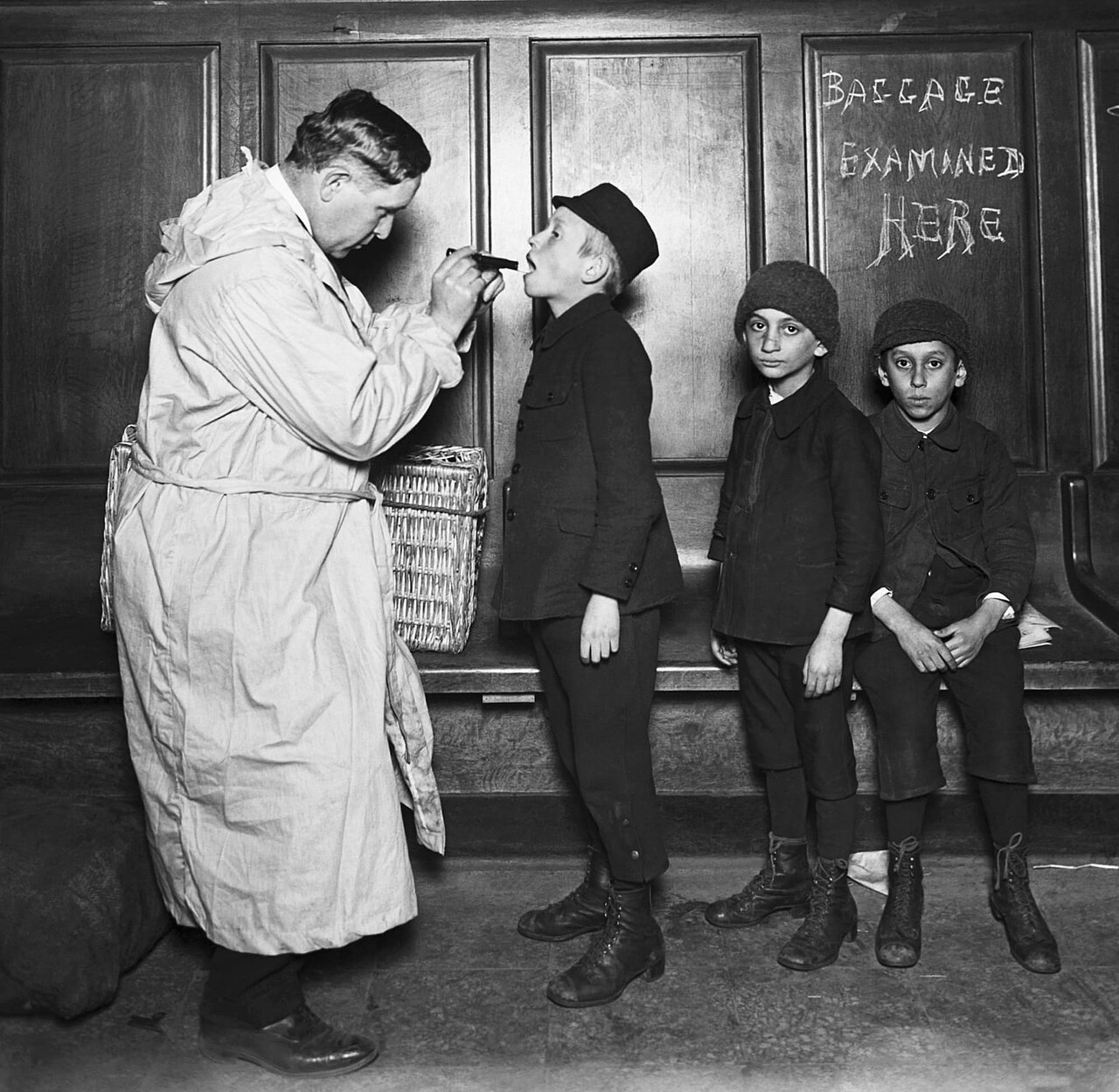
Visual AidA doctor and a line of children
Photograph of a city health officer examining children as they arrived in New York in the early twentieth century. It shows what the Knowledge Bank means by medicine that came to you: a doctor with no clinic, no machines and no antibiotics, working with his eyes and his hands. This is a public health check of many children at once, not the private house call the Aldens receive, and the children here are strangers to the doctor. Notice how close he has to get. Without tests, looking carefully was most of what a doctor could do.
Immigrant children examined by a city health officer on arrival at the Battery, New York. Source: Wikimedia Commons, public domain.
ⓘ Vocabulary words are selected to help you understand and complete this workbook. Some may not appear verbatim in the novel.
fevern.Ch.11
A high body temperature when you are ill
“Violet’s cheeks were hot with fever.”
illadj.Ch.11
Sick; not well
“In the night, Violet became ill.”
concernedadj.Ch.11
Worried about someone or something
“The children were concerned about their sister.”
fetchv.Ch.11
To go and bring back
“Henry ran to fetch the doctor.”
recoverv.Ch.11
To get well again
“With care, Violet began to recover.”
patientn.Ch.11
A sick person whom a doctor cares for
“Dr. Moore watched over his young patient.”
tendv.Ch.11
To look after or care for
“The doctor stayed to tend the sick child.”
reliefn.Ch.11
The good feeling when worry ends
“It was a relief when Violet felt better.”
gentleadj.Ch.11
Kind, soft, and careful
“The doctor had a gentle, kindly manner.”
urgentadj.Ch.11
Needing quick action right away
“It was urgent that Henry find the doctor fast.”
🧠Knowledge Bank question
1According to the Knowledge Bank, what was a house call?Ch.11
2Someone who is “ill” is healthy and well.Ch.11
3To go and bring back the doctor is to — him.Ch.11
4Fill in each blank with the correct word.Ch.11
Word choices:concernedrecoverurgentpatient- some words will not be used
The other children were worried, or
With rest, Violet would soon
5A “patient” is a sick person whom a doctor cares for.Ch.11
6To look after or care for a sick person is to — them.Ch.11
7The good feeling when worry ends is called —Ch.11
8A “gentle” person is kind, soft, and careful.Ch.11
9Fill in each blank with the correct word.Ch.11
Word choices:urgentgentlefeverfetch- some words will not be used
Finding the doctor quickly was
Hot cheeks are a sign of a
10Henry had to find the doctor fast. The need was —Ch.11
Part 2
Comprehension
How well do you understand Chapter 11?
🧠Knowledge Bank · Why Characters Act
Narrative Logic · Why Characters ActBehind every action a character takes lies a motive — the reason that pushes them to do it. Understanding motive lets you see a story from the inside rather than watching events go by. In Part 6, ask why each person behaves as they do. Why does Henry run so fast to fetch the doctor? Why does Jessie stay calm at Violet’s side? Why is Dr. Moore so gentle and curious about these children? Warner rarely states a motive outright; instead she leaves clues in what characters say and do, and she trusts you to infer the feeling underneath. When you can name why a character acts, their choices stop seeming random and reveal each person’s true heart.
🧠Knowledge Bank question
1The Knowledge Bank says a motive is —Ch.11
2Violet has a fever.Ch.11
3What does Henry do when Violet is ill?Ch.11
4Who comes to help the sick child?Ch.11
5Put these events from Part 6 in the correct order. Write 1–4 (1 = first).Ch.11
Henry runs to Silver City to fetch Dr. Moore.
Dr. Moore takes Violet to his home to care for her.
Violet becomes ill with a fever in the night.
The children are frightened and worried.
6Dr. Moore takes Violet to his home so he can care for her.Ch.11
7What is Dr. Moore’s job?Ch.11
8Dr. Moore had already guessed who the children really are.Ch.11
9How do the other children feel while Violet is sick?Ch.11
10What does ‘the doctor takes a hand’ mean?Ch.11
Part 3
Literary Elements
Understanding HOW and WHY Gertrude Chandler Warner writes Chapter 11 the way she does.
🧠Knowledge Bank · Warner’s Word-Craft: Violet’s ‘Fever’
Language · Foreshadowing SpotlightForeshadowing is a writer’s way of dropping hints about what is coming later. Violet’s fever is more than a passing illness; it is a quiet signal that the children’s hidden life in the woods cannot last forever. Because she is sick a doctor must be called, and that single event pulls the Aldens back toward the world they have been avoiding. A careful reader feels the shift: what looks like a small setback is really the hinge on which the whole plot will turn. Warner plants these clues gently, so the surprise feels earned rather than sudden. Watch for other little hints in this part, and notice how a skilled writer quietly prepares you for a coming change.
Visual AidA hint dropped early
Sequence diagram of the hint the Knowledge Bank points out, followed through to what it forces. Drawing it as three certain steps is neater than the book: at the time, a fever simply looks like a sick sister, and only later does it read as a signal. That is exactly how foreshadowing is supposed to work. The drawing explains the device, not the medicine. Notice that nothing here is a surprise once you look back, which is the sign of a hint planted rather than a twist sprung.
Foreshadowing, and Violet's illness as the hinge of the plot, as set out in the Knowledge Bank. Drawn for Garden Heights Academy.
📚 Literary Devices in This Part · definitions & examples
Foreshadowing is a clue that hints at what will happen later. Dr. Moore quietly knowing who the children are hints that a family reunion is coming.Mood is the feeling a story gives the reader. When Violet is ill, the mood becomes worried and tense.Character is shown by what a person does. Henry’s brave run and Dr. Moore’s gentle care reveal what kind of people they are.
The questions below are mixed — not grouped by device. Decide which device each one is about.
🧠Knowledge Bank question
1According to the Knowledge Bank, foreshadowing is —Ch.11
2Foreshadowing gives hints about what will happen later.Ch.11
3Fill in each blank with the correct word.Ch.11
Word choices:foreshadowingmoodthemesetting- some words will not be used
Dr. Moore’s secret knowledge hinting at the future is
The anxious, worried feeling as Violet lies sick is the .
4The anxious, worried feeling while Violet is sick is the —Ch.11
5Mood is the feeling a scene gives the reader.Ch.11
6Fill in each blank with the correct word.Ch.11
Word choices:moodforeshadowingthemeplot- some words will not be used
The tense, worried feeling of the sickroom is the
Dr. Moore’s hidden knowledge is a hint, or .
7A clue that hints at what is coming later is —Ch.11
8The scary, worried feeling as Violet’s fever rises is the —Ch.11
9Fill in each blank with the correct word.Ch.11
Word choices:foreshadowingmoodthemeplot- some words will not be used
A hint of what is to come is
The worried feeling of the scene is the .
10The anxious mood of Violet’s illness mainly makes readers feel —Ch.11
Part 4
Think Deeper
Four deeper challenges — no single-word recall. Read, weigh the evidence, and reason it through.
🧠Knowledge Bank · Hints of What’s to Come
Ethical Inquiry · Hints of What’s to ComePart 6 is heavy with worry, yet it glows with trust. When Violet grows ill, the children face a choice: keep hiding, or let an outsider into their secret world. By allowing Dr. Moore to help, they take a brave leap of faith — and his warmth quietly rewards that trust. Warner hints at brighter things to come: not every stranger is a danger, and kindness often waits where the children feared harm. Notice how caring for a sick sister pulls the family even closer, and how accepting help is its own kind of courage. Ask why opening the door to one gentle grown-up marks such a turning point, and what the Aldens gain when they trust.
1Claim: “When Violet falls ill, Henry’s courage gets her the help she needs.” — choose the two details that best prove it.Claim & Evidence
2Shows the crisis and Henry’s response, or just a detail of the scene? Tap each item to sort it — tap again to switch sides. You can keep tapping to change your answer.Sort into two
◄ The crisis and Henry’s responseJust a detail ►
3Match each cause to its result. For each cause, pick its result.Cause & Effect
Violet falls ill with a fever→
She needs a doctor→
Henry reaches Dr. Moore→
Violet is very sick→
🧠Knowledge Bank question
4Fill both blanks to complete the reasoning.Build the Argument
The Knowledge Bank says letting Dr. Moore help is brave because , which shows that .
Part 5
Standardized Test · Vocabulary & Author’s Purpose
Part 6 practices exam reading skills — Vocabulary in Context, Author’s Purpose & Inference — in the styles the SAT and TOEFL use. Read the passage (the highlighted words are tested below), then choose the answer best supported by the text.
Read the passage — the highlighted words are tested — then answer. Tap an answer, then tap it again to confirm.
SATWords in Context — a word's meaning in this passage
SATInference — a conclusion the passage implies
SATRhetorical Purpose — why the author put a sentence there
SATText Structure & Purpose — how the passage is built, and why
TOEFLFactual Information — a fact stated in the passage
TOEFLProse Summary — the three sentences that sum it up
TOEFLInference — what the passage implies
The Newspaper as Early Internet
For most of history, news traveled only as fast as a person could walk or ride. The invention of the printing press changed everything, because a press could produce hundreds of identical pages in the time it once took to copy a single one by hand. Soon printers began gathering the latest and most urgent events onto one cheap sheet, and the newspaper was born. A single newspaper could inform thousands of readers on the same morning, spreading the same facts across a whole city at once. People used papers to sell goods and find lost pets, and concerned families even searched for a missing relative by offering a reward. Editors had to be careful, because a printed mistake could not be erased once thousands of copies had been sold. Since anyone with a coin could buy one, the newspaper made knowledge far less exclusive than it had ever been. In many ways, the newspaper was the internet of its day.
Original passage written for Garden Heights — not a quotation from the novel.
1As used in the passage, the word “urgent” most nearly means —SAT · Words in Context
2The passage suggests newspapers mainly helped ordinary people become more —SAT · Inference
3According to the passage, why did the printing press change everything?TOEFL · Factual Information
4As used in the passage, the word “concerned” most nearly means —SAT · Words in Context
5According to the passage, why did editors have to be careful?TOEFL · Factual Information
6The passage compares the newspaper to the internet mainly to show it —SAT · Rhetorical Purpose
7As used in the passage, the word “exclusive” most nearly means —SAT · Words in Context
8This TOEFL task lists six sentences; choose the THREE that best capture the passage’s main ideas. The other three do not belong — they state minor details or ideas the passage does not present.TOEFL · Prose Summary
9Why does the author end by calling the newspaper “the internet of its day”?SAT · Text Structure & Purpose
10The passage most strongly suggests that before the printing press, knowledge reached —TOEFL · Inference
Part 6 · Optional
Creative Writing
A bonus challenge to practice your English.
About This Section
This writing task is optional and not part of your auto-graded score. Feedback checks length, spelling, and grammar only.
Writing Task — Part 6 “The Night Violet Fell Ill”
Describe the night Violet becomes sick and Henry runs for the doctor. Use mood to make the reader feel the family’s worry, then their relief when help arrives. Write at least 40 words.
You can start with: “Violet’s cheeks were burning hot, and without a word Henry pulled on his shoes and…”
0 / 40 words minimum
🗣 Teach It · Just for Fun (optional)
No right or wrong — close the screen and tell someone nearby what happened in this part. Can’t find anyone? Tell yourself out loud. The moment you teach it, you truly understand it.
Part 6 Complete!
You finished Chapter 11 of The Boxcar Children.
Here are your auto-graded results:
-
points out of 100
Teach it to someone
The best last step is to teach it. In your own words, explain what happened — retell a favorite scene, teach a character’s big choice, or sum up the main idea for a parent, friend, or classmate. When you can teach it clearly, you truly own it.
SAT® is a registered trademark of College Board, which is not affiliated with, and does not endorse, these materials. TOEFL® is a registered trademark of ETS. These materials are not endorsed or approved by ETS. Garden Heights is an independent provider of test-style reading practice.