New here? Just sign up with Google — your account includes Matilda, our gift book, forever.
📚
Garden Heights Academy
Members sign in to continue.
The Boxcar Children · Garden Heights Academy
Part 7
for The Boxcar Children · Part 7 · Chapter 12
a novel by Gertrude Chandler Warner
25 min5 Parts
This workbook is built on a solid pedagogical foundation, effectively integrating content and language learning based on the CLIL framework (Content and Language Integrated Learning), elevated by our unique 5th C — Connection — and an integrated Standardized Test section that weaves every SAT & TOEFL question type right into the novel, so learners build real test skills easily, naturally, and with fun.
What Happens in Part 7
The children learn that the grandfather they feared has been searching for them all along.
The great secretThe great secret is revealed. The children's grandfather is Mr. James Henry Alden, a wealthy and generous man from Greenfield.
Searching everywhereHe has been searching everywhere for his lost grandchildren. He did not know where they were, or even whether they were still alive.
The hidden nameAll this time Henry had hidden the family name. He called himself Henry James, so that nobody could trace the children back to their grandfather.
Not cruel at allWith kind Dr. Moore's help the family is brought together. The children are astonished. The grandfather they feared is not cruel at all, but loving and kind, and they are overjoyed.
What We Will Learn
Literary Element
What It Means
Climax
The most exciting, important turning point of a story
Irony
When what happens is the opposite of what was expected
Theme
The big idea behind a story, such as not judging too soon
Chapter Summary
Chapter
Key Events
Ch.12
James Henry and Henry James — the children’s grandfather, Mr. James Henry Alden, is revealed; with Dr. Moore’s help the family is reunited and the children find their grandfather is kind
Copyright Notice
Independent study guide by Garden Heights Academy. Not affiliated with or endorsed by Gertrude Chandler Warner or Albert Whitman & Company. No text from the novel is reproduced. Students should read the original book. Reference edition: this workbook follows the standard Albert Whitman & Company edition (the 1942 text) — the version sold in bookstores today. Early 1924-text reprints differ substantially and will not match this workbook’s chapters.
Part 1
Vocabulary
Study 10 key words from Chapter 12, then answer each question.
🧠Knowledge Bank · Orphans and Lost Families
Background · Literary HistoryStories about orphans fill children’s books from Warner’s time, and there is a real history behind them. In the early 1900s, before modern medicine, many children did lose their parents young and depended on relatives or on the goodness of their community. Newspapers even ran notices offering rewards for news of missing children or scattered kin, and searching relatives could spend years trying to find one another. That background makes the Aldens’ situation believable rather than far-fetched. It also explains the shape of the whole book: a grandfather quietly hunting for his lost grandchildren was a very real hope in that era. Notice how Warner turns a common hardship of her day into a warm story of reunion.
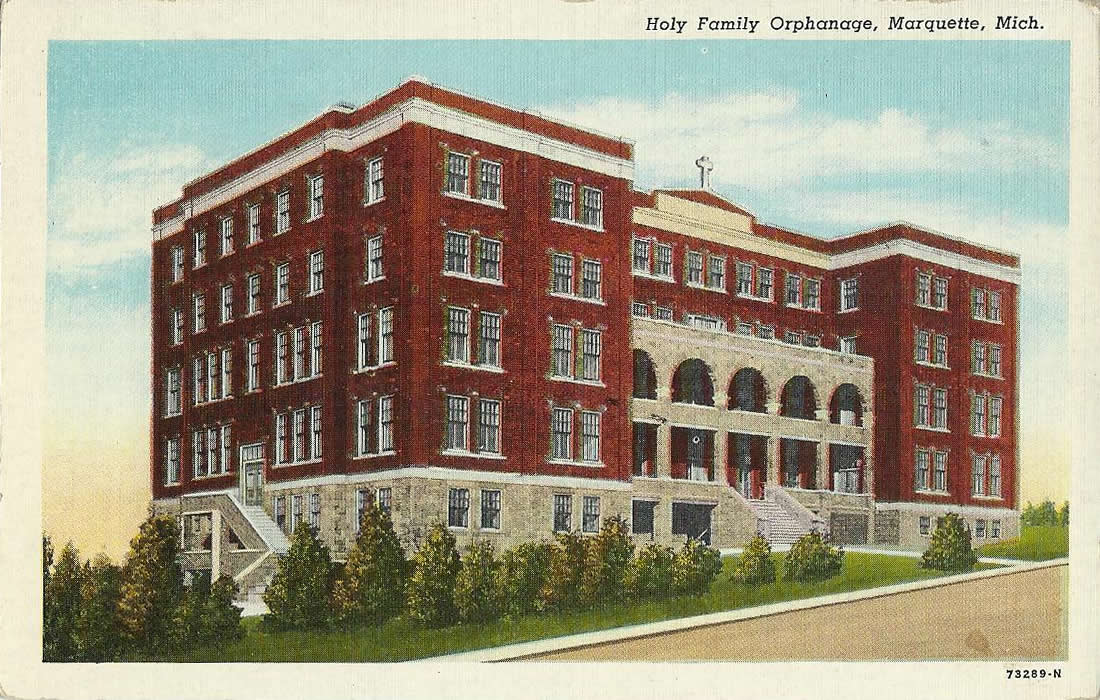
Visual AidThe place the children were running from
Photograph of a 1917 postcard of an American orphanage, a building of the kind the Knowledge Bank has in mind. Places like this are why the Aldens run: a children's home was where brothers and sisters could be separated, and Henry and Jessie leave the bakery the moment they hear one mentioned. A postcard shows the best face of a building, photographed from the lawn on a good day, and says nothing about life inside. Notice the rows of identical windows. That is a building meant to hold a great many children at once.
Postcard of the Holy Family Orphanage, 1917. Source: Wikimedia Commons, public domain.
ⓘ Vocabulary words are selected to help you understand and complete this workbook. Some may not appear verbatim in the novel.
revealv.Ch.12
To make known something that was hidden
“At last the story reveals who the grandfather is.”
relativen.Ch.12
A member of your family
“Their grandfather is their only living relative.”
fortunen.Ch.12
A large amount of money; great wealth
“Mr. Alden was a man of great fortune.”
generousadj.Ch.12
Happy to give and share
“The generous grandfather wanted to give them everything.”
reunionn.Ch.12
A happy meeting of people who were apart
“The reunion brought the family together at last.”
disguisev.Ch.12
To change something to hide what it really is
“Henry tried to disguise his name to stay hidden.”
searchv.Ch.12
To look hard for someone or something
“The grandfather had searched everywhere for them.”
astonishedadj.Ch.12
Very surprised
“The children were astonished by the happy news.”
kindlyadj.Ch.12
Kind and caring
“Their grandfather had a kindly face after all.”
overjoyedadj.Ch.12
Extremely happy
“The children were overjoyed to find a loving grandfather.”
🧠Knowledge Bank question
1According to the Knowledge Bank, why does the Aldens' situation feel believable?Ch.12
2A “relative” is a member of your family.Ch.12
3A person who is happy to give and share is —Ch.12
4Fill in each blank with the correct word.Ch.12
Word choices:reunionfortunedisguisekindly- some words will not be used
A happy meeting of family who were apart is a
The wealthy grandfather had a great
5To “disguise” your name means to show it clearly to everyone.Ch.12
6To look hard for the lost children is to — for them.Ch.12
7The children were very surprised by the news. They were —Ch.12
8Someone “kindly” is kind and caring.Ch.12
9Fill in each blank with the correct word.Ch.12
Word choices:overjoyedsearchrelativereveal- some words will not be used
The children were extremely happy, or
Their grandfather is their only living
10When the children meet their kind grandfather, they feel —Ch.12
Part 2
Comprehension
How well do you understand Chapter 12?
🧠Knowledge Bank · Putting the Clues Together
Narrative Logic · Putting the Clues TogetherGood stories scatter clues across chapters, and sharp readers fit them together, a skill called synthesizing. By Part 7 Warner has laid a trail: a grandfather searching for lost children, a doctor who knows more than he says, and four youngsters hiding their names. On their own, each clue is small; combined, they point clearly toward one big surprise. Practice holding several hints in mind and asking how they connect. When you notice that separate details all lean the same way, you can often predict where a story is heading before the writer spells it out. Putting the clues together turns a passive reader into a detective who reads a book the way a sleuth reads a mystery.
🧠Knowledge Bank question
1The Knowledge Bank says synthesizing means —Ch.12
2The grandfather had been searching for his lost grandchildren.Ch.12
3What had Henry done with his name to hide who he was?Ch.12
4What surprises the children most about their grandfather?Ch.12
5Put these events from Part 7 in the correct order. Write 1–4 (1 = first).Ch.12
The grandfather searches everywhere for his grandchildren.
Henry hides the family name by calling himself ‘Henry James’.
The children meet their kind grandfather at last.
Dr. Moore helps bring the family together.
6The children find out their grandfather is cruel and unkind.Ch.12
7Where does the grandfather live?Ch.12
8Who helps bring the grandfather and the children together?Ch.12
9The grandfather is a wealthy and generous man.Ch.12
10How do the children feel when they meet their kind grandfather?Ch.12
Part 3
Literary Elements
Understanding HOW and WHY Gertrude Chandler Warner writes Chapter 12 the way she does.
🧠Knowledge Bank · Warner’s Word-Craft: The Searching Grandfather
Language · Dramatic-Irony SpotlightDramatic irony happens when the reader knows something the characters do not, and it fills a scene with tension. In Part 7 we realize that the grandfather the Aldens fear is the kind man searching everywhere to find them. The children still dread him, sure he is cruel, while we can see the happy truth drawing near. That gap between what they believe and what we know keeps us leaning forward. Warner uses the device to build warmth rather than dread, so the coming reunion feels all the sweeter. Watch how knowing more than the characters do can make you ache for them to catch up — that pull is the special power of dramatic irony.
Visual AidWhen the reader knows more
Structure diagram of the gap the Knowledge Bank describes, with what the children believe on one side and what the reader knows on the other. Drawing it as two clean boxes hides how the gap closes: the reader does not learn everything at once either, but gathers clues across several chapters. The drawing explains the device, not the plot of Part 7. Notice that neither side is lying. The children are honestly afraid, and their fear is built on a guess about a person they have never met.
Dramatic irony, and fear built on a guess rather than knowledge, as set out in the Knowledge Bank. Drawn for Garden Heights Academy.
📚 Literary Devices in This Part · definitions & examples
The climax is the most exciting, important turning point of a story. The reunion with the grandfather is this book’s climax.Irony is when what happens is the opposite of what was expected. The children feared a cruel grandfather, but he is kind — the opposite of their fear.Theme is the big idea behind a story. A theme of Part 7 is that you should not judge someone before you truly know them.
The questions below are mixed — not grouped by device. Decide which device each one is about.
🧠Knowledge Bank question
1According to the Knowledge Bank, dramatic irony happens when —Ch.12
2The climax is the story’s peak or turning point.Ch.12
3Fill in each blank with the correct word.Ch.12
Word choices:climaxironythemesetting- some words will not be used
The big reveal that grandfather is kind is the story’s
That they fled the very grandfather who loves them is .
4That the children feared the grandfather who actually loves them is —Ch.12
5Irony is a gap between what we expect and what is true.Ch.12
6Fill in each blank with the correct word.Ch.12
Word choices:ironyclimaxthememood- some words will not be used
The gap between the feared grandfather and the kind one is
The reveal about grandfather is the story’s .
7The reveal that grandfather is kind and rich is the story’s —Ch.12
8That the children ran from a loving grandfather is an example of —Ch.12
9Fill in each blank with the correct word.Ch.12
Word choices:climaxironythemeplot- some words will not be used
The peak reveal about grandfather is the
Fearing the very grandfather who loves them is .
10The theme that we should not judge before knowing is shown by the children’s —Ch.12
Part 4
Think Deeper
Four deeper challenges — no single-word recall. Read, weigh the evidence, and reason it through.
🧠Knowledge Bank · The Opposite of What They Feared
Ethical Inquiry · The Opposite of What They FearedPart 7 turns a long-held fear upside down, and that reversal carries the book’s lesson. From the first page the children have run from their grandfather, certain he is cruel, when in truth he is loving and desperate to find them. Their fear was built on a guess, never on knowledge — and a guess about a stranger can be badly wrong. Warner warns young readers not to judge someone they have never met: the person we dread most can be the one who loves us best. Notice the relief when the truth lands, and how quickly fear melts once real understanding arrives. Ask how much worry the Aldens might have spared themselves by giving their grandfather a fair chance.
1Claim: “The grandfather the children feared turns out to be kind and loving.” — choose the two details that best prove it.Claim & Evidence
2Reveals the truth about the grandfather, or just a detail of the scene? Tap each item to sort it — tap again to switch sides. You can keep tapping to change your answer.Sort into two
◄ The truth about the grandfatherJust a detail ►
3Match each cause to its result. For each cause, pick its result.Cause & Effect
The children feared their grandfather→
Their grandfather searched everywhere→
The secret is revealed→
The truth comes out→
🧠Knowledge Bank question
4Fill both blanks to complete the reasoning.Build the Argument
The Knowledge Bank says the children feared their grandfather because , which shows that .
Part 5
Standardized Test · Words in Context & Inference
Part 7 practices exam reading skills — Vocabulary in Context, Inference & Main Idea — in the styles the SAT and TOEFL use. Read the passage (the highlighted words are tested below), then choose the answer best supported by the text.
Read the passage — the highlighted words are tested — then answer. Tap an answer, then tap it again to confirm.
SATWords in Context — a word's meaning in this passage
SATInference — a conclusion the passage implies
SATRhetorical Purpose — why the author put a sentence there
SATCentral Ideas — the passage's main point
SATText Structure & Purpose — how the passage is built, and why
TOEFLFactual Information — a fact stated in the passage
TOEFLInference — what the passage implies
Tracing a Family Tree
A family tree is a map of how people are connected across time. It begins with the people alive today and branches backward through parents, grandparents, and every other relative who lived long ago. Building one is a kind of detective work, for a researcher must gather old letters, photographs, and official records, then fit the clues together. Names can be tricky, because their spellings often varied from one generation to the next. A single discovery — a birth record or a faded photograph — can suddenly reveal a whole branch of the family that nobody knew about. Some searches even end in a reunion with cousins nobody knew existed. Tracing a family can also explain where a person's features, or even their last name, first originated. Many people feel a deep sense of belonging when they see how far back their roots extend. A family tree turns a list of strangers into a living story that a person is still part of.
Original passage written for Garden Heights — not a quotation from the novel.
1As used in the passage, the word “relative” most nearly means —SAT · Words in Context
2The passage suggests that a family’s history is often —SAT · Inference
3According to the passage, why is building a family tree like detective work?TOEFL · Factual Information
4As used in the passage, the word “reveal” most nearly means —SAT · Words in Context
5According to the passage, what can tracing a family explain?TOEFL · Factual Information
6As used in the passage, the word “reunion” most nearly means —SAT · Words in Context
7The passage mainly presents a family tree as a way to —SAT · Rhetorical Purpose
8Which statement best expresses the central idea of the passage?SAT · Central Ideas
9The passage most strongly suggests that changing name spellings make a researcher’s work —TOEFL · Inference
10Why does the author end by calling a family tree “a living story”?SAT · Text Structure & Purpose
Part 6 · Optional
Creative Writing
A bonus challenge to practice your English.
About This Section
This writing task is optional and not part of your auto-graded score. Feedback checks length, spelling, and grammar only.
Writing Task — Part 7 “Meeting Grandfather”
Describe the moment the children meet their grandfather and learn he is kind. Use the idea of irony — show how different he is from the cruel man they feared. Write at least 40 words.
You can start with: “The children had feared this meeting for so long, but when the kind old man smiled at them…”
0 / 40 words minimum
🗣 Teach It · Just for Fun (optional)
No right or wrong — close the screen and tell someone nearby what happened in this part. Can’t find anyone? Tell yourself out loud. The moment you teach it, you truly understand it.
Part 7 Complete!
You finished Chapter 12 of The Boxcar Children.
Here are your auto-graded results:
-
points out of 100
Teach it to someone
The best last step is to teach it. In your own words, explain what happened — retell a favorite scene, teach a character’s big choice, or sum up the main idea for a parent, friend, or classmate. When you can teach it clearly, you truly own it.
SAT® is a registered trademark of College Board, which is not affiliated with, and does not endorse, these materials. TOEFL® is a registered trademark of ETS. These materials are not endorsed or approved by ETS. Garden Heights is an independent provider of test-style reading practice.