New here? Just sign up with Google — your account includes Matilda, our gift book, forever.
Bud, Not Buddy · Garden Heights
Part 2
for Bud, Not Buddy · Part 2 · Chapters 3–4
8 Parts40 min
What Happens in Part 2
Locked in the pitch-black shed, Bud is sure a vampire bat is hanging above him — but when he finally screws up his courage, it turns out to be a paper hornets’ nest, and he gets stung breaking the window to climb out. Free at last, Bud does not simply run: he settles his score. He sneaks back into the house, rescues his suitcase, and takes a quiet revenge on Todd, dipping the sleeping bully’s hand in warm water and pouring more over the bed so it will look as if Todd wet it himself. Then Bud slips off into the dark. At dawn he heads for the public library, hoping the kind librarian, Miss Hill, will hide him — only to learn she has married and moved away to Chicago. Bud reads a while, rests, and later finds his old friend Bugs, who has a plan: hop a freight train out west, where there is said to be work, and live ‘on the rails’ like thousands of others in these hard times. First, though, they will head for a shantytown by the tracks — a ‘Hooverville’ — to wait for the westbound train. Bud, with nowhere else to go and no one else to count on, decides to throw in with Bugs and take his chances on the road.
Comic revenge, a dashed hope, and a decision that starts the journey
Cross-Curricular
Segregation and the color line in 1930s America
Chapter Summary
Ch.
What happens
Chapter 3
The Shed and the Revenge — the ‘vampire bat’ is only a hornets’ nest; Bud escapes, rescues his suitcase, and gets even with Todd before slipping into the night.
Chapter 4
Miss Hill Is Gone — Bud goes to the library for help but learns the kind librarian has moved away; he meets up with Bugs, who plans to ride a freight train out west.
Part 1
Vocabulary
Study 10 key words from Chapters 3–4, then answer each question.
🧠Knowledge Bank · Words for the Road
Lexical Semantics · Words for the Road
Four words, and two of them are the kind a ten-year-old is not supposed to need. Revenge is harm done in return for a wrong, and Bud’s on Todd is a prank, cleverer than it is cruel. Courage is bravery in the face of fear, and it takes some to go back into that shed and face what he believes is waiting in it. A librarian is a person who works in a library, and Miss Hill is Bud’s favorite adult in the world — worth noticing, because a library is the one public building in 1936 that will let him in and then leave him alone. Freight is goods carried by train, or the train itself, and Bugs wants to hop one west. Two of these words are for surviving a house. The other two are for getting out.
revengen.Ch.3
Harm done in return for a wrong
“Bud’s revenge on Todd was a clever prank.”
couragen.Ch.3
Bravery in the face of fear
“It took courage to face the ‘bat.’”
librariann.Ch.4
A person who works in a library
“Miss Hill was Bud’s favorite librarian.”
freightn.Ch.4
Goods carried by train; a cargo train
“Bugs wanted to hop a freight train west.”
shantytownn.Ch.4
A settlement of rough, makeshift huts
“A shantytown had grown up by the tracks.”
hornetn.Ch.3
A large stinging wasp
“The ‘bat’ was really a hornets’ nest.”
disappointv.Ch.4
To fail to meet a hope
“The news would disappoint Bud badly.”
makeshiftadj.Ch.4
Made from whatever is at hand
“The huts were makeshift and cold.”
companionn.Ch.4
A person you travel or spend time with
“Bugs became his companion on the road.”
settlev.Ch.3
To deal with or put right
“First Bud would settle the score.”
ⓘ The vocabulary words in this list are selected to help you understand and complete this workbook. Some may not appear verbatim in the original novel.
🧠Knowledge Bank question
1According to the Knowledge Bank, which two of the words are for getting out?Ch.3
2‘Courage’ means running away in fear.Ch.3
3A cargo train that carries goods is a ___ train.Ch.4
4A ‘shantytown’ is a town of grand mansions.Ch.4
5Fill in each blank with the correct word.Ch.4
Word choices:librarianfreightrevengesneer- some words will not be used
Bud hoped the , Miss Hill, would help him.
Bugs wanted to ride a train out west.
6To ‘disappoint’ someone is to ___ their hope.Ch.4
7A ‘hornet’ is a large stinging wasp.Ch.3
8Something ‘makeshift’ is made from ___.Ch.4
9Fill in each blank with the correct word.Ch.4
Word choices:companionshantytowncouragefreight- some words will not be used
Bugs became Bud’s on the road.
A of huts had grown up by the tracks.
10To ‘settle’ a score is to ___ it.Ch.3
Part 2
Comprehension
Show you understood what happens in Chapters 3–4.
🧠Knowledge Bank · Escape and a Plan
Narrative Causality · Escape and a Plan
The events of Chapters 3–4 become clearer when readers separate a character’s motive from the obstacle encountered and the response that follows. Locked in the pitch-black shed, Bud is sure a vampire bat is hanging above him — but when he finally screws up his courage, it turns out to be a paper hornets’ nest, and he gets stung breaking the window to climb out. Free at last, Bud does not simply run: he settles his score. He sneaks back into the house, rescues his suitcase, and takes a quiet revenge on Todd, dipping the sleeping bully’s hand in warm water and pouring more over the bed so it will look as if Todd wet it himself. Following motive through response reveals why “Escape and a Plan” forms a consequential sequence.
Visual AidOut of the shed, and even
Diagram for the Knowledge Bank on Bud's escape. The four cards are the order of events the Knowledge Bank gives, and card 5 is the part Bud adds himself. Notice how much of this is chosen rather than forced. He could have run at step 3; instead he goes back inside for the case, which tells you what it is worth to him.
Bud's escape from the shed, as described in the Knowledge Bank. Drawn for Garden Heights Academy.
🧠Knowledge Bank question
1The Knowledge Bank explains that the shape hanging in the dark shed turns out to be ___.Ch.3
2Before leaving, Bud goes back inside to ___.Ch.3
3Bud’s revenge on Todd is a cruel beating.Ch.3
4At the library, Bud learns that Miss Hill ___.Ch.4
5Write the numbers 1–5 in the boxes to show the correct order of events. Number 1 = what happens first.Chapters 3–4
He sneaks back for his suitcase and gets even with Todd.
He goes to the library and learns Miss Hill is gone.
Bud faces the ‘bat’ and finds a hornets’ nest.
He meets Bugs and agrees to ride the rails.
He breaks the window and climbs out.
6Bud finds Miss Hill and stays safely at the library.Ch.4
7Bugs’s plan is to ___.Ch.4
8First, Bud and Bugs will go to ___.Ch.4
9Bud has many people he can safely turn to for help.Ch.4
10Bud decides to go with Bugs mainly because he ___.Ch.4
Part 3
Literary Elements
Understanding HOW and WHY Christopher Paul Curtis tells the story across Chapters 3–4.
🧠Knowledge Bank · Revenge as Comedy
Narrative Technique · Revenge as Comedy
The craft of Part 2 works through tone, reversal, and decision, each shaping how readers judge the new conflict. Notice how Curtis handles Bud’s revenge on Todd. It could have been ugly; instead it is a prank — warm water and a ‘wet’ bed — that makes us laugh even as it lets Bud reclaim a little power. This is tone at work: the same events could be told as tragedy, but Curtis chooses comedy, and that choice shapes how we feel about Bud. He is not a victim to be pitied but a clever survivor to be cheered. Watch how often the book turns a frightening moment (a shed, a stranger, a locked door) toward humor. The comic tone is Curtis’s way of keeping Bud — and the reader — from being crushed by how hard this world is. That authorial design makes “Revenge as Comedy” a lesson in deliberate suspense.
Tone
Curtis’s warm, comic tone — Bud’s revenge is a prank, so we cheer instead of pity.
Reversal
Bud’s hope for Miss Hill’s help is dashed when he learns she has moved away.
Inciting decision
Choosing to ride the rails with Bugs — the choice that launches Bud’s real journey.
🧠Knowledge Bank question
1According to the Knowledge Bank, why does Curtis tell the revenge as comedy?Ch.3
2Fill in each blank with the correct literary term.Ch.3
Word choices:tonereversalsettingrhyme- some words will not be used
The warm, comic feeling of Bud’s revenge is the story’s .
Bud’s dashed hope for Miss Hill’s help is a .
3Tone is the feeling or attitude a story creates.Ch.3
4Learning Miss Hill has moved away is an example of a ___.Ch.4
5Curtis tells the revenge as a prank mainly so we see Bud as a ___.Ch.3
6A reversal is when a story’s events stay exactly as expected.Ch.4
7The choice to ride the rails with Bugs works as the story’s ___.Ch.4
8Fill in each blank with the correct literary term.Ch.4
Word choices:inciting decisiontonenarratormotif- some words will not be used
Choosing to ride the rails is the story’s .
The warm, funny feeling of the book is its .
9A comic tone can make a sad situation easier to bear.Ch.3
10The clearest sign the journey has truly begun is that Bud ___.Ch.4
Part 4
Think Deeper
Four deeper challenges — no single-word recall. Read, weigh the evidence, and reason it out.
🧠Knowledge Bank · The Color Line
Jim Crow America · The Color Line
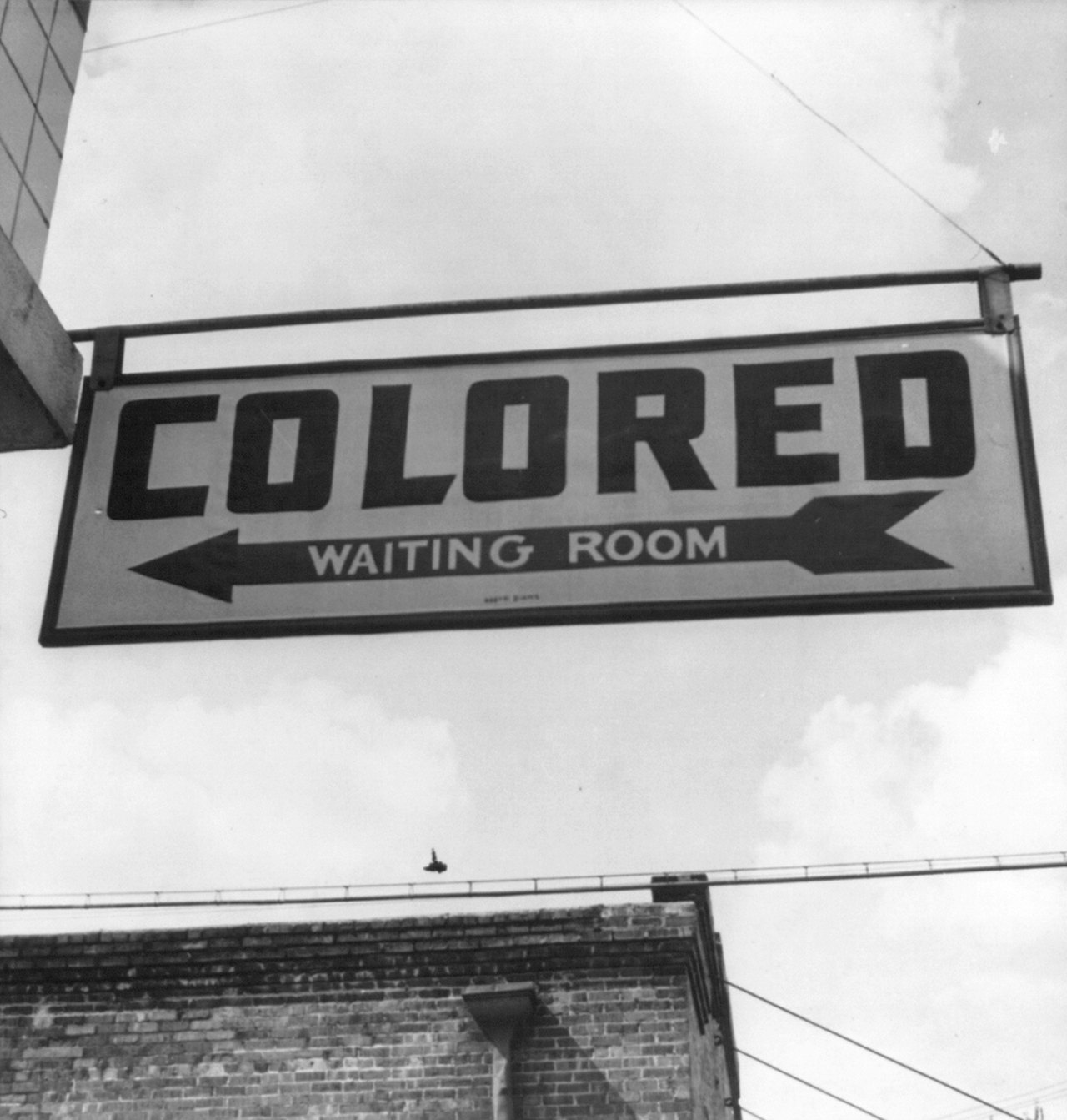
As Bud sets out to travel alone across 1936 Michigan, remember what that meant for a Black child. This was the era of Jim Crow — a web of laws and customs, strongest in the South but present across the whole country, that kept Black and white Americans apart and unequal. Segregated schools, separate waiting rooms, whites-only hotels and restaurants, and the daily danger of being a Black stranger in an unfamiliar town were all facts of life. A white boy hopping a train or walking a highway ran real risks; a Black boy like Bud ran far greater ones. Curtis writes Bud’s adventure with warmth and humor, but the danger under it is real: every stranger Bud meets, every town he passes through, must be measured against the color line. Hold that beside the tone of the book. The humor is not a softening. It is how Bud gets through.
Visual AidThe rule written on a sign
A station sign photographed for a federal agency in 1943. The Knowledge Bank explains that Jim Crow was a web of laws and customs that kept Black and white Americans apart and unequal — separate schools, separate waiting rooms, whites-only hotels — and that it made ordinary travel dangerous for a Black child alone. Notice that the sign does not argue. It is painted, hung and bolted, which is what it means to say the rule was built into the buildings.
A segregated waiting room sign, 1943; Office of War Information photograph by Esther Bubley, Library of Congress. Source: Wikimedia Commons, public domain.
Think back over these chapters. A boy in a black shed stares up at a shape he is sure will bite his neck — and finds only paper and hornets, which sting him as he smashes his way out. Free, he does the un-obvious thing: he goes back, for his suitcase and for a little justice, leaving a sleeping bully to wake in a wet bed of his own supposed making. By morning he is at the library door, certain the kind woman there will take him in — and certain, a minute later, that she is gone for good. So when an old friend says the word ‘train,’ Bud, who has nowhere on earth to be, says yes.
Original passage written for Garden Heights — not a quotation from the novel.
1Claim: “Part 2 shows that Curtis uses humor to keep Bud from being merely a victim.” — choose the two details that best prove it.Claim & Evidence
2Told as tragedy, or Told as comedy (Curtis’s way)? Tap each detail to sort it — tap again to switch sides. You can keep tapping to change your answer.Sort into two
◄ Told as tragedyTold as comedy (Curtis’s way) ►
3Match each cause to its result. For each cause, pick its result.Cause & Effect
The ‘bat’ is only a hornets’ nest→
Bud pranks the sleeping Todd→
Miss Hill has moved away→
Bud agrees to ride the rails→
🧠Knowledge Bank question
4Fill both blanks to complete the reasoning.Build the Argument
The Knowledge Bank argues that the road is more dangerous for Bud than for a white boy because , which shows that .
Part 5
Standardized Test
Reading passage · The Color Line: Jim Crow America · SAT & TOEFL-style practice
Read the passage — the highlighted words are tested — then answer. Tap an answer, then tap it again to confirm.
SATCentral Ideas — the passage's main point
SATDetail — a fact stated in the passage
SATWords in Context — a word's meaning in this passage
TOEFLFactual Information — a fact stated in the passage
TOEFLVocabulary — a tested word's meaning here
TOEFLInference — what the passage implies
TOEFLProse Summary — the three sentences that sum it up
TOEFLRhetorical Purpose — why the author included a detail
Traveling Under Jim Crow Laws
Bud travels alone across Michigan in 1936, and to understand the danger in that, you have to understand Jim Crow. ‘Jim Crow’ is the name for the system of laws and customs that kept Black and white Americans separate and unequal from the end of slavery well into the twentieth century. It was harshest in the Southern states, where laws forced Black people into separate schools, separate railroad cars, separate drinking fountains, and the backs of buses. But segregation was not only Southern. Across the North and Midwest — including Michigan — unwritten rules and open prejudice kept Black families out of many neighborhoods, hotels, restaurants, and jobs.
For a Black traveler, this made the ordinary business of moving through the country risky. A hotel might refuse a room; a diner might refuse a meal; a strange town after dark could be genuinely dangerous. Black motorists even carried a special guidebook, later famous as the ‘Green Book,’ that listed the few places where they would be served and safe. A white child hopping a freight train or walking a highway in 1936 faced hardship; a Black child like Bud faced that hardship compounded by the constant threat of the color line. Curtis fills Bud’s journey with humor and kindness, but the danger beneath it is real history. It is why every stranger Bud meets must be carefully weighed, why that road takes real courage, and why the genuine kindness he does receive shines so brightly against so hard a background.
Original passage written for Garden Heights — not a quotation from the novel.
1What does the passage mainly explain?SAT · Central Ideas
2‘Jim Crow’ refers to a system that kept Black and white Americans ___.TOEFL · Factual Information
3According to the passage, Jim Crow was harshest in the ___.SAT · Detail
4The passage says segregation in the North was often enforced by ___.TOEFL · Factual Information
5The ‘Green Book’ listed places where Black travelers would be ___.SAT · Detail
6In the passage, a freight train carries ___.SAT · Words in Context
7In the passage, courage most nearly means ___.TOEFL · Vocabulary
8The passage says the kindness Bud receives shines because it stands against ___.TOEFL · Inference
9Prose Summary (TOEFL).The passage explains the Jim Crow color line and why it made Bud’s journey dangerous. This TOEFL task lists six sentences; choose the THREE that best capture the passage’s main ideas. The other three do not belong — they state minor details or ideas the passage does not present.TOEFL · Prose Summary
10Why does this passage matter for Part 2?TOEFL · Rhetorical Purpose
Part 6 · Optional
Creative Writing
A bonus challenge to practice your English. Take your time and have fun with it.
About This Section
This writing task is optional and is not part of your auto-graded score. The feedback below checks only the basics — length, spelling, and grammar — not whether your ideas are right or wrong. It is meant for classroom discussion and creative practice, so feel free to use your imagination!
Writing Task — Part 2 “Turning Fear Into a Laugh”
Bud faces a terrifying ‘bat’ that turns out to be a hornets’ nest, and the scary night becomes almost funny. Write about a time something you feared turned out to be less scary than you imagined — or a hard moment you can now laugh about. What happened, and how did your feelings change? 6–10 sentences. End with what the experience taught you about fear.
You can start with: “At the time it felt terrifying, but looking back...”
0 / 40 words minimum
🗣 Teach It · Just for Fun (optional)
No right or wrong — close the screen and tell someone nearby what happened in this part. Can’t find anyone? Tell yourself out loud. The moment you teach it, you truly understand it.
Part 2 Complete!
You finished Chapters 3–4 of Bud, Not Buddy.
Here are your auto-graded results:
-
points out of 100
Teach it to someone
The best last step is to teach it. In your own words, explain what happened — retell a favorite scene, teach a character’s big choice, or sum up the main idea for a parent, friend, or classmate. When you can teach it clearly, you truly own it.
Independent study guide by Garden Heights. Not affiliated with or endorsed by Christopher Paul Curtis. Contains original analysis only; no text from the novel is reproduced. Reference text: This workbook follows Christopher Paul Curtis’s classic text (the standard Puffin edition sold worldwide). Revised 2023 UK editions change some wording and may not match the vocabulary studied here.
SAT® is a registered trademark of College Board, which is not affiliated with, and does not endorse, these materials. TOEFL® is a registered trademark of ETS. These materials are not endorsed or approved by ETS. Garden Heights is an independent provider of test-style reading practice.