
Part 4
Before dawn the westbound train finally comes, and the whole Hooverville rushes the tracks — but so do the railroad police, swinging clubs and firing a warning shot to keep the desperate crowd off the cars. In the chaos Bugs manages to leap onto a moving boxcar and reaches back for Bud, but Bud, weighed down and a step too slow, cannot make it and is left standing in the dust as his friend rolls away west. Alone once more, Bud does the only thing he knows: he returns to the library, the one place that has ever felt safe, and sleeps beneath a tree with his suitcase for a pillow. There, thinking it all through, he seizes on an idea that hardens into a plan. His mother kept those flyers of the bandleader Herman E. Calloway for a reason — and to Bud, the only reason that makes sense is that Calloway must be his father. Grand Rapids, where Calloway plays, is more than a hundred miles (160.9 km) away, but Bud has walked out of worse. He sets off on foot in the cool of the night, following the road out of Flint, certain that at the end of it he will finally find his family.
| Section | What you will practice |
|---|---|
| Vocabulary | Road words: desperate, boxcar, determined, flyer, abandon… |
| Literary Elements | A near miss, a leap of logic, and a hero’s quest begins |
| Cross-Curricular | Riding the rails: Depression America on the move |
| Ch. | What happens |
|---|---|
| Chapter 7 | The Train Leaves Without Him — police charge the crowd as the train comes; Bugs leaps aboard and reaches for Bud, but Bud is left behind in the dust. |
| Chapter 8 | The Plan — alone again, Bud decides Herman E. Calloway must be his father and sets off on foot to walk over a hundred miles (160.9 km) to Grand Rapids. |
Four words, and two of them belong to a crowd while two belong to one boy. Desperate means driven by great need or fear, and it describes the crowd that rushes the train. A boxcar is an enclosed railroad freight car, and Bugs leaps into an open one. Determined means firmly decided, not giving up, and it is Bud’s word — he is going to reach Grand Rapids whether or not the train cooperates. A flyer is a printed sheet advertising something, and Momma kept one of a band, which is the only reason Bud has a destination at all. Notice the difference between the first word and the third. Desperation has no direction; determination does. The crowd runs from something. Bud is the only person at that train yard running toward.
ⓘ The vocabulary words in this list are selected to help you understand and complete this workbook. Some may not appear verbatim in the original novel.
Left Behind, Then Onward is organized around a difficult decision, the risk it creates, and the eventual result. Before dawn the westbound train finally comes, and the whole Hooverville rushes the tracks — but so do the railroad police, swinging clubs and firing a warning shot to keep the desperate crowd off the cars. In the chaos Bugs manages to leap onto a moving boxcar and reaches back for Bud, but Bud, weighed down and a step too slow, cannot make it and is left standing in the dust as his friend rolls away west. Alone once more, Bud does the only thing he knows: he returns to the library, the one place that has ever felt safe, and sleeps beneath a tree with his suitcase for a pillow. Once decision and result are joined, “Left Behind, Then Onward” supplies narrative momentum.
- Police charge the crowd rushing the tracks.
- Bud sleeps under the library tree.
- Bud decides to walk to Grand Rapids to find Calloway.
- Bugs leaps aboard; Bud is left behind.
- The westbound train arrives at dawn.
Christopher Paul Curtis makes the midpoint turn through quest, irony, and point rather than through explanation alone. Part 4 turns Bud’s story into a quest — a journey toward a goal that will test and change the hero. Missing the train is the hinge: it closes off the aimless drifting of ‘riding the rails’ and opens a purposeful road toward one destination, Grand Rapids, and one goal, a father. From here the book has a spine: every person Bud meets, every mile he walks, measures him against that goal. Notice that Bud’s quest rests on a guess — that Calloway is his father — that may be wrong. Curtis is setting up the difference between what Bud is looking for and what he will actually find, which is where the story’s power will come from. That authorial design makes “The Quest Begins” a lesson in deliberate symbolism.
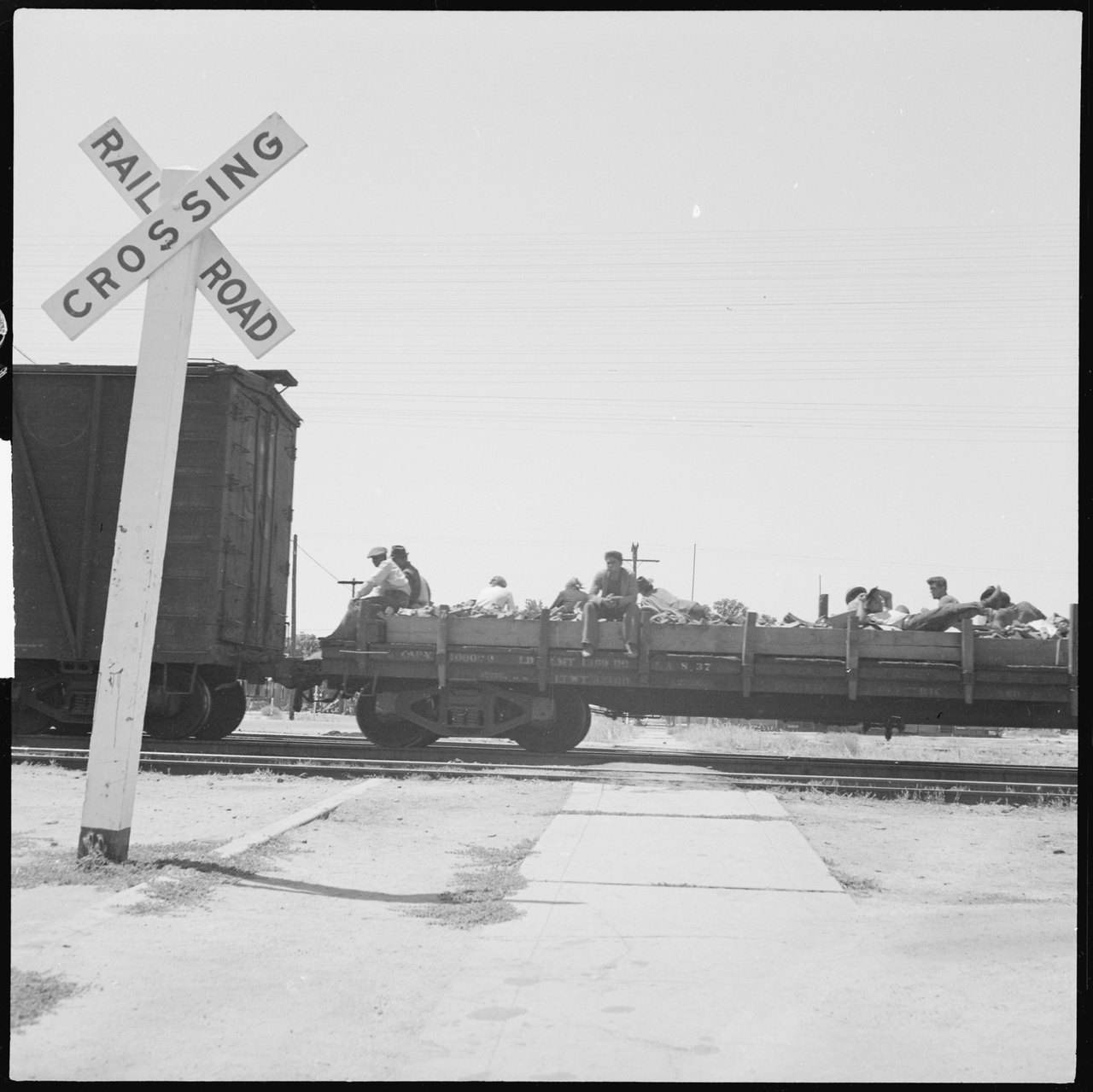
The frightening scene at the train yard captures a real Depression phenomenon. With jobs gone, an estimated quarter of a million young people — some as young as Bud — left home and rode the rails, hopping empty freight cars in search of work or simply of somewhere better. It was illegal and dangerous. Railroad guards, nicknamed ‘bulls,’ patrolled the yards and could beat riders, throw them from moving trains, or have them jailed. Thousands were injured or killed falling under the wheels. Yet so many risked it that a whole rough culture grew up around the rails, with its own slang, signs, and hobo camps. Put Bud’s age against that number for a moment. A quarter of a million young people on the rails means the boy in this novel was not unusual, only unusually well written — and it is why the near-miss at the yard is played for real fear rather than adventure.
Think back over these chapters. In the gray before dawn a whole camp throws itself at a moving train while men with clubs and a gun drive them back; a boy leans out of a boxcar, hand open, and another boy runs and runs and cannot quite reach it, and then the train is gone and Bugs with it. Left in the settling dust, Bud does not sit down and quit. He walks back to the one safe place he knows, sleeps under its tree, and turns a stack of old flyers over in his mind until they add up, in his heart, to a single word: father. By dark he is on the road out of town, a hundred miles (160.9 km) of hope ahead of him.
The terrifying scramble at the train yard was a real part of Depression life. When the economy collapsed and jobs vanished, an astonishing number of Americans — by some estimates a quarter of a million of them young people, some no older than Bud — left home to ‘ride the rails.’ They sneaked aboard freight trains, hiding in empty boxcars or clinging to the frames beneath, and rode from town to town desperate for a rumor of work, or anything better than the hunger behind them. It was against the law and brutally hard: freezing nights, little food, and the constant need to hide.
The greatest danger was the railroad police, guards the riders nicknamed ‘bulls.’ Bulls patrolled the train yards and could club riders, arrest them, or throw them from moving cars; every year, many people were injured or killed falling beneath the wheels. And yet so many took the risk that an entire rough culture grew up along the rails, complete with its own slang and its camps at the edges of towns. Curtis stages Bud’s missed train so that a young reader can feel the truth of it: that boxcar offered a way out, but it could just as easily have offered a grave. When Bud is left behind, we ache for him — yet the road he takes instead, walking toward a hoped-for family, turns out to be the truer path. The rails are where the Depression sent its displaced; Bud’s resolve to walk toward someone is quietly different from riding away from everything.
“For every rider who found work, many more found only another cold, hungry town.”
This writing task is optional and is not part of your auto-graded score. The feedback below checks only the basics — length, spelling, and grammar — not whether your ideas are right or wrong. It is meant for classroom discussion and creative practice, so feel free to use your imagination!
Writing Task — Part 4 “Choosing a Direction”
After missing the train, Bud makes a bold choice: to walk over a hundred miles (160.9 km) toward a hoped-for family. Write about a time you made a bold or difficult decision to go after something you wanted. What did you decide, what made it hard, and what happened? 6–10 sentences. End with how the choice changed you.
No right or wrong — close the screen and tell someone nearby what happened in this part. Can’t find anyone? Tell yourself out loud. The moment you teach it, you truly understand it.

Part 4 Complete!
You finished Chapters 7–8 of Bud, Not Buddy.
Here are your auto-graded results:
The best last step is to teach it. In your own words, explain what happened — retell a favorite scene, teach a character’s big choice, or sum up the main idea for a parent, friend, or classmate. When you can teach it clearly, you truly own it.
Independent study guide by Garden Heights. Not affiliated with or endorsed by Christopher Paul Curtis. Contains original analysis only; no text from the novel is reproduced. Reference text: This workbook follows Christopher Paul Curtis’s classic text (the standard Puffin edition sold worldwide). Revised 2023 UK editions change some wording and may not match the vocabulary studied here.