New here? Just sign up with Google — your account includes Matilda, our gift book, forever.
Bud, Not Buddy · Garden Heights
Part 5
for Bud, Not Buddy · Part 5 · Chapters 9–10
8 Parts40 min
What Happens in Part 5
Deep in the night, walking the dark highway toward Grand Rapids, Bud is exhausted and afraid when a car slows beside him. The driver is Lefty Lewis, a kind, quick-talking Black man who is alarmed to find a young boy alone on the road after dark — he knows how dangerous that is for a Black child in 1936 — and insists on helping. Bud, wary of all grown-ups, climbs in but keeps his guard up. When he snoops in a box on the back seat and finds glass tubes of what is plainly labeled human blood, his imagination runs wild and he is briefly certain Lefty is a vampire carrying him off. Lefty, amused and patient, explains the truth: he is helping carry blood donations for a hospital drive, and he is a Pullman porter — one of the Black men who work the nation’s sleeping cars — who does quiet, risky work for the porters’ labor union on the side. Over food and easy talk, Lefty wins Bud’s trust, and it turns out he knows exactly who Herman E. Calloway is. He agrees to take Bud most of the way, first stopping at his daughter’s house in Grand Rapids. For the first time in a long while, Bud is riding toward his goal in the company of someone who means him nothing but good.
Comic misunderstanding, a helper on the quest, and growing trust
Cross-Curricular
The Great Migration: Black families moving north
Chapter Summary
Ch.
What happens
Chapter 9
A Ride in the Dark — Lefty Lewis finds Bud alone on the night road and helps him; Bud panics over a box of blood, sure Lefty is a vampire, until Lefty explains.
Chapter 10
Winning Trust — Lefty, a Pullman porter and union man, feeds Bud, gains his trust, and — knowing Herman E. Calloway — agrees to drive him toward Grand Rapids.
Part 1
Vocabulary
Study 10 key words from Chapters 9–10, then answer each question.
🧠Knowledge Bank · Words of the Road North
Lexical Semantics · Words of the Road North
Four words, and the last two turn out to be about the same man. Suspicious means distrustful, sensing something is wrong, and Bud is suspicious of every grown-up he meets, with cause. A porter is a worker who serves travelers on a train, and Lefty Lewis is a Pullman porter. A donation is something given to help others, and the box in Lefty’s car holds blood for a hospital — not, as Bud concludes, the tools of a vampire. A union is a group of workers organized for their rights, and the porters had formed one. Notice how much of Part 5 depends on Bud guessing wrong. He reads a kind man as a monster, because suspicion has kept him alive so far and there is no safe moment to put it down.
suspiciousadj.Ch.9
Distrustful; sensing something is wrong
“Bud was suspicious of every grown-up.”
portern.Ch.10
A worker who serves travelers on a train
“Lefty was a Pullman porter.”
donationn.Ch.9
Something given to help others
“The blood was a donation for a hospital.”
unionn.Ch.10
A group of workers organized for their rights
“The porters had formed a labor union.”
gratituden.Ch.10
Thankfulness
“Bud felt gratitude for the ride and the meal.”
imaginationn.Ch.9
The power to form pictures in the mind
“His imagination turned Lefty into a vampire.”
patientadj.Ch.9
Calm and not easily upset
“Lefty was patient with the frightened boy.”
trustv.Ch.10
To believe in someone’s good intentions
“Slowly, Bud began to trust Lefty.”
waryadj.Ch.9
Cautious and watchful
“He stayed wary in the stranger’s car.”
reliefn.Ch.9
The easing of fear or worry
“It was a relief to learn the truth.”
ⓘ The vocabulary words in this list are selected to help you understand and complete this workbook. Some may not appear verbatim in the original novel.
🧠Knowledge Bank question
1According to the Knowledge Bank, why does Bud read a kind man as a monster?Ch.10
2To be ‘suspicious’ is to trust everyone at once.Ch.9
3A group of workers organized for their rights is a ___.Ch.10
4A ‘donation’ is something given to help others.Ch.9
5Fill in each blank with the correct word.Ch.10
Word choices:porteruniondonationsneer- some words will not be used
Lefty worked as a Pullman .
The porters had formed a labor .
6‘Imagination’ is the power to form ___ in the mind.Ch.9
7Someone ‘patient’ is calm and not easily upset.Ch.9
8To be ‘wary’ is to be ___.Ch.9
9Fill in each blank with the correct word.Ch.9
Word choices:reliefgratitudesuspiciousunion- some words will not be used
It was a to learn the blood was harmless.
Bud felt for the ride and the meal.
10To ‘trust’ someone is to believe in their ___.Ch.10
Part 2
Comprehension
Show you understood what happens in Chapters 9–10.
🧠Knowledge Bank · A Stranger Who Helps
Narrative Causality · A Stranger Who Helps
Part 5 raises a specific threat, answers it through character action, and leaves an altered aftermath. Deep in the night, walking the dark highway toward Grand Rapids, Bud is exhausted and afraid when a car slows beside him. The driver is Lefty Lewis, a kind, quick-talking Black man who is alarmed to find a young boy alone on the road after dark — he knows how dangerous that is for a Black child in 1936 — and insists on helping. Bud, wary of all grown-ups, climbs in but keeps his guard up. When he snoops in a box on the back seat and finds glass tubes of what is plainly labeled human blood, his imagination runs wild and he is briefly certain Lefty is a vampire carrying him off. That progression explains how “A Stranger Who Helps” produces lasting consequence.
Visual AidA hundred miles on foot
Scale drawing for the Knowledge Bank on the night Lefty Lewis finds Bud. Bar 1 is the road to Grand Rapids and the teal sliver on it, card 2, is one whole hour of walking — look at the two together. The bar is straight where the real road bends, so it measures distance rather than mapping a route, and the novel never says how far Bud had got before the car stopped. Card 4 is the consequence: he was never going to finish this on his own.
The road from Flint to Grand Rapids, measured against an hour of walking. Drawn for Garden Heights Academy.
🧠Knowledge Bank question
1The Knowledge Bank explains that the box on the back seat holds ___.Ch.9
2In the car, Bud is frightened by a box holding ___.Ch.9
3Lefty really is a vampire.Ch.9
4Lefty explains that he works as a ___.Ch.10
5Write the numbers 1–5 in the boxes to show the correct order of events. Number 1 = what happens first.Chapters 9–10
Lefty gains Bud’s trust and drives him toward Grand Rapids.
Bud walks the dark highway, exhausted.
Lefty explains the blood and his porter work.
Lefty Lewis stops his car to help.
Bud finds the box of blood and panics.
6Bud trusts Lefty instantly and completely.Ch.9
7Bud’s suspicion of grown-ups comes from ___.Ch.9
8It matters to Bud’s quest that Lefty ___.Ch.10
9Lefty refuses to take Bud any closer to Grand Rapids.Ch.10
10By the end of Part 5, Bud is traveling with ___.Ch.10
Part 3
Literary Elements
Understanding HOW and WHY Christopher Paul Curtis tells the story across Chapters 9–10.
🧠Knowledge Bank · The Vampire That Wasn’t
Narrative Technique · The Vampire That Wasn’t
Part 5 layers misunderstanding, helper, and irony so that an ordinary detail carries later significance. The blood-box scene is a perfect example of Curtis’s method: a genuinely frightening idea (a stranger driving a child into the dark) is defused by comedy (Bud’s certainty that Lefty is a vampire). The humor comes from dramatic irony — the reader can guess the blood is harmless while Bud panics — and from Bud’s wonderful, overactive imagination. But notice the scene also builds character: Bud’s suspicion is not silly, it is survival, the reflex of a child who has learned that grown-ups can hurt you. Lefty’s patient, laughing response is what begins to teach Bud that some adults can be trusted after all. That authorial design makes “The Vampire That Wasn’t” a lesson in deliberate irony.
Visual AidOne box, two readings
Diagram for the Knowledge Bank on the vampire scene. Card 1 is the object itself, cards 2 and 3 are the two readings of it, and card 4 names where the comedy lives. Card 5 is the part that is not funny. Notice that Bud is not being foolish; he is applying a rule that has kept him safe, to the first adult in the book who does not deserve it.
The blood-box scene read two ways at once, as described in the Knowledge Bank. Drawn for Garden Heights Academy.
Comic misunderstanding
Bud’s certainty that Lefty is a vampire — a scary idea turned into a joke.
The helper
Lefty Lewis — the wise, kind ally who guides the hero along the quest.
Dramatic irony
The reader guesses the blood is harmless while Bud panics — knowing more than he does.
🧠Knowledge Bank question
1According to the Knowledge Bank, where does the humor of the blood-box scene come from?Ch.9
2Fill in each blank with the correct literary term.Ch.9
Word choices:comic misunderstandinghelpersettingrhyme- some words will not be used
Bud thinking Lefty is a vampire is a .
Lefty, the kind ally who guides Bud, is the .
3In many quests, a ‘helper’ guides or aids the hero.Ch.10
4The reader guessing the blood is harmless while Bud panics is ___.Ch.9
5Bud’s suspicion in the car mainly shows that his fear is ___.Ch.9
6A helper in a story always works against the hero.Ch.10
7Lefty’s patient laughter begins to teach Bud that some adults are ___.Ch.9
8Fill in each blank with the correct literary term.Ch.9
Word choices:dramatic ironyhelpernarratormotif- some words will not be used
The reader knowing more than Bud about the blood is .
Lefty, the ally who guides the hero, is the .
9Curtis’s humor and his heart often do the same work in a scene.Ch.9
10The clearest sign Lefty is the story’s helper is that he ___.Ch.10
Part 4
Think Deeper
Four deeper challenges — no single-word recall. Read, weigh the evidence, and reason it out.
🧠Knowledge Bank · The Great Migration
Moving North · The Great Migration
Bud’s whole world — a Black family in Flint, Grand Rapids clubs, a porter driving between cities — exists because of the Great Migration. Beginning around 1916 and continuing for decades, roughly six million Black Americans left the rural South, with its brutal Jim Crow laws and failing farm work, and moved to cities in the North and Midwest, including Michigan’s Flint, Detroit, and Grand Rapids. They came seeking factory jobs, safer lives, and a measure of freedom. The Depression hit these newcomers hard — they were often ‘last hired, first fired’ — but the communities they built endured: churches, businesses, and the musicians and workers who fill Bud’s story. That is worth stating plainly, because the novel never does. Nobody in it explains why there is a Black band in Grand Rapids or a Black porter driving between cities. Curtis assumes the migration the way a book set in London assumes the Thames.
Visual AidThe road north
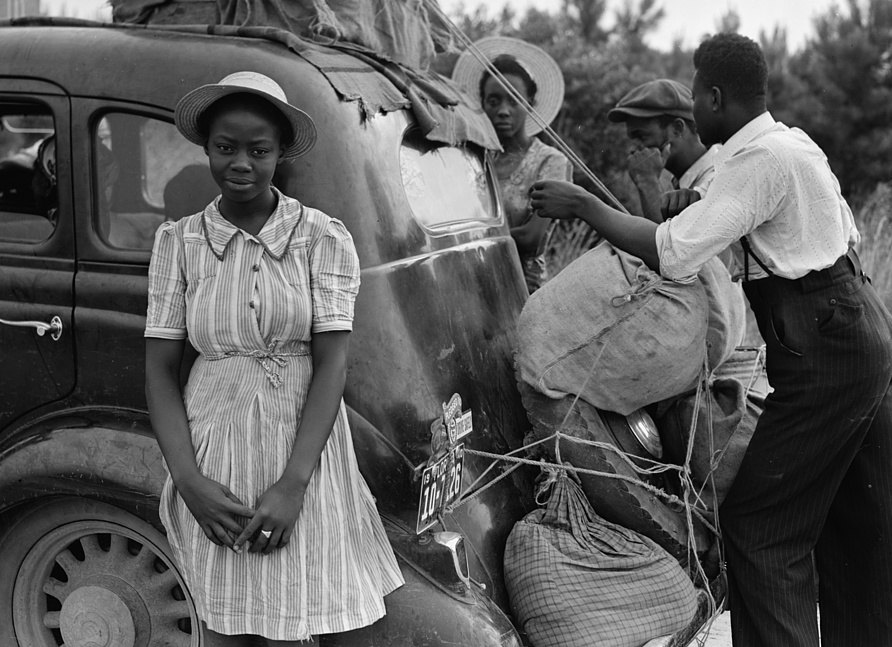
A family loading a car for the journey north in 1940. The Knowledge Bank explains that roughly six million Black Americans left the rural South between about 1916 and the 1960s for cities in the North and Midwest — among them Flint, Detroit and Grand Rapids, where Bud lives and travels. Look at how the bundles are tied on. Everything the family owns is going with them, which is the part of a migration a statistic cannot show.
A family setting out from Florida for New Jersey, 1940; Farm Security Administration photograph by Jack Delano, Library of Congress. Source: Wikimedia Commons, public domain.
Think back over these chapters. A small boy trudges a black highway in the middle of the night, and headlights swing up behind him — the exact thing every rule he owns says to fear. A quick-talking man will not leave him out there, bundles him into the car, and Bud, watchful as a cat, pokes into a box and finds tubes of blood and decides, with perfect ten-year-old certainty, that he has been kidnapped by a vampire. The man just laughs, explains the hospital drive and his life on the sleeping cars, shares his food — and somewhere in the miles between, a boy who trusts no grown-up starts, against his own rules, to trust this one.
Original passage written for Garden Heights — not a quotation from the novel.
1Claim: “Part 5 shows Curtis using humor to do serious work: teaching Bud that some adults can be trusted.” — choose the two details that best prove it.Claim & Evidence
2Bud’s fear (the joke’s surface), or The trust being built (the heart)? Tap each detail to sort it — tap again to switch sides. You can keep tapping to change your answer.Sort into two
◄ Bud’s fear (the joke’s surface)The trust being built (the heart) ►
3Match each cause to its result. For each cause, pick its result.Cause & Effect
Bud walks the night road→
Bud panics over the blood→
Lefty explains and laughs→
Lefty knows Calloway→
🧠Knowledge Bank question
4Fill both blanks to complete the reasoning.Build the Argument
The Knowledge Bank argues that Bud's Black community exists in Michigan because , which shows that .
Part 5
Standardized Test
Reading passage · The Great Migration · SAT & TOEFL-style practice
Read the passage — the highlighted words are tested — then answer. Tap an answer, then tap it again to confirm.
SATCentral Ideas — the passage's main point
SATDetail — a fact stated in the passage
SATWords in Context — a word's meaning in this passage
TOEFLFactual Information — a fact stated in the passage
TOEFLVocabulary — a tested word's meaning here
TOEFLRhetorical Purpose — why the author included a detail
The Great Migration North
Bud’s journey takes place on the map drawn by the Great Migration, one of the largest movements of people in American history. Beginning around 1916 and continuing for more than half a century, roughly six million Black Americans left the rural South and moved to cities in the North, Midwest, and West. They were fleeing the harsh Jim Crow laws, the violence, and the collapsing farm economy of the South, and they were drawn by the promise of factory jobs, better schools, and greater freedom. Michigan cities such as Flint, Detroit, and Grand Rapids — where Bud lives and travels — grew rapidly as Black families arrived to work in the booming auto plants.
Life in the North was better in important ways, but it was far from easy. Newcomers met their own kinds of prejudice: segregated neighborhoods, limited jobs, and, when the Depression struck, the cruel pattern of being ‘last hired, first fired.’ Still, the families of the Great Migration built lasting communities — churches, businesses, newspapers, and a rich musical culture that would give America blues, jazz, and much more. Both of the men who help Bud find his way are products of this migration: Lefty Lewis, a porter shuttling between northern cities, and Herman E. Calloway, a bandleader earning a living in Grand Rapids. Understanding the Great Migration is understanding why Bud’s Black community exists where it does — and why a boy in Michigan in 1936 might be only a generation removed from the rural South.
Original passage written for Garden Heights — not a quotation from the novel.
1What does the passage mainly explain?SAT · Central Ideas
2About how many Black Americans took part in the Great Migration?TOEFL · Factual Information
3They were fleeing the South’s Jim Crow laws, violence, and ___.SAT · Detail
4They were drawn north by the promise of ___.TOEFL · Factual Information
5Michigan cities grew as Black families came to work in the ___.SAT · Detail
6The phrase ‘last hired, first fired’ describes how Black workers were treated ___.SAT · Words in Context
7Despite prejudice, the migrants built lasting ___.TOEFL · Factual Information
8The passage names both Lefty and Calloway as products of the ___.SAT · Detail
9In the passage, a porter is a worker who ___.TOEFL · Vocabulary
10Why does this passage matter for Part 5?TOEFL · Rhetorical Purpose
Part 6 · Optional
Creative Writing
A bonus challenge to practice your English. Take your time and have fun with it.
About This Section
This writing task is optional and is not part of your auto-graded score. The feedback below checks only the basics — length, spelling, and grammar — not whether your ideas are right or wrong. It is meant for classroom discussion and creative practice, so feel free to use your imagination!
Writing Task — Part 5 “Learning to Trust”
Bud, who trusts no adults, slowly comes to trust Lefty Lewis. Write about a time you were unsure about someone but came to trust them — or a time someone earned your trust. What made you cautious, and what changed your mind? 6–10 sentences. End with what you learned about giving people a chance.
You can start with: “At first I kept my guard up, but little by little...”
0 / 40 words minimum
🗣 Teach It · Just for Fun (optional)
No right or wrong — close the screen and tell someone nearby what happened in this part. Can’t find anyone? Tell yourself out loud. The moment you teach it, you truly understand it.
Part 5 Complete!
You finished Chapters 9–10 of Bud, Not Buddy.
Here are your auto-graded results:
-
points out of 100
Teach it to someone
The best last step is to teach it. In your own words, explain what happened — retell a favorite scene, teach a character’s big choice, or sum up the main idea for a parent, friend, or classmate. When you can teach it clearly, you truly own it.
Independent study guide by Garden Heights. Not affiliated with or endorsed by Christopher Paul Curtis. Contains original analysis only; no text from the novel is reproduced. Reference text: This workbook follows Christopher Paul Curtis’s classic text (the standard Puffin edition sold worldwide). Revised 2023 UK editions change some wording and may not match the vocabulary studied here.
SAT® is a registered trademark of College Board, which is not affiliated with, and does not endorse, these materials. TOEFL® is a registered trademark of ETS. These materials are not endorsed or approved by ETS. Garden Heights is an independent provider of test-style reading practice.