New here? Just sign up with Google — your account includes Matilda, our gift book, forever.
Bud, Not Buddy · Garden Heights
Part 6
for Bud, Not Buddy · Part 6 · Chapters 11–12
8 Parts40 min
What Happens in Part 6
Lefty Lewis brings Bud home to his daughter’s house in Grand Rapids, where Mrs. Sleet and her children welcome the exhausted, half-starved boy with a huge, warm breakfast and the ordinary kindness of a real household — something Bud has not felt in years. Fed and rested, Bud is at last driven to the Log Cabin, the club where the famous band plays, and comes face to face with the man from the flyers: Herman E. Calloway, older and heavier than Bud imagined, and anything but welcoming. When Bud blurts out that Calloway is his father, the old man reacts with suspicion and irritation, sure the boy is running some kind of scam. But the rest of the band is another story. The musicians — among them the friendly sax player Steady Eddie — and especially the warm singer, Miss Thomas, take one look at the small, determined boy and decide he needs looking after. They feed him, tease him kindly, and fold him into their circle, even as Calloway keeps his gruff distance. Bud has finally reached the person he crossed the state to find — and discovered that the reunion he dreamed of is nothing like he imagined, and that this strange, musical, generous group of grown-ups may matter more than he expected.
An anticlimax, a warm foil to a cold man, and a reunion that surprises
Cross-Curricular
The Pullman porters and the first great Black labor union
Chapter Summary
Ch.
What happens
Chapter 11
A Real Breakfast — Lefty brings Bud to Mrs. Sleet’s house, where a warm family and a huge meal give the starved boy the ordinary care he has long missed.
Chapter 12
Meeting Calloway — at the Log Cabin, Bud finally meets gruff Herman E. Calloway, who suspects a scam; but the band, and warm Miss Thomas, take the boy in.
Part 1
Vocabulary
Study 10 key words from Chapters 11–12, then answer each question.
🧠Knowledge Bank · Words of the Bandstand
Lexical Semantics · Words of the Bandstand
Four words, and two of them collide in the same room. A welcome is a warm greeting for a guest, and the Sleets give Bud a real one — the first he has had from strangers in the whole book. A bandleader is the person who directs a band, and Herman E. Calloway is one. Suspicion is a feeling that something is wrong, and it is what Calloway meets Bud with, cold and immediate. A musician is a person who plays music, and each one in this band plays a different part. Notice that Bud arrives expecting the bandleader and gets the band. Every member of it takes him in, feeds him, names him — and the one man he came all this way for is the only person in the room who will not look.
welcomen.Ch.11
A warm greeting for a guest
“The Sleets gave Bud a real welcome.”
bandleadern.Ch.12
The person who directs a band
“Herman E. Calloway was the bandleader.”
suspicionn.Ch.12
A feeling that something is wrong
“Calloway met Bud with cold suspicion.”
musiciann.Ch.12
A person who plays music
“Each musician played a different part.”
gruffadj.Ch.12
Rough and unfriendly in manner
“The old man’s voice was gruff.”
reunionn.Ch.12
A coming together after being apart
“The reunion was nothing like Bud’s dream.”
nourishv.Ch.11
To feed and help grow
“The big meal would nourish the tired boy.”
exhaustedadj.Ch.11
Completely worn out
“Bud arrived exhausted and hungry.”
scamn.Ch.12
A dishonest scheme to trick someone
“Calloway feared the boy was running a scam.”
foldv.Ch.12
To take in as part of a group
“The band began to fold Bud into their circle.”
ⓘ The vocabulary words in this list are selected to help you understand and complete this workbook. Some may not appear verbatim in the original novel.
🧠Knowledge Bank question
1According to the Knowledge Bank, what does Bud get instead of the bandleader he came for?Ch.11
2A ‘bandleader’ is someone who directs a band.Ch.12
3A feeling that something is wrong is ___.Ch.12
4Someone ‘gruff’ is warm and friendly.Ch.12
5Fill in each blank with the correct word.Ch.12
Word choices:bandleadersuspicionwelcomesneer- some words will not be used
Herman E. Calloway was the band’s .
He met the boy with cold .
6A ‘scam’ is a dishonest scheme to ___ someone.Ch.12
7To ‘nourish’ someone is to feed and help them grow.Ch.11
8Someone ‘exhausted’ is ___.Ch.11
9Fill in each blank with the correct word.Ch.12
Word choices:reunionfoldgruffwelcome- some words will not be used
The was nothing like Bud’s dream.
The band began to Bud into their circle.
10A ‘musician’ is a person who ___.Ch.12
Part 2
Comprehension
Show you understood what happens in Chapters 11–12.
🧠Knowledge Bank · Meeting the Man
Narrative Causality · Meeting the Man
Careful sequence reading reveals the textual evidence, the structural pivot, and the resulting consequence in Chapters 11–12. Lefty Lewis brings Bud home to his daughter’s house in Grand Rapids, where Mrs. Sleet and her children welcome the exhausted, half-starved boy with a huge, warm breakfast and the ordinary kindness of a real household — something Bud has not felt in years. Fed and rested, Bud is at last driven to the Log Cabin, the club where the famous band plays, and comes face to face with the man from the flyers: Herman E. Calloway, older and heavier than Bud imagined, and anything but welcoming. When Bud blurts out that Calloway is his father, the old man reacts with suspicion and irritation, sure the boy is running some kind of scam. Reading evidence around the pivot turns “Meeting the Man” into meaningful convergence.
🧠Knowledge Bank question
1The Knowledge Bank explains that Calloway meets Bud's news with ___.Ch.11
2The man from the flyers, Herman E. Calloway, turns out to be ___.Ch.12
3Calloway happily accepts Bud as his son.Ch.12
4When Bud says Calloway is his father, Calloway reacts with ___.Ch.12
5Write the numbers 1–5 in the boxes to show the correct order of events. Number 1 = what happens first.Chapters 11–12
Bud meets the gruff Herman E. Calloway.
Bud is fed and rested by the warm family.
The band and Miss Thomas take Bud in.
Lefty brings Bud to Mrs. Sleet’s house.
Bud is driven to the Log Cabin club.
6The band treats Bud as coldly as Calloway does.Ch.12
7The band member who is especially warm to Bud is ___.Ch.12
8Bud’s long-imagined reunion turns out to be ___.Ch.12
9Bud crossed the state and finally reached Calloway.Ch.12
10By the end of Part 6, Bud senses that family here may be ___.Ch.12
Part 3
Literary Elements
Understanding HOW and WHY Christopher Paul Curtis tells the story across Chapters 11–12.
🧠Knowledge Bank · The Reunion That Isn’t
Narrative Technique · The Reunion That Isn’t
The pressure of Chapters 11–12 is crafted through anticlimax, foil, and expectation working in combination. Bud has walked a hundred miles (160.9 km) toward a single, glowing moment — meeting his father — and Curtis deliberately lets it fall flat. Calloway is not a loving father throwing open his arms; he is a suspicious old man who thinks Bud is a con. This is an anticlimax: the big scene we were promised arrives, and it deflates. But Curtis is not being cruel; he is being honest, and clever. The deflation forces the story’s real question to the surface — if Calloway is so wrong for the ‘father’ role, then who IS he to Bud? The gap between the dreamed reunion and the awkward real one is where the truth of Part 8 is hiding. That authorial design makes “The Reunion That Isn’t” a lesson in deliberate perspective.
Visual AidThe scene he walked all that way for
Diagram for the Knowledge Bank on the anticlimax. Card 1 is the meeting Bud has been carrying in his head and card 2 is the one Curtis actually writes, with card 3 showing where the warmth turns up instead. Card 4 says why the letdown is deliberate. Notice that the deflation is not cruelty; it is the question the last two parts will answer.
The reunion that deliberately falls flat, as described in the Knowledge Bank. Drawn for Garden Heights Academy.
Anticlimax
The long-awaited meeting with Calloway falls flat — the dreamed reunion deflates.
Foil
Warm Miss Thomas beside gruff Calloway — each makes the other stand out.
Reversal of expectation
Bud expected a loving father and finds a suspicious stranger instead.
🧠Knowledge Bank question
1According to the Knowledge Bank, what is an anticlimax?Ch.12
2Fill in each blank with the correct literary term.Ch.12
Word choices:anticlimaxfoilsettingrhyme- some words will not be used
The deflated reunion with Calloway is an .
Warm Miss Thomas beside gruff Calloway is a .
3An anticlimax is a big moment that deflates instead of soaring.Ch.12
4Miss Thomas and Calloway are foils because they ___.Ch.12
5Curtis lets the reunion deflate mainly to ___.Ch.12
6A foil is two characters whose contrast highlights them both.Ch.12
7Finding a suspicious stranger where he hoped for a father is a reversal of ___.Ch.12
8Fill in each blank with the correct literary term.Ch.12
Word choices:reversal of expectationanticlimaxnarratormotif- some words will not be used
Hoping for a father and finding a cold stranger is a .
The deflated big meeting is an .
9A perfect, happy reunion would have kept the book’s mystery going.Ch.12
10The band giving Bud warmth Calloway withholds points toward the theme that family can be ___.Ch.12
Part 4
Think Deeper
Four deeper challenges — no single-word recall. Read, weigh the evidence, and reason it out.
🧠Knowledge Bank · The Men of the Sleeping Cars
Pullman Porters & the First Black Union · The Men of the Sleeping Cars
Lefty Lewis’s job as a Pullman porter, glimpsed in Part 5, sits at the center of a proud chapter of American history. The Pullman Company ran the sleeping cars on the nation’s railroads, and it staffed them almost entirely with Black men, who made the beds, carried the bags, and served the passengers — for low wages, endless hours, and tips they were forced to depend on. Yet a porter’s job was steady and respected within Black communities, and porters, traveling everywhere, carried news, money, and even banned Black newspapers across the country. In 1925, led by A. Philip Randolph, they founded the Brotherhood of Sleeping Car Porters, which became the first Black-led union to win a contract with a major American company — a victory built on exactly that network of traveling porters, and one of the quiet engines of the movement Bud is living alongside. Lefty carries blood in his car and papers he does not explain, and Bud never asks.
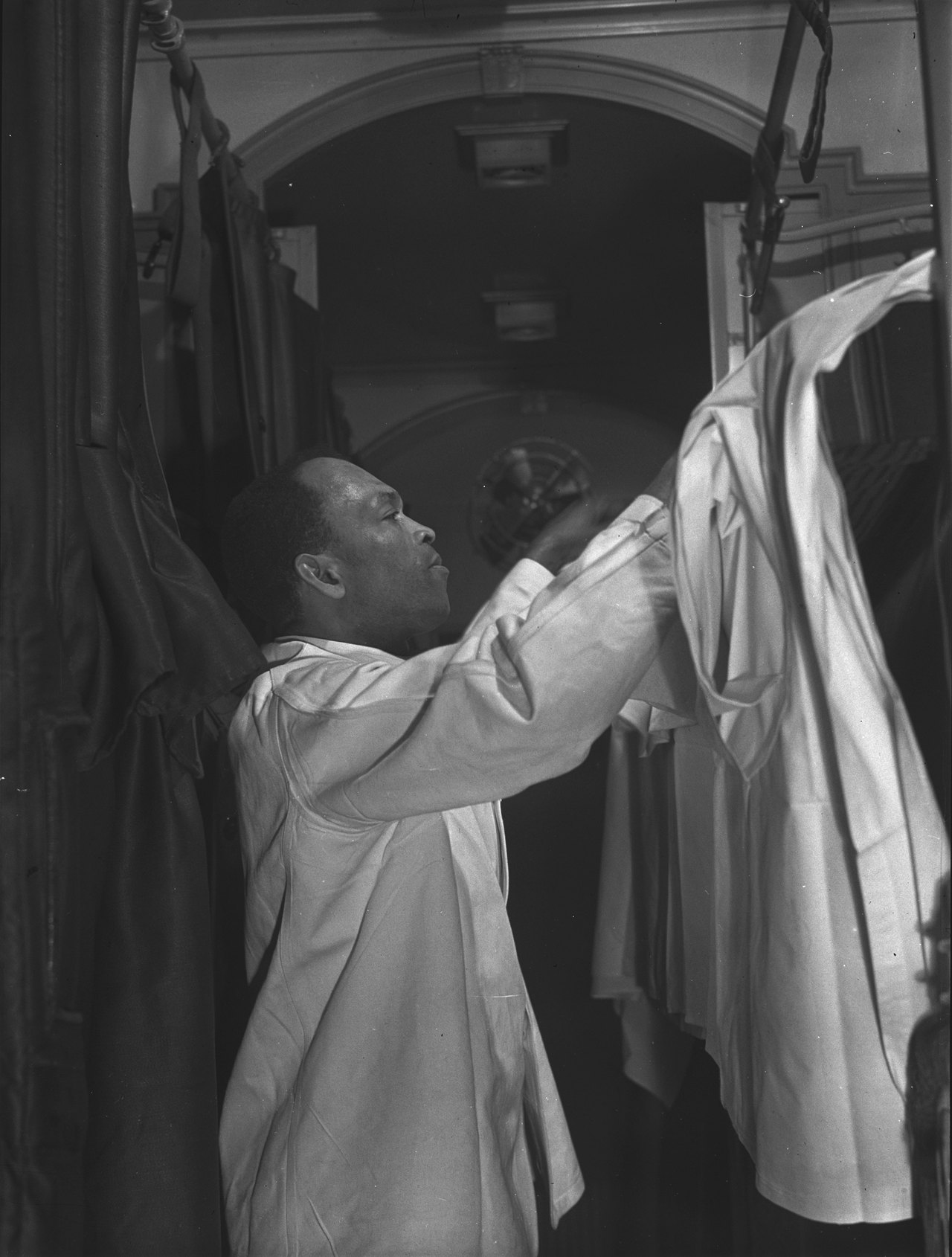
Visual AidThe men of the sleeping cars
A Pullman porter making up an upper berth on a train to Chicago. The Knowledge Bank explains that the Pullman Company staffed its sleeping cars almost entirely with Black men, for low wages and punishing hours, and that in 1925 the porters founded the Brotherhood of Sleeping Car Porters, the first Black-led union to win a contract with a major American company. Look at the aisle he is working in. Every bed on the train was made in that space, by hand, overnight.
A Pullman porter making up an upper berth, 1942; photograph by Jack Delano, Library of Congress. Source: Wikimedia Commons, public domain.
Think back over these chapters. A starved boy sits at a stranger’s table and is handed plate after plate by a family that treats him, for an hour, like one of their own. Then the moment he has walked a hundred miles (160.9 km) for: the man from the flyers, in the flesh — older, heavier, and looking at Bud not with love but with narrow-eyed suspicion, certain the boy wants something. Around that cold old man, though, a warm circle forms: musicians who tease and feed him, and a singer named Miss Thomas who takes one look and decides this child will be cared for. Bud has found who he was seeking, and found, too, that the finding is only the beginning of the mystery.
Original passage written for Garden Heights — not a quotation from the novel.
1Claim: “Part 6 deflates Bud’s reunion on purpose to keep the story’s real mystery alive.” — choose the two details that best prove it.Claim & Evidence
2The reunion Bud dreamed, or The reunion Bud got? Tap each detail to sort it — tap again to switch sides. You can keep tapping to change your answer.Sort into two
◄ The reunion Bud dreamedThe reunion Bud got ►
3Match each cause to its result. For each cause, pick its result.Cause & Effect
The Sleets feed and welcome Bud→
Calloway meets Bud with suspicion→
Miss Thomas takes Bud in→
Bud senses a wider family→
🧠Knowledge Bank question
4Fill both blanks to complete the reasoning.Build the Argument
The Knowledge Bank argues that Curtis made the kind stranger a porter on purpose because , which shows that .
Part 5
Standardized Test
Reading passage · The Pullman Porters & the First Black Union · SAT & TOEFL-style practice
Read the passage — the highlighted words are tested — then answer. Tap an answer, then tap it again to confirm.
SATCentral Ideas — the passage's main point
SATDetail — a fact stated in the passage
SATWords in Context — a word's meaning in this passage
TOEFLFactual Information — a fact stated in the passage
TOEFLProse Summary — the three sentences that sum it up
TOEFLRhetorical Purpose — why the author included a detail
Pullman Porters and Their Union
Lefty Lewis works as a Pullman porter, and behind that job lies a proud American story. In the decades around 1900, the Pullman Company ran the sleeping cars attached to passenger trains all across the country, and it hired Black men — many of them only a generation from slavery — to staff them. Porters made up the berths, carried luggage, shined shoes, and waited on travelers around the clock. The pay was low and the hours left men exhausted, and passengers often treated porters with little respect, even calling every one of them by the same name. Yet within Black communities the job was steady and respected, and porters, who traveled everywhere, became carriers of news, money, and ideas between distant cities.
Their greatest achievement was to organize: in 1925, under the leader A. Philip Randolph, the porters founded the Brotherhood of Sleeping Car Porters, the first major labor union led by Black Americans. The Pullman Company fought them fiercely, firing organizers and hiring spies, and it took twelve hard years before the union finally won a real contract in 1937. That victory improved thousands of porters’ lives and helped train a generation of leaders who would go on to shape the later civil rights movement. Curtis makes the kind stranger who rescues Bud a porter and quiet union man on purpose. It ties one boy’s small journey to a large, brave struggle for dignity — and reminds readers that the ordinary-seeming adults in Bud’s world were part of history being forged.
Original passage written for Garden Heights — not a quotation from the novel.
1What does the passage mainly explain?SAT · Central Ideas
2The Pullman Company staffed its sleeping cars with ___.TOEFL · Factual Information
3Porters’ pay and hours were ___.SAT · Detail
4Within Black communities, the porter’s job was ___.TOEFL · Factual Information
5Because they traveled everywhere, porters carried ___ between cities.SAT · Detail
6The porters’ union was founded in 1925 under the leader ___.TOEFL · Factual Information
7How long did it take the union to win a real contract?SAT · Detail
8In the passage, exhausted most nearly means ___.SAT · Words in Context
9Prose Summary (TOEFL).The passage explains the Pullman porters’ work and their historic union. This TOEFL task lists six sentences; choose the THREE that best capture the passage’s main ideas. The other three do not belong — they state minor details or ideas the passage does not present.TOEFL · Prose Summary
10Why does Curtis make Bud’s rescuer a porter?TOEFL · Rhetorical Purpose
Part 6 · Optional
Creative Writing
A bonus challenge to practice your English. Take your time and have fun with it.
About This Section
This writing task is optional and is not part of your auto-graded score. The feedback below checks only the basics — length, spelling, and grammar — not whether your ideas are right or wrong. It is meant for classroom discussion and creative practice, so feel free to use your imagination!
Writing Task — Part 6 “When Reality Surprises You”
Bud imagines meeting his father one way, and the reality is completely different. Write about a time something you looked forward to turned out very different from what you expected. What did you imagine, what really happened, and how did you feel? 6–10 sentences. End with what the surprise taught you.
You can start with: “I had pictured it so many times, but when it finally happened...”
0 / 40 words minimum
🗣 Teach It · Just for Fun (optional)
No right or wrong — close the screen and tell someone nearby what happened in this part. Can’t find anyone? Tell yourself out loud. The moment you teach it, you truly understand it.
Part 6 Complete!
You finished Chapters 11–12 of Bud, Not Buddy.
Here are your auto-graded results:
-
points out of 100
Teach it to someone
The best last step is to teach it. In your own words, explain what happened — retell a favorite scene, teach a character’s big choice, or sum up the main idea for a parent, friend, or classmate. When you can teach it clearly, you truly own it.
Independent study guide by Garden Heights. Not affiliated with or endorsed by Christopher Paul Curtis. Contains original analysis only; no text from the novel is reproduced. Reference text: This workbook follows Christopher Paul Curtis’s classic text (the standard Puffin edition sold worldwide). Revised 2023 UK editions change some wording and may not match the vocabulary studied here.
SAT® is a registered trademark of College Board, which is not affiliated with, and does not endorse, these materials. TOEFL® is a registered trademark of ETS. These materials are not endorsed or approved by ETS. Garden Heights is an independent provider of test-style reading practice.