New here? Just sign up with Google — your account includes Matilda, our gift book, forever.
Chains · Garden Heights
Part 2
for Chains · Part 2 · Chapters 7–12
8 Parts40 min
What Happens in Part 2
Isabel learns the Locktons are secret loyalists, and after Madam beats Ruth she carries their hidden money to the rebels.
The Wall Street HouseCurzon delivers the sisters to the Lockton house on Wall Street, where the hired maid Becky Berry shows them the kitchen and the cellar where they will sleep. Becky warns them not to wander, since a strange girl far from her household is assumed to be running, explains that the Locktons are loyal to the King in a rebel-held city, and tells Isabel to stay away from Curzon.
A New NameMadam Lockton quarrels violently with her husband, then takes Ruth out of the kitchen to dress up and display as her own maid. Becky describes what Madam once did to another enslaved girl with a fireplace poker and warns Isabel to guard her tongue. Summoned to the parlor, Isabel is told her name is now Sal Lockton. She begins reconsidering Curzon's offer.
The Linen ChestCarrying refreshment into Master Lockton's library, Isabel hears guests discuss buying men out of the rebel army as freely as if she were a chair, and through a gap in a door she sees money hidden in Madam's linen chest. Afterward she finds that Madam has beaten Ruth. That night she slips out, finds Curzon, and hands over the chest and the conversation.
The Soldiers ComeDays later soldiers arrive with Bellingham, claiming they want the lead in the windows melted into musket balls; Isabel knows they are hunting the money. Master Lockton is arrested on suspicion of helping the enemy, Madam collapses, and Becky sends Isabel running to fetch Lady Seymour, who feeds her and calls her by her own name.
What We Will Learn
Section
What you will practice
Vocabulary
Words for service and for treason: loyalist, parlor, insolent, bribe, conceal…
Literary Elements
A first-person narrator who survives by listening, characterization built out of small cruelties, and a forced name used as a symbol of ownership
Cross-Curricular
New York City in 1776 — a town of twenty thousand on the tip of Manhattan, its wharves and markets, and where its drinking water came from
Chapter Summary
Ch.
What happens
Chapter 7
The House on Wall Street — Curzon brings the sisters to the Lockton home, where Becky Berry lays out the work, the cellar the girls will sleep in, and the rule against wandering, since a girl far from her household looks like a runaway. Becky explains that the family are loyalists holding their tongues in a rebel-held city, that Lady Seymour is expected, and that Curzon is trouble.
Chapter 8
A Living Doll — The Locktons quarrel furiously, and Madam takes Ruth out of the kitchen to be her personal maid, dressing her up as proof that the household can afford such a thing. Becky describes what Madam once did to another enslaved girl with a fireplace poker and warns Isabel to guard her mouth. Isabel starts to reconsider Curzon’s offer.
Chapter 9
Sal Lockton — Called from her knife-sharpening into the parlor, Isabel is told her name is now Sal and that she will wear shoes. That evening she carries refreshment into the library, where the gentlemen discuss buying men out of the rebel army in front of her as if she were furniture. Through a gap in a door she sees money hidden in Madam’s linen chest.
Chapter 10
Out After Dark — When the guests have gone, Isabel finds that Madam has beaten Ruth. She feeds her sister and sings her to sleep, then slips out into the night to Bellingham’s house, finds Curzon, and gives him the chest and the conversation. Curzon tells her to go home and behave as though nothing has changed.
Chapter 11
Soldiers at the Door — Bellingham arrives with soldiers who say they have come for the lead in the windows, to be melted into musket balls. Isabel understands that the real object is the money. A chest turns out to have a false bottom, Master Lockton is arrested on suspicion of aiding the enemy, and Madam faints once the soldiers are gone.
Chapter 12
Lady Seymour’s Garden — Becky sends Isabel across town to Lady Seymour’s house near Trinity Church. A maid turns her away at the door before the lady herself takes her into a warm kitchen, feeds her, and calls her by her own name. Lady Seymour has no love for how her nephew’s household is run, and no plan for changing it.
Part 1
Vocabulary
Study 10 key words from Chapters 7–12, then answer each question.
📚Knowledge Bank · Household Words and Hanging Words
Language History · Words of a Colonial HouseholdTwo families of words run through these chapters, and Isabel lives inside both of them. The first belongs to a house that ran on other people’s arms. A parlor was the front room kept for receiving visitors, the part of the building meant to be looked at, and a girl entered it only when she was summoned or carrying something. Words like that quietly map a floor plan: display in front, labor behind and below. The second family belongs to the war outside the windows. A loyalist kept faith with the King. To bribe a soldier meant paying him in secret to abandon his side, and the charge that could hang a man for such dealings was treason. Watch the two families collide in Chapter 9. Isabel is called into the parlor to be handed a new name, and within hours she is standing in the library with a tray, listening to gentlemen discuss business they would never write down and cannot afford to conceal.
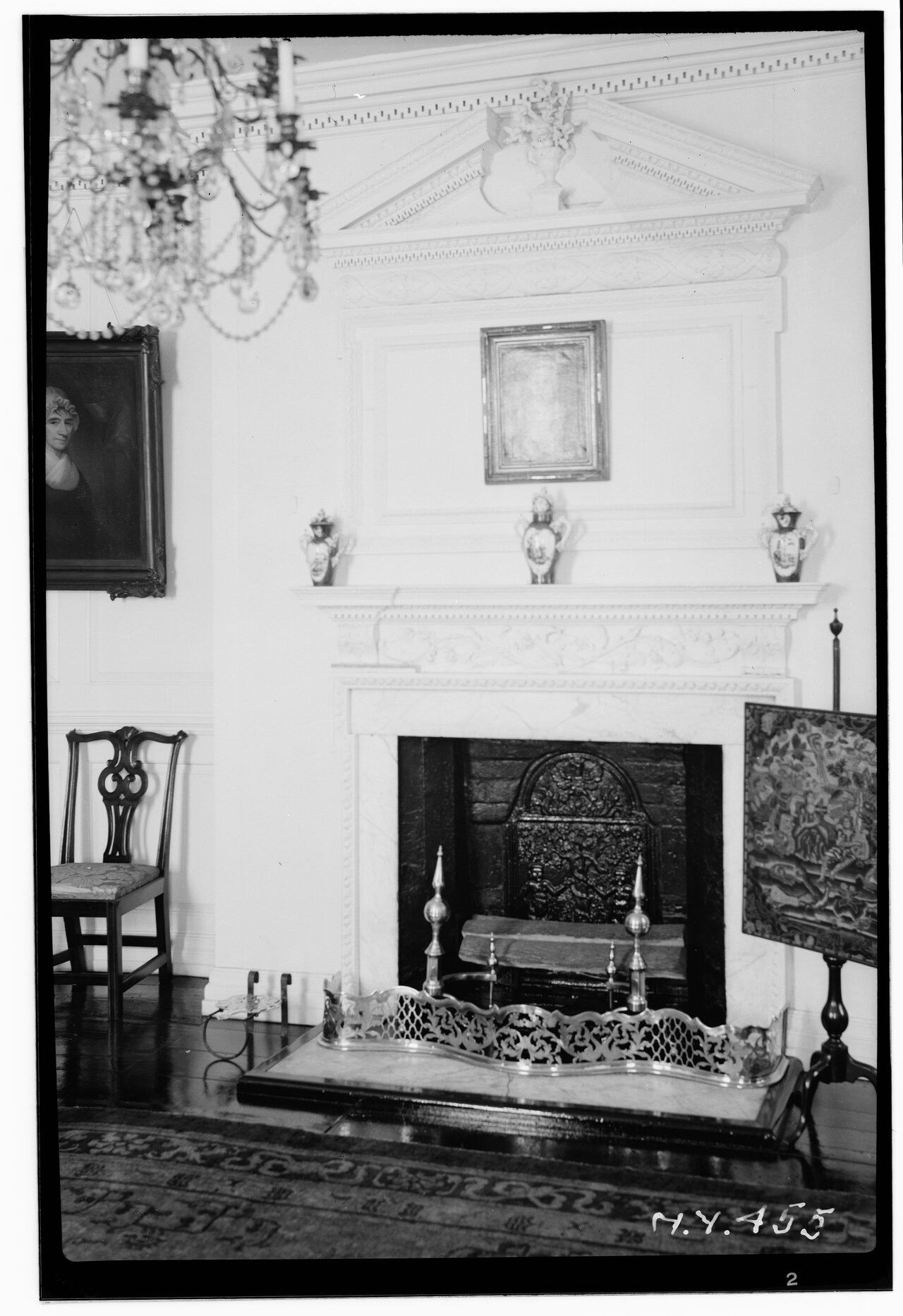
Visual AidThe room a girl entered only when summoned
Photograph made in 1937 by the Historic American Buildings Survey inside the Van Cortlandt Mansion in the Bronx, a New York family’s house of 1748: the parlor chimneypiece, with its carved overmantel, a cut-glass chandelier, imported porcelain on the shelf and a portrait in a gilt frame. This is the room the Knowledge Bank defines — the front room kept for receiving visitors, the part of a building meant to be looked at. The picture is a museum arrangement photographed 160 years later, so the furniture is not a record of what stood in any room in 1776, and this is not the Locktons’ house. Notice what the camera cannot show: the water, fuel and ash that kept that hearth alive were carried in and out by somebody, out of sight.
Parlor fireplace, Frederick Van Cortlandt Mansion, Bronx, New York; Historic American Buildings Survey, photograph by Arnold Moses, March 29, 1937, Library of Congress. Source: Wikimedia Commons, file "Van Cortlandt Mansion, parlor fireplace" (HABS NY,3-BRONX,5-5.tif), public domain.
loyalistn.Ch.7
A colonist who stayed on the side of the British King
“Becky explains in a low voice that the Locktons are loyalists.”
insolentadj.Ch.8
Rude and disrespectful toward someone in authority
“A word out of turn was enough for Madam to call a girl insolent.”
fretv.Ch.8
To worry steadily about something
“Isabel began to fret the moment Ruth left the kitchen.”
parlorn.Ch.9
The front room of a house, kept for receiving visitors
“Isabel was summoned to the parlor and given a new name.”
bribev.Ch.9
To pay someone secretly to do something dishonest
“The gentlemen spoke of ways to bribe men out of the army.”
concealv.Ch.9
To hide something so that it will not be found
“Madam had chosen a linen chest to conceal the money.”
obligedadj.Ch.10
Bound or forced to do something
“She was obliged to stand at the wall until the guests rose.”
commotionn.Ch.11
A noisy, confused disturbance
“The soldiers made a commotion in every room of the house.”
treasonn.Ch.11
The crime of betraying your own country or side
“Helping the enemy in wartime was treason, and men hanged for it.”
errandn.Ch.12
A short trip made to fetch or deliver something
“Becky sent her on an errand clear across the city.”
ⓘ The vocabulary words in this list are selected to help you understand and complete this workbook. Some may not appear verbatim in the original novel.
🧠Knowledge Bank question
1According to the Knowledge Bank, what does the word parlor reveal about a colonial house?Ch.7
2Calling someone ‘insolent’ means calling them rude and disrespectful.Ch.8
3A ‘parlor’ is the room of a house used for ___.Ch.9
4To ‘bribe’ someone is to ___.Ch.9
5Fill in each blank with the correct word.Ch.8
Word choices:fretobligedtreasonparlor- some words will not be used
Isabel began to the moment Ruth left the kitchen.
She was to stand at the wall until the guests rose.
6To ‘conceal’ something means to display it where all can see it.Ch.9
7A ‘commotion’ is best described as ___.Ch.11
8‘Treason’ means ___.Ch.11
9An ‘errand’ is a short trip made to fetch or deliver something.Ch.12
10Fill in each blank with the correct word.Ch.11
Word choices:commotionloyalisterrandconceal- some words will not be used
The search filled the house with .
Madam had used a linen chest to the money.
Part 2
Comprehension
Show you understood what happens in Chapters 7–12.
🏠Knowledge Bank · Front Rooms, Back Rooms
Social History · Inside a Merchant’s Town HouseA wealthy town house in 1776 was really two buildings stacked into one. The front rooms existed to be seen: a hall, a parlor, a dining room with good chairs, polished silver, imported tea. The back and lower rooms existed to make the front rooms possible — kitchen, pantry, cellar, and yard, where fires were kept alive, water was hauled in by hand, ashes were carried out, and chamber pots were emptied before dawn. Nothing arrived by pipe or switch. Every bucket, every log, and every hot dish crossed the gap between the two halves in somebody’s arms. That is why Part 2 keeps standing Isabel in doorways. Her work requires her to enter every room in the building, including the ones where the family says things it would never say in the street, and the men at the table have trained themselves not to see the person refilling their cups. A house built to display its owners also makes them careless in front of the one person best placed to listen.
Visual AidA merchant town house, cut in half
Structure diagram of the arrangement the Knowledge Bank describes: front rooms built to be seen, back and lower rooms built to make them possible, and every load crossing the gap in somebody’s arms. Rooms are drawn as two tidy columns, which no real house was — stairs, passages, garrets and the yard are left out, and a town house was stacked upward as well as split front to back. The plan is not the Locktons’ house, which Laurie Halse Anderson (author) never gives a floor plan. Notice the arrows: they are the reason one person has to enter every room in the building.
Room use and service circulation in a wealthy colonial town house, as described in the Knowledge Bank and in standard accounts of eighteenth-century American domestic architecture. Drawn for Garden Heights Academy.
🧠Knowledge Bank question
1The Knowledge Bank explains that a merchant’s town house made its owners careless because ___.Ch.7
2The Locktons openly declare their support for the rebel cause in the streets.Ch.7
3Why does Madam Lockton take Ruth out of the kitchen?Ch.8
4What new name does Madam decide Isabel will answer to?Ch.9
5Write the numbers 1–5 in the boxes to show the correct order of events. Number 1 = what happens first.Chapters 7–12
Isabel slips out at night and reports to Curzon.
Isabel is told that her name is now Sal.
Soldiers search the house and arrest Master Lockton.
Madam takes Ruth from the kitchen to serve as her maid.
Becky lays out the rules of the Lockton household.
6What do the gentlemen in the library discuss in front of Isabel?Ch.9
7Where does Isabel see the hidden money?Ch.9
8Isabel waits several days before telling Curzon what she has found.Ch.10
9What reason do the soldiers give for entering the Lockton house?Ch.11
10After the arrest, Becky sends Isabel across town to fetch Lady Seymour.Ch.12
Part 3
Literary Elements
Understanding HOW and WHY Laurie Halse Anderson tells the story across Chapters 7–12.
🎭Knowledge Bank · A Narrator Who Must Not Be Seen
Literary Craft · Voice and Point of ViewChains is told in the first person, so the reader receives the world only as Isabel receives it: what she sees from a doorway, what drifts across a table, what she guesses from a face. That limit is not a flaw in the design, it is the engine. Because Isabel cannot follow the gentlemen into the library uninvited or read their letters, the reader leans in exactly as hard as she does, and every scrap of overheard business arrives incomplete. Anderson (author) pairs the voice with a plain, physical style — cold water, sore hands, a beaten child — so that the history never floats free of a body. Two other devices work underneath it. Characterization arrives through small acts rather than descriptions: a renaming, a warning, a plate of food pushed across a kitchen table. And a forced name becomes a symbol, because whoever decides what you are called is claiming to own your name.
First-Person Narration
Isabel tells her own story, so the reader learns the war one overheard sentence at a time, exactly as she does.
Characterization
Madam is built out of small acts — a renaming, a display, a beating — rather than out of speeches about her nature.
Symbol
The name Sal is more than an insult. A person who can rename you is claiming to own what you are.
Foreshadowing
Becky’s story about a fireplace poker and the money glimpsed in a linen chest are both planted well before they matter.
🧠Knowledge Bank question
1According to the Knowledge Bank, why is Isabel’s limited first-person view called the engine of the novel?Ch.7
2A first-person narrator can tell the reader everything every character thinks.Ch.9
3Madam renaming Isabel ‘Sal’ works in the novel mainly as a ___.Ch.9
4Building Madam’s cruelty from actions rather than speeches is ___.Ch.8
5Fill in each blank with the correct literary term.Ch.8
Word choices:foreshadowingcharacterizationrhymeglossary- some words will not be used
Becky’s story about the poker is .
Lady Seymour feeding Isabel is .
6Foreshadowing is a hint planted early about something that matters later.Ch.9
7The reader learns the loyalists’ plans only in scraps because ___.Ch.9
8Which detail best shows characterization through action?Ch.10
9A symbol is an object or detail that carries a meaning larger than itself.Ch.9
10Fill in each blank with the correct literary term.Ch.12
Word choices:first-personsymbolindexpreface- some words will not be used
Because the book is written in the , we know only what Isabel knows.
The name Sal functions as a of ownership.
Part 4
Think Deeper
Four deeper challenges — no single-word recall. Read, weigh the evidence, and reason it out.
💡Knowledge Bank · Deciding What a Promise Is Worth
Rhetoric · Claims and EvidenceCurzon asks Isabel to risk her life on a sentence nobody has written down, and Part 2 hands the reader the job of judging that offer. Weighing it properly means separating three different things. First, the claim: rebel gentlemen could help a girl who helped them. Second, the evidence: what has actually happened so far whenever powerful people made promises to Isabel’s family. Third, the stakes: what is lost if the claim turns out to be false, which here is not disappointment but a hanging, and not only her own. Notice that Isabel hesitates for good reasons rather than cowardly ones. She is doing what a careful reasoner does, which is asking who gains if she believes and who pays if she is wrong. Use these four challenges to test how the chapters build a decision with no safe answer.
A girl walks up a street she has never seen, carrying a bundle in one arm and her little sister’s hand in the other. The street is Wall Street, the town is New York, and the year is 1776. Ahead of her is a tall house where a woman will look her over the way a buyer looks over a horse, decide that her name is inconvenient, and hand her a new one. Below it is a cellar where the two sisters will sleep. Behind her is a boy in a red hat who has already worked out something the household has not: that a girl who carries the trays hears everything said above them. Part 2 is where Isabel learns the exact shape of her new cage — which door she may use, how far she may walk before somebody assumes she is running, and how quickly Madam’s hand moves. It is also where she discovers the one thing the cage does not take away. She can listen.
Original passage written for Garden Heights — not a quotation from the novel.
1Claim: “Part 2 shows that Isabel decides to spy for the rebels because of what is done to Ruth.” — choose the two details that best prove it.Claim & Evidence
2Keeps Isabel safer, or Puts Isabel in danger? Tap each detail to send it left or right.Sort into two
◄ Keeps Isabel saferPuts Isabel in danger ►
3Match each cause to its result. For each cause, pick its result.Cause & Effect
Madam wants to look wealthy→
The gentlemen treat Isabel as furniture→
Isabel tells Curzon about the chest→
Master Lockton is taken away→
🧠Knowledge Bank question
4Fill both blanks to complete the reasoning.Build the Argument
Isabel’s hesitation over Curzon’s offer counts as careful reasoning because , which shows that .
Part 5
Standardized Test
A Town of Twenty Thousand · Reading & Vocabulary · SAT & TOEFL-style practice
Read the passage — the highlighted words are tested — then answer. Tap an answer, then tap it again to confirm.
SATCentral Ideas — the passage's main point
SATWords in Context — a word's meaning in this passage
SATInference — a conclusion the passage implies
SATAuthor’s Purpose — what the author wants to achieve
TOEFLFactual Information — a fact stated in the passage
TOEFLVocabulary — a tested word's meaning here
TOEFLProse Summary — the three sentences that sum it up
A Town of Twenty Thousand
The New York City of 1776 would fit inside a corner of the modern one. Its built-up streets covered only the southern tip of Manhattan Island, roughly the first mile above the harbor, and a little over twenty thousand people lived there. North of the last houses lay farms, orchards, marshy ground, and common pasture where families sent cows to graze. A person could walk from the East River docks to the Hudson shore in about a quarter of an hour.
The town lived off its harbor. Ships crowded the East River wharves, and around them stood the markets, the warehouses, and the taverns where merchants argued over cargoes and prices. The commotion of carts, sailors, and shouting traders carried far up the lanes behind the docks. Those streets ran narrow and crooked, often unpaved, and loose pigs did much of the work of clearing away garbage. One broad road ran up the middle of the island and carried the finest addresses, while poorer households, free black New Yorkers, and enslaved people filled the lanes and back buildings behind the best streets.
Water was the town’s great weakness. Manhattan is narrow and ringed by salt water, so many of the shallow wells sunk into the streets came up brackish, fit for scrubbing floors and not for drinking. The best supply came from springs beside a pond north of the built-up blocks, where a famous pump gave its water the nickname Tea Water, since it was the only water in town that made decent tea. Cartmen filled barrels there and sold clean water door to door, and a household short of it sent a servant out on an errand that crossed the whole small, watchful city.
Original passage written for Garden Heights — not a quotation from the novel.
1What is the passage mainly about?SAT · Central Ideas
2According to the passage, how many people lived in the city?TOEFL · Factual Information
3In the passage, commotion most nearly means ___.SAT · Words in Context
4What lay north of the built-up streets?TOEFL · Factual Information
5The passage suggests that news traveled quickly in the town because ___.SAT · Inference
6In the passage, brackish most nearly means ___.TOEFL · Vocabulary
7The author mentions the loose pigs in order to ___.SAT · Author’s Purpose
8Prose Summary (TOEFL).This passage describes the small city that stood at the tip of Manhattan Island in 1776. This TOEFL task lists six sentences; choose the THREE that best capture the passage’s main ideas. The other three do not belong — they state minor details or ideas the passage does not present.TOEFL · Prose Summary
9In the passage, errand most nearly means ___.SAT · Words in Context
10How does this passage best help a reader of Part 2?SAT · Inference
Part 6 · Optional
Creative Writing
A bonus challenge to practice your English. Take your time and have fun with it.
About This Section
This writing task is optional and is not part of your auto-graded score. The feedback below checks only the basics — length, spelling, and grammar — not whether your ideas are right or wrong. It is meant for classroom discussion and creative practice, so feel free to use your imagination!
Writing Task — Part 2 “The Name You Answer To”
Madam Lockton decides that Isabel will be called Sal, and Isabel answers to it out loud while keeping her real name to herself. Write about what a name does for a person, and why taking one away is a way of taking power. You may use your own experience of being called something you did not choose. 6–10 sentences. End with what you think Isabel keeps when she keeps her name silently.
You can start with: “She said my name was Sal, and I said nothing at all...”
0 / 40 words minimum
🗣 Teach It · Just for Fun (optional)
No right or wrong — close the screen and tell someone nearby what happened in this part. Can’t find anyone? Tell yourself out loud. The moment you teach it, you truly understand it.
Independent study guide by Garden Heights. Not affiliated with or endorsed by Laurie Halse Anderson. Contains original analysis only; no text from the novel is reproduced. Reference text: This workbook follows Laurie Halse Anderson’s classic text (the standard Puffin edition sold worldwide). Revised 2023 UK editions change some wording and may not match the vocabulary studied here.