Chains cover
Garden Heights

Chains

This workbook is for Garden Heights members. Sign in to continue.

Sign in with Google →
New here? Just sign up with Google — your account includes Matilda, our gift book, forever.
Chains · Garden Heights

Part 3

for Chains · Part 3 · Chapters 13–18
8 Parts40 min
What Happens in Part 3

Isabel overhears a plot to kill Washington and trades it to Colonel Regan for a promise he never keeps.

Serving and WaitingLockton comes home from jail to find Madam packing for Charleston, and they fight furiously. For two weeks he entertains loyalist friends while Isabel serves and listens; the blame for his arrest has landed on a friend who already fled, and nobody suspects the girl with the tea. Nobody frees her either, so she rights the cellar, twists Ruth a cornhusk doll, and plants her mother's seeds.

The Library PlotOn June twenty-second, Madam sends Isabel in with refreshments to learn what her husband is hiding, so a girl neither side notices hears the plan settled. Bribery has failed and independence is days away, so the men agree to assassinate General George Washington, cut New York off from the other colonies, and end the rebellion. Lockton insists every man who knows be written on a list.

Ruth and the BroomA scream comes from the kitchen. Ruth is having a seizure — a sudden storm of electrical activity in the brain — and Madam, calling it the devil, beats her with a broom. Lockton stops it and overrules the demand that Ruth be sold. That night Isabel decides she cannot wait for rescue.

Hickey HangsOn Sunday Isabel carries the list to Colonel Regan at the Battery and offers the plot for her freedom and Ruth's; he promises to look into it, tells her to replace the list, and gives her a password, ad astra, Latin for to the stars. Nothing comes. The conspiracy is uncovered, Lockton escapes the city inside a cheese crate, and on June twenty-eighth Thomas Hickey hangs for treason. Regan never appears; Isabel covers Ruth's eyes, then her own.

What We Will Learn
SectionWhat you will practice
VocabularyThe language of a divided city: loyalist, conspiracy, treason, bribe, allegiance
Literary ElementsDramatic irony built out of a servant nobody watches, foreshadowing planted in a promise that costs nothing to make, and a motif of locks, keys, and things carried out of a house
Cross-CurricularLoyalists and patriots — how a single city split in 1776, who chose which side and why, what committees and loyalty oaths did to neighbors, and what a loyalist stood to lose
Chapter Summary
Ch.What happens
Chapter 13 · June 8–21, 1776The House After the Arrest — Lockton walks back in to find Madam packing for Charleston, and the quarrel that follows sends objects flying. For the next two weeks he receives loyalist visitors while Isabel serves and listens. She learns the blame fell on a friend who had already run, tidies the cellar, twists Ruth a cornhusk doll, and plants her mother’s seeds.
Chapter 14 · June 22, 1776The List of Names — Lockton shuts himself in the library with the mayor of New York and other loyalists, and Madam — wanting her own share of the secret — sends Isabel in with refreshments. The bribes have failed and independence is coming, so the men agree to have General Washington killed. Lockton demands a written list, and Isabel carries the names out just as a scream rises from the kitchen.
Chapter 15 · June 22, 1776The Devil in the Kitchen — The scream is Madam’s. Ruth is in the grip of a seizure on the kitchen floor, and Madam, insisting the devil is in her, beats the child with a broom. Lockton comes in and stops it, then refuses his wife’s demand that Ruth be sold, on the plain ground that the household needs her.
Chapter 16 · June 23, 1776Ad Astra — Isabel decides the conspiracy is her one bargaining chip. She lifts the list from Lockton’s desk, walks to the Battery, and tells Colonel Regan everything, asking freedom for herself and Ruth in return. He promises to look into it, orders her to replace the list and act normally, and hands her a password for getting back into the camp.
Chapter 17 · June 23–28, 1776The Cheese Crate — Isabel keeps listening and hears nothing from Regan, while Madam’s threats against Ruth grow louder. A co-conspirator brings word that the plot is out. After one more fight with his wife, Lockton folds himself into a crate built for hauling cheese and rides out of the city. Soldiers search the house too late, and Becky reports that a soldier named Hickey talked.
Chapter 18 · June 28, 1776The Hanging — Thomas Hickey is executed for treason before a vast crowd. Isabel brings Ruth, hoping to catch Colonel Regan and force him to keep his promise, but he never shows. Curzon appears and hoists Ruth onto his shoulders for a better view. When the moment comes, Isabel shields Ruth’s eyes and shuts her own.
Part 1
Vocabulary
Study 10 key words from Chapters 13–18, then answer each question.
📜Knowledge Bank · The Words a Rebellion Needed
Etymology · Words of TreasonHalf the vocabulary of these chapters comes from law rather than from ordinary speech, because in 1776 the naming of an act decided who lived. Treason is the oldest term of the set: English law had defined it since 1351 as making war against the king or aiding his enemies, and the punishment was death. That definition is why one deed could be labeled two opposite ways on the same street. A man who armed himself against the Crown was a traitor to royal officers and a patriot to his neighbors. Conspiracy descends from Latin roots meaning to breathe together, which is exactly what a plot looks like from outside: several people sharing one held breath. Loyalist was mainly a label applied by the other side, since those it described preferred older words for a king’s friend. Even bribe had traveled a long way, from a term for a scrap of bread begged or stolen to money handed across a table to purchase a man’s allegiance.
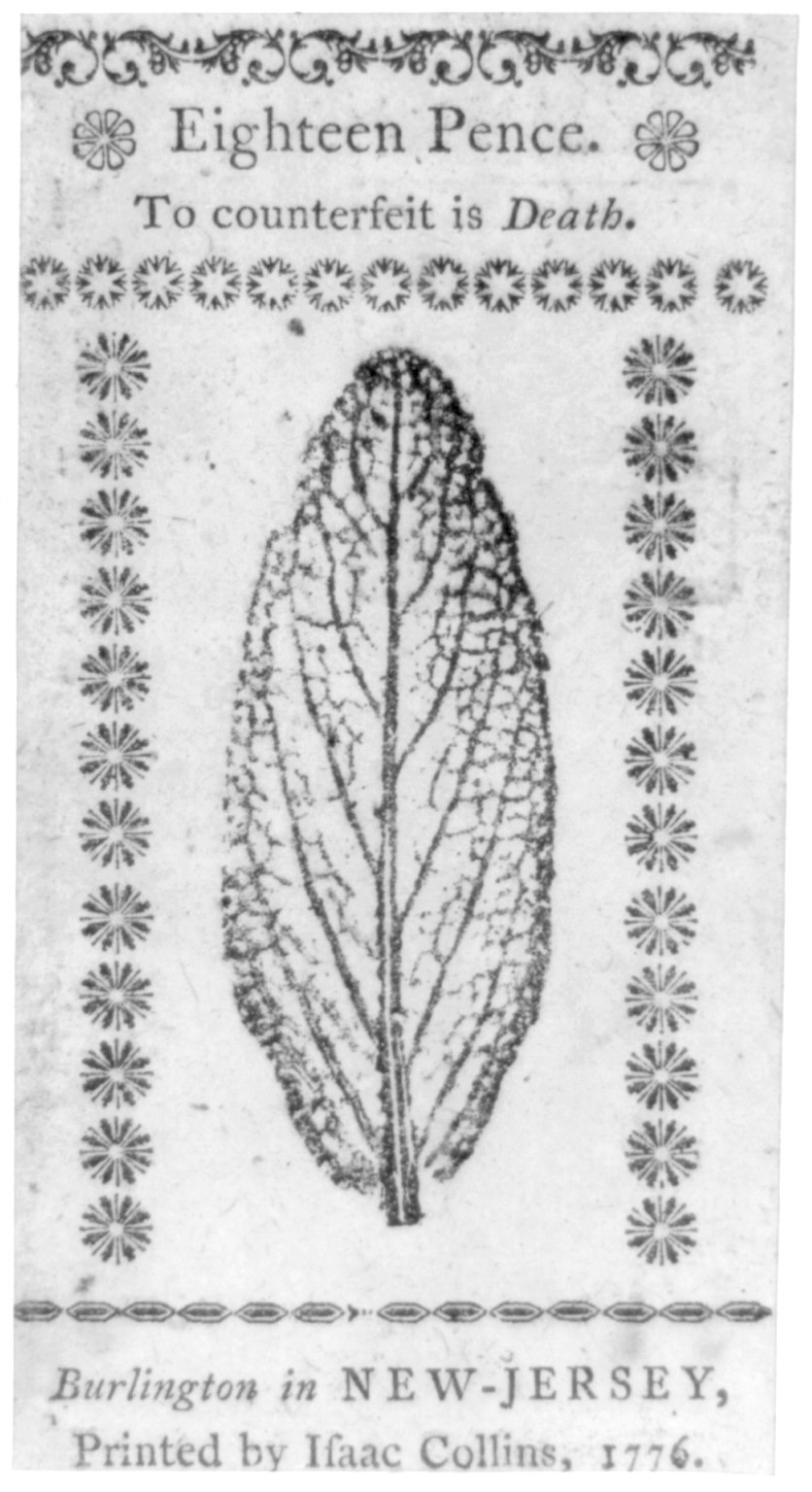
Visual AidA law printed on the money itself
A small printed paper note headed Eighteen Pence, with the line to counterfeit is death beneath it, a detailed leaf printed in the center inside borders of small flower ornaments, and an imprint reading Burlington in New-Jersey, printed by Isaac Collins, 1776
Photograph of a paper note for eighteen pence printed at Burlington in New Jersey in 1776, from the Library of Congress. Under the value the sheet prints its own criminal law in four words: to counterfeit is death. That is the Knowledge Bank’s point made visible — in 1776 the naming of an act decided who lived, and the penalty was set out on the thing itself. The leaf in the middle is not decoration: printers pressed a real leaf into the printing plate because its veins were beyond a forger’s copying. This is a New Jersey issue, not a New York one, and it is not money any character in the novel handles.
Eighteen pence note, Burlington, New Jersey, printed by Isaac Collins, 1776; Library of Congress Prints and Photographs Division. Source: Wikimedia Commons, file "Eighteen pence. To counterfeit is death LCCN2002723321.jpg", public domain.
loyalistn.Ch.13
A colonist who stayed faithful to the King during the Revolution
“Lockton fills his library with loyalist friends who share his views.”
quarreln.Ch.13
An angry argument between people who know each other well
“The quarrel over the packed trunks can be heard through the whole house.”
conspiracyn.Ch.14
A secret plan made by several people to do something harmful or illegal
“The conspiracy takes shape in a library over one afternoon.”
briben.Ch.14
Money offered in secret to persuade someone to act dishonestly
“The men admit that every bribe they offered the soldiers has failed.”
assassinatev.Ch.14
To murder an important leader, usually for political reasons
“The plotters decide to assassinate the commander of the rebel army.”
seizuren.Ch.15
A sudden burst of electrical activity in the brain that causes shaking and confusion
“Ruth’s seizure sends Madam into a rage instead of a panic.”
bargainn.Ch.16
An agreement in which each side gives something to get something
“Isabel offers the colonel a bargain rather than a favor.”
dreadn.Ch.17
A heavy, waiting fear of something that has not happened yet
“The week after the Battery is nothing but dread.”
treasonn.Ch.18
The crime of betraying one’s own country or government
“Hickey is hanged for treason and not for anything else.”
allegiancen.Ch.18
Loyalty owed to a ruler, a country, or a cause
“Every man in the city is being asked where his allegiance lies.”

ⓘ The vocabulary words in this list are selected to help you understand and complete this workbook. Some may not appear verbatim in the original novel.

🧠Knowledge Bank question
1According to the Knowledge Bank, what do the Latin roots of conspiracy literally mean?Ch.13
2A ‘quarrel’ is an angry argument.Ch.13
3A ‘conspiracy’ is best described as ___.Ch.14
4Fill in each blank with the correct word.Ch.14
Word choices:bribeassassinatedreadquarrel- some words will not be used
Not one persuaded the soldiers to change sides.
The plotters decide to the rebel commander.
5To ‘assassinate’ someone means to ___.Ch.14
6A ‘seizure’ is a sudden disturbance in the brain that causes shaking and confusion.Ch.15
7A ‘bargain’ is an agreement in which ___.Ch.16
8Fill in each blank with the correct word.Ch.17
Word choices:dreadtreasonloyalistbargain- some words will not be used
The waiting week fills Isabel with .
Hickey is put to death for .
9‘Allegiance’ means ___.Ch.18
10‘Dread’ means a light, cheerful kind of curiosity.Ch.17
Part 2
Comprehension
Show you understood what happens in Chapters 13–18.
Knowledge Bank · The Plot That Really Happened
History · The Hickey ConspiracyThe conspiracy Isabel overhears was real. In June 1776 the royal governor of New York, William Tryon, was directing loyalist work from a warship anchored in the harbor, and money moved ashore through loyalist merchants to draw soldiers away from the Continental Army. The mayor of the city, David Mathews, was arrested at his home in Flatbush in the small hours of June 22, and dozens of others were taken up in the days that followed. The scheme unraveled the way schemes usually do, through talk. Thomas Hickey, an Irish-born soldier serving in General Washington’s own guard, was already jailed on a charge of passing counterfeit money when he discussed the plan with fellow prisoners, and one of them informed. A court-martial, meaning a military trial, convicted him of mutiny and sedition on June 26, and two days later he was hanged in a field just north of the city before a crowd that witnesses put at close to twenty thousand people. He is usually named the first person put to death for treason against the United States, and no soldier of the new American army had ever before been executed.
Visual AidEleven days in June 1776
Eleven days in June 1776Six boxes in two columns, read down the left and then down the right. Early June: Governor Tryon directs loyalist work from a warship in the harbor. Money moves ashore through loyalist merchants to draw soldiers away from the Continental Army. June 22: Mayor David Mathews is arrested at Flatbush before dawn and dozens more are taken. Thomas Hickey, already jailed for passing counterfeit money, discusses the plan and a fellow prisoner informs. June 26: a court-martial convicts him of mutiny and sedition. June 28: he is hanged before a crowd witnesses put at close to twenty thousand. Notes say the scheme unraveled through talk, and that one deed carried two names.ELEVEN DAYS IN JUNE 1776 — HOW THE PLOT CAME APARTEARLY JUNEGovernor Tryon directs loyalist workfrom a warship in the harborThomas Hickey, jailed already forpassing counterfeit money, discussesthe plan — a fellow prisoner informsmoney moves ashore throughloyalist merchants, to draw soldiersaway from the Continental ArmyJUNE 26 — a court-martial, a militarytrial, convicts him of mutinyand seditionJUNE 22 — Mayor David Mathews isarrested at Flatbush before dawn;dozens more are taken in days afterJUNE 28 — hanged in a field north ofthe city, before a crowd witnessesput at close to twenty thousandthe scheme unraveled the way schemes usually do, through talkone deed, two names: a traitor to royal officers, a patriot to the next street
Sequence diagram of the real conspiracy the Knowledge Bank sets out, read down the left column and then down the right: loyalist work directed from a warship, money moving ashore, the mayor arrested at Flatbush, a jailed soldier talking to fellow prisoners, a court-martial, and a public hanging. Six panels compress weeks of arrests in which dozens of people were taken, and the drawing shows only the strand that led to Thomas Hickey. It records what historians can document, not what Isabel overhears, which is Laurie Halse Anderson (author)’s invention set inside the real one. Notice how the plot comes apart: not by detection, but by talk.
The Hickey conspiracy of June 1776 in New York, dates and figures as given in the Knowledge Bank and in standard histories of the Revolution in New York. Drawn for Garden Heights Academy.
🧠Knowledge Bank question
1The Knowledge Bank explains that the 1776 plot in New York was uncovered because ___.Ch.13
2What does Isabel learn about the blame for Lockton’s arrest?Ch.13
3Madam sends Isabel into the library with refreshments because she wants to learn what the men are discussing.Ch.14
4What plan do the men in the library settle on?Ch.14
5Write the numbers 1–5 in the boxes to show the correct order of events. Number 1 = what happens first.Chapters 13–18
  • Ruth collapses in the kitchen and Madam beats her with a broom.
  • Isabel carries the stolen list of names to Colonel Regan.
  • Lockton comes home to find Madam packing trunks for Charleston.
  • Thomas Hickey is hanged in front of an enormous crowd.
  • The mayor and the other guests settle on killing General Washington.
6Lockton agrees with Madam that Ruth should be sold after the seizure.Ch.15
7What does Isabel ask Colonel Regan to give her in return for the plot?Ch.16
8What does Colonel Regan give Isabel before she leaves the Battery?Ch.16
9Lockton escapes the city hidden inside a crate meant for hauling cheese.Ch.17
10Why does Isabel take Ruth to watch the execution?Ch.18
Part 3
Literary Elements
Understanding HOW and WHY Laurie Halse Anderson tells the story across Chapters 13–18.
👁Knowledge Bank · The Servant in the Room
Literary Craft · Point of ViewA story told by someone nobody notices is one of the oldest engines in fiction, and these chapters run entirely on it. Isabel carries a tray into a room full of powerful men, and because they see a servant rather than a witness they treat her as invisible and say aloud what none of them would ever write down. Critics call this a constrained narrator: a first-person voice with genuine access to a scene and almost no power to act on what it learns. The device does two jobs at once. It pulls the reader forward, since we hear the plot at the same instant Isabel does and share her helplessness. And it turns dramatic irony inside out. Usually a reader knows more than the characters do; here a reader knows exactly as much as one girl whom nobody she could tell would believe. Every scrap she gathers must be smuggled, and knowledge she cannot spend becomes a kind of weight.
Dramatic Irony
The reader knows what the characters do not — Madam sends Isabel to spy for her and never guesses the girl is already spying for the other side.
Foreshadowing
A hint of what is coming — a promise given without a witness, a date, or a signature is a warning long before it is broken.
Motif
A repeated image carrying meaning — locks, keys, and things carried secretly out of a house run through every one of these chapters.
🧠Knowledge Bank question
1According to the Knowledge Bank, how does a constrained narrator turn dramatic irony inside out?Ch.14
2Colonel Regan’s vague promise mainly works in the story as ___.Ch.16
3A motif is an image or idea that repeats across a work and gathers meaning.Ch.17
4The recurring images of locks and keys in these chapters form a ___.Ch.13
5Fill in each blank with the correct literary term.Ch.14
Word choices:ironymotifstanzarhyme- some words will not be used
Madam spying through her own spy is .
Locks and keys returning again and again form a .
6Foreshadowing means telling the reader plainly how the book will end.Ch.16
7Choosing a narrator who is present but powerless mainly increases the story’s ___.Ch.14
8Dramatic irony requires that every character in the scene know the secret.Ch.14
9Ruth carried on Curzon’s shoulders above a hanging crowd works as ___.Ch.18
10Fill in each blank with the correct literary term.Ch.18
Word choices:foreshadowingmotifglossaryindex- some words will not be used
An unwritten promise is quiet .
Chains, locks, and keys make up a .
Part 4
Think Deeper
Four deeper challenges — no single-word recall. Read, weigh the evidence, and reason it out.
🔒Knowledge Bank · The Price of Telling
Political Psychology · Informers and TrustIsabel’s decision at the Battery puts her into one of the ugliest categories in any war: the informer. Historians who study divided societies find the same pattern repeating across centuries and continents. When a community splits, the side that cannot win by force tries to win by information, and the person who supplies it is almost never a soldier. Informers tend to be the people with the least power and the most access, such as servants, children, clerks, and neighbors, because those are the people others talk carelessly in front of. Two things follow. First, informing is enormously dangerous for the informer and nearly free for the officer who receives it, so the exchange is almost never equal. Second, the reward is usually promised rather than paid, since a promise costs nothing until the fighting stops. Isabel understands the first half exactly. What she has not yet learned is that a bargain without witnesses is worth no more than the other man’s word.

A girl carries a tray of refreshments into a library full of important men and sets it down without being looked at. That is the whole trick. Because nobody in the room counts her as a person who can hear, they say the thing out loud: the bribes have failed, independence is coming, and the only way left to save the King’s New York is to kill the general who commands the rebel army. Isabel walks out with every name she could catch. What she does next is not brave in the way a battle is brave. It is a trade. She has one thing of value in the world — a secret — and one thing she wants more than her own life, which is to get herself and her little sister out of that house before Madam finds a way to sell Ruth. So she carries the secret across the city to a patriot colonel and offers it for their freedom. In three weeks in June 1776, a plot collapses, a man is hanged in front of a crowd, a master escapes in a crate, and a promise made to a thirteen-year-old girl quietly turns out to be worth nothing at all.

Original passage written for Garden Heights — not a quotation from the novel.
1Claim: “In these chapters Isabel’s whole plan rests on a promise that costs Colonel Regan nothing to make.” — choose the two details that best prove it.Claim & Evidence
2The loyalist side of the split, or The patriot side of the split? Tap each detail to send it left or right.Sort into two
◄ The loyalist side of the splitThe patriot side of the split ►
3Match each cause to its result. For each cause, pick its result.Cause & Effect
Madam sends Isabel into the library with a tray
Ruth has a seizure and Madam demands she be sold
Isabel carries the list of names to the Battery
A jailed soldier lets the conspiracy slip in prison
🧠Knowledge Bank question
4Fill both blanks to complete the reasoning.Build the Argument
Historians find that informers are usually servants, children, and clerks because , which shows that .
Part 5
Standardized Test
Picking a Side in 1776 · Reading & Vocabulary · SAT & TOEFL-style practice
Picking a Side in 1776

In 1776 the thirteen colonies did not divide into two neat armies. Historians estimate that about one white colonist in five stayed loyal to the King, that a larger share became rebels, and that many in the middle hoped to be left alone. What separated them was rarely a single idea. A merchant whose ships sailed under British protection, a farmer whose landlord had declared for the other side, and a minister sworn to an oath of allegiance to the Crown each had his own reason.

Neither side allowed neutrality for long. Beginning in 1774, towns and counties elected committees to enforce the boycott of British goods, and they became the closest thing to a government many places had. They inspected account books, questioned travelers, and printed offenders’ names in the newspapers so neighbors would denounce them and refuse to trade. Several states later required adult men to swear a test oath to the new government, and anyone who refused could lose the right to vote, to sue in court, or carry a weapon. Openly arming the King’s forces could be charged as treason, a capital crime.

The risks were never symmetrical, and they shifted with whichever army stood nearest. In a patriot town a suspected loyalist might be disarmed, fined, jailed, or tarred and feathered by an unauthorized crowd. Conviction could also bring the seizure of a shop or farm, the property sold to pay for the war. Where British troops held the ground the same treatment fell on rebels, and committees that bullied their neighbors one month were hunted the next. New York changed hands, and changed rules, more often than any other American city, so a family there could not safely say aloud what it believed.

Original passage written for Garden Heights — not a quotation from the novel.
1Which sentence best states the main idea of the passage?SAT · Central Ideas
2According to the passage, about how many white colonists stayed loyal to the King?TOEFL · Factual Information
3The passage says local committees were first elected in order to ___.TOEFL · Factual Information
4According to the passage, a man who refused a test oath could lose the right to ___.TOEFL · Factual Information
5It can be inferred from the passage that a person’s safety depended largely on ___.SAT · Inference
6Why does the author describe a merchant, a farmer, and a minister?SAT · Author’s Purpose
7The passage suggests that publishing offenders’ names worked because ___.SAT · Inference
8As used in the passage, allegiance most nearly means ___.SAT · Words in Context
9In the passage, treason most nearly means ___.TOEFL · Vocabulary
10In the passage, seizure most nearly means ___.TOEFL · Vocabulary
Part 6 · Optional
Creative Writing
A bonus challenge to practice your English. Take your time and have fun with it.
About This Section

This writing task is optional and is not part of your auto-graded score. The feedback below checks only the basics — length, spelling, and grammar — not whether your ideas are right or wrong. It is meant for classroom discussion and creative practice, so feel free to use your imagination!

Writing Task — Part 3 “The Promise Nobody Wrote Down”

Isabel hands over the most valuable thing she owns and gets back two Latin words and an assurance that somebody will look into it. Write about a time you were promised something and had to wait to find out whether the promise would be kept — by a friend, a coach, a teacher, a family member, or an employer. Describe what you gave or risked first, how the waiting felt, and what actually happened in the end. 6–10 sentences. End with what you would ask for now if the same offer were made to you again.

You can start with: “I gave them what they wanted first, and then I waited...”
0 / 40 words minimum
🗣 Teach It · Just for Fun (optional)

No right or wrong — close the screen and tell someone nearby what happened in this part. Can’t find anyone? Tell yourself out loud. The moment you teach it, you truly understand it.

Garden Heights

Part 3 Complete!

You finished Chapters 13–18 of Chains.

Here are your auto-graded results:

-
points out of 100
🗣 Teach It · Just for Fun (optional)
Move on to Part 4 →

Independent study guide by Garden Heights. Not affiliated with or endorsed by Laurie Halse Anderson. Contains original analysis only; no text from the novel is reproduced. Reference text: This workbook follows Laurie Halse Anderson’s classic text (the standard Puffin edition sold worldwide). Revised 2023 UK editions change some wording and may not match the vocabulary studied here.