New here? Just sign up with Google — your account includes Matilda, our gift book, forever.
Charlie and the Chocolate Factory · Garden Heights
Part 5
for Charlie and the Chocolate Factory · Part 5 · Chapters 17–19
8 Parts40 min
What Happens in Part 5
The first child is lost. Ignoring every warning, greedy Augustus Gloop leans over the bank to gulp chocolate straight from the river — and plunges in. The current sweeps him against a great glass pipe, where he sticks fast until the pressure shoots him up and out of sight, off toward the Fudge Room. The Oompa-Loompas burst into a song about his greed. The tour rolls on: everyone climbs aboard a bright pink boat rowed by a hundred Oompa-Loompas and glides down the chocolate river, through a dark tunnel, while Wonka ladles out mugs of hot chocolate. At last they reach the Inventing Room, Wonka’s most secret place, where he shows off two of his creations: the Everlasting Gobstopper, a sweet that never gets smaller no matter how long you suck it, and a batch of Hair Toffee that is still not quite right.
What We Will Learn
Section
What you will practice
Vocabulary
Words of mishap and making: warning, plunge, wedge, invention, everlasting…
Literary Elements
Rhyme, poetic justice, and theme
Cross-Curricular
How inventions come from trial and error, and how pressure builds in a pipe
Chapter Summary
Ch.
What happens
17
Augustus Gloop Goes up the Pipe — Augustus falls in the river and is sucked up a glass pipe.
18
Down the Chocolate River — the group rides a pink boat down the river through a dark tunnel.
19
The Inventing Room — Wonka shows the Everlasting Gobstopper and his unfinished Hair Toffee.
Part 1
Vocabulary
Study 10 key words from Chapters 17–19, then answer each question.
🧠Knowledge Bank · Gobstoppers and Glass Pipes
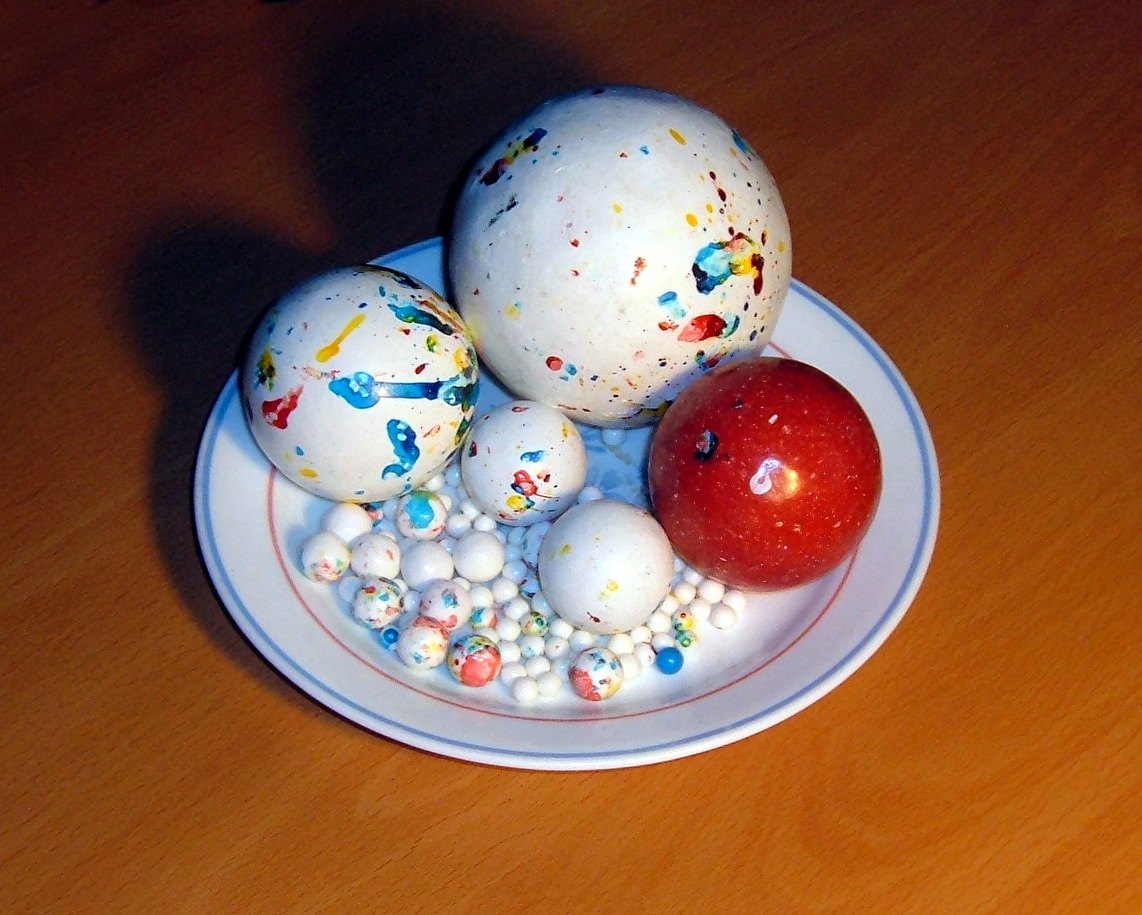
Candy Science · Layers & PressureTwo of this part’s marvels rest on real science. A gobstopper, sometimes called a jawbreaker, is built by tumbling a tiny candy seed in slowly turning pans and letting coat after coat of boiled sugar syrup harden around it, so cutting one open shows rings like a tree trunk. That is why your tongue needs so long to dissolve one: it must work through the layers one by one. The glass pipes are physics instead. When something plugs a pipe, the liquid behind it cannot pass and its pressure climbs until the blockage is shoved along, which is the same push that clears a blocked drinking straw. Wonka exaggerates, but the ideas underneath his marvels are ones you could meet in a kitchen or a lab.
Visual AidA sweet built in layers
Photograph taken in September 2008 of jawbreakers on a plate. The Knowledge Bank explains that such a sweet is built by tumbling a tiny candy seed in slowly turning pans while coat after coat of boiled sugar syrup hardens around it, so cutting one open shows rings like a tree trunk, and that is why the tongue needs so long to work through the layers. Compare the big ones with the tiny ones beside them. Every one of the large ones began that size.
Jawbreakers on a plate, September 2008; photograph by Ixnayonthetimmay. Source: Wikimedia Commons, public domain.
warningn.Ch.17
A caution about danger
“Augustus ignored every warning.”
plungev.Ch.17
To fall or dive suddenly
“He plunged into the chocolate river.”
wedgev.Ch.17
To stick fast in a tight space
“Augustus got wedged in the pipe.”
vanishv.Ch.17
To disappear from sight
“He shot up the pipe and vanished.”
currentn.Ch.18
The flow of a river
“The current carried the boat along.”
glistenv.Ch.18
To shine with a soft light
“The chocolate river glistened.”
inventionn.Ch.19
A newly created device
“The room was full of Wonka’s inventions.”
everlastingadj.Ch.19
Lasting forever
“An Everlasting Gobstopper never ends.”
experimentn.Ch.19
A test to discover something
“Hair Toffee was a failed experiment.”
ridiculousadj.Ch.19
Very silly; absurd
“The hair-growing toffee looked ridiculous.”
🧠Knowledge Bank question
1According to the Knowledge Bank, cutting a gobstopper open shows ___.Ch.17
2To ‘plunge’ is to —Ch.17
3Fill in each blank with the correct word.Chs. 17–18
Word choices:wedgecurrentvanishwarning- some words will not be used
Augustus got stuck fast, or d, inside the pipe.
The river’s carried the boat swiftly along.
4To ‘vanish’ is to —Ch.17
5If something is ‘everlasting,’ it lasts forever.Ch.19
6An ‘experiment’ is —Ch.19
7Fill in each blank with the correct word.Chs. 18–19
Word choices:inventionglistenridiculousexperiment- some words will not be used
The chocolate river seemed to in the light.
Each strange filled the secret room.
8Something ‘ridiculous’ is —Ch.19
9To ‘glisten’ is to —Ch.18
10To ‘wedge’ something is to leave it loose and free to move.Ch.17
Part 2
Comprehension
Show you understood what happens in Chapters 17–19.
🧠Knowledge Bank · Finding the Story’s Pattern
Reading Skill · Finding the PatternA wise reader starts noticing patterns, the repeating shapes a story falls into. Here the book’s engine finally starts turning: a greedy child ignores a warning, a fitting disaster follows, and the Oompa-Loompas sing about it. Augustus is the first to run this course. Spotting the pattern early gives you a kind of reading superpower, because you can predict the rhythm of the chapters to come while still enjoying each new twist. Ask yourself what stays the same each time and what changes. The flaw changes — gluttony now, others later — but the shape holds: temptation, disobedience, consequence, comment. Recognizing this structure also reveals Dahl’s design; he is not tossing out random accidents but building a careful ladder of lessons. As you read, sketch the pattern in your mind; you will find that this wild-seeming story is really following a careful, hidden plan.
Visual AidThe shape every child's chapter takes
Diagram for the Knowledge Bank on pattern. The four numbered cards are the order the Knowledge Bank sets out, and the long arrow returning to the start is the repetition itself. No child is named, because the Knowledge Bank says only the flaw changes. Notice that the pattern is a loop rather than a line, which is what lets a reader predict the rhythm of the chapters still to come.
The repeating pattern of the chapters, as described in the Knowledge Bank. Drawn for Garden Heights Academy.
🧠Knowledge Bank question
1The Knowledge Bank says spotting the pattern early lets a reader ___.Ch.17
2What happens to Augustus right after he falls in?Ch.17
3Fill in each blank with the correct word.Ch.17
Word choices:pipeFudgeriverboat- some words will not be used
Chocolate builds up behind Augustus inside the .
Mr. Wonka sends the Gloops off to the Room.
4Who sings a song about Augustus’s greed?Ch.17
5The group travels down the chocolate river in a boat rowed by Oompa-Loompas.Ch.18
6Who are Everlasting Gobstoppers specially made for?Ch.19
7What does Hair Toffee make grow?Ch.19
8Write the numbers 1–5 in the boxes to show the correct order of events in Part 5. Number 1 = what happens first.Chs. 17–19
Augustus topples in and is sucked up a great glass pipe.
The boat glides through a dark tunnel as Wonka hands out hot chocolate.
The group boards a pink boat and rides down the chocolate river.
Augustus leans over and gulps chocolate from the river.
In the Inventing Room, Wonka shows the Everlasting Gobstopper.
9Why is Wonka so proud of the Everlasting Gobstopper?Ch.19
10The Inventing Room is Wonka’s most secret and important room.Ch.19
Part 3
Literary Elements
Understanding HOW and WHY Roald Dahl tells the story across Chapters 17–19.
🧠Knowledge Bank · The Songs That Judge
Author’s Craft · The Oompa-Loompa SongsWhen Augustus vanishes up the pipe, the Oompa-Loompas burst into a rhyming song, and these verses are one of Dahl’s cleverest devices. In old plays a group called the chorus would step forward to comment on the action and tell the audience what to think; the Oompa-Loompas do exactly that in bouncing rhyme. Their songs are not decoration. Each one names the child’s flaw plainly, links it to the disaster, and draws the moral out loud, so no reader can mistake the lesson. Rhyme and rhythm make the message stick in the ear like a jingle. Notice how the playful, sing-song tune sits atop a rather stern warning — the fun surface makes the scolding go down easily. This is satire dressed as nursery verse. As each child falls, read the song that follows as the book’s own voice, cheerfully spelling out its judgment.
📚 Literary Devices in This Part · definitions & examples
Rhyme is words ending in matching sounds (the Oompa-Loompa songs). Poetic justice is a punishment that fits the fault (greedy Augustus swept off by chocolate). Theme is the lesson a story teaches (greed leads to trouble).
🧠Knowledge Bank question
1According to the Knowledge Bank, the Oompa-Loompas do the job once done by ___.Ch.17
2Poetic justice is when a character’s punishment fits their fault.Ch.17
3Fill in each blank with the correct word.Ch.17
Word choices:rhymepoetic justicesettingindex- some words will not be used
The Oompa-Loompas’ song is written in .
Augustus drowning in chocolate he could not resist is .
4The lesson a story teaches, such as ‘greed leads to trouble,’ is its —Ch.17
5The Oompa-Loompas’ songs are just silly noise with no meaning at all.Ch.17
6Fill in the blank with the correct word.Ch.17
Word choices:themehyperboleglossary- some words will not be used
The clear moral lesson behind the song is the story’s .
7Why does Dahl have the Oompa-Loompas sing right after Augustus is swept away?Ch.17
8That greedy Augustus is punished by chocolate itself is a clear case of —Ch.17
9Fill in the blank with the correct word.Ch.17
Word choices:rhymeplotsetting- some words will not be used
Words that end in the same sound, as in a song, are said to .
10Dahl mainly uses the Oompa-Loompa songs to —Ch.17
Part 4
Think Deeper
Four deeper challenges — no single-word recall. Read, weigh the evidence, and reason it through.
🧠Knowledge Bank · Choices & Consequences
Ethics · Choices & ConsequencesAt the heart of this book lies a firm belief in consequences — the idea that choices carry results as surely as night follows day. Augustus was warned not to drink from the river, yet his appetite decided for him. Dahl is careful to make the punishment fit the fault: the boy who could not stop swallowing is carried off by the very chocolate he could not resist. Storytellers call that neat matching justice, and it teaches by pattern rather than by preaching. Notice how different this is from bad luck. Augustus is not unlucky; he chose, and the choice answered him. A story that hands out results this tidily is not describing chance at all — it is arguing that character is destiny.
1Claim: “Augustus’s downfall is caused by his own greed, not by bad luck.” — choose the two details that best prove it.Claim & Evidence
2His fault, or his fate? Tap each detail to sort it — tap again to switch sides. You can keep tapping to change your answer.Sort into two
◄ His faultHis fate ►
3Match each cause to its result. For each cause, pick its result.Cause & Effect
Augustus leans over to gulp the chocolate→
The pipe sucks him upward→
Poor children cannot afford long-lasting sweets→
The Hair Toffee recipe is not yet right→
🧠Knowledge Bank question
4Fill both blanks to complete the reasoning.Build the Argument
The Knowledge Bank says Dahl makes the punishment fit the fault, which storytellers call , and it stresses that Augustus is .
Part 5
Standardized Test
How Inventions Really Happen · SAT & TOEFL-style practice
Read the passage — the highlighted words are tested — then answer. Tap an answer, then tap it again to confirm.
SATWords in Context — a word's meaning in this passage
SATDetail — a fact stated in the passage
SATInference — a conclusion the passage implies
SATCentral Idea — the passage's main point
SATPurpose — why the author included a part
TOEFLFactual Information — a fact stated in the passage
TOEFLVocabulary — a tested word's meaning here
TOEFLRhetorical Purpose — why the author included a detail
Invention Through Trial and Error
Where does a new invention come from? Almost never from a single flash of genius. Most begin with an idea, which the maker then tests again and again in a careful experiment. The first try almost always goes wrong in some small, stubborn way. The second attempt often goes wrong in a different way. Each failure, though, teaches something about what does not work and why, and points the way toward a better attempt.
This slow path of trying, failing, and trying again is called trial and error. A famous inventor once said he had not failed, but had simply found thousands of ways that did not work. Bit by bit, each version is used to sharpen the next, until at last something succeeds. Careful workshops keep notes on every attempt, because a failure nobody records has to be discovered all over again by somebody else. Patience matters as much as cleverness, since an inventor who quits at the tenth try never reaches the eleventh. Wonka’s factory runs on exactly this spirit: for every everlasting sweet that truly never wears away, there is a hair toffee that still needs fixing.
Original passage written for Garden Heights — not a quotation from the novel.
1According to the passage, where do most new inventions come from?TOEFL · Factual Information
2In the passage, an invention is ___.SAT · Words in Context
3According to the passage, what does each failure teach the inventor?SAT · Detail
4In the passage, to “improve” something is to —TOEFL · Vocabulary
5What is the slow path of trying, failing, and trying again called?TOEFL · Factual Information
6What did the famous inventor mean by finding “ways that did not work”?SAT · Inference
7How does the passage connect Wonka’s factory to invention?TOEFL · Rhetorical Purpose
8In the passage, an everlasting sweet is one that ___.SAT · Words in Context
9What is the passage mainly about?SAT · Central Idea
10This passage connects to Part 5 because the Inventing Room shows —SAT · Purpose
Part 6 · Optional
Creative Writing
A bonus challenge to practice your English. Take your time and have fun with it.
About This Section
This writing task is optional and is not part of your auto-graded score. The feedback below checks only the basics — length, spelling, and grammar — not whether your ideas are right or wrong. It is meant for classroom discussion and creative practice, so feel free to use your imagination!
Writing Task — Part 5 “My Own Invention”
Mr. Wonka fills his Inventing Room with wild new sweets, some finished and some not. Invent a brand-new sweet or gadget of your own. What does it do, how does it work, and what would you name it? Write at least 40 words.
You can start with: “My invention is called…”
0 / 40 words minimum
🗣 Teach It · Just for Fun (optional)
No right or wrong — close the screen and tell someone nearby what happened in this part. Can’t find anyone? Tell yourself out loud. The moment you teach it, you truly understand it.
Part 5 Complete!
You finished Chapters 17–19 of Charlie and the Chocolate Factory.
Here are your auto-graded results:
-
points out of 100
Teach it to someone
The best last step is to teach it. In your own words, explain what happened — retell a favorite scene, teach a character’s big choice, or sum up the main idea for a parent, friend, or classmate. When you can teach it clearly, you truly own it.
Independent study guide by Garden Heights. Not affiliated with or endorsed by Roald Dahl. Contains original analysis only; no text from the novel is reproduced. Reference text: This workbook follows Roald Dahl’s classic text (the standard Puffin edition sold worldwide). Revised 2023 UK editions change some wording and may not match the vocabulary studied here.
SAT® is a registered trademark of College Board, which is not affiliated with, and does not endorse, these materials. TOEFL® is a registered trademark of ETS. These materials are not endorsed or approved by ETS. Garden Heights is an independent provider of test-style reading practice.