New here? Just sign up with Google — your account includes Matilda, our gift book, forever.
Charlie and the Chocolate Factory · Garden Heights
Part 6
for Charlie and the Chocolate Factory · Part 6 · Chapters 20–23
8 Parts40 min
What Happens in Part 6
In the Inventing Room, a tremendous machine rumbles and whizzes and at last drops out a tiny gray strip of gum — a whole three-course dinner (tomato soup, roast beef, and blueberry pie) in a single stick. Wonka warns that it is not quite ready, but Violet Beauregarde, the champion gum-chewer, cannot resist: she pops it in her mouth. All goes well until the dessert, when she begins to swell and turns a deep blue, ballooning into an enormous blueberry. The Oompa-Loompas roll her away to the Juicing Room. On they go, down a corridor lined with doors bearing the most extraordinary labels — hot ices, chocolate-giving cows, lickable wallpaper, and fizzy lifting drinks that fill you with bubbles and float you toward the ceiling, unless you burp your way back down.
What We Will Learn
Section
What you will practice
Vocabulary
Words of machines and mishap: rumble, tremendous, swell, corridor, fizzy, float…
Literary Elements
Onomatopoeia, hyperbole, and motif
Cross-Curricular
Why fizzy drinks bubble and rise, and how taste really works
Chapter Summary
Ch.
What happens
20
The Great Gum Machine — a huge machine makes a stick of gum that is a whole dinner.
21
Good-bye Violet — Violet chews it and swells into a giant blueberry.
22
Along the Corridor — doors reveal wonders, including fizzy lifting drinks.
23
Fizzy Lifting Drinks — Wonka explains the bubbly drinks that float you upward.
Part 1
Vocabulary
Study 10 key words from Chapters 20–23, then answer each question.
🧠Knowledge Bank · The Truth About Chewing Gum
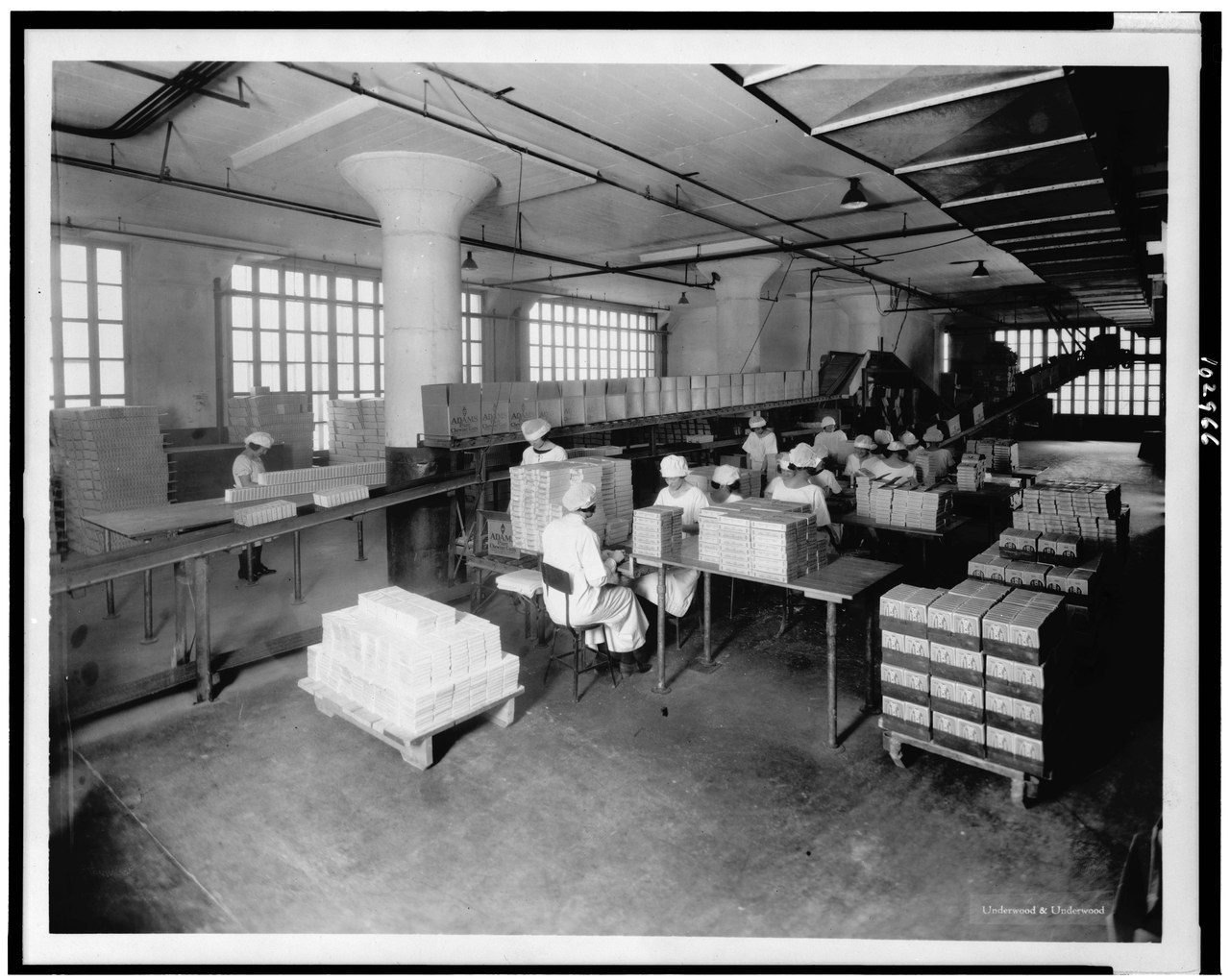
Candy Science · The Truth About GumViolet’s downfall centers on a food most children never think about: gum. Real gum is strange because it is meant to be chewed and never eaten. For centuries people chewed chicle, a rubbery sap drained from the sapodilla tree in Central America, and most modern gum still uses a springy base much like it. That base will not dissolve in your mouth or your stomach, which is exactly why you are told to spit it out rather than swallow. Flavor and sugar are mixed in only to be tasted and slowly lost. Flavor is stranger still: most of what you call taste is really smell, joined to texture and memory, which is how one sensation can fade and a wholly different one arrive on the same tired tongue.
Visual AidWhere chewing gum was packed
Photograph of the gum packing department at a chewing-gum plant in the United States. The Knowledge Bank explains that gum is strange because it is meant to be chewed and never eaten, that people once chewed chicle, a rubbery sap drained from the sapodilla tree, and that the springy base will not dissolve in your mouth or your stomach, which is why you are told to spit it out. Notice the boxes. Flavor and sugar are mixed in only to be tasted and slowly lost.
Gum packing department at a chewing-gum plant, photograph by Underwood and Underwood, U.S. Library of Congress. Source: Wikimedia Commons, public domain.
tremendousadj.Ch.20
Very great in size or amount
“A tremendous machine filled the room.”
rumblev.Ch.20
To make a deep rolling sound
“The machine began to rumble and shake.”
samplev.Ch.21
To try a small amount of
“Violet could not wait to sample the gum.”
swellv.Ch.21
To grow bigger
“Violet began to swell up like a balloon.”
extraordinaryadj.Ch.22
Very unusual; remarkable
“The doors hid extraordinary inventions.”
corridorn.Ch.22
A long passage with doors
“They walked down a long corridor.”
labeln.Ch.22
A tag that names something
“Each door had a strange label.”
fizzyadj.Ch.23
Full of bubbles
“Fizzy lifting drinks are full of bubbles.”
floatv.Ch.23
To drift on air or water
“The bubbles could make you float upward.”
burpv.Ch.22
To release gas from the stomach
“You must burp to come back down.”
🧠Knowledge Bank question
1According to the Knowledge Bank, chicle is a rubbery sap drained from ___.Ch.20
2To ‘rumble’ is to —Ch.20
3Fill in each blank with the correct word.Ch.21
Word choices:sampleswellrumblelabel- some words will not be used
Violet could not wait to the new gum.
Soon she began to up like a great balloon.
4Something ‘extraordinary’ is —Ch.22
5A ‘corridor’ is a long passage with doors along it.Ch.22
6To ‘float’ is to —Ch.23
7Fill in each blank with the correct word.Chs. 22–23
Word choices:fizzylabelburpcorridor- some words will not be used
Each door bore a strange naming its wonder.
To come down from a lifting drink, you must burp.
8Something ‘fizzy’ is —Ch.23
9To ‘sample’ food is to —Ch.21
10To ‘swell’ is to shrink down to a smaller size.Ch.21
Part 2
Comprehension
Show you understood what happens in Chapters 20–23.
🧠Knowledge Bank · Alike and Different
Reading Skill · Compare & ContrastThis section invites you to compare and contrast — to hold two things together and study how they are alike and how they differ. Violet Beauregarde and Augustus Gloop meet similar fates, yet their faults are not the same: his is gluttony, hers a boastful hunger for records. Setting them side by side sharpens both. Comparing reveals the shared shape of a warning ignored, a fitting punishment, and a song, while contrasting shows how carefully Dahl varies each case so the book never feels repetitive. Run the same tool on the settings, weighing the Chocolate Room against the Inventing Room, and on the parents, who answer trouble in ways that are not alike at all. Two things placed together always explain each other better than either one explained alone.
Visual AidTwo children, one shape
A Venn diagram for the Knowledge Bank on compare and contrast, drawn this way because the lesson really is the overlap. Circle 1 holds what belongs to Augustus alone and circle 2 what belongs to Violet alone, while the middle holds what the Knowledge Bank says they share: a warning, ignored, a fitting end, and a song. Notice how small the differences are beside the shared shape.
Augustus and Violet compared, as described in the Knowledge Bank. Drawn for Garden Heights Academy.
🧠Knowledge Bank question
1The Knowledge Bank says setting Violet and Augustus side by side ___.Ch.20
2What are the three courses of the dinner gum?Ch.20
3Fill in each blank with the correct word.Ch.21
Word choices:VioletblueberryCharliegum- some words will not be used
Ignoring the warning, grabs the gum and chews it.
At the dessert she swells into a giant .
4Where do the Oompa-Loompas roll Violet?Ch.21
5Mr. Wonka warned Violet not to take the gum.Ch.21
6What lines the corridor the group walks down?Ch.22
7According to Wonka, how do you come down from a fizzy lifting drink?Ch.22
8Write the numbers 1–5 in the boxes to show the correct order of events in Part 6. Number 1 = what happens first.Chs. 20–23
Violet swells up and turns into a giant blueberry.
Violet grabs the gum and chews it despite the warning.
Wonka explains the fizzy lifting drinks along the corridor.
The Oompa-Loompas roll Violet away to the Juicing Room.
The great machine rumbles and drops out a stick of dinner gum.
9What will still be true of Violet even after she is juiced?Ch.22
10In the book, Charlie drinks a fizzy lifting drink and floats up to the ceiling.Ch.23
Part 3
Literary Elements
Understanding HOW and WHY Roald Dahl tells the story across Chapters 20–23.
🧠Knowledge Bank · Sound, Size & Pattern
Author’s Craft · Sound & OnomatopoeiaDahl is a writer for the ear, and this section shows off his love of sound. Machines clank and hiss, gum snaps, Violet swells with a squishy, rounding fullness, and the words themselves seem to bounce and pop. He reaches for onomatopoeia — words that imitate the noises they name — and for repetition that drums a rhythm into the prose. These sound-effects do more than amuse; they make the fantastic feel physical, so we almost hear the factory around us. Sound also serves the larger pattern of the book, for each child’s doom arrives with its own signature noise, from a slurp to a fizz. As you read aloud in your head, listen for the music Dahl builds, and notice how a well-placed clatter or squelch can carry as much meaning as any sentence. In Dahl’s hands, even a page of pure noise can teach and delight.
📚 Literary Devices in This Part · definitions & examples
Onomatopoeia is a word that copies a sound (the machine’s rumble). Hyperbole is wild exaggeration for effect (Violet as a giant blueberry). A motif is a repeated idea or pattern (each child’s warning, disaster, and song).
🧠Knowledge Bank question
1According to the Knowledge Bank, onomatopoeia means words that ___.Ch.20
2Hyperbole is wild exaggeration used for effect.Ch.21
3Fill in each blank with the correct word.Chs. 20–21
Word choices:onomatopoeiahyperbolesettingrhyme- some words will not be used
Sound words like rumble and hiss are .
A girl ballooning into a giant blueberry is pure .
4The repeated pattern of warning, disaster, and a song is called a —Ch.21
5Violet’s downfall follows the very same pattern as Augustus’s.Chs. 17–21
6Fill in the blank with the correct word.Chs. 17–21
Word choices:motifhyperboleindex- some words will not be used
The repeating warning-disaster-song shape is a .
7Why does Dahl repeat the same downfall pattern for each spoiled child?Chs. 17–21
8Turning Violet into a giant blueberry is an example of Dahl’s love of —Ch.21
9Fill in the blank with the correct word.Ch.20
Word choices:onomatopoeiarhymeplot- some words will not be used
A word that imitates the sound it names is .
10The Oompa-Loompa songs about each child mainly serve to —Chs. 17–21
Part 4
Think Deeper
Four deeper challenges — no single-word recall. Read, weigh the evidence, and reason it through.
🧠Knowledge Bank · The Power of Pattern
Ethics · The Power of PatternBy the third child, the book’s moral pattern has become impossible to miss, and that repetition is itself a kind of teaching. Each disaster answers a flaw so exactly that we begin to expect it, and the expecting is the point. Dahl is training young readers to see cause and effect in behavior: pride puffs Violet up, and so, fittingly, she puffs up. When a lesson arrives dressed the same way again and again, it sinks past the surface and settles into memory. Notice, though, that predictability does not dull the fun — instead it builds a satisfying sense of justice, the comfort of a world where actions truly matter. Ask why an author would repeat a structure on purpose rather than hide it. The answer is that Dahl trusts a firm, clear pattern to carry his message farther than any single, one-time warning.
1Claim: “Violet’s fate follows the same flaw-then-downfall pattern as Augustus’s.” — choose the two details that best prove it.Claim & Evidence
2Augustus, or Violet? Tap each detail to sort it — tap again to switch sides. You can keep tapping to change your answer.Sort into two
◄ AugustusViolet ►
3Match each cause to its result. For each cause, pick its result.Cause & Effect
Wonka presses the machine’s buttons→
Violet chews the unfinished gum→
The Oompa-Loompas juice her→
You drink a fizzy lifting drink→
🧠Knowledge Bank question
4Fill both blanks to complete the reasoning.Build the Argument
The Knowledge Bank says that when a lesson arrives dressed the same way again and again it , and it adds that this predictability .
Part 5
Standardized Test
Why Bubbles Rise · SAT & TOEFL-style practice
Read the passage — the highlighted words are tested — then answer. Tap an answer, then tap it again to confirm.
SATWords in Context — a word's meaning in this passage
SATCause & Effect — what led to what
SATDetail — a fact stated in the passage
SATInference — a conclusion the passage implies
SATCentral Idea — the passage's main point
TOEFLFactual Information — a fact stated in the passage
TOEFLVocabulary — a tested word's meaning here
TOEFLProse Summary — the three sentences that sum it up
The Science of Fizzy Bubbles
Open a bottle of fizzy drink and it hisses. Where does that fizz come from? Before the bottle is sealed, a gas called carbon dioxide is pushed into the liquid under pressure, where it stays dissolved and invisible. The same gas puts the sparkle in sparkling water and lifts a loaf of bread as it bakes. The moment you unscrew the cap the pressure drops, and the gas can no longer stay hidden. It gathers into tiny bubbles that rush to the surface and escape into the air with a fizzing sound.
Those bubbles rise because gas is far lighter than liquid. Anything lighter than what surrounds it will float, rising upward just as a cork bobs to the top of water. A hot-air balloon climbs for the same reason, because warm air weighs less than the cool air around it. Each bubble is a tiny balloon of gas lifting itself through the drink. Roald Dahl simply took this everyday science and made it enormous: his lifting drinks fill you with so many bubbles that you, too, would rise toward the ceiling, unless you burped them out.
Original passage written for Garden Heights — not a quotation from the novel.
1According to the passage, what is pushed into a fizzy drink before it is sealed?TOEFL · Factual Information
2In the passage, a fizzy drink is one that ___.SAT · Words in Context
3What happens the moment you unscrew the cap?SAT · Cause & Effect
4In the passage, when the bubbles “escape,” they —TOEFL · Vocabulary
5Why do the bubbles rise to the top?SAT · Cause & Effect
6In the passage, to float is to ___.SAT · Words in Context
7What everyday example does the passage use for buoyancy?SAT · Detail
8How does the passage say Dahl changed this everyday science?SAT · Inference
9What is the passage mainly about?SAT · Central Idea
10Prose Summary (TOEFL).The passage explains why a fizzy drink bubbles and why the bubbles rise. This TOEFL task lists six sentences; choose the THREE that best capture the passage’s main ideas. The other three do not belong — they state minor details or ideas the passage does not present.TOEFL · Prose Summary
Part 6 · Optional
Creative Writing
A bonus challenge to practice your English. Take your time and have fun with it.
About This Section
This writing task is optional and is not part of your auto-graded score. The feedback below checks only the basics — length, spelling, and grammar — not whether your ideas are right or wrong. It is meant for classroom discussion and creative practice, so feel free to use your imagination!
Writing Task — Part 6 “Don’t Touch That!”
Violet is warned not to take the gum, but she grabs it anyway — and pays the price. Write about a time you were warned not to do something. Did you listen, or not? What happened next? Write at least 40 words.
You can start with: “Everyone told me not to, but…”
0 / 40 words minimum
🗣 Teach It · Just for Fun (optional)
No right or wrong — close the screen and tell someone nearby what happened in this part. Can’t find anyone? Tell yourself out loud. The moment you teach it, you truly understand it.
Part 6 Complete!
You finished Chapters 20–23 of Charlie and the Chocolate Factory.
Here are your auto-graded results:
-
points out of 100
Teach it to someone
The best last step is to teach it. In your own words, explain what happened — retell a favorite scene, teach a character’s big choice, or sum up the main idea for a parent, friend, or classmate. When you can teach it clearly, you truly own it.
Independent study guide by Garden Heights. Not affiliated with or endorsed by Roald Dahl. Contains original analysis only; no text from the novel is reproduced. Reference text: This workbook follows Roald Dahl’s classic text (the standard Puffin edition sold worldwide). Revised 2023 UK editions change some wording and may not match the vocabulary studied here.
SAT® is a registered trademark of College Board, which is not affiliated with, and does not endorse, these materials. TOEFL® is a registered trademark of ETS. These materials are not endorsed or approved by ETS. Garden Heights is an independent provider of test-style reading practice.