New here? Just sign up with Google — your account includes Matilda, our gift book, forever.
The Chocolate Touch · Garden Heights Academy
Part 1
for The Chocolate Touch · Part 1 · Chapters 1–2
a novel by Patrick Skene Catling
30 min5 Parts
This workbook is built on a solid pedagogical foundation, effectively integrating content and language learning based on the CLIL framework (Content and Language Integrated Learning), elevated by our unique 5th C — Connection — and an integrated Standardized Test section that weaves every SAT & TOEFL question type right into the novel, so learners build real test skills easily, naturally, and with fun.
What Happens in Part 1
John Midas loves candy so much that he will not share a single piece.
A boy and candyJohn Midas is a good, clever boy with one big fault. He spends all his money on sweets, gobbles them down, and never shares.
Red spots appearRed spots appear on his face and he keeps feeling unwell, so his worried parents take him to a doctor.
The doctor’s warningDr. Cranium tells John he eats far too much candy and not nearly enough proper food.
John will not stopStubborn John has no plans at all to give up his beloved chocolate.
What We Will Learn
Focus
What It Means
Character
John Midas and his greedy love of candy
Myth Link
How the story echoes the legend of King Midas
Health
Why too much sugar is bad for you
Chapter Summary
Chapter
Key Events
Ch.1
We meet John Midas, a good boy who is greedy about candy and never shares
Ch.2
Red spots and feeling ill lead his parents to take John to Dr. Cranium, who warns him to eat properly
Copyright Notice
This is an independent study guide created by Garden Heights Academy to support reading comprehension and literary analysis. It contains original analysis questions and does not reproduce any text from the novel. The Chocolate Touch is a work by Patrick Skene Catling. This guide is not affiliated with, authorized by, or endorsed by the author or any associated rights holders. Students should read the original book, available from libraries and booksellers.
Part 1
Vocabulary
Study 10 key words from Chapters 1–2, then answer each question.
🧠Knowledge Bank · How Your Tongue Tastes Sweet
Science · Taste & the TongueHave you ever wondered why candy tastes so good? Look closely at your tongue and you will see tiny bumps. Inside them are taste buds, and some are built to notice sweet things. When sugar lands on them, they send a happy message to your brain. Long ago, sweet food meant quick energy, so our brains learned to love it. That is why John Midas finds candy so hard to resist. His tongue is only doing its normal job — but John lets that little happy signal rule his whole day. A healthy person enjoys sweetness and still knows when to say enough.
Visual AidHow a sweet taste reaches your brain
Diagram for the Knowledge Bank on tasting sweetness, in four steps from the tongue to the brain. It leaves out the nerves that actually carry the message and everything the nose adds. It does not claim sweetness is the only taste a bud can notice. Notice that the last step happens in the brain, not the mouth. Sweetness is a message about food, and the liking is added afterwards.
Sequence as given in introductory accounts of taste. Drawn for Garden Heights Academy.
greedyadj.Ch.1
Wanting much more than your fair share
“John was greedy about candy.”
candyn.Ch.1
Sweets such as chocolate
“He spent all his money on candy.”
spotsn.Ch.1
Small round marks on the skin
“Red spots appeared on his face.”
faultn.Ch.1
A bad point or weakness
“His one fault was loving candy.”
gobblev.Ch.1
To eat quickly and greedily
“He would gobble his sweets at once.”
sharev.Ch.1
To give part of something to others
“John would never share his candy.”
stubbornadj.Ch.2
Refusing to change your mind
“Stubborn John ignored the warning.”
advicen.Ch.2
A suggestion about what to do
“He did not take the doctor’s advice.”
examinev.Ch.2
To look at carefully
“Dr. Cranium began to examine John.”
healthyadj.Ch.2
Good for your body
“He needed more healthy food.”
ⓘ The vocabulary words in this list are selected to help you understand and complete this workbook. Some may not appear verbatim in the original novel.
🧠Knowledge Bank question
1According to the Knowledge Bank, what does a healthy person still know?Ch.1
2True or False: To “gobble” food is to eat it slowly and politely.Ch.1
3A bad point or weakness in someone is a ___.Ch.1
4True or False: To “share” is to give part of something to others.Ch.1
5Fill in each blank with the correct word.Ch.1
Word choices:greedysharegobblespots- some words will not be used
John was so that he would his candy and never it.
6True or False: A “stubborn” person easily changes their mind.Ch.2
7Small round marks on the skin are ___.Ch.1
8True or False: “Advice” is a suggestion about what you should do.Ch.2
9Fill in the blanks with the correct words.Ch.2
Word choices:examinehealthyadvicestubborn- some words will not be used
Dr. Cranium would John and give about eating food.
10Sweets such as chocolate and lollipops are called ___.Ch.1
Part 2
Comprehension
How well do you understand Chapters 1–2?
🧠Knowledge Bank · Reading Clues to Predict
Reading Skill · PredictingGood readers are a little like detectives. As you read, you gather clues and make a smart guess about what might happen next. This is called predicting. In these first chapters, the author gives you many clues about John: he spends every coin on candy, he never shares, and a wise doctor warns him to slow down. Put those clues together. What do you think will happen to a boy who loves sweets more than anything? Making a prediction keeps your mind busy and makes reading more fun. Later you can check whether your guess came true and enjoy every surprise.
🧠Knowledge Bank question
1According to the Knowledge Bank, what makes a prediction a smart guess?Ch.1
2What does John do with his money?Ch.1
3What appears on John when he eats too much candy?Ch.1
4True or False: John happily shares his candy with others.Ch.1
5Write the numbers 1–5 in the boxes to show the correct order of events in Part 1.Ch.1–2
The doctor warns John to eat proper food, not just candy.
Red spots appear and John feels unwell.
His worried parents take him to Dr. Cranium.
John never shares his sweets with anyone.
We meet John Midas, who loves candy more than anything.
6True or False: Dr. Cranium tells John he eats too much candy.Ch.2
7Who do John’s parents take him to see?Ch.2
8How does John respond to the doctor’s warning?Ch.2
9True or False: John is a good, clever boy apart from his candy habit.Ch.1
10Fill in the blanks.Ch.1–2
Word choices:candysharewatergold- some words will not be used
John loved but would never it with anyone.
Part 3
Literary Elements
Understanding HOW and WHY Patrick Skene Catling creates certain feelings across Chapters 1–2.
🧠Knowledge Bank · Catling’s Word-Craft: The Name ‘Midas’
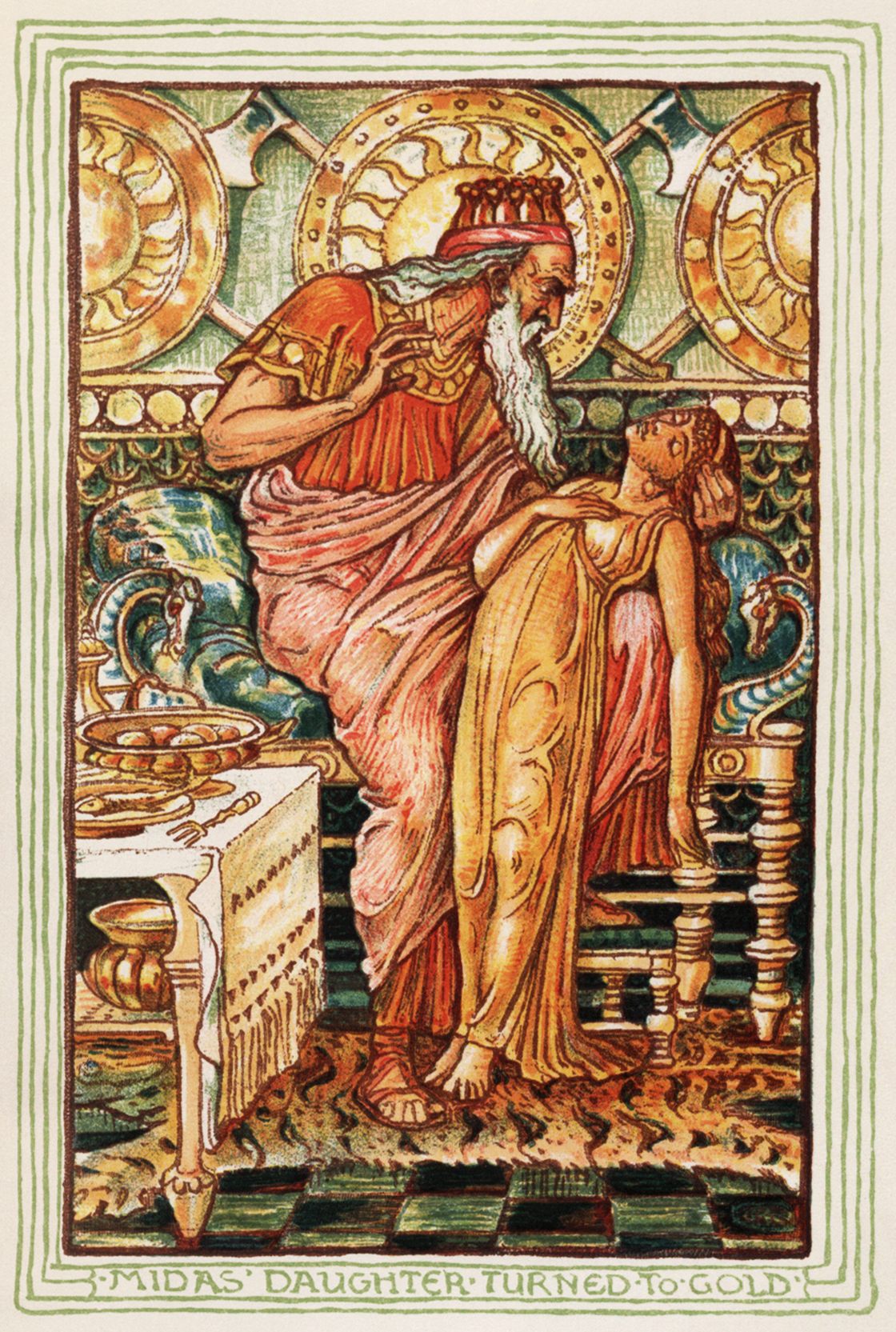
Literary Craft · AllusionAuthors choose names on purpose. Our hero’s surname is Midas, and that name is a quiet signpost. Using a name that points to an older, famous story is called an allusion. Ancient Greek storytellers told of a king named Midas who was so greedy for riches that he wished everything he touched would turn to gold. A god granted the wish. At first the king was delighted, and then his bread, his water, and his own cup went hard and cold in his hands. When Patrick Skene Catling borrows that name, he warns careful readers what sort of lesson is coming. One well-chosen name can carry a whole ancient myth.
Visual AidThe story the name Midas points to
Color illustration of the moment the Knowledge Bank describes: King Midas has embraced his daughter and she has turned to gold. Walter Crane drew it in 1893 for a retelling of the myth, so it is one artist’s picture of an ancient story rather than a record of anything that happened. The gold plates and dishes around the table are part of his point. Notice that the king is pulling away. The wish he begged for has become the thing he most wants undone.
‘Midas’ Daughter Turned to Gold’, color illustration by Walter Crane, 1893. Source: Wikimedia Commons, file "Midas gold2.jpg", public domain.
📚 Literary Devices in This Part · definitions & examples
An allusion is a hint at another famous story — here, the King Midas myth.A character flaw is a weakness; John’s flaw is his greed for candy.The name ‘Midas’ is foreshadowing — a clue about trouble to come.
The questions below are mixed — not grouped by device. Decide which device each one is about.
🧠Knowledge Bank question
1According to the Knowledge Bank, what is an allusion?Ch.1–2
2A character flaw is a weakness in a character.Ch.1–2
3Fill in each blank with the correct word.Ch.1–2
Word choices:allusionflawgreedrhyme- some words will not be used
A hint at another famous story is an
John’s biggest character weakness, or .
4The surname ‘Midas’ quietly warns us of trouble to come. This kind of clue is —Ch.1–2
5Foreshadowing is a plain, exact description that gives no hint of the future.Ch.1–2
6Fill in each blank with the correct word.Ch.1–2
Word choices:retellingforeshadowingsettingtitle- some words will not be used
Telling an old myth in a fresh new way is called a
The Midas name is a clue, an example of .
7We mainly learn what John is like through —Ch.1–2
8Why does Catling give his greedy hero the surname Midas?Ch.1–2
9Fill in each blank with the correct word.Ch.1–2
Word choices:mythallusionplotrhyme- some words will not be used
The old Greek King Midas story that Catling borrows is a
The clever nod to that story is an .
10Showing John’s greed so early mostly prepares us for —Ch.1–2
Part 4
Think Deeper
Four deeper challenges — no single-word recall. Read, weigh the evidence, and reason it through.
🧠Knowledge Bank · Is a Little Treat Okay?
Psychology · ModerationHere is something worth thinking about. John’s problem is not that he likes candy — almost everyone does. His problem is that he always wants more, and he will not share. There is a real difference between enjoying a treat and being greedy. A small piece of chocolate after dinner can be a lovely thing. Ten bars in one afternoon is too much for any body. Learning where that line sits is called moderation, and it is one of the hardest lessons to learn. As you meet John, ask yourself an honest question: with the things I love, do I know how to show balance?
1Claim: “John’s one big fault is his greed for candy.” — choose the two details that best prove it.Claim & Evidence
2Shows John’s greed, or just a fact about him? Tap each item to sort it — tap again to switch sides. You can keep tapping to change your answer.Sort into two
◄ John’s greedJust a fact ►
3Match each cause to its result. For each cause, pick its result.Cause & Effect
John loves candy above all→
He is greedy and selfish→
He eats far too many sweets→
His name is Midas→
🧠Knowledge Bank question
4Fill both blanks to complete the reasoning.Build the Argument
The Knowledge Bank says John’s real problem is not liking candy because , which shows that .
Part 5
Standardized Test · Vocabulary in Context & Main Idea
Part 1 practices exam reading skills — Vocabulary in Context, Main Idea, Inference, and Author’s Purpose — in the styles the SAT and TOEFL use. Read the passage (the highlighted words are tested below), then choose the answer best supported by the text.
Read the passage — the highlighted words are tested — then answer. Tap an answer, then tap it again to confirm.
SATWords in Context — a word's meaning in this passage
SATRhetorical Purpose — why the author put a sentence there
SATCentral Ideas — the passage's main point
SATText Structure & Purpose — how the passage is built, and why
TOEFLVocabulary — a tested word's meaning here
TOEFLFactual Information — a fact stated in the passage
TOEFLInference — what the passage implies
Why Humans Crave Sweetness
Humans are born with a powerful love of sweet tastes, and there is a good reason for it. Long ago, sweetness was a reliable signal that a food was rich in energy and safe to eat, so a sweet tooth helped our ancestors survive. Sugar gives the body quick fuel, which is why a sugary snack can bring a tired person a sudden burst of energy. The trouble is that this burst does not last, and it is often followed by a heavy, sleepy feeling. Because sweetness is so pleasant, it is very easy to crave far more sugar than the body actually needs. Eating too much can harm the teeth and, over time, a healthy body. Nutrition experts therefore give the same advice: enjoy sweets in moderation rather than all at once. A craving is natural, but a wise eater learns to control it.
Original passage written for Garden Heights — not a quotation from the novel.
1In the passage, “healthy” most nearly means ___.TOEFL · Vocabulary
2According to the passage, sugar gives the body —TOEFL · Factual Information
3According to the passage, why were humans born loving sweetness?TOEFL · Factual Information
4In the passage, “advice” most nearly means ___.SAT · Words in Context
5According to the passage, what often follows a sugary burst of energy?TOEFL · Factual Information
6The author most likely mentions the “heavy, sleepy feeling” to —SAT · Rhetorical Purpose
7As used in the passage, the word “moderation” most nearly means —SAT · Words in Context
8Which statement best expresses the central idea of the passage?SAT · Central Ideas
9The passage most strongly suggests that a person who eats sweets constantly will —TOEFL · Inference
10Why does the author explain how sweetness helped ancient people?SAT · Text Structure & Purpose
Part 6 · Optional
Creative Writing
A bonus challenge to practice your English. Take your time and have fun with it.
About This Section
This writing task is optional and is not part of your auto-graded score. The feedback below checks only the basics — length, spelling, and grammar — not whether your ideas are right or wrong. It is meant for classroom discussion and creative practice, so feel free to use your imagination!
Writing Task — Part 1 “Too Much of a Good Thing”
John loves candy so much he eats almost nothing else. Write about a treat or hobby you love. Why do you love it, and how could having too much of it cause problems? Write at least 40 words.
You can start with: “One thing I love so much I could enjoy it all day is…”
0 / 40 words minimum
🗣 Teach It · Just for Fun (optional)
No right or wrong — close the screen and tell someone nearby what happened in this part. Can’t find anyone? Tell yourself out loud. The moment you teach it, you truly understand it.
Part 1 Complete!
You finished Chapters 1–2 of The Chocolate Touch.
Here are your auto-graded results:
-
points out of 100
Teach it to someone
The best last step is to teach it. In your own words, explain what happened — retell a favorite scene, teach a character’s big choice, or sum up the main idea for a parent, friend, or classmate. When you can teach it clearly, you truly own it.
Independent study guide by Garden Heights Academy. Not affiliated with or endorsed by the author or any rights holders. Contains original analysis only; no text from the novel is reproduced.
SAT® is a registered trademark of College Board, which is not affiliated with, and does not endorse, these materials. TOEFL® is a registered trademark of ETS. These materials are not endorsed or approved by ETS. Garden Heights is an independent provider of test-style reading practice.