New here? Just sign up with Google — your account includes Matilda, our gift book, forever.
The Chocolate Touch · Garden Heights Academy
Part 4
for The Chocolate Touch · Part 4 · Chapters 7–8
a novel by Patrick Skene Catling
30 min5 Parts
This workbook is built on a solid pedagogical foundation, effectively integrating content and language learning based on the CLIL framework (Content and Language Integrated Learning), elevated by our unique 5th C — Connection — and an integrated Standardized Test section that weaves every SAT & TOEFL question type right into the novel, so learners build real test skills easily, naturally, and with fun.
What Happens in Part 4
The chocolate touch begins to ruin the things John cares about.
A healthy lunchTrying to please his mother, John picks a healthy lunch. It turns to chocolate too.
The trumpet soloWorse is still to come. At school orchestra practice John lifts his trumpet to play his big solo in front of everyone.
Everyone laughsThe instant the trumpet touches his lips it turns to solid chocolate and makes a silly, blubbering sound. The whole room bursts out laughing, and a red-faced John runs from the room.
What We Will Learn
Focus
What It Means
Plot (Embarrassment)
The healthy lunch fails and the trumpet solo disaster
Music
The trumpet and the school orchestra
Character
How John’s feelings begin to change
Chapter Summary
Chapter
Key Events
Ch.7
John chooses a healthy lunch to please his mother, but it still turns to chocolate
Ch.8
At orchestra practice his trumpet turns to chocolate during his solo and everyone laughs
Copyright Notice
This is an independent study guide created by Garden Heights Academy to support reading comprehension and literary analysis. It contains original analysis questions and does not reproduce any text from the novel. The Chocolate Touch is a work by Patrick Skene Catling. This guide is not affiliated with, authorized by, or endorsed by the author or any associated rights holders. Students should read the original book, available from libraries and booksellers.
Part 1
Vocabulary
Study 10 key words from Chapters 7–8, then answer each question.
🧠Knowledge Bank · From Bean to Bar
Food Technology · ProcessingHow does a bitter little bean become sweet, smooth chocolate? It takes many careful steps. First the cocoa beans are roasted until they smell rich and warm. Then they are ground into a thick, dark paste. Workers mix in sugar and often creamy milk, then stir the mixture for hours until it turns silky. Finally it is poured into molds and cooled until hard. All that work is hidden inside one small bar. John gobbles chocolate without a thought, but each piece is the end of a long, patient journey. Knowing the work behind a treat can help us enjoy it with more respect.
Visual AidFrom bean to bar
Flow diagram for the Knowledge Bank on making chocolate, in four steps. Fermenting and drying happen on the farm before any of this and are left out to keep the sequence short, and the hours of stirring are folded into one box. It does not claim every maker follows exactly these steps. Notice that not one step is quick. That is the point the Knowledge Bank makes about a bar John swallows in seconds.
Steps as given in standard accounts of chocolate manufacture. Drawn for Garden Heights Academy.
orchestran.Ch.8
A large group of musicians
“He played in the school orchestra.”
trumpetn.Ch.8
A brass musical instrument
“His trumpet turned to chocolate.”
solon.Ch.8
A part played by one person alone
“John had a big trumpet solo.”
instrumentn.Ch.8
A tool for making music
“The instrument melted into chocolate.”
embarrassv.Ch.8
To make someone feel ashamed
“The accident embarrassed John.”
blushv.Ch.8
To turn red in the face
“John blushed and ran away.”
performv.Ch.8
To do something in front of others
“He had to perform his solo.”
audiencen.Ch.8
People who watch or listen
“The audience burst out laughing.”
nervousadj.Ch.8
Worried and uneasy
“John felt nervous before his solo.”
pleasev.Ch.7
To make someone happy
“He tried to please his mother.”
ⓘ The vocabulary words in this list are selected to help you understand and complete this workbook. Some may not appear verbatim in the original novel.
🧠Knowledge Bank question
1According to the Knowledge Bank, what happens to the beans first?Ch.8
2True or False: A “solo” is a part played by one person alone.Ch.8
3A brass musical instrument that you blow is a ___.Ch.8
4True or False: To “blush” is to turn red in the face.Ch.8
5Fill in each blank with the correct word.Ch.8
Word choices:orchestrasolotrumpetaudience- some words will not be used
In the , John raised his to play his .
6True or False: To “embarrass” someone is to make them feel proud.Ch.8
7The people who watch or listen to a performance are the ___.Ch.8
8True or False: To “perform” is to do something in front of others.Ch.8
9Fill in the blanks with the correct words.Ch.7–8
Word choices:nervouspleaseblushperform- some words will not be used
John felt and began to as the audience laughed.
10A tool for making music is an ___.Ch.8
Part 2
Comprehension
How well do you understand Chapters 7–8?
🧠Knowledge Bank · Following the Story’s Big Idea
Reading Skill · ThemeEvery good story has a theme — a big idea or lesson hiding under the events. It is not just what happens, but what it all means. In The Chocolate Touch, one big idea grows clearer with every chapter: too much of a good thing can hurt you. As John’s magic causes more and more trouble, watch how the story keeps teaching that same lesson in new ways. Following a theme is like following a golden thread through the whole book. When you can say the lesson in your own words, you truly understand the story, and not only its plot.
🧠Knowledge Bank question
1According to the Knowledge Bank, what is a theme?Ch.7
2What happens to the healthy lunch?Ch.7
3What happens when John plays his trumpet solo?Ch.8
4True or False: The other children laugh at John during his solo.Ch.8
5Write the numbers 1–5 in the boxes to show the correct order of events in Part 4.Ch.7–8
Even the healthy lunch turns to chocolate.
Everyone laughs and a red-faced John runs away.
At orchestra practice he raises his trumpet to play his solo.
John picks a healthy lunch to please his mother.
It turns to chocolate and makes a silly sound.
6True or False: John runs away, embarrassed, after the trumpet turns to chocolate.Ch.8
7What does the trumpet sound like after it turns to chocolate?Ch.8
8How is the curse changing John’s life now?Ch.8
9True or False: John’s plan to eat a healthy lunch works perfectly.Ch.7
10Fill in the blanks.Ch.7–8
Word choices:trumpetchocolateappledrum- some words will not be used
John’s turned to in the middle of his solo.
Part 3
Literary Elements
Understanding HOW and WHY Patrick Skene Catling creates certain feelings across Chapters 7–8.
🧠Knowledge Bank · Catling’s Word-Craft: The Chocolate Trumpet
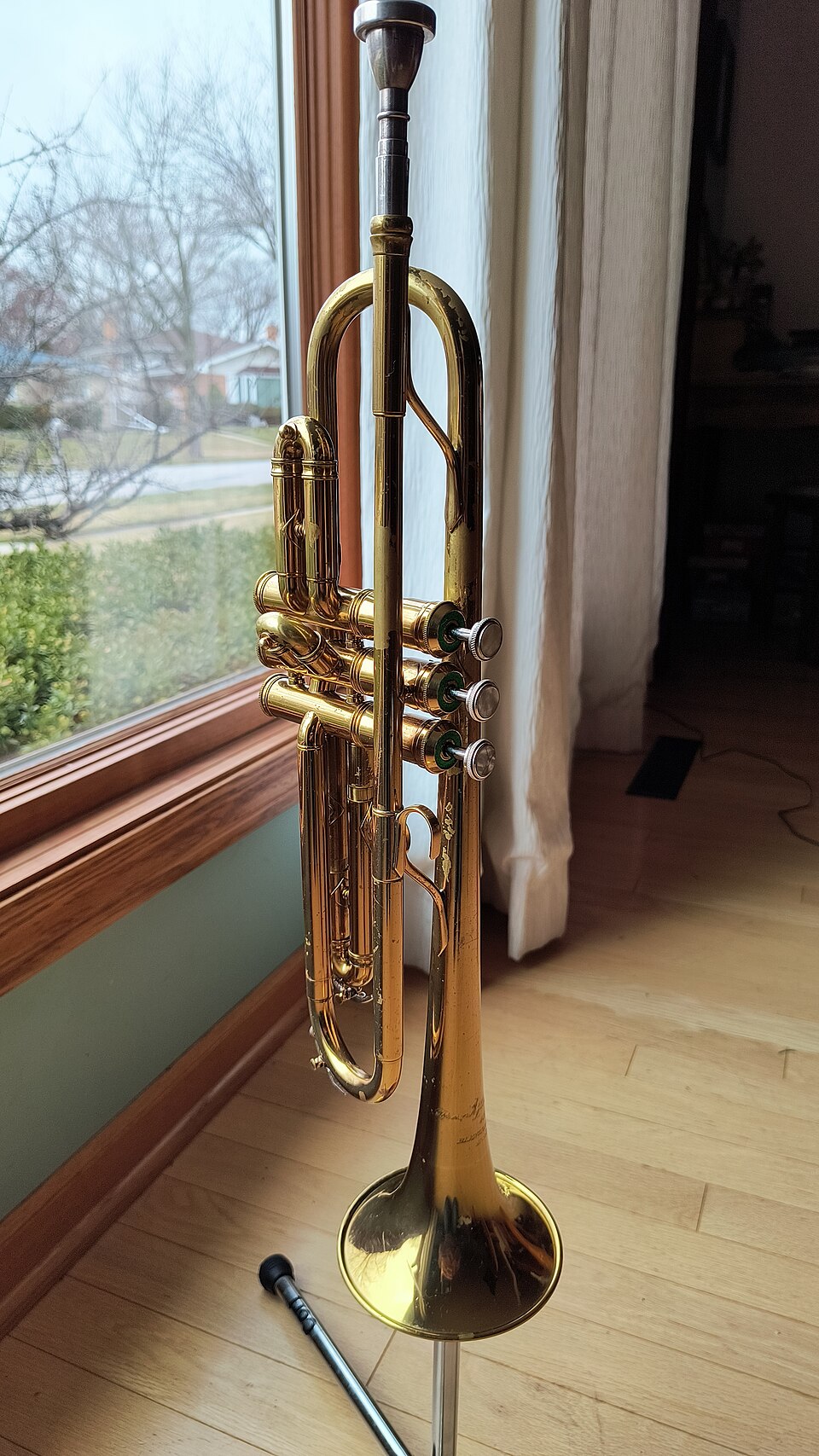
Music & Acoustics · Situational IronyA trumpet is a brass instrument, and it works only by touch. The player presses both lips against the mouthpiece and buzzes them, while three valves open extra loops of tubing to change the note. So the instant John lifts his trumpet to his mouth, the metal turns soft and brown, and buzzing lips cannot make a chocolate tube ring. When an action produces the exact opposite of what a character expects, we call it situational irony. Catling makes us laugh and teaches at the same time: John’s greed keeps spoiling the very things he loves.
Visual AidThe instrument that turns to chocolate
Photograph of a brass trumpet on its stand, the instrument the Knowledge Bank explains. All three parts it names are here: the cup mouthpiece at the top that the lips press against, the three finger buttons in a row for the valves that open extra loops of tubing, and the bell flaring open at the bottom. It is standing in somebody’s front room rather than being played, so the picture cannot show you the buzzing. Notice that every part is hard metal. Nothing here would work if it turned soft, which is exactly what happens to John.
Holton Model 48 trumpet, photographed 2024. Source: Wikimedia Commons, file "Holton Trumpet Model 48.jpg", CC0.
📚 Literary Devices in This Part · definitions & examples
Situational irony: John hopes to shine, but the opposite happens.Dahl-like humor turns John’s disaster into a funny scene for readers.Each new failure is rising action pushing toward the story’s peak.
The questions below are mixed — not grouped by device. Decide which device each one is about.
🧠Knowledge Bank question
1According to the Knowledge Bank, why can a chocolate trumpet not play?Ch.7–8
2Situational irony is when the opposite of what a character expects happens.Ch.7–8
3Fill in each blank with the correct word.Ch.7–8
Word choices:ironyhumorrisingsymbol- some words will not be used
John wanting to shine but being shamed is situational
The author’s playful .
4The author turns John’s trumpet disaster into a funny scene. This use of comedy is —Ch.7–8
5Rising action is the calm ending after all the problems are solved.Ch.7–8
6Fill in each blank with the correct word.Ch.7–8
Word choices:risinghumorironyfalling- some words will not be used
Each new failure is
The mix of shame and comedy adds dark .
7Why does the author make John’s trumpet turn to chocolate in public?Ch.7–8
8The trumpet scene is an example of rising action because it —Ch.7–8
9Fill in each blank with the correct word.Ch.7–8
Word choices:ironyrisinghumorsymbol- some words will not be used
John hoping to shine but failing is
His mounting failures are .
10Making a painful moment funny mainly helps readers —Ch.7–8
Part 4
Think Deeper
Four deeper challenges — no single-word recall. Read, weigh the evidence, and reason it through.
🧠Knowledge Bank · Wanting to Change
Psychology · The First Step to ChangeSomething new is stirring inside John. For the first time, his magic is not fun anymore, and he begins to wish it would stop. That feeling is the first step of real change. Nobody can grow better until they first want to be better. John is starting to see that his greed has a cost, and that seeing is painful but important. In your own life, change often begins the same way — with a quiet, uncomfortable feeling that something must be different. Notice this turning point in John. Wanting to change is where every good lesson truly begins.
1Claim: “The curse ruins even John’s efforts to do well.” — choose the two details that best prove it.Claim & Evidence
2How the curse spoils things, or just a detail of the scene? Tap each item to sort it — tap again to switch sides. You can keep tapping to change your answer.Sort into two
◄ How the curse spoils thingsJust a detail ►
3Match each cause to its result. For each cause, pick its result.Cause & Effect
John picks a healthy lunch→
He lifts his trumpet to play→
His big solo is ruined→
The curse keeps spreading→
🧠Knowledge Bank question
4Fill both blanks to complete the reasoning.Build the Argument
The Knowledge Bank calls John’s new feeling the first step of change because , which shows that .
Part 5
Standardized Test · Vocabulary & Text Structure
Part 4 practices exam reading skills — Vocabulary in Context, Text Structure & Inference — in the styles the SAT and TOEFL use. Read the passage (the highlighted words are tested below), then choose the answer best supported by the text.
Read the passage — the highlighted words are tested — then answer. Tap an answer, then tap it again to confirm.
SATWords in Context — a word's meaning in this passage
SATCentral Ideas — the passage's main point
SATText Structure & Purpose — how the passage is built, and why
TOEFLFactual Information — a fact stated in the passage
TOEFLInsert Text — where a sentence best fits
TOEFLInference — what the passage implies
How a Trumpet Makes Music
A trumpet turns a player’s breath into music through a clever chain of events. When the player presses their lips together and blows, the lips vibrate rapidly, buzzing like a tiny motor. This buzzing shakes the air inside the long metal tube and produces a sound wave. The shape of the tube makes the note loud and clear as the wave travels toward the wide, flaring bell at the end. By pressing valves, the player changes the length of the tube, and a longer path makes a deeper note. Skilled players who perform in public control the pitch mostly with their lips, tightening them for high notes and loosening them for low ones. A brass instrument makes no sound on its own; it only shapes and amplifies the buzz the player creates. Music, in the end, is moving air that we have learned to control.
Original passage written for Garden Heights — not a quotation from the novel.
1As used in the passage, the word “vibrate” most nearly means —SAT · Words in Context
2According to the passage, what first makes the sound in a brass instrument?TOEFL · Factual Information
3According to the passage, what first makes the sound in a trumpet?TOEFL · Factual Information
4In the passage, “instrument” most nearly means ___.SAT · Words in Context
5According to the passage, how does a player make a deeper note?TOEFL · Factual Information
6In the passage, “perform” most nearly means ___.SAT · Words in Context
7Insert Text (TOEFL). Look at the four squares [1]–[4] in the excerpt below. They show where this sentence could be added: “For this reason, a tuba, with its very long tube, booms out the deepest notes of all.”
A brass player changes pitch by pressing valves. [1] Each valve the player presses opens up more tubing. [2] Because the air must travel a longer path, the note comes out lower and deeper. [3] A short bugle has no valves, so it can play only a few high notes. [4]
Where would the sentence fit best?TOEFL · Insert Text
8Which statement best expresses the central idea of the passage?SAT · Central Ideas
9The passage most strongly suggests that without a player’s buzzing lips, a trumpet would —TOEFL · Inference
10Why does the author describe the sound moving from lips to bell?SAT · Text Structure & Purpose
Part 6 · Optional
Creative Writing
A bonus challenge to practice your English. Take your time and have fun with it.
About This Section
This writing task is optional and is not part of your auto-graded score. The feedback below checks only the basics — length, spelling, and grammar — not whether your ideas are right or wrong. It is meant for classroom discussion and creative practice, so feel free to use your imagination!
Writing Task — Part 4 “An Embarrassing Moment”
John is embarrassed in front of everyone when his trumpet turns to chocolate. Write about an embarrassing moment (real or imagined). What happened, how did it feel, and what did you do next? Write at least 40 words.
You can start with: “I wanted to disappear when…”
0 / 40 words minimum
🗣 Teach It · Just for Fun (optional)
No right or wrong — close the screen and tell someone nearby what happened in this part. Can’t find anyone? Tell yourself out loud. The moment you teach it, you truly understand it.
Part 4 Complete!
You finished Chapters 7–8 of The Chocolate Touch.
Here are your auto-graded results:
-
points out of 100
Teach it to someone
The best last step is to teach it. In your own words, explain what happened — retell a favorite scene, teach a character’s big choice, or sum up the main idea for a parent, friend, or classmate. When you can teach it clearly, you truly own it.
Independent study guide by Garden Heights Academy. Not affiliated with or endorsed by the author or any rights holders. Contains original analysis only; no text from the novel is reproduced.
SAT® is a registered trademark of College Board, which is not affiliated with, and does not endorse, these materials. TOEFL® is a registered trademark of ETS. These materials are not endorsed or approved by ETS. Garden Heights is an independent provider of test-style reading practice.