New here? Just sign up with Google — your account includes Matilda, our gift book, forever.
The City of Ember · Garden Heights
Part 6
for The City of Ember · Part 6 · Chapters 13–15
8 Parts40 min
What Happens in Part 6
The shortages turn out to be theft — the mayor is looting a secret storeroom, and reporting him backfires.
Following the sackLizzie keeps arriving with things nobody in Ember can buy any more, and when Lina finally asks where they come from, the answer leads her underground. Trailing a carrier's heavy sack past the pipes, she finds a door on no map, and behind it a room stacked to the ceiling with crates: canned food, bulbs, cloth — the very supplies shopkeepers swear have run out.
Theft, not luckMayor Cole is inside, taking what he likes by lantern light, and the city's shortages stop looking like bad luck and start looking like theft. Lina and Doon carry the discovery to the one office supposed to act on it — and find the investigators answer to the man they accuse. The warning travels the wrong way.
The watched doorLizzie's loyalty splits between the truth and the person who supplies her treats; guards begin looking for two names; ordinary footsteps acquire new meaning. By the close of Ch.15 the torn document the two have been piecing together is no longer a curiosity. It is the only plan left, and they work at it with the door watched.
What We Will Learn
Section
What you will practice
Vocabulary
Words for public wrongdoing: hoard, pilfer, contraband, accomplice, audit…
Literary Elements
Investigation structure, dramatic irony, and a ladder of rising danger
Cross-Curricular
How societies keep officials honest — audits, inspectors, whistle-blowers
Chapter Summary
Ch.
What happens
13
A Sack Too Heavy — gifts that no shop in Ember still sells send Lina after a delivery; a tunnel door, a lantern, and a room stacked with crates turn the city’s shortages into something worse than bad luck.
14
Telling the Wrong Desk — Lina and Doon carry what they saw to the office that is supposed to act on it, and learn that the people with the power to investigate answer to the man they are accusing.
15
Footsteps and Paper — a friend’s loyalty splits, guards begin looking for two names, and the torn document the pair had treated as a puzzle becomes the only plan they have left.
Part 1
Vocabulary
Study 10 key words from Chapters 13–15, then answer each question.
📚Knowledge Bank · Words for Public Wrongdoing
Civics · Language of CorruptionWriters about government use precise words for taking what belongs to everyone. To hoard is to build a private store of scarce goods while others go without; the act is selfish even when no law names it. To pilfer is to steal small amounts again and again, which is far harder to notice than one large theft, because each missing unit looks like an ordinary mistake. When a person entrusted with money or supplies takes them for personal use, investigators call it embezzlement, and the goods themselves become contraband the moment they move outside the rules. Anyone who knowingly helps is an accomplice, whether or not that helper keeps any of the goods. Officials who use public power for private gain are described as corrupt, and every system built to expose them rests on one plain expectation: a person who spends other people’s resources must be able to explain each unit of them. That expectation has a name, and this part of the book is really about its absence — accountability.
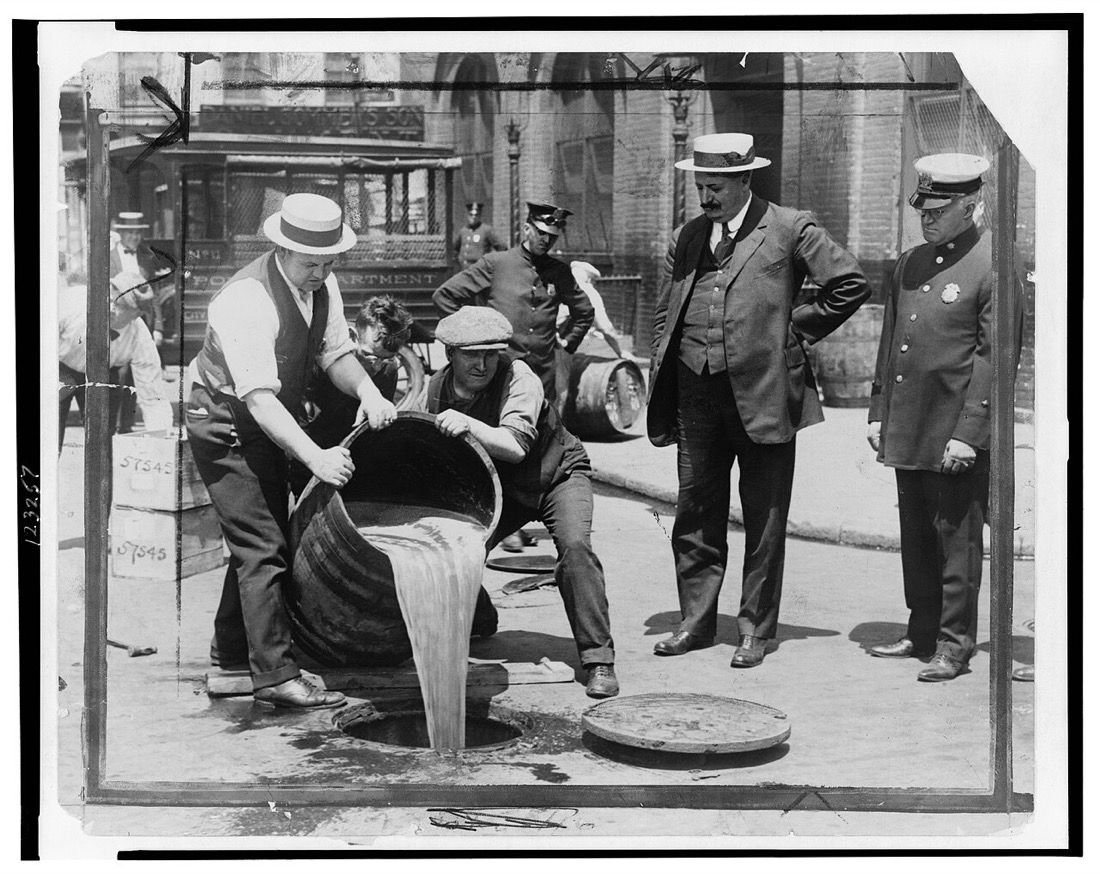
Visual AidContraband, poured down a drain
Photograph from New York City during Prohibition, about 1921: agents tip a seized barrel of liquor into the sewer while the deputy police commissioner watches, hands on hips. The barrel is contraband exactly as the Knowledge Bank defines the word — ordinary goods that became illegal the moment they moved outside the rules. The picture records enforcement done deliberately in public, where everyone can count the barrels. It does not claim the hoarded cans in Ember will meet any such end; what carries over is the word, not the fate.
New York City Deputy Police Commissioner John A. Leach (right) watching agents pour confiscated liquor into a sewer during Prohibition, c. 1921; Library of Congress. Source: Wikimedia Commons, File:5 Prohibition Disposal(9).jpg, public domain.
hoardv.Ch.13
To build up a hidden private store of scarce goods
“One man had learned to hoard while the shops emptied.”
pilferv.Ch.13
To steal small amounts again and again
“A clerk can pilfer a can at a time for years.”
contrabandn.Ch.13
Goods held or moved against the rules
“Every crate in that room was contraband.”
accomplicen.Ch.13–14
A person who helps another do wrong
“The carrier with the sack was an accomplice.”
clandestineadj.Ch.13
Kept secret because it is not allowed
“A clandestine door opened off the tunnel.”
corruptadj.Ch.14
Using public power for private gain
“A corrupt official counts the city’s goods as his own.”
incriminatev.Ch.14
To make someone appear guilty of a crime
“The crates alone were enough to incriminate him.”
auditn.Ch.14
An official check of records against actual stock
“No audit had ever counted those shelves.”
accountableadj.Ch.14–15
Required to explain and answer for your actions
“Nobody in Ember could hold the mayor accountable.”
denouncev.Ch.15
To accuse someone publicly of wrongdoing
“To denounce him aloud was suddenly dangerous.”
ⓘ The vocabulary words in this list are selected to help you understand and complete this workbook. Some may not appear verbatim in the original novel.
🧠Knowledge Bank question
1According to the Knowledge Bank, why is pilfering harder to notice than one large theft?Ch.13
2To ‘pilfer’ is to steal small amounts again and again.Ch.13
3Goods held or moved against the rules are ___.Ch.13
4A person who helps another do wrong is an ___.Ch.13–14
5Fill in each blank with the correct word.Ch.13–14
Word choices:clandestineaccountabledenounceaudit- some words will not be used
A door opened off the tunnel, listed on no map.
An official who must explain every crate is .
6To make someone appear guilty of a crime is to ___.Ch.14
7Someone who is ‘accountable’ never has to explain their decisions.Ch.14–15
8A ‘corrupt’ official uses public power for private gain.Ch.14
9Fill in each blank with the correct word.Ch.13–14
Word choices:pilferhoardauditincriminate- some words will not be used
Clerks a can at a time until the count stops matching.
A yearly compares the shelves against the paperwork.
10To accuse someone publicly of wrongdoing is to ___.Ch.15
Part 2
Comprehension
Show you understood what happens in Chapters 13–15.
📋Knowledge Bank · How Audits Catch Missing Goods
Public Administration · Oversight SystemsStopping theft from a public storehouse is mostly a matter of design rather than suspicion. Every item that arrives is recorded, every item that leaves is signed for, and the paperwork is then compared with a physical count of the shelves; a gap between the two is called a discrepancy, and it is the first thing investigators look for. Well-built systems also use separation of duties: the person who orders goods is not the person who receives them, and neither one keeps the books. Because a clerk who controls all three steps can hide losses for years, organizations rotate staff and hold surprise counts. The review itself is performed by an examiner employed by nobody inside the storehouse, and that independent review is the audit. Ember fails at the very first step, since the man who controls the supplies also controls everyone who might count them — which removes the one condition an audit cannot do without, its independence.
🧠Knowledge Bank question
1According to the Knowledge Bank, why does Ember fail at the very first step of oversight?Ch.13
2Where does Lina go when she follows the loaded sack?Ch.13
3What does Lina find inside the hidden room?Ch.13
4Who does Lina see in the storeroom?Ch.13
5Write the numbers 1–5 in the boxes to show the correct order of events in Chapters 13–15. Number 1 = what happens first.Ch.13–15
Lina follows a heavy sack down into the tunnels.
Guards begin looking for the two of them.
A lantern shows a room stacked high with crates.
Lina and Doon report the mayor to the guards’ office.
Lizzie hands Lina a treat no shop in Ember still sells.
6How does Lizzie react when Lina explains where the gifts come from?Ch.13–15
7Lina and Doon decide to keep the discovery entirely to themselves.Ch.14
8The office they report to opens a real investigation of the mayor.Ch.14
9After the report, the danger to Lina and Doon increases.Ch.14–15
10Why does the torn document matter more to the pair after these chapters?Ch.15
Part 3
Literary Elements
Understanding HOW and WHY Jeanne DuPrau (author) tells the story across Chapters 13–15.
🧠Knowledge Bank · Building a Discovery Scene
Literary Craft · Investigation PlotA discovery only feels earned when the reader has been handed the clues first. DuPrau plants small oddities — a treat no shop still sells, a sack too heavy for its errand — long before anyone says the word theft, so the reveal arrives as confirmation instead of coincidence. The chapters then borrow the shape of an investigation: notice, follow, see, report. Because readers learn what sits behind the tunnel door while most of Ember still hears speeches about shared hardship, the middle of this novel runs on dramatic irony. DuPrau also controls the rate of alarm through escalation: a suspicion becomes a fact, a fact becomes an accusation, and an accusation becomes a search for two names. Notice how the scenes shorten as the danger rises; a paragraph that once described a street now only moves a character across it. That tightening is what turns quiet work over a torn page into genuine suspense.
Investigation plot
Notice, follow, see, report — DuPrau borrows the shape of a detective case for a girl with a lantern.
Dramatic irony
Ember hears speeches about patience while the reader has already been shown the crates.
Escalation
A suspicion becomes a fact, a fact becomes an accusation, an accusation becomes a search.
🧠Knowledge Bank question
1According to the Knowledge Bank, what happens to the scenes as the danger in these chapters rises?Ch.13–15
2Fill in each blank with the correct literary term.Ch.13–15
Word choices:ironyescalationrhymesetting- some words will not be used
Speeches about shortage above a full storeroom create dramatic .
Each new threat raises the stakes, a pattern called .
3Readers see the crates before most of Ember does. That gap creates ___.Ch.13–14
4Lina stumbles onto the storeroom by pure accident, with no earlier hints.Ch.13
5The stacked crates work in the story mainly as ___.Ch.13
6These chapters use shorter, quicker scenes to build a sense of closing danger.Ch.14–15
7Why does DuPrau put Lizzie’s loyalty in the way of the truth?Ch.13–15
8Fill in the blank with the correct literary term.Ch.15
Word choices:suspensesummarypreviewmoral- some words will not be used
Guards searching while the two work on the page builds .
9The document scenes slow the story so the danger can be forgotten.Ch.15
10Chapters 13–15 mainly work to ___.Ch.13–15
Part 4
Think Deeper
Four deeper challenges — no single-word recall. Read, weigh the evidence, and reason it out.
💡Knowledge Bank · When Reporting Carries Risk
Ethics · Whistle-BlowingReporting wrongdoing inside an organization creates a predictable problem: the person best placed to see the wrong usually holds the least power. Someone who reports it is called a whistleblower, and many countries now forbid employers to fire, demote, or harass such a person, because punishment of that kind — retaliation — teaches everyone else to stay quiet. Ethics also asks about the route a report travels. A complaint delivered to an office controlled by the accused is not a safeguard at all; it is a warning handed to the wrong desk, which is precisely what happens to Lina and Doon. Sound systems therefore require independent channels, such as an ombudsman or an outside examiner, plus a firm rule that no one may decide a case in which they hold a personal interest. Judging these chapters means weighing more than one official’s appetite. It means asking why a citizen holding real evidence had nowhere honest to take it — a gap that is never bad luck but a failure of design.
Visual AidTwo roads for a report
Structure diagram of the design flaw the Knowledge Bank isolates: the same report can travel two roads. Route A ends at an office the accused already controls, so it arrives not as a safeguard but as a warning on the wrong desk; Route B — an independent auditor or ombudsman — can actually hear the case. Real organizations have more steps and more people than two arrows can show. The drawing judges no individual; the rule it pictures is that no one should decide a case in which they hold a personal interest — and Lina and Doon’s report goes down Route A.
Independent reporting channels as described in standard whistleblower-protection guidance, e.g. the U.S. Whistleblower Protection Act of 1989. Drawn for Garden Heights Academy.
Think back over these chapters. Something sweet appears on a table where nothing sweet has been for years, and a girl who has learned to notice things asks one quiet question too many. Then a heavy sack goes down into the tunnels, a lock turns, and a lantern lifts to show crates stacked past the height of a grown man — food, bulbs, cloth, every bit of it counted out of existence in the shops above. Somebody in that room has spent years telling the city to be patient. Two children carry the truth to the only door that is supposed to open for it, and the door opens onto the wrong face. After that, footsteps in the street mean something new, and a torn page they had treated as a puzzle becomes the only plan they own.
Original passage written for Garden Heights — not a quotation from the novel.
1Claim: “Ember’s shortages are a failure of oversight, not of luck.” — choose the two details that best prove it.Claim & Evidence
2What a working check would do, or What Ember actually does? Tap each detail to sort it — tap again to switch sides. You can keep tapping to change your answer.Sort into two
◄ What a working check would doWhat Ember actually does ►
3Match each cause to its result. For each cause, pick its result.Cause & Effect
Lizzie brings gifts no shop still sells→
Lina follows a loaded sack into the tunnels→
The pair reports the theft to a compromised office→
Guards begin searching for two names→
🧠Knowledge Bank question
4Fill both blanks to complete the reasoning.Build the Argument
The Knowledge Bank argues that Lina and Doon's report was doomed because , which shows that .
Part 5
Standardized Test
Reading passage · Keeping Officials Honest · Words in Context & Central Ideas · SAT & TOEFL-style practice
Read the passage — the highlighted words are tested — then answer. Tap an answer, then tap it again to confirm.
SATCentral Ideas — the passage's main point
SATWords in Context — a word's meaning in this passage
SATInference — a conclusion the passage implies
TOEFLFactual Information — a fact stated in the passage
TOEFLVocabulary — a tested word's meaning here
TOEFLProse Summary — the three sentences that sum it up
Who Watches the Watchers
Every society that hands resources to officials faces the same question: who checks the checkers? Ancient Athens answered with compulsory review — officials leaving public office had to submit their accounts for examination, and citizens could publicly denounce them before a panel. Imperial China maintained a censorate, a body of investigators whose duty was to report misconduct by officials at every level, including men who outranked them. Both systems rested on a habit modern governments still depend on: the audit, an independent check of records against reality. Much of an audit's power comes from being ordinary rather than accusing.
Modern oversight adds machinery to hold officials accountable. National auditors general and inspectors general review spending and publish their findings; purchasing rules demand competing bids and written justification; inventory systems separate the people who order goods from the people who receive them. Investigators usually begin with a discrepancy — a gap between what the paperwork claims and what the shelves actually hold. Sweden went further than most in 1809 by creating a parliamentary ombudsman, an official whose whole task was to receive citizens' complaints about the government and investigate them independently. The design principle is repetition: several separate sets of eyes, none of them appointed by the person under review.
The machinery still needs people willing to speak. Most wrongdoing is noticed first by someone inside the organization, and such a person is called a whistleblower. The risk they run is retaliation: being fired, demoted, transferred, or shunned for telling the truth. Because that risk silences witnesses, many countries have passed protection laws and opened confidential channels that bypass the accused person's own office. Wherever one official controls the goods, the records, the inspectors, and the punishment of complainers, no single safeguard survives on its own.
Original passage written for Garden Heights — not a quotation from the novel.
1What is the main idea of the passage?SAT · Central Ideas
2In the passage, an audit is ___.SAT · Words in Context
3In Athens, officials leaving public office had to ___.TOEFL · Factual Information
4The censorate of imperial China was ___.TOEFL · Factual Information
5In the passage, denounce most nearly means ___.TOEFL · Vocabulary
6Why do inventory systems separate ordering from receiving?TOEFL · Factual Information
7What did Sweden create in 1809?TOEFL · Factual Information
8Prose Summary (TOEFL).The passage explains how societies try to keep public officials honest. This TOEFL task lists six sentences; choose the THREE that best capture the passage’s main ideas. The other three do not belong — they state minor details or ideas the passage does not present.TOEFL · Prose Summary
9In the passage, accountable most nearly means ___.SAT · Words in Context
10Which Part 6 situation does this passage BEST explain?SAT · Inference
Part 6 · Optional
Creative Writing
A bonus challenge to practice your English. Take your time and have fun with it.
About This Section
This writing task is optional and is not part of your auto-graded score. The feedback below checks only the basics — length, spelling, and grammar — not whether your ideas are right or wrong. It is meant for classroom discussion and creative practice, so feel free to use your imagination!
Writing Task — Part 6 “The Wrong Desk”
Lina and Doon take the truth to the one place that is supposed to act on it — and it is the wrong desk. Write about a time you had to tell someone in charge that something was unfair or wrong. Who did you tell? What made it hard to speak? What happened next — and what would you do differently now? 6–10 sentences. End with the one thing you would say to someone in the same position.
You can start with: “I knew what I had seen, and I knew exactly who I was supposed to tell...”
0 / 40 words minimum
🗣 Teach It · Just for Fun (optional)
No right or wrong — close the screen and tell someone nearby what happened in this part. Can’t find anyone? Tell yourself out loud. The moment you teach it, you truly understand it.
Part 6 Complete!
You finished Chapters 13–15 of The City of Ember.
Here are your auto-graded results:
-
points out of 100
Teach it to someone
The best last step is to teach it. In your own words, explain what happened — retell a favorite scene, teach a character’s big choice, or sum up the main idea for a parent, friend, or classmate. When you can teach it clearly, you truly own it.
Independent study guide by Garden Heights. Not affiliated with or endorsed by Jeanne DuPrau. Contains original analysis only; no text from the novel is reproduced. Reference text: This workbook follows Jeanne DuPrau’s classic text (the standard Puffin edition sold worldwide). Revised 2023 UK editions change some wording and may not match the vocabulary studied here.
SAT® is a registered trademark of College Board, which is not affiliated with, and does not endorse, these materials. TOEFL® is a registered trademark of ETS. These materials are not endorsed or approved by ETS. Garden Heights is an independent provider of test-style reading practice.