New here? Just sign up with Google — your account includes Matilda, our gift book, forever.
The Cricket in Times Square · Garden Heights
Part 2
for The Cricket in Times Square · Part 2 · Chapters 3–4
8 Parts40 min
What Happens in Part 2
Alone with his new neighbor, the cricket — Chester — tells Tucker how a country musician ended up under Times Square. Home was a meadow in Connecticut, with an old tree stump for a house. Then a family spread a picnic nearby, and a delicious aroma floated over the grass: liverwurst. Chester hopped into the basket for one little taste, the sandwiches shifted, and he was buried — trapped in the dark while the basket rode a train all the way to New York City. When he finally struggled free, he was underground in the biggest, loudest world he had ever seen. Then a new shadow falls across the drainpipe: an enormous cat. Chester braces for disaster — a cat and a mouse! — but Harry Cat turns out to be Tucker’s oldest and best friend, gentle, deep-voiced, and wise in the ways of the city. Together the three new friends slip out to see Times Square at night, where the towering signs blaze so bright that Chester can hardly breathe — dazzled, terrified, and a very long way from his stump.
What We Will Learn
Section
What you will practice
Vocabulary
Words of the journey: meadow, aroma, tempting, struggle, enormous…
Literary Elements
Flashback, surprised expectations, and sensory imagery
Cross-Curricular
Why crickets really chirp, and how a basket rides a train to the city
Chapter Summary
Ch.
What happens
3
Chester — the cricket tells his story: a liverwurst-baited leap into a picnic basket, a burial in sandwiches, and a one-way ride from a Connecticut meadow to New York.
4
Harry Cat — a huge cat turns out to be Tucker’s best friend; the three explore, and Chester sees the blazing lights of Times Square at night.
Part 1
Vocabulary
Study 10 key words from Chapters 3–4, then answer each question.
🧠Knowledge Bank · A Thermometer with Legs
Insect Science · Chirp Rate & TemperatureA cricket’s chirp is not idle noise but a message with a job. Males rub their wings to call for a mate, to warn a rival off a patch of grass, or simply to announce that they are alive and well. Stranger still, the tempo tracks the weather. Crickets are cold-blooded, so warmth speeds the tiny muscles that work the wings and the song runs faster, while a cool night slows it down. Country people once counted chirps for fifteen seconds, added a fixed number, and landed close to the true temperature. A meadow in August is therefore a chorus of living thermometers, and a cricket singing under Times Square has carried that outdoor language down into a world of tile and steel.
Visual AidCount the chirps, read the weather
Chart for the Knowledge Bank on chirp rate and temperature. The three bars are chirps counted in fifteen seconds on a cool, a mild, and a warm night, and the red card is the country rule the Knowledge Bank mentions, with the fixed number filled in: add forty to the count and you land near the temperature in degrees Fahrenheit. The counts are typical examples, not a night from the book. Notice that the warm bar is twice the cool one — warmth doubles the tempo.
Chirp counts and the country rule as described in the Knowledge Bank; example values. Drawn for Garden Heights Academy.
meadown.Ch.3
A field of grass and wildflowers
“Chester’s meadow hummed with insects all summer long.”
stumpn.Ch.3
The bottom of a tree left after the trunk is cut
“The old stump made a snug home for a cricket.”
aroman.Ch.3
A pleasant smell, especially of food
“The aroma of liverwurst drifted across the grass.”
temptingadj.Ch.3
So attractive it is hard to resist
“One tempting sniff was all it took.”
strugglev.Ch.3
To try hard against something difficult
“Chester had to struggle out from under the sandwiches.”
journeyn.Ch.3
A trip, especially a long one
“His journey ended a hundred miles (160.9 km) from home.”
enormousadj.Ch.4
Extremely large; huge
“An enormous cat filled the mouth of the drainpipe.”
alarmedadj.Ch.4
Suddenly worried or frightened
“Chester was alarmed to see a cat so near his friend.”
companionn.Ch.4
A friend who spends time with you
“Harry had been Tucker’s companion for years.”
dazzledadj.Ch.4
Almost blinded by bright light; amazed
“Chester stood dazzled beneath the blazing signs.”
ⓘ The vocabulary words in this list are selected to help you understand and complete this workbook. Some may not appear verbatim in the original novel.
🧠Knowledge Bank question
1According to the Knowledge Bank, a cricket's song runs faster when ___.Ch.3
2An ‘aroma’ is an ugly sight that makes you look away.Ch.3
3Something so attractive that it is hard to resist is ___.Ch.3
4If you are ‘alarmed,’ you feel suddenly worried or frightened.Ch.4
5Fill in each blank with the correct word.Ch.3–4
Word choices:strugglestumpdazzledjourney- some words will not be used
An old tree was Chester’s house in the meadow.
He had to out from under the shifting sandwiches.
6A friend who spends time with you is a ___.Ch.4
7Something ‘enormous’ is extremely small and hard to see.Ch.4
8A trip, especially a long one, is a ___.Ch.3
9Fill in the blanks with the correct words.Ch.3–4
Word choices:dazzledaromacompaniontempting- some words will not be used
The of liverwurst floated over the picnic.
Chester stood under the lights of Times Square.
10To try hard against something difficult is to ___.Ch.3
Part 2
Comprehension
Show you understood what happens in Chapters 3–4.
🧠Knowledge Bank · An Hour of Track from Meadow to Midtown
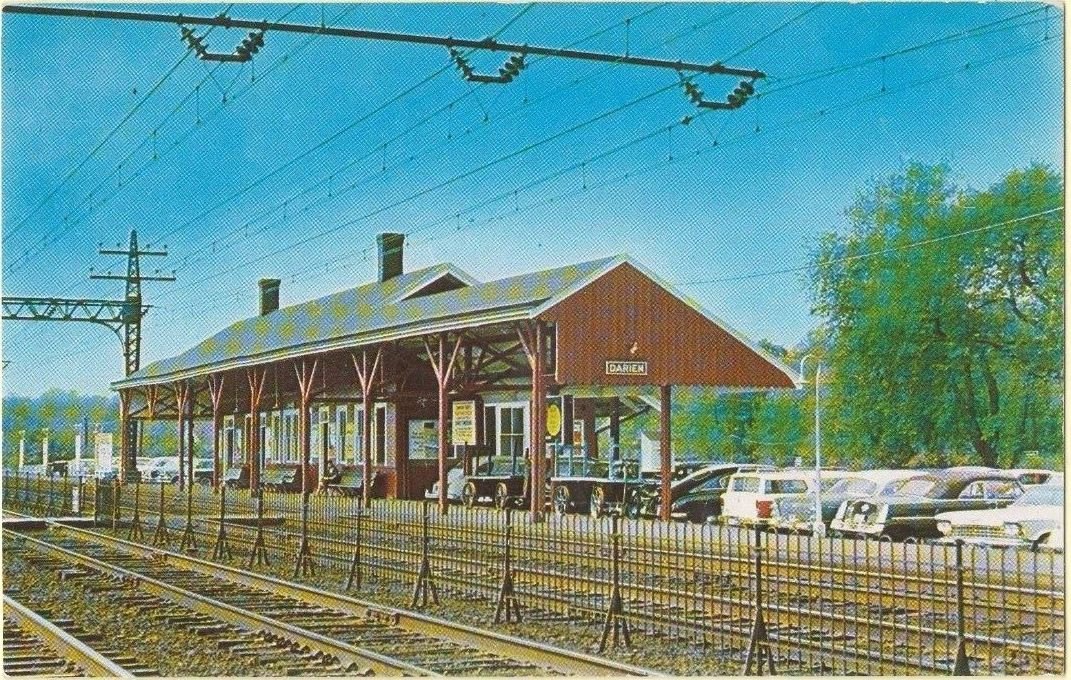
Regional Geography · Commuter RailroadsConnecticut begins just northeast of New York City, and in 1960 its green towns emptied into Manhattan every weekday morning by rail. Commuter lines ran out of Grand Central by the hundreds of trips a day, carrying office workers in and, at evening, carrying them home again; the same families rode those cars out to the country for a summer picnic. A basket packed beside a Connecticut stump could sit on a luggage rack within the hour and be under Manhattan before dark. That is the plain mechanism behind Chester’s accident: he did not fly or wander to the city, he rode it, asleep beneath the sandwiches like unpaid freight. Tracing such a chain of causes is how a pile of happenings becomes a story.
Visual AidA Connecticut station on the line to Grand Central
Midcentury postcard of the railroad station at Darien, Connecticut, on the New Haven line that runs into Grand Central Terminal, with electric wires strung above the tracks and cars parked beside the platform. The Knowledge Bank explains that Connecticut’s green towns emptied into Manhattan by rail every weekday morning and that the same families rode those cars out to the country for a summer picnic. A station like this one is where a picnic basket would climb aboard. Nothing says Chester’s basket passed through Darien; it is one Connecticut stop among many on that line, and the card dates from the 1950s or 1960s, the story’s own era. Notice the wires above the tracks — electric trains, an hour of track from meadow to midtown.
Midcentury postcard of the railroad station at Darien, Connecticut, 1950s–1960s; publisher unknown. Source: Wikimedia Commons, public domain.
🧠Knowledge Bank question
1The Knowledge Bank says Chester reached the city by ___.Ch.3
2What lured Chester into the picnic basket?Ch.3
3Chester planned his trip to New York carefully for many weeks.Ch.3
4Why couldn’t Chester escape from the basket?Ch.3
5Write the numbers 1–5 in the boxes to show the correct order of events in Chapters 3–4. Number 1 = what happens first.Ch.3–4
Chester hops into the basket for a taste.
Three friends look out at Times Square by night.
A train carries the buried stowaway to New York.
A delicious smell drifts over the meadow grass.
An enormous cat appears at the drainpipe.
6When Harry Cat first appears, Chester is afraid for Tucker’s safety.Ch.4
7What is the true relationship between Harry Cat and Tucker?Ch.4
8How does Chester react to seeing Times Square at night?Ch.4
9Chapter 3 is mostly set in the present moment at the newsstand.Ch.3
10What do the two chapters together show about Chester’s situation?Ch.3–4
Part 3
Literary Elements
Understanding HOW and WHY George Selden tells the story across Chapters 3–4.
🧠Knowledge Bank · A Story Inside the Story
Literary Craft · FlashbackWhen Chester describes his journey, Selden stops the present and steps backward in time. That move is a flashback — a scene set before the main action, dropped into the middle of it like a door cut in a hallway wall. The author opens it, we walk into an earlier season, then we come back out and keep going. Writers take the trouble because a character makes far more sense once you know where he has been. Hearing about a quiet meadow and moonlit singing explains exactly why a roaring station feels so wrong to him now. Good readers keep a firm grip on when a story means now and when it means then, so the two never blur into one confused present.
Flashback
A scene from before the story’s present — Chester’s meadow, basket, and train ride, told to Tucker at the newsstand.
Surprised expectation
The author sets up what readers expect — cat hunts mouse — then delivers the opposite: Harry and Tucker are best friends.
Sensory imagery
Words aimed at the senses — the blazing signs and roaring streets of Times Square as a cricket’s eyes and ears take them in.
🧠Knowledge Bank question
1According to the Knowledge Bank, a flashback is ___.Ch.3
2Fill in the blank with the correct literary term.Ch.3–4
Word choices:imageryflashbackmoralrhyme- some words will not be used
A scene set before the story’s present is a .
Words aimed at the reader’s senses create .
3Selden has Chester tell his own journey, instead of describing it directly, mainly because ___.Ch.3
4The friendship of Harry and Tucker is surprising because readers expect cats to hunt mice.Ch.4
5Describing Times Square through Chester’s dazzled senses makes the city seem ___.Ch.4
6The liverwurst in Chapter 3 works in the plot as ___.Ch.3
7In Chapter 4, Selden describes the city lights exactly as a human adult would see them.Ch.4
8Fill in the blank with the correct literary term.Ch.4
Word choices:expectationsettingsequelchorus- some words will not be used
Setting up cat-hunts-mouse and delivering friendship surprises the reader’s .
9Chester’s mixed feelings at the end of Chapter 4 — dazzled AND terrified — tell readers that ___.Ch.4
10Chapters 3 and 4 sit side by side — one all past, one all present. This structure mainly lets readers ___.Ch.3–4
Part 4
Think Deeper
Four deeper challenges — no single-word recall. Read, weigh the evidence, and reason it out.
🧠Knowledge Bank · The Cat Who Befriends the Mouse
Social-Emotional · Unlikely FriendsIn a field a cat hunts a mouse and a mouse flees a cat, yet Harry and Tucker share a drainpipe like two old roommates. Selden knows the pairing is a shock, and he uses it. Real friendship, the book argues, is not built on being the same; it is built on choosing, over and over, to be decent across a difference that could easily have made you enemies. Harry could pounce and instead keeps watch. Tucker could hide and instead trusts. When a lost country cricket turns up, the odd pair simply widens its circle without fuss. The warmest thing a newcomer can find in a crowded city is company that measures him not by what he is but by how he behaves — which is what makes such a bond rich.
Think back over the chapters. A cricket rides a hundred miles (160.9 km) in the dark, pressed under somebody’s lunch, and climbs out into a world of thunder and electric fire. Within a day he has lost a meadow and gained a mouse who talks like a salesman and a cat who purrs like a philosopher. At midnight the three of them look out on Times Square, where the signs burn brighter than any moon the meadow ever raised — and the smallest one of them wonders whether he has arrived somewhere wonderful, somewhere terrible, or somehow both.
Original passage written for Garden Heights — not a quotation from the novel.
1Claim: “Chester’s journey to New York was a pure accident.” — choose the two details that best prove it.Claim & Evidence
2What Chester expects, or What turns out true? Tap each detail to sort it — tap again to switch sides. You can keep tapping to change your answer.Sort into two
◄ What Chester expectsWhat turns out true ►
3Match each cause to its result. For each cause, pick its result.Cause & Effect
The aroma of liverwurst drifts over the meadow→
The sandwiches shift and pile over him→
The family carries the basket onto a train→
An enormous cat pads up to the drainpipe→
🧠Knowledge Bank question
4Fill both blanks to complete the reasoning.Build the Argument
The Knowledge Bank says real friendship is built on , which is why a newcomer is measured by .
Part 5
Standardized Test
Reading passage · The City Under the City · SAT & TOEFL-style practice
Read the passage — the highlighted words are tested — then answer. Tap an answer, then tap it again to confirm.
SATCentral Idea — the passage's main point
SATWords in Context — a word's meaning in this passage
SATInference — a conclusion the passage implies
SATText Connections — how two parts of the text relate
TOEFLFactual Information — a fact stated in the passage
TOEFLVocabulary — a tested word's meaning here
TOEFLProse Summary — the three sentences that sum it up
New York's Underground World
Beneath the streets of New York runs a second city. Its avenues are train tunnels, its town squares are stations, and its weather never changes — warm, windy, and lit by electric light. The subway opened in 1904, and by the middle of the century its trains carried millions of riders every day. Its busiest crossroads lay under Times Square, where several lines met and a special short train called the shuttle ran back and forth to Grand Central Terminal, ferrying crowds between the two great stations. An underground station is a world of its own. Stairways pour people down from the sidewalks; newsstands and lunch counters serve them as they hurry past; and the air hums with an enormous din of wheels, brakes, and a thousand echoing footsteps. Most riders notice none of it — they are too busy rushing to work or home. But for the small creatures who live in its warm corners, the station is not a passage to somewhere else. It is a complete world, with food, shelter, dangers, and — once in a great while — a little unexpected music.
Original passage written for Garden Heights — not a quotation from the novel.
1What is the main idea of the passage?SAT · Central Idea
2According to the passage, when did the New York subway open?TOEFL · Factual Information
3In the passage, ferrying most nearly means ___.TOEFL · Vocabulary
4What is the shuttle?TOEFL · Factual Information
5In the passage, an enormous din is ___.SAT · Words in Context
6According to the passage, what makes the underground’s ‘weather’ unusual?TOEFL · Factual Information
7The passage says most riders notice little about the station because they ___.SAT · Inference
8For the small creatures who live there, the station is described as ___.TOEFL · Factual Information
9The closing words about ‘a little unexpected music’ connect the passage to ___.SAT · Text Connections
10Prose Summary (TOEFL).The passage describes the world of the New York subway. This TOEFL task lists six sentences; choose the THREE that best capture the passage’s main ideas. The other three do not belong — they state minor details or ideas the passage does not present.TOEFL · Prose Summary
Part 6 · Optional
Creative Writing
A bonus challenge to practice your English. Take your time and have fun with it.
About This Section
This writing task is optional and is not part of your auto-graded score. The feedback below checks only the basics — length, spelling, and grammar — not whether your ideas are right or wrong. It is meant for classroom discussion and creative practice, so feel free to use your imagination!
Writing Task — Part 2 “Buried in Somebody’s Lunch”
Chester’s whole life changes because of one tempting smell. Now tell the story of an accidental journey from the traveler’s point of view: you are a small creature (or a small object!) that gets carried somewhere far away by mistake. What carried you? What did you hear and feel along the way? Describe the journey in 6–10 sentences, using at least three senses — the way Selden lets us feel the dark basket and hear the roaring city.
You can start with: “I only meant to stay for a moment, but then everything above me shifted...”
0 / 40 words minimum
🗣 Teach It · Just for Fun (optional)
No right or wrong — close the screen and tell someone nearby what happened in this part. Can’t find anyone? Tell yourself out loud. The moment you teach it, you truly understand it.
Part 2 Complete!
You finished Chapters 3–4 of The Cricket in Times Square.
Here are your auto-graded results:
-
points out of 100
Teach it to someone
The best last step is to teach it. In your own words, explain what happened — retell a favorite scene, teach a character’s big choice, or sum up the main idea for a parent, friend, or classmate. When you can teach it clearly, you truly own it.
Independent study guide by Garden Heights. Not affiliated with or endorsed by George Selden. Contains original analysis only; no text from the novel is reproduced. Reference text: This workbook follows George Selden’s classic text (the standard Puffin edition sold worldwide). Revised 2023 UK editions change some wording and may not match the vocabulary studied here.
SAT® is a registered trademark of College Board, which is not affiliated with, and does not endorse, these materials. TOEFL® is a registered trademark of ETS. These materials are not endorsed or approved by ETS. Garden Heights is an independent provider of test-style reading practice.