New here? Just sign up with Google — your account includes Matilda, our gift book, forever.
The Cricket in Times Square · Garden Heights
Part 3
for The Cricket in Times Square · Part 3 · Chapters 5–6
8 Parts40 min
What Happens in Part 3
Sunday morning belongs to Chester. Mario feeds his cricket bread, sugar, and even a Brussels sprout, and at the lunch counter Mickey the counterman mixes the smallest strawberry soda in New York. Then Mr. Smedley — a music teacher and the newsstand’s best customer — stops by to talk Italian opera with Papa, and Mario proudly asks Chester to demonstrate his chirp. The teacher goes very still: the cricket is sounding a perfect middle C. Smedley conducts the tiny musician like an orchestra, declares that great things are surely in store, and even mentions Orpheus, the legendary musician of the Greeks. Fired with pride, Mario rides the subway to Chinatown to find his cricket a proper home. In a shop stacked with wonders he meets old Sai Fong, who is overjoyed to meet a cricket-keeper. He brings out a pagoda-shaped cage that once housed an emperor’s cricket, adds a tiny silver bell as a gift, and tells the legend of Hsi Shuai, the truthful man the gods transformed into the very first cricket — which is why wisdom and truth live in a cricket’s song. Mario leaves with a bargain price and a fortune cookie that reads: good luck is coming — be ready.
What We Will Learn
Section
What you will practice
Vocabulary
Words of music and wonder: demonstrate, conduct, opera, legend, fortune…
Literary Elements
Foreshadowing, allusion, and a legend inside the story
Cross-Curricular
What middle C really is, and why crickets are treasured in China
Chapter Summary
Ch.
What happens
5
Sunday Morning — breakfast treats, a tiny strawberry soda, and Mr. Smedley’s discovery: Chester chirps a perfect middle C, and great things are in store.
6
Sai Fong — Mario travels to Chinatown, where Sai Fong sells him an emperor’s pagoda cage, gifts a silver bell, and tells the legend of the first cricket.
Part 1
Vocabulary
Study 10 key words from Chapters 5–6, then answer each question.
🧠Knowledge Bank · What Makes a Note a Note
Sound Science · Pitch & FrequencySound is nothing but air trembling, and the speed of that trembling has a name: frequency. Fast vibration arrives at the ear as a high note and slow vibration as a low one, and musicians call the result a note’s pitch. Middle C — the note at the center of a piano keyboard and the home base of every beginner — is air shivering about two hundred and sixty times each second, no more and no less. What turns a chirp into music is not loudness but that exactness: the wings must land on the number rather than beside it. A rare few people can name any note from memory alone, a gift called perfect pitch, which is why a trained music teacher goes still when an untaught insect holds a true, steady C.
Visual AidFast trembling, high note
Diagram for the Knowledge Bank on pitch and frequency. Each wavy line stands for air trembling: the top line trembles slowly and reaches the ear as a low note, the gold middle line trembles about two hundred and sixty times each second and is middle C, and the bottom line trembles fast and is heard as a high note. The waves are drawn to compare, not to scale — a real middle C would need far more ripples than the page can hold. Notice that only the speed changes; the height of the waves, which is loudness, stays the same.
Slow, middle-C and fast vibration as described in the Knowledge Bank; not to scale. Drawn for Garden Heights Academy.
customern.Ch.5
A person who buys from a shop or business
“Mr. Smedley was the newsstand’s best customer.”
operan.Ch.5
A play in which the story is sung to music
“Papa and Mr. Smedley loved to talk about Italian opera.”
demonstratev.Ch.5
To show how something works or is done
“Mario asked Chester to demonstrate his beautiful chirp.”
conductv.Ch.5
To lead musicians as they play
“Mr. Smedley began to conduct the chirping cricket.”
noveltyn.Ch.6
Something new, unusual, and interesting
“Sai Fong’s shop sold every kind of Chinese novelty.”
pagodan.Ch.6
A tower with many curved, stacked roofs
“The little cage was shaped like a golden pagoda.”
legendn.Ch.6
An old story handed down over many years
“Sai Fong told the legend of the very first cricket.”
transformv.Ch.6
To change something completely
“In the legend, the gods transform a man into a cricket.”
fortunen.Ch.6
Luck, or what will happen to someone
“The cookie promised good fortune on its little slip.”
wisdomn.Ch.6
Deep understanding of what is true and right
“A cricket’s song, said Sai Fong, carries wisdom and truth.”
ⓘ The vocabulary words in this list are selected to help you understand and complete this workbook. Some may not appear verbatim in the original novel.
🧠Knowledge Bank question
1According to the Knowledge Bank, pitch depends on ___.Ch.5
2To ‘demonstrate’ something is to hide it so no one can see it.Ch.5
3To lead musicians as they play is to ___ them.Ch.5
4A ‘pagoda’ is a tower with many curved, stacked roofs.Ch.6
5Fill in each blank with the correct word.Ch.5–6
Word choices:legendcustomerconductnovelty- some words will not be used
Mr. Smedley was the stand’s best .
Sai Fong told the of the first cricket.
6Something new, unusual, and interesting is a ___.Ch.6
7If the gods ‘transform’ a man, they leave him exactly as he was.Ch.6
8Deep understanding of what is true and right is ___.Ch.6
9Fill in the blanks with the correct words.Ch.5–6
Word choices:fortunepagodaoperatransform- some words will not be used
The cage was shaped like a tiny golden .
The cookie’s slip promised good ahead.
10A person who buys from a shop or business is a ___.Ch.5
Part 2
Comprehension
Show you understood what happens in Chapters 5–6.
🧠Knowledge Bank · Two Worlds, One Subway Ride
Urban History · Chinatown & the Lunch CounterNew York’s Chinatown grew up in lower Manhattan in the 1800s, built by immigrants from China who opened groceries, teahouses, herb shops, and markets along a few narrow streets. By 1960 it was a world of its own — roast duck hanging in windows, silk and porcelain behind glass, and novelty shops where a curious visitor might find paper lanterns or a carved cricket cage. A single subway ride carried a boy from a roaring station into that neighborhood. Uptown stood the other great small business of the age: before fast food, New Yorkers perched on stools at a lunch counter while a counterman poured coffee and mixed sodas by hand from syrup, soda water, and ice cream. Both counters teach the same lesson about an enormous city: welcome is handed across a counter one cup, one cage, one shopkeeper.
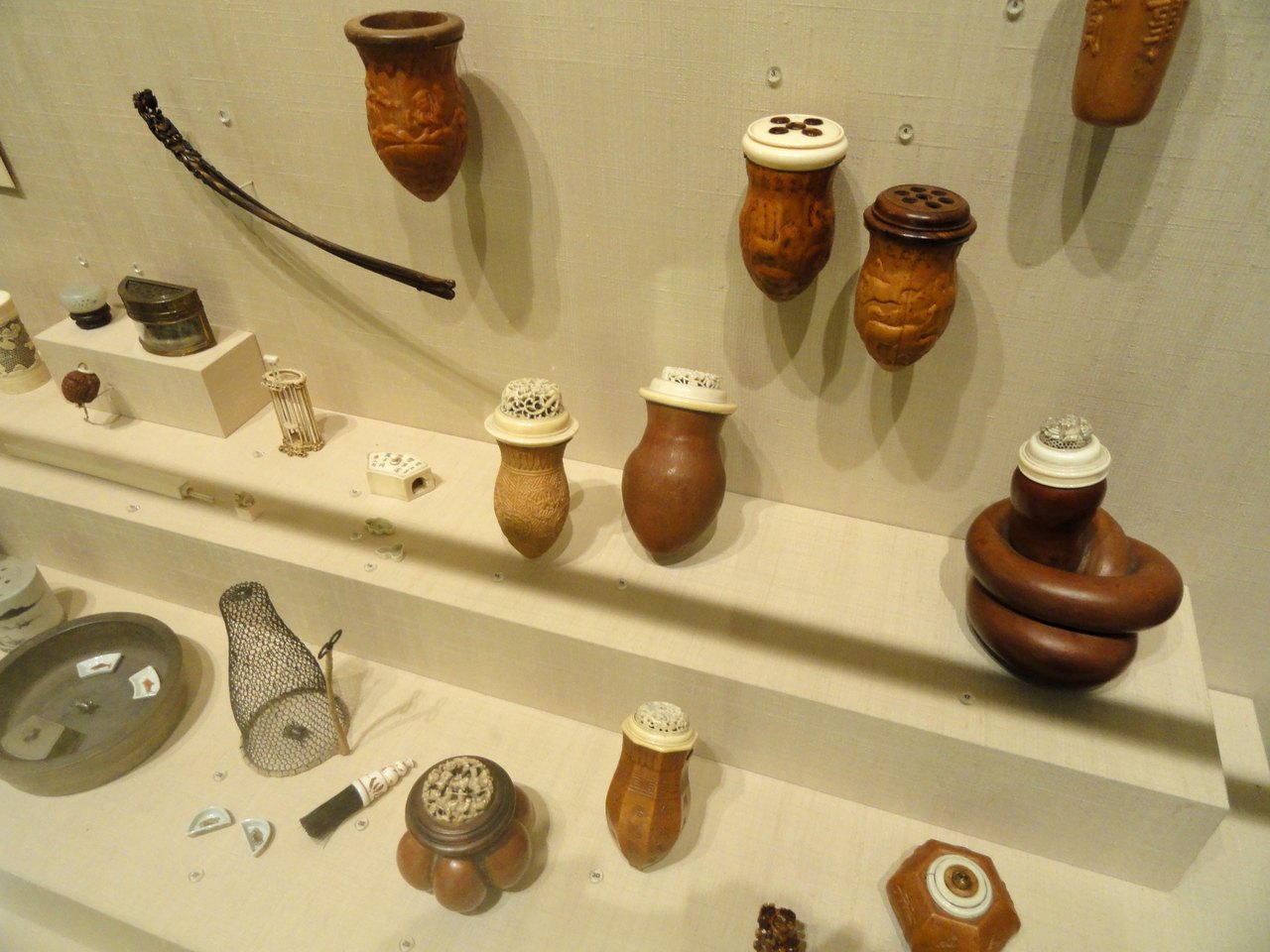
Visual AidCricket cages from China
Photograph of a museum case of Chinese cricket-keeping gear at the Nelson-Atkins Museum of Art in Kansas City: carved gourds with pierced lids for carrying a singing cricket, small dishes for its food and water, slender tools, and a little wire cage. The Knowledge Bank says a curious visitor to a Chinatown novelty shop in 1960 might find a carved cricket cage; these are the older, finer cousins of such a cage, made for a tradition of keeping crickets for their song that reaches back centuries in China. They are museum pieces, not shop goods, and none of them came from Sai Fong’s shelves. Notice the pierced lids — the song gets out while the cricket stays in.
Cricket-keeping paraphernalia from China, Nelson-Atkins Museum of Art, Kansas City; photograph by Daderot, released under CC0. Source: Wikimedia Commons, CC0.
🧠Knowledge Bank question
1The Knowledge Bank says both counters teach that welcome is ___.Ch.5
2What does Mr. Smedley discover about Chester’s chirp?Ch.5
3Mr. Smedley compares Chester to Orpheus, the great musician of Greek legend.Ch.5
4Why does Mario travel to Chinatown?Ch.6
5Write the numbers 1–5 in the boxes to show the correct order of events in Chapters 5–6. Number 1 = what happens first.Ch.5–6
Mr. Smedley recognizes a perfect middle C.
A fortune cookie promises good luck on the way.
Mario rides the subway to Chinatown.
Mario treats Chester to a Sunday breakfast.
Sai Fong brings out the emperor’s pagoda cage.
6Sai Fong charges Mario extra money because the cage is so old and rare.Ch.6
7According to Sai Fong’s legend, who was Hsi Shuai?Ch.6
8What does Sai Fong say is contained in a cricket’s song?Ch.6
9The pagoda cage once belonged to a cricket kept by an emperor.Ch.6
10What message does Mario’s fortune cookie hold?Ch.6
Part 3
Literary Elements
Understanding HOW and WHY George Selden tells the story across Chapters 5–6.
🧠Knowledge Bank · Painting with the Five Senses
Literary Craft · ImagerySelden rarely announces that a place is interesting; he lets you taste it. Language aimed at the five senses is called imagery, and it works because the brain treats a well-described smell almost like a real one, stirring memory and feeling along with the picture. Through the Chinatown chapters come colors, aromas, the fizz of a soda counter, and the clink of a bell no bigger than a raindrop. Imagery also suits this particular book, since a story about the beauty of sound naturally crowds itself with things to hear. As you read, mark the words that touch a sense and watch how a flat sentence turns vivid the instant an author lets you see, smell, or listen.
Foreshadowing
Hints of what is to come — a teacher’s prophecy and a fortune cookie’s promise, pointing at the same future.
Allusion
A reference to a famous older story — naming Orpheus ties a subway cricket to the greatest musician in Greek myth.
Legend
An old story handed down for generations — Hsi Shuai, the truthful man who became the first cricket.
🧠Knowledge Bank question
1According to the Knowledge Bank, imagery works because ___.Ch.5–6
2Fill in the blank with the correct literary term.Ch.5–6
Word choices:allusionlegendclimaxdialogue- some words will not be used
Naming Orpheus, a figure from Greek myth, is an .
Sai Fong’s tale of Hsi Shuai is a .
3The allusion to Orpheus suggests that Chester’s music may one day ___.Ch.5
4The legend of Hsi Shuai gives Chester’s song a deeper meaning: truth lives inside it.Ch.6
5By placing a legend inside his novel, Selden mainly ___.Ch.6
6The gifts in Chapter 6 — a bargain, a bell, a cookie — show Sai Fong is ___.Ch.6
7An allusion is a reference to a famous older story or figure.Ch.5
8Fill in the blank with the correct literary term.Ch.5
Word choices:foreshadowingsettingmoralstanza- some words will not be used
A hint about what will happen later in a story is .
9Chapter 5’s talk of opera and Chapter 6’s talk of legends surround Chester with ___.Ch.5–6
10Chapter 6 ends not with the cage but with the fortune cookie’s message. Ending there leaves readers feeling ___.Ch.6
Part 4
Think Deeper
Four deeper challenges — no single-word recall. Read, weigh the evidence, and reason it out.
🧠Knowledge Bank · A Gift Can Say You Belong
Social-Emotional · The Welcome of StrangersA city of millions can feel cold, and Part 3 answers that coldness with one warm stranger. Sai Fong barely knows Mario, yet he treats the cricket as a wonder, tells the boy an old story about crickets and luck, and sends him home with a gift. Small kindnesses do a large job: without a word of explanation they inform a newcomer that he is welcome here. Immigrant neighborhoods themselves grew from that same impulse — people far from their first homes building a place where their food, language, and customs could survive and be shared with anyone curious enough to walk in. A stranger who offers wonder instead of suspicion can turn a frightening city into somewhere a lost cricket, and a shy boy, may slowly begin to belong.
Think back over the chapters. On Sunday morning a cricket breakfasts like a little king — bread, sugar, a soda the size of a raindrop. A man who has taught music all his life hears one chirp and goes still, as if the station had spoken. That same afternoon, in a shop smelling of incense a world away from Times Square, an old man lifts down a cage built for an emperor’s cricket and tells of a truthful man who became the first of Chester’s kind. By suppertime the cricket has a palace, a silver bell, and two prophecies — and he has not yet performed a single song.
Original passage written for Garden Heights — not a quotation from the novel.
1Claim: “Chester’s special talent is already being noticed.” — choose the two details that best prove it.Claim & Evidence
2Sunday at the station, or The Chinatown visit? Tap each detail to sort it — tap again to switch sides. You can keep tapping to change your answer.Sort into two
◄ Sunday at the stationThe Chinatown visit ►
3Match each cause to its result. For each cause, pick its result.Cause & Effect
Mario asks Chester to demonstrate his chirp→
Mario decides his cricket deserves a proper home→
Sai Fong meets a true cricket-keeper at last→
Sai Fong tells the legend of Hsi Shuai→
🧠Knowledge Bank question
4Fill both blanks to complete the reasoning.Build the Argument
The Knowledge Bank says Sai Fong's small kindnesses , which shows that a stranger offering wonder instead of suspicion can .
Part 5
Standardized Test
Reading passage · The Luckiest House Guest · SAT & TOEFL-style practice
Read the passage — the highlighted words are tested — then answer. Tap an answer, then tap it again to confirm.
SATCentral Idea — the passage's main point
SATWords in Context — a word's meaning in this passage
SATInference — a conclusion the passage implies
SATText Connections — how two parts of the text relate
TOEFLFactual Information — a fact stated in the passage
TOEFLVocabulary — a tested word's meaning here
TOEFLNegative Factual Information — the statement the passage does NOT support
Crickets as Lucky Charms in China
In China, the cricket has been an honored guest for more than a thousand years. Long ago, farmers listened for the first cricket song of the season, which told them the fields were warming and it was nearly planting time. In the palaces, crickets were treasured for their voices: emperors and fine ladies kept singing crickets in beautiful cages of bamboo, gourd, and gold, and carried them close to enjoy their music through the autumn. Some cages were elaborate little palaces themselves, shaped like tiny towers. A cricket in the house came to be seen as a happy omen — a sign of luck, plenty, and cheerfulness under that roof, a singer thought to bring the whole family good fortune. Poets wrote verses to their crickets; children raised them tenderly; and a fine singer might be treasured like a jewel. Chinese families who later settled in cities far away carried the custom with them, along with their food, their festivals, and their music. So when an old shopkeeper meets a boy who keeps a cricket, he is not meeting a stranger with a strange pet. He is meeting the newest keeper of a very old and lucky tradition.
Original passage written for Garden Heights — not a quotation from the novel.
1What is the main idea of the passage?SAT · Central Idea
2According to the passage, what did the first cricket song of the season tell farmers?TOEFL · Factual Information
3In the passage, good fortune is ___.SAT · Words in Context
4According to the passage, cricket cages were made of ___.TOEFL · Factual Information
5In the passage, elaborate most nearly means ___.TOEFL · Vocabulary
6In the passage, an omen is ___.SAT · Words in Context
7All of the following are named in the passage as ways people honored crickets EXCEPT ___.TOEFL · Negative Factual Information
8A cricket in the house was seen as a sign of ___.TOEFL · Factual Information
9The final sentences suggest that Sai Fong welcomes Mario so warmly because ___.SAT · Inference
10Which moment from the chapters does this passage BEST explain?SAT · Text Connections
Part 6 · Optional
Creative Writing
A bonus challenge to practice your English. Take your time and have fun with it.
About This Section
This writing task is optional and is not part of your auto-graded score. The feedback below checks only the basics — length, spelling, and grammar — not whether your ideas are right or wrong. It is meant for classroom discussion and creative practice, so feel free to use your imagination!
Writing Task — Part 3 “The Legend of the First…”
Sai Fong explains a cricket’s song with a legend: the first cricket was once a truthful man. Now invent YOUR own legend that explains an animal’s special gift — why the firefly glows, why the owl asks ‘who,’ why the cat purrs. Who was the animal before? What did the gods see in them? Tell your legend in 6–10 sentences, and end it the way Sai Fong does — with what the gift still means today.
You can start with: “Long ago, before the first firefly glowed, there lived a child who was afraid of the dark...”
0 / 40 words minimum
🗣 Teach It · Just for Fun (optional)
No right or wrong — close the screen and tell someone nearby what happened in this part. Can’t find anyone? Tell yourself out loud. The moment you teach it, you truly understand it.
Part 3 Complete!
You finished Chapters 5–6 of The Cricket in Times Square.
Here are your auto-graded results:
-
points out of 100
Teach it to someone
The best last step is to teach it. In your own words, explain what happened — retell a favorite scene, teach a character’s big choice, or sum up the main idea for a parent, friend, or classmate. When you can teach it clearly, you truly own it.
Independent study guide by Garden Heights. Not affiliated with or endorsed by George Selden. Contains original analysis only; no text from the novel is reproduced. Reference text: This workbook follows George Selden’s classic text (the standard Puffin edition sold worldwide). Revised 2023 UK editions change some wording and may not match the vocabulary studied here.
SAT® is a registered trademark of College Board, which is not affiliated with, and does not endorse, these materials. TOEFL® is a registered trademark of ETS. These materials are not endorsed or approved by ETS. Garden Heights is an independent provider of test-style reading practice.