New here? Just sign up with Google — your account includes Matilda, our gift book, forever.
The Tale of Despereaux · Garden Heights
Part 2
for The Tale of Despereaux · Part 2 · Chapters 9–15 · Book the First
8 Parts40 min
What Happens in Part 2
Furlough’s report reaches their father, Lester, who does the unthinkable: he beats the drum that summons the Mouse Council to judge his own son. Before the assembled mice, Despereaux is condemned for sitting at the king’s foot and speaking with the princess. The narrator hands us the exact word for what his family does — perfidy, the breaking of faith — and asks us to remember it. Offered one chance to renounce his love and beg pardon, Despereaux stands in front of them all and refuses: he is not sorry. The sentence is the dungeon — from which no mouse returns — and the Threadmaster ties the red thread of death around his neck. His mother offers only a fluttering French adieu; his own brother helps roll him down the stairs into the dark. Falling, fainting, waking in blackness that smells of despair, Despereaux does what heroes do: he tells himself the old story — knight, maiden, honor — and walks forward. And there the dark produces a giant: Gregory the jailer, rope tied to his ankle, who closes a huge hand around the mouse and offers an impossible bargain: Gregory will save him — if Despereaux tells Gregory a story.
What We Will Learn
Section
What you will practice
Vocabulary
Words of the trial: council, perfidy, renounce, condemn, dungeon, adieu…
Literary Elements
The red thread as symbol, character versus society, and the theme of courage
Cross-Curricular
What castle dungeons really were, and why stories keep prisoners alive
Chapter Summary
Ch.
What happens
9–11
The Drum — Lester summons the Mouse Council against his own son; the word for it is perfidy.
12–13
The Trial — asked to renounce his love, Despereaux refuses before them all: he is not sorry.
14
The Red Thread — the Threadmaster ties the mark of death; a fluttered adieu; down the stairs into the dark.
15
Gregory — the giant jailer with a rope at his ankle offers a bargain: a life for a story.
Part 1
Vocabulary
Study 10 key words from Chapters 9–15 · Book the First, then answer each question.
🧠Knowledge Bank · Down to the Dungeon
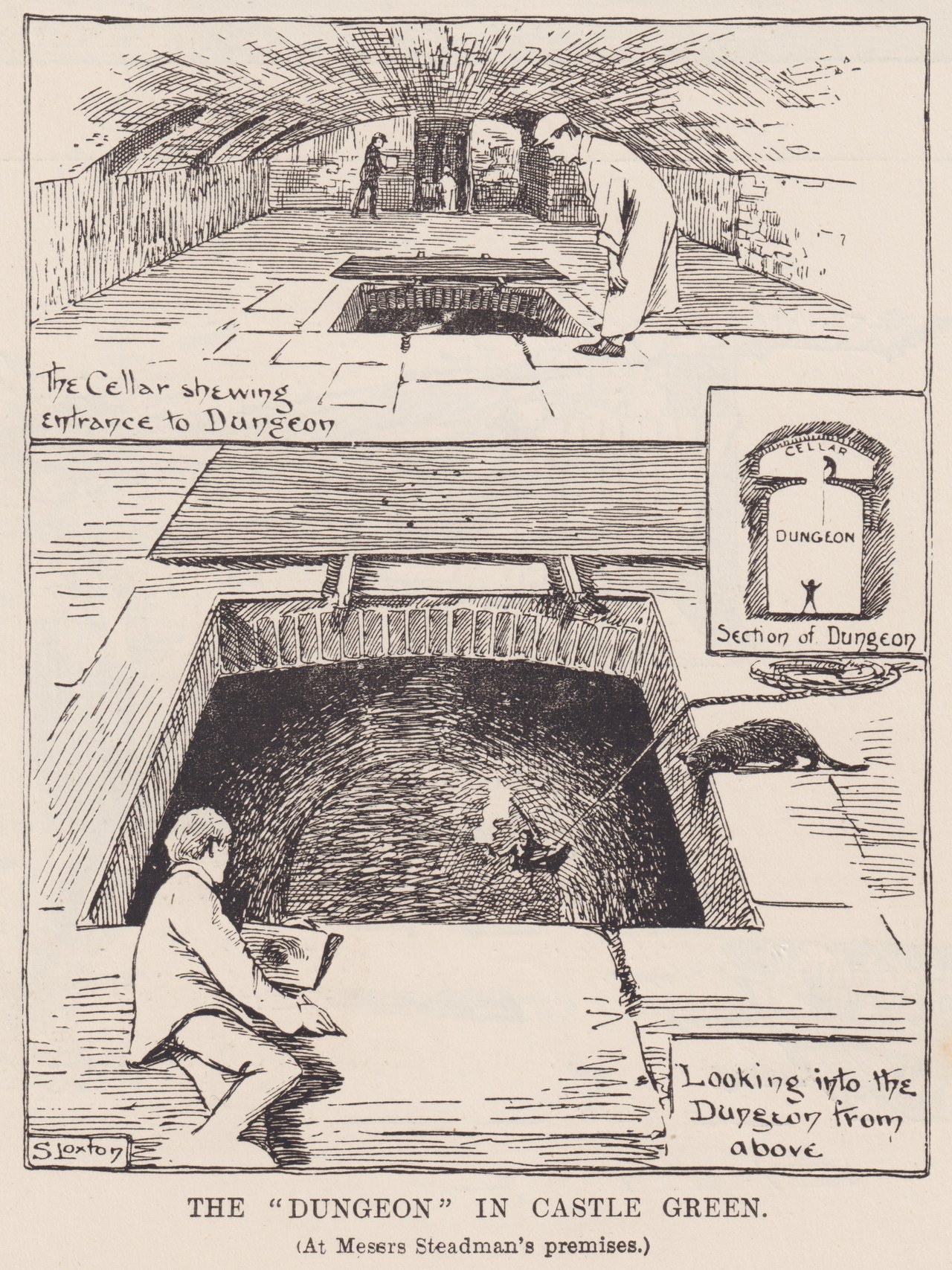
History · The Dungeon When the mouse council sentences Despereaux to the dungeon, DiCamillo reaches for one of the most feared rooms of the real medieval castle. A great castle was built in layers of light: bright halls and towers above, busy kitchens and workrooms between, and far below, cut into cold rock, the dungeon — damp, lightless, and forgotten. The worst cells carried a name that tells you everything: the oubliette, from the French word meaning ‘to forget,’ a pit where a prisoner was dropped and simply left, out of sight and out of mind. That is why sending a mouse down to the rats is so terrible — it is not only danger but erasure, a fall out of the world of the living. In this book, going down always means going into the forgotten.
Visual AidA pit beneath a castle
A pen drawing from 1908 recording a dungeon beneath Castle Green in Bristol, England. The Knowledge Bank explains that a great castle was built in layers of light, bright halls above and, far below, a dungeon cut into cold rock, and that the worst cells carried a name from the French word meaning to forget. Look at the upper panel and then the lower one. The only way in is a hole in the ceiling, which is the whole point of the design.
Drawing of the dungeon at Castle Green, Bristol, 1908, by Samuel Loxton. Source: Wikimedia Commons, public domain.
counciln.Ch.9–11
A group that meets to make decisions
“The Mouse Council gathered to judge him.”
perfidyn.Ch.10
Betrayal; the breaking of faith
“The narrator names the family’s act: perfidy.”
renouncev.Ch.12–13
To give something up formally
“He would not renounce his love.”
condemnv.Ch.13
To declare guilty and sentence
“The council condemned him to the dungeon.”
dungeonn.Ch.13–15
A castle’s dark underground prison
“No mouse returns from the dungeon.”
solemnadj.Ch.13–14
Deeply serious and grave
“The threading was a solemn ceremony.”
banishv.Ch.13
To send away, never to return
“To banish a mouse below was to end him.”
adieun.Ch.14
A goodbye (from the French)
“His mother fluttered one small adieu.”
faintv.Ch.14–15
To lose consciousness briefly
“Falling, the little mouse fainted.”
jailern.Ch.15
The keeper of a prison
“Gregory the jailer ruled the dark.”
ⓘ The vocabulary words in this list are selected to help you understand and complete this workbook. Some may not appear verbatim in the original novel.
🧠Knowledge Bank question
1According to the Knowledge Bank, the word oubliette comes from a French word meaning ___.Ch.9–11
2‘Perfidy’ means loyalty and kept promises.Ch.10
3To give something up formally is to ___ it.Ch.12–13
4To ‘condemn’ someone is to declare them innocent.Ch.13
5Fill in each blank with the correct word.Ch.13–14
Word choices:dungeonadieusolemnbanish- some words will not be used
No mouse ever returns from the .
His mother fluttered one small .
6Deeply serious and grave describes a ___ ceremony.Ch.13–14
7To ‘banish’ someone is to welcome them home.Ch.13
8The keeper of a prison is a ___.Ch.15
9Fill in the blanks with the correct words.Ch.10–15
Word choices:perfidyfaintjailerrenounce- some words will not be used
The narrator names the family’s act: .
Falling through the dark, the mouse began to .
10A goodbye, borrowed from the French, is an ___.Ch.14
Part 2
Comprehension
Show you understood what happens in Chapters 9–15 · Book the First.
🧠Knowledge Bank · The Trial, Step by Step
Reading Skill · Cause & Effect This part runs like a machine, and your job as a reader is to trace the exact order of its gears. Lay the events out in sequence: a brother reports the crime, the father drums his son to trial, the council questions him, he refuses to repent, a red thread is tied about his neck, and he is carried down the stairs into the dark. Watch how each step causes the next — how one small choice by one frightened mouse triggers the whole grinding response of a society protecting itself. Keeping this cause-and-effect chain straight matters, because the book will later ask you to remember precisely who did what to whom: which mouse drummed, which mouse hoped, which turned away. Track the ledger carefully now; a tale that braids this many threads repays only the reader who kept an honest count.
Visual AidThe trial, gear by gear
Diagram for the Knowledge Bank on cause and effect. The six numbered cards are the order the Knowledge Bank lays out, read left to right and then down. No feeling is recorded, because the Knowledge Bank asks only for the sequence. Notice that step 4 is the only one that is a choice; every other step is a machine turning.
The order of the trial, as described in the Knowledge Bank. Drawn for Garden Heights Academy.
🧠Knowledge Bank question
1The Knowledge Bank says this part runs like a machine, so a reader should trace ___.Ch.9–11
2What single chance is Despereaux offered at the trial?Ch.12–13
3Despereaux tells the council he is sorry for loving the princess.Ch.12–13
4What does the Threadmaster do?Ch.14
5Write the numbers 1–5 in the boxes to show the correct order of events in Chapters 9–15. Number 1 = what happens first.Ch.9–15
Down the stairs he goes, into the dungeon’s dark.
Before the council, Despereaux refuses to renounce his love.
Lester beats the drum and summons the Mouse Council.
Gregory the jailer offers a bargain: a life for a story.
The Threadmaster ties the red thread around his neck.
6His mother fights the council’s sentence to the end.Ch.14
7What does Despereaux do to steady himself in the dark?Ch.14–15
8Why does Gregory keep a rope tied to his ankle?Ch.15
9Gregory offers to save Despereaux in exchange for a story.Ch.15
10Which family members take part in Despereaux’s downfall?Ch.9–14
Part 3
Literary Elements
Understanding HOW and WHY Kate DiCamillo tells the story across Chapters 9–15 · Book the First.
🧠Knowledge Bank · The Thread and the Refusal
Author’s Craft · Symbol & ConflictThe red thread knotted around Despereaux’s neck is the part’s central symbol, and a symbol is an ordinary object asked to carry meaning heavier than itself. Tied on by the council, the thread means death and shame — a mark that says this one is finished. But watch it closely, because fairy-tale burdens are made to transform; the very same thread will return later wearing an opposite meaning. The trial itself is the purest kind of character-versus-society conflict: a single small heart set against the assembled law of its own people, everyone certain, everyone frightened, all of them wrong. And through the whole ordeal shines the book’s quiet theme of courage — not a hero who feels no fear, but one who, trembling and hopelessly outnumbered, still will not speak the lie the crowd demands. That refusal, more than any sword, is what the story counts as bravery.
Symbol
The red thread — tied on as a mark of death, and marked itself for transformation.
Character vs. Society
One mouse against the assembled law of his own people — and family.
Theme of Courage
Not fearlessness — the trembling refusal to renounce what he knows is true.
🧠Knowledge Bank question
1According to the Knowledge Bank, a symbol is an ordinary object asked to ___.Ch.14
2Fill in the blank with the correct literary term.Ch.9–13
Word choices:societycourageimagerynarrator- some words will not be used
One mouse against his people’s law is character versus .
Refusing the lie while trembling is the theme of .
3The narrator teaching the word ‘perfidy’ mid-scene does what?Ch.10
4Despereaux’s courage is shown as fearlessness — he trembles at nothing.Ch.12–14
5The council demanding he renounce love — not apologize for trespass — reveals the trial’s true target: ___.Ch.12–13
6Gregory trading a life for a story plants the book’s claim that ___.Ch.15
7A symbol may mean one thing when introduced and grow into another by the end.Ch.14
8Fill in the blank with the correct literary term.Ch.14
Word choices:symbolcourageconflicttone- some words will not be used
An object carrying meaning beyond itself, like the red thread, is a .
9Telling himself the knight’s story in the dark shows Despereaux using stories as ___.Ch.14–15
10The family’s perfidy is placed EARLY in the book because the ending will need ___.Ch.9–14
Part 4
Think Deeper
Four deeper challenges — no single-word recall. Read, weigh the evidence, and reason it out.
🧠Knowledge Bank · The Price of Not Renouncing
Think Deeper · The Cost of Honesty One sentence would have unlocked the whole trap: I am sorry, and I take it all back. The council does not truly want Despereaux dead; it wants him to renounce — to declare that his love for the princess was wrong and to promise to be an ordinary, fearful mouse again. To renounce would buy his life at the price of his honesty, and Despereaux has already decided that a life kept by a lie is not worth keeping. Weigh both sides fairly: the refusal costs him his home, his family, and nearly his life, yet it preserves the one thing the council can never reach — his belief that what he felt was real. Notice, too, that the dark he is thrown into offers its own bargain through Gregory, and bargains will matter in this book. Sometimes the bravest thing a small creature owns is a costly, unshaken refusal.
Think back over the trial. A drumbeat, and a father’s face behind it. Rows of proper mice, and one small prisoner offered a single sentence of escape — who answers instead that he is not sorry. A thread red as a wound, tied with ceremony. Stairs, darkness, the smell of despair. And then the dark itself strikes a match: a giant’s voice, a rope, and the strangest ransom ever named — tell Gregory a story.
Original passage written for Garden Heights — not a quotation from the novel.
1Claim: “Despereaux’s refusal to renounce is principle, not stubbornness.” — choose the two details that best prove it.Claim & Evidence
2The council’s law, or Despereaux’s law? Tap each detail to sort it — tap again to switch sides. You can keep tapping to change your answer.Sort into two
◄ The council’s lawDespereaux’s law ►
3Match each cause to its result. For each cause, pick its result.Cause & Effect
Furlough reports what he saw at the throne→
Despereaux refuses to renounce his love→
The sentence requires its solemn mark→
A giant in the dark hungers for light→
🧠Knowledge Bank question
4Fill both blanks to complete the reasoning.Build the Argument
The Knowledge Bank says the council does not truly want Despereaux dead; it wants him to , and he refuses because a life kept by a lie is .
Part 5
Standardized Test
The Castle’s Darkest Floor · SAT & TOEFL-style practice
Read the passage — the highlighted words are tested — then answer. Tap an answer, then tap it again to confirm.
SATWords in Context — a word's meaning in this passage
SATDetail — a fact stated in the passage
SATInference — a conclusion the passage implies
SATText Connections — how two parts of the text relate
TOEFLFactual Information — a fact stated in the passage
TOEFLProse Summary — the three sentences that sum it up
Life Inside a Castle Dungeon
Beneath every great castle lay its underground, and in the grimmest corner of it, the dungeon. A castle was first a fortress, built for war, and its cellars served war’s needs: storerooms for siege grain, wells and cisterns for the months when the gates stayed shut. Deeper still lay the cells, where a captive, an enemy knight, a traitor, a debtor, could be held beyond any hope of rescue. The deepest cells of all were reached through a trapdoor in the ceiling, and French builders called such a pit an oubliette, from their word for forget.
Darkness was the dungeon’s true wall. Underground no window ever opened; light lived and died with the jailer’s torch, and when it withdrew, a prisoner’s world shrank to sounds, water dripping, doors above, the scurry of the cellar’s other tenants. Those keepers themselves took care never to be lost, because the passages twisted and a man who missed a turning joined the darkness he guarded. Some marked walls, some counted steps, and some, the old and wise ones, simply tied a rope to an ankle and paid it out behind them, a thread leading always back to the light.
Original passage written for Garden Heights — not a quotation from the novel.
1In the passage, a castle was first a ___.TOEFL · Factual Information
2In the passage, a jailer is ___.SAT · Words in Context
3What was an oubliette?TOEFL · Factual Information
4What does the passage call the dungeon’s ‘true wall’?SAT · Detail
5Where did light live and die underground?TOEFL · Factual Information
6When light withdrew, a prisoner’s world shrank to ___.SAT · Detail
7Why did jailers fear the passages themselves?SAT · Inference
8What was the old jailers’ wisest trick?TOEFL · Factual Information
9How does the passage connect to Chapters 13–15?SAT · Text Connections
10Prose Summary (TOEFL).The passage describes what castle dungeons were and how their darkness ruled. This TOEFL task lists six sentences; choose the THREE that best capture the passage’s main ideas. The other three do not belong — they state minor details or ideas the passage does not present.TOEFL · Prose Summary
Part 6 · Optional
Creative Writing
A bonus challenge to practice your English. Take your time and have fun with it.
About This Section
This writing task is optional and is not part of your auto-graded score. The feedback below checks only the basics — length, spelling, and grammar — not whether your ideas are right or wrong. It is meant for classroom discussion and creative practice, so feel free to use your imagination!
Writing Task — Part 2 “The Story I Would Tell in the Dark”
Gregory demands a story as ransom. You are in the dark, and one well-told tale is your candle and your payment. Which story would you tell — and how would you begin it so a giant leans closer? Write your opening. Write at least 40 words.
You can start with: “Once, when the world still believed in…”
0 / 40 words minimum
🗣 Teach It · Just for Fun (optional)
No right or wrong — close the screen and tell someone nearby what happened in this part. Can’t find anyone? Tell yourself out loud. The moment you teach it, you truly understand it.
Part 2 Complete!
You finished Chapters 9–15 · Book the First of The Tale of Despereaux.
Here are your auto-graded results:
-
points out of 100
Teach it to someone
The best last step is to teach it. In your own words, explain what happened — retell a favorite scene, teach a character’s big choice, or sum up the main idea for a parent, friend, or classmate. When you can teach it clearly, you truly own it.
Independent study guide by Garden Heights. Not affiliated with or endorsed by Kate DiCamillo. Contains original analysis only; no text from the novel is reproduced. Reference text: This workbook follows Kate DiCamillo’s classic text (the standard Puffin edition sold worldwide). Revised 2023 UK editions change some wording and may not match the vocabulary studied here.
SAT® is a registered trademark of College Board, which is not affiliated with, and does not endorse, these materials. TOEFL® is a registered trademark of ETS. These materials are not endorsed or approved by ETS. Garden Heights is an independent provider of test-style reading practice.