New here? Just sign up with Google — your account includes Matilda, our gift book, forever.
The Tale of Despereaux · Garden Heights
Part 3
for The Tale of Despereaux · Part 3 · Chapters 16–23 · Book the Second
8 Parts40 min
What Happens in Part 3
The story turns back in time, and down — to the dungeon-born rat with the impossible name: Chiaroscuro, called Roscuro, a name that means the play of light and dark. Roscuro is a wrong-souled rat the way Despereaux is a wrong-souled mouse: one day a match flares in the blackness, and he is entranced — he decides that light is the meaning of life. His elder, Botticelli Remorso, swinging a locket and smiling, teaches the opposite philosophy: the meaning of life is the suffering of others — specifically, arranging it. Torn between torch and torment, Roscuro goes upstairs, into the light — and into catastrophe. At a royal banquet, he climbs to the chandelier to watch the glitter; discovered, he loses his grip and falls, ridiculous and terrible, straight into the Queen’s soup. The Queen’s heart stops; she dies with soup on her lips. Fleeing, Roscuro looks up into the one face that might have understood — and Princess Pea gives him a look of pure disgust. Something in the rat breaks. He steals the Queen’s silver spoon, descends, and vows revenge; above him, the grieving king outlaws soup itself — kettles, bowls, spoons and all — and declares every rat an outlaw.
What We Will Learn
Section
What you will practice
Vocabulary
Words of light and dark: chiaroscuro, philosophy, banquet, chandelier, vow, outlaw…
Literary Elements
The sympathetic villain, the light-and-dark motif, and the turning point
Cross-Curricular
Chiaroscuro in Renaissance art, and why one look can change a heart
Chapter Summary
Ch.
What happens
16–17
A Rat Named for Light — dungeon-born Chiaroscuro is entranced by a match’s flame.
18–19
Botticelli’s Lesson — the elder rat’s philosophy: life’s meaning is others’ suffering.
20–22
The Chandelier — upstairs to the banquet; the fall into the Queen’s soup; the Queen’s death.
23
The Look — the Pea’s disgust breaks Roscuro’s heart; a spoon stolen, revenge vowed; soup and rats outlawed.
Part 1
Vocabulary
Study 10 key words from Chapters 16–23 · Book the Second, then answer each question.
🧠Knowledge Bank · Why a Rat Loves the Dark
Zoology · Eyes Made for Dark Roscuro is a rat who aches for light, and that longing is a quiet rebellion against his own body. Real rats are built for the opposite life: they are nocturnal, most awake when the world goes black, and their eyes are tuned for gloom rather than glare. An eye sees dim scenes using cells called rods, which drink in the faintest light but cannot read color or fine detail; strong light overwhelms them, which is one reason a rat flinches from the open and hurries for the shadow. So when Roscuro turns his face up toward a shaft of light and loves what he sees, he is wanting the very thing his kind is built to avoid — and in this book, to desire the forbidden light is the first small crack that begins to make a villain.
Visual AidTwo kinds of cell in an eye
Diagram for the Knowledge Bank on eyes made for the dark. Card 1 is the cell type the Knowledge Bank names for dim scenes and card 2 is its opposite, with the red card recording which row a rat lives by. No numbers are given, because the Knowledge Bank describes the difference rather than measuring it. Notice that the strength of rods is also their weakness: what reads the faintest light is overwhelmed by a lot of it.
Rods and cones, as described in the Knowledge Bank. Drawn for Garden Heights Academy.
chiaroscuron.Ch.16
The play of light and dark (an art term)
“His name, Chiaroscuro, means light-and-dark.”
entrancedadj.Ch.16–17
Spellbound; filled with wonder
“The match’s flame left him entranced.”
philosophyn.Ch.18
A way of thinking about life’s meaning
“Botticelli taught a dark philosophy.”
sufferingn.Ch.18
Great pain of body or heart
“The meaning of life, said the old rat, is others’ suffering.”
banquetn.Ch.20
A grand, formal feast
“The royal banquet glittered below.”
chandeliern.Ch.20–21
A branched, hanging holder of lights
“He climbed to the chandelier to watch.”
ridiculousadj.Ch.21
Deserving laughter; absurd
“A rat in the soup is ridiculous — and terrible.”
disgustn.Ch.23
Strong dislike, close to sickness
“The Pea’s look was pure disgust.”
vowv.Ch.23
To promise solemnly
“In the dark, Roscuro vowed revenge.”
outlawv.Ch.23
To make something against the law
“The grieving king outlawed soup itself.”
ⓘ The vocabulary words in this list are selected to help you understand and complete this workbook. Some may not appear verbatim in the original novel.
🧠Knowledge Bank question
1According to the Knowledge Bank, the cells that read dim light are called ___.Ch.16
2Someone ‘entranced’ is bored and looking away.Ch.16–17
3A way of thinking about life’s meaning is a ___.Ch.18
4A ‘banquet’ is a grand, formal feast.Ch.20
5Fill in each blank with the correct word.Ch.20–21
Word choices:chandelierridiculousbanquetentranced- some words will not be used
He climbed to the to watch the glitter.
A rat in the soup is — and terrible.
6To promise something solemnly is to ___ it.Ch.23
7To ‘outlaw’ something is to make it required by law.Ch.23
8Great pain of body or heart is ___.Ch.18
9Fill in the blanks with the correct words.Ch.18–23
Word choices:vowphilosophydisgustoutlaw- some words will not be used
Botticelli taught his dark with a smile.
The Pea’s look was pure .
10A branched, hanging holder of lights is a ___.Ch.20–21
Part 2
Comprehension
Show you understood what happens in Chapters 16–23 · Book the Second.
🧠Knowledge Bank · The Making of a Villain
Reading Skill · Sequence & Turning PointBook Two is an origin story — the account of how a creature becomes what it becomes — and the skill it asks of you is precise ordering. Lay Roscuro’s path out step by step: a rat born in darkness, a strange hunger for light, a cruel lesson from an older prisoner, a glittering banquet glimpsed from above, a tumble into the queen’s soup, her death from fright, and then the moment that changes everything. Now hunt for the single hinge on which accident tips over into villainy. It is not the fall, which was clumsy chance; it is the look — the instant the princess gazes down at him with disgust, and something in Roscuro closes and hardens for good. Learning to spot the exact turning point in a sequence is a reader’s sharpest tool, because in this book, as in life, the order of the events is the real argument.
🧠Knowledge Bank question
1The Knowledge Bank says Book Two asks you to hunt for the single hinge on which ___.Ch.16
2What first entrances Roscuro?Ch.16–17
3Botticelli Remorso teaches that the meaning of life is the suffering of others.Ch.18
4Why does Roscuro climb toward the chandelier?Ch.20–21
5Write the numbers 1–5 in the boxes to show the correct order of events in Chapters 16–23. Number 1 = what happens first.Ch.16–23
Met by the Pea’s disgust, Roscuro vows revenge.
Botticelli teaches his philosophy of suffering.
The Queen dies with soup on her lips.
A match’s flame entrances the young dungeon rat.
Roscuro falls from the chandelier into the soup.
6The Queen recovers quickly from the shock of the rat.Ch.21–22
7What breaks something inside Roscuro as he flees?Ch.23
8What does Roscuro take with him back to the dark?Ch.23
9In his grief, the king outlaws soup, spoons, kettles, and bowls.Ch.23
10What does Roscuro vow at Book Two’s end?Ch.23
Part 3
Literary Elements
Understanding HOW and WHY Kate DiCamillo tells the story across Chapters 16–23 · Book the Second.
🧠Knowledge Bank · A Villain Painted in Light and Dark
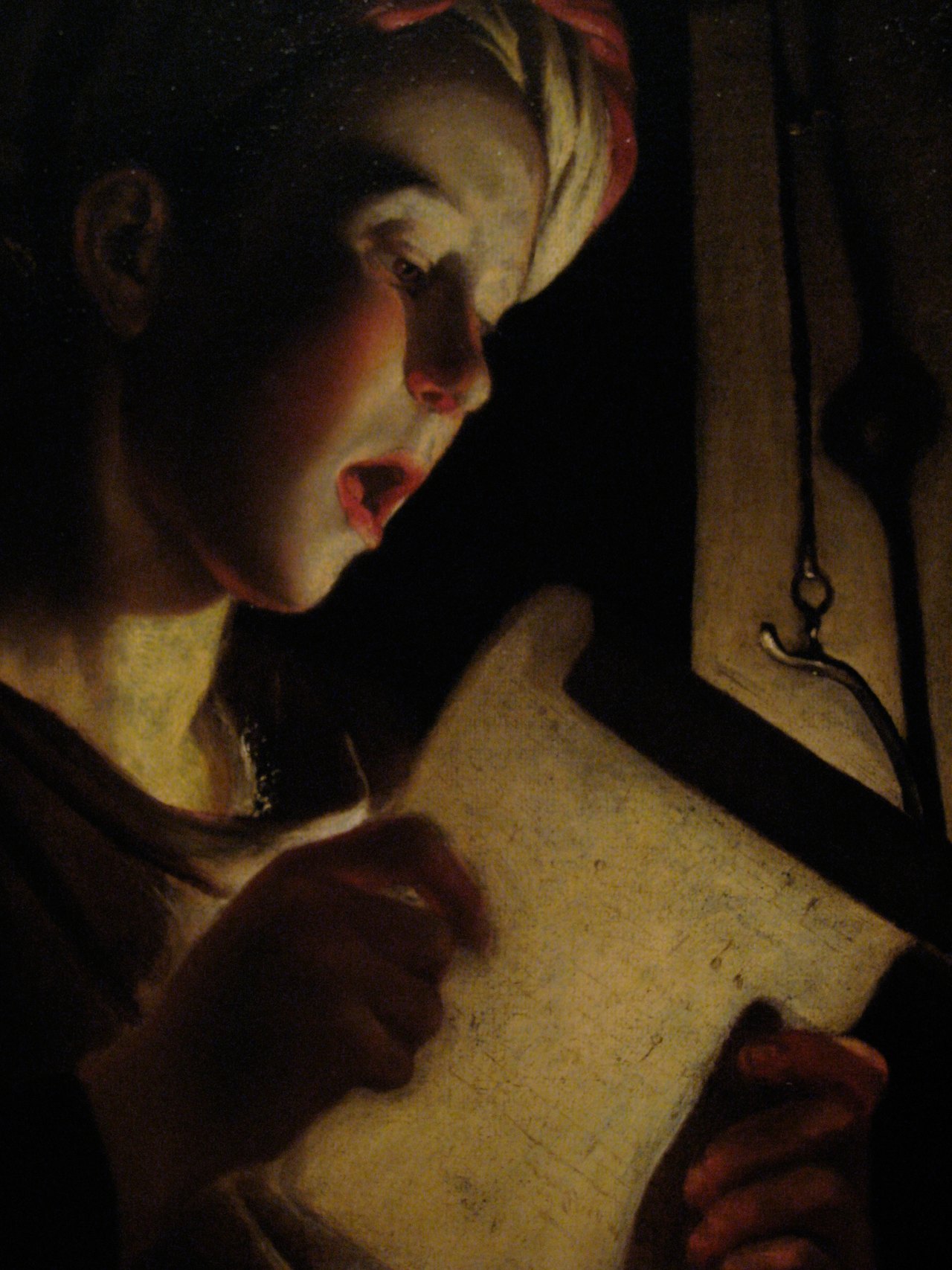
Author’s Craft · Light & Dark Book Two hands us a sympathetic villain — a creature we pity before we ever fear him, one who wanted nothing worse than a little brightness and was answered with cruelty. DiCamillo paints him using the book’s master motif, the endless play of light against dark, and she writes it right into his name: Chiaroscuro, an artist’s word for the mingling of shadow and glow on a single canvas. Watch how his turning point is staged in exactly these terms: he climbs toward the banquet’s candles, tumbles into the soup, and is met not by welcome but by a look that shoves him back down into the black. A motif is never mere decoration; it is meaning made visible, and here the tug between light and dark inside one small heart becomes the book’s whole question.
Visual AidA face lit by a single flame
A painting of a boy singing by candlelight, made around 1650 in the manner of Georges de La Tour. The Knowledge Bank explains that DiCamillo paints her villain using the book’s master motif, the endless play of light against dark, and writes it into his name, an artist’s word for the mingling of shadow and glow on one canvas. Notice how little of the room you are given. Almost the whole picture is dark, which is precisely what makes the lit part matter.
Young Boy Singing by candlelight, circa 1650, in the manner of Georges de La Tour. Source: Wikimedia Commons, public domain.
Sympathetic Villain
An enemy the reader pities first — a rat who wanted light and was handed darkness.
Light-and-Dark Motif
The book’s master pattern — torch and dungeon, soup and grief, split down a rat’s name.
Turning Point
The exact hinge of a soul — not the fall but the Pea’s look, and the vow it births.
🧠Knowledge Bank question
1According to the Knowledge Bank, Roscuro is a villain we ___.Ch.16–23
2Fill in the blank with the correct literary term.Ch.16–23
Word choices:motifturning pointimagerydialogue- some words will not be used
Light against dark, repeating through the book, is its master .
The Pea’s look, hinging Roscuro’s soul, is his .
3Giving the rat a name that means ‘light-dark’ tells the reader that ___.Ch.16
4Roscuro falls into the soup on purpose, as revenge.Ch.21
5Botticelli’s role in Book Two is that of ___.Ch.18
6Placing the Queen’s death at a BANQUET — the castle’s brightest scene — uses the light-dark motif to show ___.Ch.20–22
7A turning point can be as small as a single look.Ch.23
8Fill in the blank with the correct literary term.Ch.16–23
Word choices:sympathetic villainmotifironytheme- some words will not be used
An enemy whose making we watch with pity is a .
9The stolen spoon works as a symbol of ___.Ch.23
10The king outlawing soup dramatizes how ___.Ch.23
Part 4
Think Deeper
Four deeper challenges — no single-word recall. Read, weigh the evidence, and reason it out.
🧠Knowledge Bank · Who Made Roscuro?
Think Deeper · Light vs Dark in People When a good creature turns cruel, who holds the blame? Book Two refuses to hand you a single guilty party; instead it deals out responsibility in pieces and asks you to weigh each one. There is the match and the cruel old prisoner who taught him that suffering is owed; there is the accident of the fall; there is the queen’s sudden death; and there is the look that met his shame with contempt. The book keeps pity and judgment in the very same hand: Roscuro chooses his revenge and is responsible for it, yet we cannot forget the frightened, light-loving rat he was first. That double vision — understanding a villain without excusing him — is the hardest and most grown-up kind of reading, because it insists that the darkness in a person almost always began as wounded light.
Think back over the rat’s making. A creature born to blackness sees one match flare and cannot forget it. His teacher swings a locket and preaches suffering. Upstairs, the light he longed for turns him ridiculous in the one moment the whole court is watching; a queen dies of the sight of him. And fleeing, he looks for mercy in the brightest face in the kingdom — and finds disgust. The spoon he steals is heavy. The vow he makes is heavier.
Original passage written for Garden Heights — not a quotation from the novel.
1Claim: “Roscuro becomes a villain by wounds, not by nature.” — choose the two details that best prove it.Claim & Evidence
2What pulls Roscuro toward the light, or What chains him to the dark? Tap each detail to sort it — tap again to switch sides. You can keep tapping to change your answer.Sort into two
◄ What pulls Roscuro toward the lightWhat chains him to the dark ►
3Match each cause to its result. For each cause, pick its result.Cause & Effect
A match flares in the dungeon black→
Botticelli pours his lesson for years→
A grip slips on the chandelier→
The Pea’s face closes in disgust→
🧠Knowledge Bank question
4Fill both blanks to complete the reasoning.Build the Argument
The Knowledge Bank says Book Two refuses to hand you a single guilty party and instead , keeping pity and judgment .
Part 5
Standardized Test
Painting with Light and Dark · SAT & TOEFL-style practice
Read the passage — the highlighted words are tested — then answer. Tap an answer, then tap it again to confirm.
SATWords in Context — a word's meaning in this passage
SATDetail — a fact stated in the passage
SATText Connections — how two parts of the text relate
TOEFLFactual Information — a fact stated in the passage
TOEFLVocabulary — a tested word's meaning here
The Art of Light and Shadow
In the crowded art workshops of Renaissance Italy, painters perfected a method they called chiaroscuro, from their words for light and dark, building a picture not from outlines but from the war between brightness and shadow. Earlier panels had often been lit evenly, corner to corner, so that nothing in them pressed forward and nothing fell away. A face lit by a single candle; a room that is mostly night; one white sleeve blazing out of blackness. The strong contrast did what soft, even daylight could not: it made paintings feel like moments, caught, dramatic, alive.
The master of the method was Caravaggio, whose canvases seem lit from within by torchlight. He understood its secret, which is really a rule of seeing: light means most where dark presses closest. A candle at noon is nothing; the same flame in a cellar can light a whole story. Viewers are entranced long before they can name why, which is one reason the trick has never gone out of use. Writers borrowed the idea from the painters, so that heroes shine brightest in their darkest chapters, and one modern storyteller went further still and named a dungeon rat for the method itself.
Original passage written for Garden Heights — not a quotation from the novel.
1What does the Italian word ‘chiaroscuro’ mean?TOEFL · Factual Information
2In the passage, chiaroscuro is ___.SAT · Words in Context
3Chiaroscuro builds a picture from ___.TOEFL · Factual Information
4In the passage, “contrast” means ___.TOEFL · Vocabulary
5What did strong contrast do for paintings?SAT · Detail
6Who was the master of chiaroscuro, according to the passage?TOEFL · Factual Information
7What is the technique’s secret ‘rule of seeing’?SAT · Detail
8In the passage, viewers who are entranced are ___.SAT · Words in Context
9How did writers borrow the painters’ idea?TOEFL · Factual Information
10How does the passage connect to Book the Second?SAT · Text Connections
Part 6 · Optional
Creative Writing
A bonus challenge to practice your English. Take your time and have fun with it.
About This Section
This writing task is optional and is not part of your auto-graded score. The feedback below checks only the basics — length, spelling, and grammar — not whether your ideas are right or wrong. It is meant for classroom discussion and creative practice, so feel free to use your imagination!
Writing Task — Part 3 “The Villain’s Side of the Story”
Book Two lets the villain explain himself. Choose any famous villain — from a fairy tale, a film, your own invention — and write the moment that made them: the wound, the teacher, or the look. Make us pity them for one page. Write at least 40 words.
You can start with: “Before you judge me, let me tell you about the night it started…”
0 / 40 words minimum
🗣 Teach It · Just for Fun (optional)
No right or wrong — close the screen and tell someone nearby what happened in this part. Can’t find anyone? Tell yourself out loud. The moment you teach it, you truly understand it.
Part 3 Complete!
You finished Chapters 16–23 · Book the Second of The Tale of Despereaux.
Here are your auto-graded results:
-
points out of 100
Teach it to someone
The best last step is to teach it. In your own words, explain what happened — retell a favorite scene, teach a character’s big choice, or sum up the main idea for a parent, friend, or classmate. When you can teach it clearly, you truly own it.
Independent study guide by Garden Heights. Not affiliated with or endorsed by Kate DiCamillo. Contains original analysis only; no text from the novel is reproduced. Reference text: This workbook follows Kate DiCamillo’s classic text (the standard Puffin edition sold worldwide). Revised 2023 UK editions change some wording and may not match the vocabulary studied here.
SAT® is a registered trademark of College Board, which is not affiliated with, and does not endorse, these materials. TOEFL® is a registered trademark of ETS. These materials are not endorsed or approved by ETS. Garden Heights is an independent provider of test-style reading practice.