New here? Just sign up with Google — your account includes Matilda, our gift book, forever.
Diary of a Wimpy Kid · Garden Heights
Part 2
for Diary of a Wimpy Kid · Part 2 · October
8 Parts40 min
What Happens in Part 2
October belongs to Halloween — and to Greg’s first real business plan. After Greg’s mom takes the boys to a professional haunted house, Greg decides he and Rowley can build a better one in Rowley’s basement and charge admission. They paper the neighborhood with flyers promising the scare of a lifetime; what they actually build is a few blankets, a bed, and a lot of imagination. Exactly one kid pays — then gets so terrified at the first station that he hides under the bed and refuses to come out. Rowley’s dad discovers the screaming customer, shuts the whole operation down, and grounds Rowley. On Halloween night, Greg’s dad and little Manny tag along trick-or-treating — until a truckload of teenagers blasts the boys with a fire extinguisher. Soaked and furious, Greg and Rowley shout a threat, then have to take shelter at Gramma’s house while the truck circles the block. They sneak home late — where Greg’s own dad, guarding the house against big kids, dumps a garbage can of water on them and finishes what the teenagers started. The candy never recovers.
What We Will Learn
Section
What you will practice
Vocabulary
Words of the season: haunted, admission, terrified, costume, shelter…
Literary Elements
Situational irony, foreshadowing, and how cartoons carry the joke
Cross-Curricular
Why being scared can be fun, and where Halloween really comes from
Diary Summary
Month
What happens
Oct.
Scares for sale — the basement haunted house opens and closes with one terrified customer; on Halloween night, teenagers with a fire extinguisher — and then Dad’s water ambush — soak the boys and their candy.
Part 1
Vocabulary
Study 10 key words from the October diary entries, then answer each question.
🧠Knowledge Bank · What a Diary Chooses to Keep
Writing Craft · The Selective DiaryA diary can never hold a whole day; a writer must choose which few minutes are worth ink. That choosing is a hidden craft called selection, and it shapes a story as powerfully as any event. Greg records the haunted house, the chase, and the long night at his grandmother’s, yet he skips a hundred ordinary hours in between. What a narrator keeps and what he quietly leaves out tell you what he thinks matters — and sometimes what he would rather you not examine. Real people keep diaries this way too, tilting the record toward moments that flatter them or make the best story. Historians call such a personal, first-hand account a primary source, and they read it knowing it is shaped by one hand. When you meet Greg’s October, remember you are seeing a scrapbook he built on purpose, arranged to make himself the hero.
Visual AidThe night a diary would keep
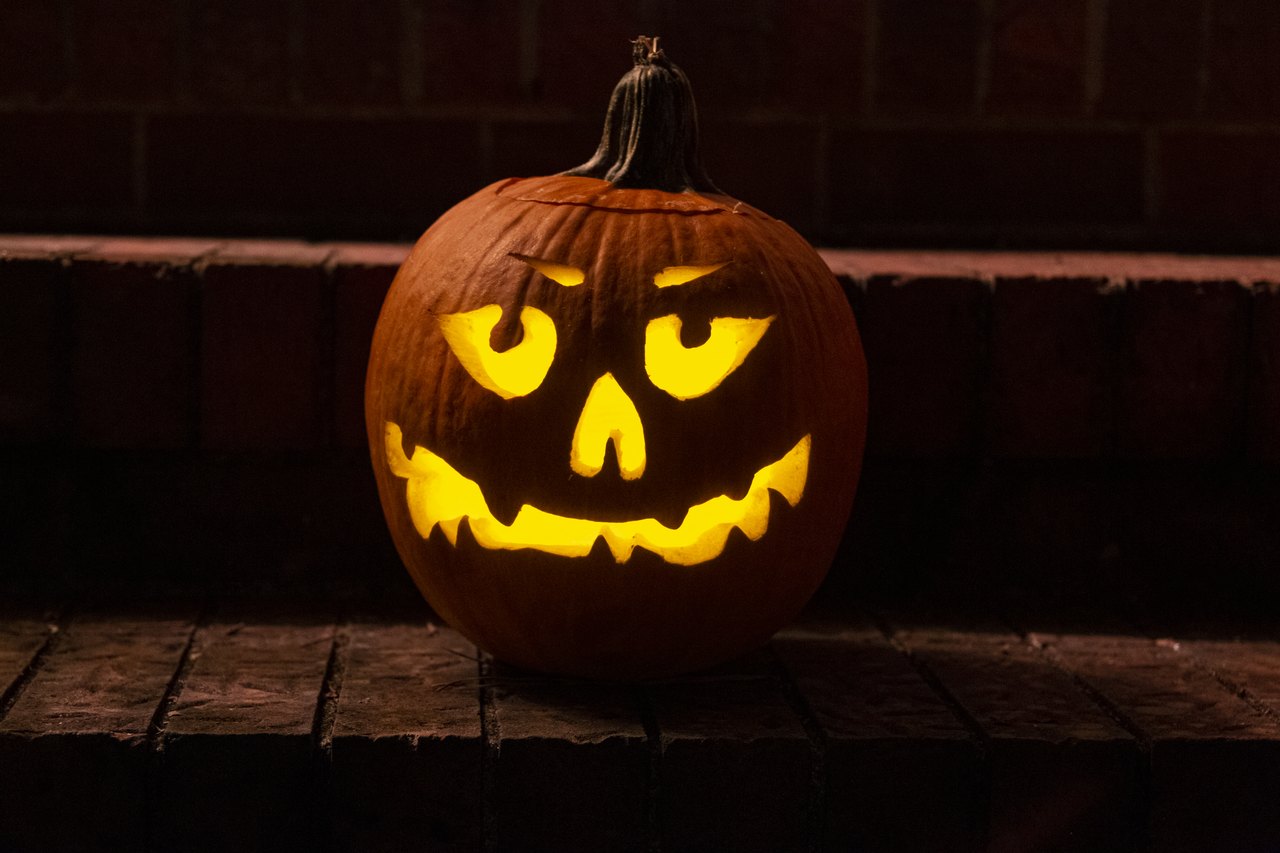
Photograph taken in November 2022 of a lit jack-o-lantern on a step after dark. The Knowledge Bank explains that a diary can never hold a whole day, so a writer must choose which few minutes are worth ink, and that what a narrator keeps tells you what he thinks matters. An hour of homework that same evening left no trace; this is the image that would survive. Selection is why a month of ordinary time can vanish and one lit pumpkin can last forever.
Lit jack-o-lantern, November 2022; photograph by Alabama Extension, released under CC0. Source: Wikimedia Commons, CC0.
hauntedadj.Oct.
Visited by ghosts — or made to seem that way
“The flyers called the basement the most haunted place in town.”
admissionn.Oct.
The price paid to enter a place or event
“Admission to the basement of terror cost two dollars.”
advertisev.Oct.
To tell people about something so they will come or buy
“The boys advertise their haunted house all over the neighborhood.”
terrifiedadj.Oct.
Extremely frightened
“The first customer was so terrified he hid under the bed.”
profitn.Oct.
The money left after costs are paid
“Greg counted his profit before a single customer arrived.”
costumen.Oct.
Clothes worn to look like someone or something else
“Choosing a Halloween costume is serious business for Greg.”
routen.Oct.
The planned path from one place to another
“Greg mapped a trick-or-treat route to hit the best houses.”
sheltern.Oct.
A safe place that protects you
“Gramma’s house became their shelter from the circling truck.”
soakedadj.Oct.
Completely wet, through and through
“Two blasts of water left the boys and their candy soaked.”
groundedadj.Oct.
Kept home as a punishment
“After the haunted house, Rowley ended up grounded.”
ⓘ The vocabulary words in this list are selected to help you understand and complete this workbook. Some may not appear verbatim in the original novel.
🧠Knowledge Bank question
1According to the Knowledge Bank, selection is the craft of ___.Oct.
2If you are ‘terrified,’ you are only slightly nervous.Oct.
3To tell people about something so they will come or buy it is to ___.Oct.
4A ‘route’ is the planned path you follow from place to place.Oct.
5Fill in each blank with the correct word.Oct.
Word choices:shelterprofithauntedcostume- some words will not be used
The boys ran to Gramma’s house for .
Greg dreamed of the before earning a single dollar.
6Clothes worn to look like someone or something else are a ___.Oct.
7If you are ‘grounded,’ you are being rewarded with a special trip.Oct.
8Completely wet, through and through, is ___.Oct.
9Fill in the blanks with the correct words.Oct.
Word choices:admissionterrifiedadvertisegrounded- some words will not be used
Rowley’s dad found the customer under the bed.
After the discovery, Rowley was .
10Money left over after costs are paid is ___.Oct.
Part 2
Comprehension
Show you understood what happens in October.
🧠Knowledge Bank · Reading the Clues Greg Leaves
Reading Skill · InferenceAn inference is a smart guess a reader builds from clues on the page plus what she already knows about the world. Kinney fills October with chances to practice it. When Greg and Rowley flee the teenagers and end up shivering on a porch, Greg never announces ‘I was terrified,’ yet his pounding heart and desperate choices let you infer the fear for yourself. Skilled readers gather two things — the evidence the text gives and their own experience of being scared — and quietly add them together. This matters doubly here, because Greg often refuses to admit weakness out loud. If you wait for him to confess an embarrassing feeling, you may wait forever; instead you must watch what he does and deduce what he will not say. Learning to infer turns a plain sentence into a window, letting you see the truth a proud narrator tries to hide.
Visual AidHow a reader builds an inference
Diagram for the Knowledge Bank on inference. Card 1 is the evidence the page actually prints, card 2 is what the reader already knows about being frightened, and card 3 is the feeling the narrator refuses to name. The plus sign is the whole method: the Knowledge Bank says a reader must supply the second half herself. Notice that the drawing never states the feeling, because working it out is the reader’s job.
Building an inference, as described in the Knowledge Bank. Drawn for Garden Heights Academy.
🧠Knowledge Bank question
1The Knowledge Bank says a reader builds an inference from clues on the page plus ___.Oct.
2How many customers actually pay to enter the basement haunted house?Oct.
3The paying customer gets so scared that he hides under the bed and refuses to come out.Oct.
4How does the haunted house business end?Oct.
5Write the numbers 1–5 in the boxes to show the correct order of October’s events. Number 1 = what happens first.Oct.
Teenagers blast the trick-or-treaters with a fire extinguisher.
Rowley’s dad shuts down the basement and grounds Rowley.
Greg’s mom takes the boys to a real haunted house.
Greg’s dad soaks the boys with the garbage-can water.
Flyers promise the neighborhood the scare of a lifetime.
6On Halloween night, Greg and Rowley go trick-or-treating completely alone.Oct.
7Why do Greg and Rowley end up at Gramma’s house?Oct.
8What happens to the boys at the end of Halloween night?Oct.
9Greg’s dad soaks the boys on purpose, knowing exactly who they are.Oct.
10What do the basement scare and the Halloween soaking have in common?Oct.
Part 3
Literary Elements
Understanding HOW and WHY Jeff Kinney tells the story across October.
🧠Knowledge Bank · Making It Funny by Making It Bigger
Author’s Craft · Comic ExaggerationMuch of this book’s laughter comes from one old comedian’s trick: exaggeration, stretching an ordinary event until it grows absurd. A dark house becomes a death trap; a mild scare becomes a life-or-death sprint; a small worry balloons into total disaster. When a writer blows something far out of proportion on purpose, that device is called hyperbole, and Kinney uses it in both his sentences and his cartoons, where a single frightened face can fill an entire panel. The humor works because we recognize the true, smaller feeling underneath the huge one — we have all treated a minor scare like the end of the world. Exaggeration also quietly reveals character, since the size of Greg’s reactions shows how dramatic and self-focused he can be. As you read October, notice how often the comedy comes not from what happens but from how enormously Greg magnifiesit.
Situational irony
When what happens is the opposite of what everyone expected — the haunted-house owner ends the night terrified himself.
Foreshadowing
A detail planted early that will matter later — remember that truck full of teenagers.
Visual punchline
In a cartoon-diary, the words set up the joke and the drawing lands it — two beats, one laugh.
🧠Knowledge Bank question
1According to the Knowledge Bank, hyperbole is ___.Oct.
2Fill in the blank with the correct literary term.Oct.
Word choices:foreshadowingironysettingdialogue- some words will not be used
A detail planted early that matters later is .
An outcome that flips expectations is situational .
3Greg’s dad soaking his own son while guarding against candy thieves is ironic because ___.Oct.
4The teenagers in the truck are a detail readers should remember for later in the book.Oct.
5In a cartoon-diary, the funniest single beat usually lands in ___.Oct.
6The flyers promising the scare of a lifetime, next to a basement with one bed, create comedy through ___.Oct.
7Situational irony is when events turn out exactly as every character expected.Oct.
8Fill in the blank with the correct literary term.Oct.
Word choices:punchlineprologuevillainmeter- some words will not be used
In this book the drawing often delivers the visual .
9By pairing the fake basement scare with the real Halloween chase, Kinney invites readers to compare ___.Oct.
10October ends with the candy destroyed by Greg’s own dad. As a chapter ending, this works mainly as ___.Oct.
Part 4
Think Deeper
Four deeper challenges — no single-word recall. Read, weigh the evidence, and reason it out.
🧠Knowledge Bank · A Friend or a Shield?
Think Deeper · Loyalty Halloween puts Greg’s friendship to a quiet test, and it is worth watching how he answers. When danger appears, Greg tends to think first about protecting himself, even if that means leaving Rowley a step closer to trouble. Loyalty means standing by a friend precisely when it costs you something; using a friend as a shield means letting him absorb the danger, the blame, or the embarrassment you would rather dodge. The tricky part is that Greg is not a villain — he genuinely likes Rowley and would call him his best friend. Kinney lets the reader see what Greg cannot quite admit: that real friendship is measured on the hard nights, not the easy ones. As you read, keep a gentle tally of who protects whom, because those quiet choices reveal a person’s true character.
Think back over the month. Two boys tape flyers to every pole in the neighborhood, promising horrors beyond imagining; their actual haunted house is a basement, a bed, and a blanket. Their only customer screams at the first station and will not come out from under the bed. Weeks later, on the one night the whole neighborhood plays at being scared, real fear arrives in a pickup truck with a fire extinguisher — and the night ends with a father, keeping watch in the dark, pouring a garbage can of water on the two smallest trick-or-treaters on the street.
Original passage written for Garden Heights — not a quotation from the novel.
1Claim: “Greg’s haunted house was a business scheme more than a Halloween game.” — choose the two details that best prove it.Claim & Evidence
2What the flyers promised, or What the basement delivered? Tap each detail to sort it — tap again to switch sides. You can keep tapping to change your answer.Sort into two
◄ What the flyers promisedWhat the basement delivered ►
3Match each cause to its result. For each cause, pick its result.Cause & Effect
Flyers go up all over the neighborhood→
The customer panics at the first scare→
The screaming brings Rowley’s dad downstairs→
The boys shout a threat at the teenagers’ truck→
🧠Knowledge Bank question
4Fill both blanks to complete the reasoning.Build the Argument
The Knowledge Bank says loyalty means standing by a friend , and it points out that Greg is .
Part 5
Standardized Test
Reading passage · How Halloween Began · SAT & TOEFL-style practice
Read the passage — the highlighted words are tested — then answer. Tap an answer, then tap it again to confirm.
SATCentral Ideas — the passage's main point
SATWords in Context — a word's meaning in this passage
SATDetail — a fact stated in the passage
SATText Structure & Purpose — how the passage is built, and why
TOEFLFactual Information — a fact stated in the passage
TOEFLVocabulary — a tested word's meaning here
TOEFLRhetorical Purpose — why the author included a detail
TOEFLProse Summary — the three sentences that sum it up
The Ancient Roots of Halloween
Halloween is far older than candy bars. More than two thousand years ago, Celtic communities in Ireland and Britain marked the end of the harvest with a festival called Samhain, when people believed the border between the living and the dead grew thin for one night. Villagers lit great bonfires and pulled on a rough costume of skins and soot so that any wandering spirits might mistake them for spirits too and pass them by. Centuries later, children went guising door to door, offering a song or a rhyme in exchange for cakes and coins, the direct ancestor of trick-or-treating.
Irish families carried these customs to America in the 1800s, where they slowly changed shape. The carved turnip lantern of the old country met the American pumpkin, bigger, softer, easier to carve, and the jack-o’-lantern was born. By the middle of the 1900s, neighborhoods had turned the wandering-spirits night into a children’s tradition of masks, porch lights, and candy given by the handful. The old festival survives inside the modern one: we still dress as things we fear, still walk a dark route through the streets in groups, and still believe, for one night, that a mask can keep trouble from recognizing us.
Original passage written for Garden Heights — not a quotation from the novel.
1What is the main idea of the passage?SAT · Central Ideas
2In the passage, a costume is ___.SAT · Words in Context
3According to the passage, why did Samhain villagers wear disguises?TOEFL · Factual Information
4What did children offer when they went ‘guising’ door to door?SAT · Detail
5The jack-o’-lantern was born when the turnip lantern met ___.TOEFL · Factual Information
6In the passage, a tradition is ___.TOEFL · Vocabulary
7In the passage, a route is ___.SAT · Words in Context
8How is the passage mainly organized?SAT · Text Structure & Purpose
9The final sentence about ‘one soaked sixth grader’ mainly serves to ___.TOEFL · Rhetorical Purpose
10Prose Summary (TOEFL).The passage explains how Halloween began and changed. This TOEFL task lists six sentences; choose the THREE that best capture the passage’s main ideas. The other three do not belong — they state minor details or ideas the passage does not present.TOEFL · Prose Summary
Part 6 · Optional
Creative Writing
A bonus challenge to practice your English. Take your time and have fun with it.
About This Section
This writing task is optional and is not part of your auto-graded score. The feedback below checks only the basics — length, spelling, and grammar — not whether your ideas are right or wrong. It is meant for classroom discussion and creative practice, so feel free to use your imagination!
Writing Task — Part 2 “The Flyer Versus the Basement”
Greg’s flyers promised the scare of a lifetime; his basement delivered a blanket and a bed. Write the story of a time when something was advertised as amazing — a movie, a game, a party, a food — and what you actually got. Describe the promise first, then the reality, in 6–10 sentences. End with one line about whether the gap made you angry or made you laugh.
You can start with: “The poster made it look like the greatest thing ever invented, so obviously...”
0 / 40 words minimum
🗣 Teach It · Just for Fun (optional)
No right or wrong — close the screen and tell someone nearby what happened in this part. Can’t find anyone? Tell yourself out loud. The moment you teach it, you truly understand it.
Part 2 Complete!
You finished October of Diary of a Wimpy Kid.
Here are your auto-graded results:
-
points out of 100
Teach it to someone
The best last step is to teach it. In your own words, explain what happened — retell a favorite scene, teach a character’s big choice, or sum up the main idea for a parent, friend, or classmate. When you can teach it clearly, you truly own it.
Independent study guide by Garden Heights. Not affiliated with or endorsed by Jeff Kinney. Contains original analysis only; no text from the novel is reproduced. Reference text: This workbook follows Jeff Kinney’s classic text (the standard Puffin edition sold worldwide). Revised 2023 UK editions change some wording and may not match the vocabulary studied here.
SAT® is a registered trademark of College Board, which is not affiliated with, and does not endorse, these materials. TOEFL® is a registered trademark of ETS. These materials are not endorsed or approved by ETS. Garden Heights is an independent provider of test-style reading practice.