New here? Just sign up with Google — your account includes Matilda, our gift book, forever.
Diary of a Wimpy Kid · Garden Heights
Part 5
for Diary of a Wimpy Kid · Part 5 · January
8 Parts40 min
What Happens in Part 5
January opens with Greg’s greatest invention yet: a game where Rowley rides the Big Wheel down the hill while Greg throws a football, trying to knock him off. Greg generously refuses to trade places — the thing picks up too much speed, he explains, to be safe. On one perfect throw, the wheel stops, the rider flies, and Rowley’s hand breaks. Then comes the twist nobody scripted: the injury makes Rowley popular. Girls carry his books, classmates line up to sign the cast, and the attention Greg has chased all year pours over his best friend instead. Jealous, Greg wraps his own perfectly healthy hand in bandages — and collects exactly no sympathy. At school, Greg enrolls in Independent Study — the class will design a robot — but the boys spend the period listing words the robot should never say, and the teacher cancels the class for the boys for the rest of the year. Greg and Rowley bounce back with a smarter plan: joining Safety Patrol, which comes with a badge of responsibility, protection from bullies, a pass out of half of Pre-Algebra — and free hot chocolate.
What We Will Learn
Section
What you will practice
Vocabulary
Words of the month: injury, sympathy, jealous, patrol, responsibility…
Literary Elements
Poetic justice, motif, and the narrator’s soft words for himself
Cross-Curricular
Why a cast draws a crowd, and why New Year’s resolutions fail
Diary Summary
Month
What happens
Jan.
The hill and the badge — Greg’s football-versus-Big-Wheel game breaks Rowley’s hand and accidentally makes him famous; Greg’s fake bandage flops; the boys’ robot class is canceled; Safety Patrol brings badges, skipped Pre-Algebra, and hot chocolate.
Part 1
Vocabulary
Study 10 key words from the January diary entries, then answer each question.
🧠Knowledge Bank · Why a Broken Bone Wins Friends
Social Science · Sympathy & Status When Rowley returns to school with his arm in a plaster cast, something surprising happens: he becomes popular. Suddenly classmates want to sign the cast and hear the story, and Greg watches in disbelief. Human beings are wired to feel sympathy for the injured, an instinct that once helped groups care for their wounded and survive. A visible injury acts like a badge that says ‘something happened to me,’ drawing curiosity and kindness that ordinary days never earn. In a middle school, that attention becomes a kind of currency, and Greg cannot understand why it flows to Rowley instead of him. The lesson underneath the comedy is that status does not follow simple fairness; it follows attention, and attention follows a good story. Greg keeps trying to seize the spotlight by cleverness, never quite seeing that Rowley won it by accident, and by being someone people actually like.
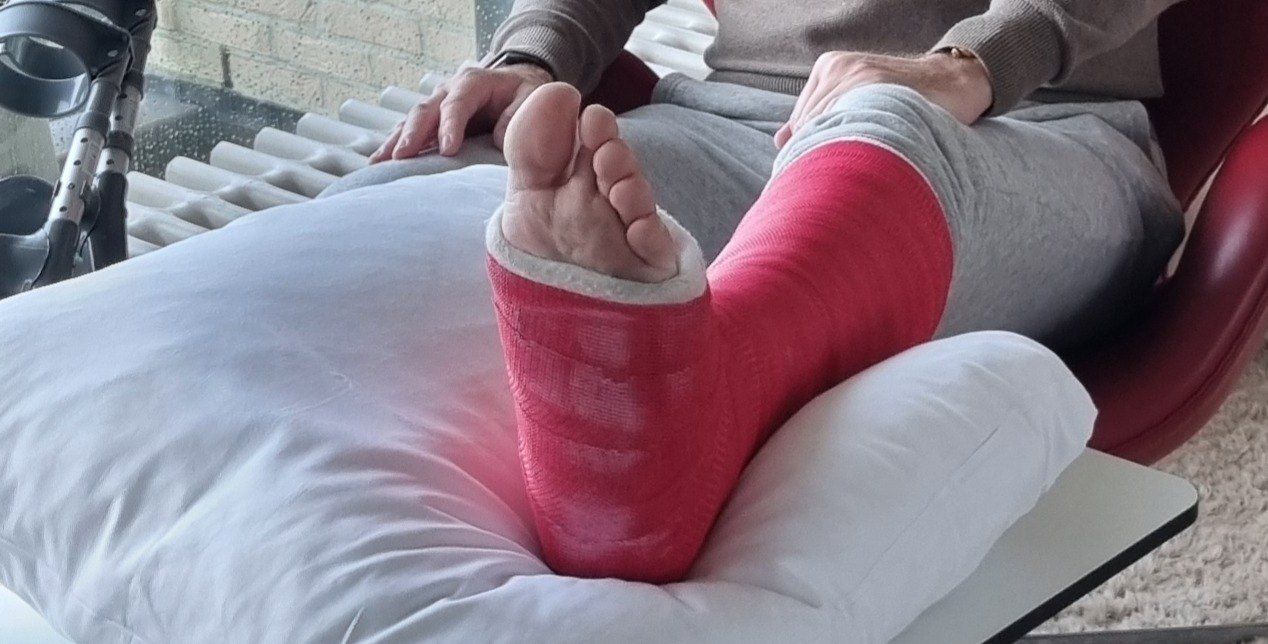
Visual AidAn injury everyone can see
Photograph taken in December 2024 of a week-old plaster cast, propped on a cushion. The Knowledge Bank explains that human beings are wired to feel sympathy for the injured, an instinct that once helped groups care for their wounded, and that a visible injury acts like a badge saying something happened to me, drawing curiosity and kindness ordinary days never earn. Notice the color. Casts are made in bright shades on purpose, and a cast is also the one surface classmates are invited to write on.
A week-old short leg cast, December 2024; photograph by Jonascumgi, released under CC0. Source: Wikimedia Commons, CC0.
injuryn.Jan.
Harm done to a person’s body
“Rowley’s injury came with a cast and a crowd.”
sympathyn.Jan.
Feeling sorry for someone else’s trouble
“The whole class showered Rowley with sympathy.”
attentionn.Jan.
The notice people give to someone or something
“Greg has wanted that kind of attention all year.”
jealousadj.Jan.
Unhappy because someone else has what you want
“Watching the cast-signing line made Greg jealous.”
patroln.Jan.
A group that watches an area to keep it safe
“The Safety Patrol walks the little kids home.”
responsibilityn.Jan.
A duty you are trusted to carry out
“A badge is really a responsibility you wear.”
designv.Jan.
To plan how something will be made
“The class was supposed to design a robot.”
enrollv.Jan.
To officially join a class or group
“Greg was quick to enroll in Independent Study.”
cancelv.Jan.
To call something off
“One list of forbidden words made the teacher cancel the class.”
rewardn.Jan.
Something good given for something done
“Free hot chocolate is the patrol’s sweetest reward.”
ⓘ The vocabulary words in this list are selected to help you understand and complete this workbook. Some may not appear verbatim in the original novel.
🧠Knowledge Bank question
1According to the Knowledge Bank, a visible injury acts like a badge that ___.Jan.
2‘Sympathy’ is feeling sorry for someone else’s trouble.Jan.
3Unhappy because someone else has what you want is ___.Jan.
4To ‘enroll’ in a class means to quit it forever.Jan.
5Fill in each blank with the correct word.Jan.
Word choices:patrolrewarddesignjealous- some words will not be used
The Safety gets to leave Pre-Algebra early.
Hot chocolate is a fine for guarding a crosswalk.
6To plan how something will be made is to ___ it.Jan.
7A ‘responsibility’ is a duty you are trusted to carry out.Jan.
8To call something off is to ___ it.Jan.
9Fill in the blanks with the correct words.Jan.
Word choices:sympathyinjuryenrollattention- some words will not be used
A fake bandage earned Greg zero .
Rowley’s turned him into a celebrity.
10The notice people give to someone is ___.Jan.
Part 2
Comprehension
Show you understood what happens in January.
🧠Knowledge Bank · Sorting What Happened from What Greg Thinks
Reading Skill · Fact vs. OpinionA journal blends two very different things on every page: facts, which can be checked, and opinions, which belong to the writer alone. Greg reports both in the same confident voice, so a careful reader must sort them apart. That Rowley broke his hand is a fact; that Rowley is milking it for attention is Greg’s opinion, colored by jealousy. When you separate the two, January reads more honestly than Greg means it to. A useful test is to ask whether a statement could be proven true or false, or whether it merely reports how someone feels. Greg’s strongest opinions tend to arrive exactly when the facts make him look bad, which is your clue to slow down. Learning to split fact from opinion is a shield against being led, in books and in life, by anyone who states a feeling as though it were a settled truth.
🧠Knowledge Bank question
1The Knowledge Bank says the test for a fact is whether a statement ___.Jan.
2Why does Greg refuse to swap places with Rowley?Jan.
3Rowley breaks his hand when Greg’s football knocks him off the Big Wheel.Jan.
4What surprising thing happens because of Rowley’s injury?Jan.
5Write the numbers 1–5 in the boxes to show the correct order of January’s events. Number 1 = what happens first.Jan.
Greg and Rowley join the Safety Patrol.
Greg invents the Big Wheel football game.
Greg’s fake bandage wins him no sympathy.
The boys’ Independent Study class is canceled.
Rowley’s hand breaks on the hill.
6Greg’s fake injury brings him even more attention than Rowley’s real one.Jan.
7What was the boys’ Independent Study class supposed to produce?Jan.
8Why does the teacher cancel Independent Study for the boys?Jan.
9Safety Patrol membership excuses Greg and Rowley from half of Pre-Algebra.Jan.
10Taken together, Greg’s January schemes show that he ___.Jan.
Part 3
Literary Elements
Understanding HOW and WHY Jeff Kinney tells the story across January.
🧠Knowledge Bank · Saying Less Than You Mean
Author’s Craft · UnderstatementSometimes a writer gets his biggest effect by making a fuss of nothing at all — this quiet trick is called understatement, describing something huge in small, calm words. Greg often narrates a genuine disaster in a flat, breezy tone, as if a catastrophe were a minor inconvenience. Closely related is the euphemism, a gentle word swapped in for a harsher truth, the way Greg might call a selfish act a favor. Both devices create a gap between the mild words and the not-so-mild reality, and comedy leaks out of that gap. They also do sly character work, because the calm voice reveals how easily Greg excuses himself. When you notice him shrinking a bad deed down to a tiny, harmless-sounding phrase, resist the wording and picture what actually happened, because the softest sentence in the chapter is often draped over the sharpest deed.
Visual AidBig event, small words
Diagram for the Knowledge Bank on understatement. Card 1 is the size of what really happened, card 2 is the calm telling, and card 3 is how small the words make it sound. Each card is narrower than the one above it on purpose. The Knowledge Bank says comedy leaks out of that shrinking, and that the calm voice also shows how easily the narrator excuses himself.
Understatement as described in the Knowledge Bank. Drawn for Garden Heights Academy.
Euphemism
Soft, harmless-sounding words for something not harmless — Greg’s specialty when describing his own actions.
Poetic justice
When the outcome punishes or rewards exactly the right person — the thrower loses, the rider wins.
Motif
An image or idea that repeats through a book — here, the scheme-for-status, from lollipops to bandages.
🧠Knowledge Bank question
1According to the Knowledge Bank, understatement means describing something huge ___.Jan.
2Fill in the blank with the correct literary term.Jan.
Word choices:motifjusticesonnetclimax- some words will not be used
A repeating idea, like Greg’s schemes for status, is a .
An ending that rewards exactly the right person is poetic .
3Rowley gaining popularity from the injury Greg caused is poetic justice because ___.Jan.
4A motif is an image or idea that appears exactly once in a book.Jan.
5The scheme-for-status pattern — posters, apples, bandages — is the book’s central ___.Jan.
6Greg’s fake bandage failing where Rowley’s real cast succeeded shows the book’s rule that ___.Jan.
7Reading past Greg’s soft self-descriptions to see what he actually did is a core skill for this book.Jan.
8Fill in the blank with the correct literary term.Jan.
Word choices:euphemismdialogueprologuerhythm- some words will not be used
A harmless-sounding word for a harmful act is a .
9Kinney lets readers see Greg’s careful aim AND hear his ‘accident’ wording so that we ___.Jan.
10January’s hill scene — inventor safe at the top, rider broken at the bottom — works as a picture of ___.Jan.
Part 4
Think Deeper
Four deeper challenges — no single-word recall. Read, weigh the evidence, and reason it out.
🧠Knowledge Bank · Owning Your Part
Think Deeper · ResponsibilityBehind Rowley’s broken hand sits an uncomfortable truth Greg would rather skate past: his own choices helped cause it. Taking responsibility means admitting the link between what you did and what happened next, even when no one is forcing you to. It is one of the hardest moves a person can make, because it trades the comfort of feeling blameless for the sting of feeling at fault. Greg, true to form, hurries to recast the accident as bad luck or Rowley’s own doing, protecting his pride at his friend’s expense. Notice how the story never lets that dodge fully succeed; the facts keep poking through his excuses. Real responsibility is not about punishment — it is about being the kind of person others can trust to tell the truth about themselves. Every time Greg shifts blame outward, he saves face in the moment and quietly spends a little of that trust.
Think back over the month. At the top of a snow-crusted hill stands a boy with a football and a plan; at the bottom, over and over, his best friend climbs back onto a little plastic tricycle. One throw finally connects. A hand breaks. And then — the miracle: the broken boy is swarmed, celebrated, signed like a movie poster, while the thrower stands at the edge of the crowd wearing a bandage nothing ever happened to, listening to nobody asking him what happened.
Original passage written for Garden Heights — not a quotation from the novel.
1Claim: “Greg designed the Big Wheel game so that only Rowley could get hurt.” — choose the two details that best prove it.Claim & Evidence
2Rowley’s January, or Greg’s January? Tap each detail to sort it — tap again to switch sides. You can keep tapping to change your answer.Sort into two
◄ Rowley’s JanuaryGreg’s January ►
3Match each cause to its result. For each cause, pick its result.Cause & Effect
Greg’s football connects on the hill→
The cast appears at school→
Greg wraps his healthy hand in bandages→
The boys list forbidden words for the robot→
🧠Knowledge Bank question
4Fill both blanks to complete the reasoning.Build the Argument
The Knowledge Bank says taking responsibility trades the comfort of feeling blameless for , and it adds that responsibility is really about .
Part 5
Standardized Test
Reading passage · Why New Year’s Resolutions Fail · SAT & TOEFL-style practice
Read the passage — the highlighted words are tested — then answer. Tap an answer, then tap it again to confirm.
SATCentral Ideas — the passage's main point
SATDetail — a fact stated in the passage
SATWords in Context — a word's meaning in this passage
SATInference — a conclusion the passage implies
SATText Connections — how two parts of the text relate
TOEFLVocabulary — a tested word's meaning here
TOEFLRhetorical Purpose — why the author included a detail
TOEFLFactual Information — a fact stated in the passage
TOEFLNegative Factual — the statement the passage does NOT support
Why New Year's Resolutions Fail
Every January, thousands enroll at gyms full of hope; by February, most of the machines stand empty again. Researchers who study behavior say the pattern is painfully reliable, and that the great majority of New Year’s promises are abandoned within weeks. The problem is rarely laziness. A typical resolution, such as get fit, read more, or stop arguing, is huge, vague, and expected to happen all at once. Worse, it leans entirely on willpower, the mind’s power to force itself, and studies suggest willpower behaves like a muscle: strong in the morning, worn out by a long day, and never strong enough to carry a giant goal alone.
What works is almost embarrassingly small. Scientists find that lasting change comes from attaching one tiny action to a routine you already have, such as two push-ups after brushing your teeth, or one page before turning off the light. Repeated in the same spot, day after day, the action stops needing willpower at all: it becomes a habit, and habits run on their own. Tracking progress helps, and so does a small reward at the end of a good week. The lesson for a certain sixth grader is direct: a barbell of sand-filled jugs was never the problem. A plan that skipped the small, boring, daily part, that was the problem.
Original passage written for Garden Heights — not a quotation from the novel.
1What is the main idea of the passage?SAT · Central Ideas
2In the passage, a resolution is ___.TOEFL · Vocabulary
3The passage says the problem with most resolutions is that they are ___.SAT · Detail
4In the passage, to enroll is to ___.SAT · Words in Context
5The passage compares willpower to a muscle because both ___.TOEFL · Rhetorical Purpose
6In the passage, a reward is ___.SAT · Words in Context
7According to paragraph 2, what happens when a tiny action is repeated in the same spot daily?TOEFL · Factual Information
8Which of these does the passage NOT mention as helping change last?TOEFL · Negative Factual
9According to the final lines, what was the real problem with Greg’s fitness plan?SAT · Inference
10Which January detail does this passage BEST help explain?SAT · Text Connections
Part 6 · Optional
Creative Writing
A bonus challenge to practice your English. Take your time and have fun with it.
About This Section
This writing task is optional and is not part of your auto-graded score. The feedback below checks only the basics — length, spelling, and grammar — not whether your ideas are right or wrong. It is meant for classroom discussion and creative practice, so feel free to use your imagination!
Writing Task — Part 5 “The Game I Would Never Play Myself”
Greg invents a game where only Rowley can get hurt. Invent the opposite: describe a game YOU would design where the inventor takes all the risk and the friend gets all the fun. Explain the rules, what could go wrong for you, and why a friend might love it, in 6–10 sentences. End with one line about what your game would prove to your friend.
You can start with: “The rules were simple, and every single one of them was dangerous only for me...”
0 / 40 words minimum
🗣 Teach It · Just for Fun (optional)
No right or wrong — close the screen and tell someone nearby what happened in this part. Can’t find anyone? Tell yourself out loud. The moment you teach it, you truly understand it.
Part 5 Complete!
You finished January of Diary of a Wimpy Kid.
Here are your auto-graded results:
-
points out of 100
Teach it to someone
The best last step is to teach it. In your own words, explain what happened — retell a favorite scene, teach a character’s big choice, or sum up the main idea for a parent, friend, or classmate. When you can teach it clearly, you truly own it.
Independent study guide by Garden Heights. Not affiliated with or endorsed by Jeff Kinney. Contains original analysis only; no text from the novel is reproduced. Reference text: This workbook follows Jeff Kinney’s classic text (the standard Puffin edition sold worldwide). Revised 2023 UK editions change some wording and may not match the vocabulary studied here.
SAT® is a registered trademark of College Board, which is not affiliated with, and does not endorse, these materials. TOEFL® is a registered trademark of ETS. These materials are not endorsed or approved by ETS. Garden Heights is an independent provider of test-style reading practice.